If this is your first visit, be sure to
check out the FAQ by clicking the
link above. You may have to register
before you can post: click the register link above to proceed. To start viewing messages,
select the forum that you want to visit from the selection below.
Hi folks, since I never made an experiment using my dual magnet rotor with bifilar coils, I am reworking my pulse motor to be run as a generator using bifilar coils with the neo magnets in bucking mode as scratchrobot posted in that article.
So, the bifilar coils will be in between the 2 magnet rotors and well see how it goes. Can't think of any other experiments to do right now, hehe.
peace love light
tyson
I have been trying to find away to disprove my results.
I thought what if I was wrong and the increase in speed was due to some anomaly in the drag created by Lenz.
I was thinking if it was the drag friction on the rotor that was some how feeding back to the drive coil increasing speed.
I have tried inducing friction from another source. I mounted a small horse hair paint brush just about the rotor and induced the smallest amount of friction to see if I could in anyway make it increase speed. There was no way this would work. No matter what amount of external drag I applied would increases speed, the slightest touch would slow it down immediately. I have tried many things and looked at every other explanation I can think of for the speed increase. There appears to be only one explanation left, the load on the generator coils are causing a drive force assisting the rotational direction.
It is now conclusive there is anomaly in the Lenz law theory if all your conditions are correct you can draw current from a generator and make it more efficient.
We are now heading in the right direction.
I stumbled up on a website with information which exactly explains what we are looking for. Since Romero confirmed he used bucking coils and pointed to the Kromrey effect he must have used Scalar current, or normal current supplied trough the two wire going down the hole in the table.
Scalar Current by Moray B. King
One of the most unusual claims associated with certain "free energy" devices is the ability to conduct appreciable power on ordinary thin wires without heating them. To an electrical engineer this result is extraordinary and it would constitute a definitive demonstration of a novel form of electromagnetism. Here is suggested an experiment that could produce "cold conduction" and demonstrate an hypothesized phenomenon known as "scalar current."
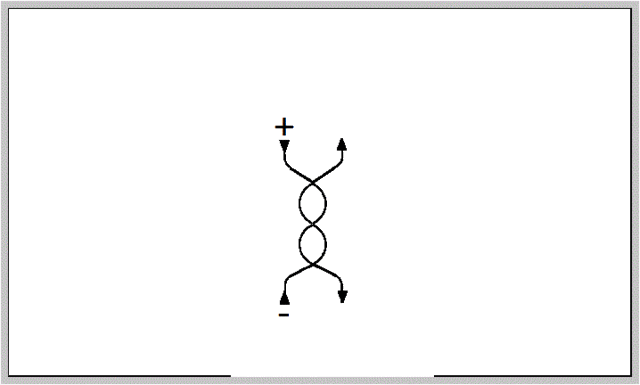
Scalar current arises by abruptly bucking magnetic fields onto a caduceus wound or a bifilar wound coil (Figure 1). If bucking magnetic fields are impressed onto an ordinary, single wound coil, no current would flow since the magnetic fields cancel. However, impressing these fields onto a caduceus or bifilar coil would allow two oppositely flowing "virtual" currents to occur because, by symmetry of the windings, the opposite current vectors sum to an effective zero current. The currents are described as "virtual" since they are comprised not of electron flow in the wires, but rather a displacement current in the vacuum zero-point energy outside the wire. It is as if the abruptly bucking magnetic field manifested a pair production of two macroscopic, oppositely rotating, displacement current vortices in the zero point energy.' These vacuum energy vortices are stabilized and supported by the two symmetric wind ings.
There are many ways to impress the abruptly bucking magnetic fields onto the caduceus or bifilar coil. One method could use two electromagnets with the proper control circuitry to appropriately phase the magnetic fields. In another method the coil could be spun in the air gap between two opposing permanent magnets using brushes and slip rings to tap the scalar current (Figure 2).
Bedini described using this method in his "gravity field generator" where he not only reported "cold conduction" but also a weight change in the apparatus as well.2 A third method could shift the bucking fields onto the coil by either physically oscillating opposing permanent magnets or shifting their field by variable reluctance techniques.3 Obviously any method that resulted in shifting a bucking magnetic flux onto the caduceus or bifilar coils could be utilized in this experiment.
The experimenter could also explore how to best combine the current in the opposite windings. The windings could remain separate or be combined in series or parallel (Figures 3 and 4). Another option could add a second caduceus (or bifilar) coil in the air gap at the opposite poles of the bucking magnets so that both ends of the alternating bucking magnets are launching scalar currents (e.g. Figure 2). These two sets of coils could then be combined appropriately to keep the currents in phase to maximize the output.
An attractive attribute of this suggested experiment is its simplicity. It is hoped that those working with these ideas freely share their results for it will expedite the development of a new technology.
Thanks for the drawings I have taken copy's and printed them out.
This is something I read about a while ago. looks like it is very good idea
and need time devoted to it.
if you could keep us posted on any thing. would be great.
Bucking magnetic field ... interesting. I'm still visualizing the coil set up in the drawing.
I think the term scalar current and displacement current are the same as current due to capacitive coupling. I also think that current through capacitive coupling is real measurable current, but its nature is fast alternating that's why we can only see it when separate the AC into 2 DC directions as an AV plug for example.
Like Rod said, we probably need every information and try out everything possible to see what is best. It's not like we didn't beat Lenz, we just need to beat him more beautifully. lol
Thanks again for joining scratchrobot.
Thank you, yes very interesting indeed and yes we need every information until it gets to much and we forget about the principle
I'm trying with different coils but without success. Someone suggested I need higher rpm so I will keep on going trying everything.
This is all old stuff and has been here for years, if it's real then why aren't we using this technology already???
Bucking magnetic field ... interesting. I'm still visualizing the coil set up in the drawing.
I think the term scalar current and displacement current are the same as current due to capacitive coupling. I also think that current through capacitive coupling is real measurable current, but its nature is fast alternating that's why we can only see it when separate the AC into 2 DC directions as an AV plug for example.
Like Rod said, we probably need every information and try out everything possible to see what is best. It's not like we didn't beat Lenz, we just need to beat him more beautifully. lol
I stumbled up on a website with information which exactly explains what we are looking for. Since Romero confirmed he used bucking coils and pointed to the Kromrey effect he must have used Scalar current, or normal current supplied trough the two wire going down the hole in the table.
Scalar Current by Moray B. King
One of the most unusual claims associated with certain "free energy" devices is the ability to conduct appreciable power on ordinary thin wires without heating them. To an electrical engineer this result is extraordinary and it would constitute a definitive demonstration of a novel form of electromagnetism. Here is suggested an experiment that could produce "cold conduction" and demonstrate an hypothesized phenomenon known as "scalar current."
Scalar current arises by abruptly bucking magnetic fields onto a caduceus wound or a bifilar wound coil (Figure 1). If bucking magnetic fields are impressed onto an ordinary, single wound coil, no current would flow since the magnetic fields cancel. However, impressing these fields onto a caduceus or bifilar coil would allow two oppositely flowing "virtual" currents to occur because, by symmetry of the windings, the opposite current vectors sum to an effective zero current. The currents are described as "virtual" since they are comprised not of electron flow in the wires, but rather a displacement current in the vacuum zero-point energy outside the wire. It is as if the abruptly bucking magnetic field manifested a pair production of two macroscopic, oppositely rotating, displacement current vortices in the zero point energy.' These vacuum energy vortices are stabilized and supported by the two symmetric wind ings.
There are many ways to impress the abruptly bucking magnetic fields onto the caduceus or bifilar coil. One method could use two electromagnets with the proper control circuitry to appropriately phase the magnetic fields. In another method the coil could be spun in the air gap between two opposing permanent magnets using brushes and slip rings to tap the scalar current (Figure 2).
Bedini described using this method in his "gravity field generator" where he not only reported "cold conduction" but also a weight change in the apparatus as well.2 A third method could shift the bucking fields onto the coil by either physically oscillating opposing permanent magnets or shifting their field by variable reluctance techniques.3 Obviously any method that resulted in shifting a bucking magnetic flux onto the caduceus or bifilar coils could be utilized in this experiment.
The experimenter could also explore how to best combine the current in the opposite windings. The windings could remain separate or be combined in series or parallel (Figures 3 and 4). Another option could add a second caduceus (or bifilar) coil in the air gap at the opposite poles of the bucking magnets so that both ends of the alternating bucking magnets are launching scalar currents (e.g. Figure 2). These two sets of coils could then be combined appropriately to keep the currents in phase to maximize the output.
An attractive attribute of this suggested experiment is its simplicity. It is hoped that those working with these ideas freely share their results for it will expedite the development of a new technology.
Yes, I thought so too, and if he use a series cap, he would have fix Groundloop's drawing. That means he used continuous shorting like Rod, except at 1xxx RPM. Oh well, it's all interesting investigation and learning.
Thank you.
I was under the impression you were referring to the Muller generator device. If i am not mistaken, Romero did state that he used no coil-shorting whatsoever in the Muller device.
However i think coil-shorting is a great way to increase the Q, Konehead has perfectionized it and i have made some pretty promising tests with this method too.
Yes, I thought so too, and if he use a series cap, he would have fix Groundloop's drawing. That means he used continuous shorting like Rod, except at 1xxx RPM. Oh well, it's all interesting investigation and learning.
Thank you.
I was under the impression you were referring to the Muller generator device. If i am not mistaken, Romero did state that he used no coil-shorting whatsoever in the Muller device.
However i think coil-shorting is a great way to increase the Q, Konehead has perfectionized it and i have made some pretty promising tests with this method too.
Would it be possible for you to source a 0.47 uF series capacitor in Romero's circuit? I don't recall any series caps, but if there is one, i'd certainly like to know.
Thank you.
Guyla asked about that cap.
"...2) There is a yellow rectangular shape capacitor on this generator coil, I assume it is in parallel with the reed switch to reduce sparking? If yes, then it eventually is in parallel with the gen coil, right? What is the capacitor value? " --reply #100
Romero replied:
"...The yellow capacitor is 0.47uf/275volts, connected in series with the reed switch." --- reply 111
Would it be possible for you to source a 0.47 uF series capacitor in Romero's circuit? I don't recall any series caps, but if there is one, i'd certainly like to know.
Thank you.
Ok, difficult to relate that exactly.
He could have meant that he used coil-shorting initially to overcome Lenz and by "constructing" the coil pair in series cancelling bucking fashion (which he confirmed on his site) he would achieve the same effect.
If he meant that the construction of the coil pair somehow shorts something, then i would not know what he could have meant.
I remember Woopy was pointing out that he sees cables in the device that would suggest that he shorts the drive circuit with the generator circuit. (RomeroUK Muller----Woopy discovery!!.ASF - YouTube)


Leave a comment: