
Hi everyone,
I am a late comer who seeking for heating alternative. Does anyone who experimenting this heater has latest result to share ?
I bought three different beer cans, 12 oz, 16 oz and 24 oz and tried to find resonant frequency of the three, unfortunately I can only get a range of resonant frequency. The 16 oz and 24 oz is pretty much close enough.... They both seems to resonate at 120 hz and 360 hz. The 12 oz also resonate at 120 hz. What I did was cut the top open, then put it against the speaker and play the wave, put a thin washer on the bottom (can bottom up) and watch and listen to the washer vibration. I tried to use oscilloscope and microphone to see the amplitude but didnot see anything.
Greatly appreciate detail replicatible plans
-
I'm interested in practical aspects of utilising this device. How do I stop/limit current leakage to ground assuming that container is metallic type also ?
How to provide adequate protection for people using such resistive heater in water connected to home heating pipes ?
Do you know any better maybe electronic way to pass any leakage current to charge for example capacitor and periodically discharge it ? Something which can become better ground then anything and able to lower current leakage to zero. Let's see : we can use this kind of protection Residual-current device - Wikipedia, the free encyclopedia in Europe but still it may be too slow , I consider it as the final protection method.
I have built this device long time ago but these dangers (and a lot ofother problems) prevents me from using it.
P.S. Here is the solution but it's patented. https://www.youtube.com/watch?v=6Hr4...8&feature=plcpLast edited by boguslaw; 11-25-2012, 03:34 PM.Leave a comment:
-
Note that two who have notably claimed to produce xs heat (relative to the input electrical power) with these "Davey Sonic Boilers" do so by tuning the device to an acoustical frequency at which they see the xs heat. Prof Savic speaks of sanding his cylinder to find the appropriate frequency, and he claims COP of 1.4 in one device and 4.53 in another. See post 1742.
Experimenter Daemonbart speaks of using an electronic device to provide variable frequency input in order to tune the frequency of his device in order to obtain xs heat. In post 1349 he provides data obtained with his Davey device compared to a resistance-heater control, and calculates a COP of 7.
Davey in his patent speaks of "means of holding the circular electrodes so that they vibrate and electrical connections" (page 2, patent 92428) -- again, acoustical vibration is key.
Let's not be lazy, and here I'm speaking to myself also!Leave a comment:
-
Very interesting points that you make, Bhairavah.Originally posted by bhairavah View Post
Ultrasonics are sound - fair enough. But the regular two bell system
must be driven by the electric field, albeit the bells are tuned to the
driving frequency acoustically and this makes the difference. I think
the two systems are quite different.
John Worrell Keely did remarkable work in the 19th century with what
he called "water dissociation". His frequency was 42.7122 Khz
(i.e. 42,712.2 Herz). I wonder if these two numbers can be reconciled.Leave a comment:
-
actually, we don't know what they are about, but the fact that they are both tuned acoustically cannot be ignored. also, if i remember correctly, the serbian professor's latest prototype includes an ultrasonic generator, so we might think alike...Originally posted by wrtner View Post
maybe i used the wrong terminology: when i say sound, i mean 'pressure/scalar/longitudinal waves' (not transverse). they might not be part of the hearing range, but they are still 'sound' (ultrasound, hypersound, etc).There may be noise but sound plays no part.
imo, in the davey's heater, the external hemisphere is the 'containing' unit (echo wall) and the inside hemisphere is the 'speaker membrane' (producer of sound waves).
meantime, i've made some progress: as per Water molecule structure, the distance of the hydrogen links in water is 2.037 A. Considering the speed of sound in water to be 1500 m/s, as frequency equals speed divided by wavelength, we obtain a frequency of 7,363 GHz in order to vibrate the intermolecular bonds. obviously we will attempt the generation of a harmonic of the said frequency...
an ultrasonic transducer is obtainable by encasing a piezo-electric crystal between 2 metallic plates. there are already ultrasonic 'humidifiers' on the market, so it's not that hard to turn liquid into vapour. what we want is to make a kind of INEFFICIENT humidifyer, because we don't want to BREAK the bonds completely (and thus turn water into vapour) but only SHAKE them (raise the heat).
research continues
P.S. thanks for the replies btw, i had doubts about the thread being still alive :PLast edited by bhairavah; 11-19-2012, 05:28 PM.Leave a comment:
-
A reasonable assumption, but wrong. Neither the Serbian device nor theOriginally posted by bhairavah View Post
Peter Daysh Davey device are about sound. Mains AC voltage are attached
to two elements which interact with each other, possibly producing
cavitation type effects. There may be noise but sound plays no part.
See Patrick, approx page 13 (page numbers change as material is added):
Paul-R
p.s. check out the rest of the book here:
Leave a comment:
-
If you watched what I posted I found that 60% of energy for heating water to the boiling state (as medium of passing heat) from cold or room temperature is taken to break bonds in long water chains (van deer walls forces).
With sound agitation of water like presented in video of Tibetan gong I believe this time is highly shortened and the effect remain active for a few minutes !
Active water ! Now compare that to the normal usage in home heating water system when cold water is returning to the heater. I believe this is the secret : partly in water agitation and partly because we are using sound byproduct of passing current (here I think the best results would be having a dome from ferromagnetic metal for magnetostriction effect like in transformer core).Leave a comment:
-
HHO or HEAT - make your pick
i had the patience of going through all this thread, thought about it, tried some experiments with beer cans (used them flattened, then as cylinders, etc).
i'll try adding my 2 cents, hope it will prove inspiring.
1. if you're trying to produce hho, you want to knock electrons off and break the molecule; if you're trying to produce heat, you only want to increase the inter (NOT intra) molecular agitation. we're talking about a heater, thus any energy lost in electrolysis is wasted (producing hho and thus not heat).
2. since we're talking about a sonic heater, it is a reasonable assumption that we want to produce sound (a longitudinal wave of a certain frequency, in a given medium). sound is usually produced by means of vibrating a membrane or a string. the sanding of the cylinder is only meant to transform it into a speaker membrane; likewise, the caduceus is a prefect example of a string being vibrated.
imo, the easiest way to produce the required sound, is to simply immerse a speaker in your medium (water). obviously, for greater efficiency one can devise a method of using a flattened beer can as a membrane - just attach a magnet in its center and vibrate it by means of an inductor. just like any ordinary speaker.
3. we also want to CONTAIN that sound, in order to concentrate the maximum ammount of 'agitation' per unit of space. that is what the spheres in witts videos do: create an acoustic 'theatre' that contains the vibrations.
best material to build our containment unit is of course, the most rigid. the worse its sound-conducting qualities, the better. we want it to reflect back the most of the incoming wave. metal is better than plastic and stone is better than metal.
best shape is of course the sphere. however that is very impractical, thus one can settle for a cylinder.
4. tuning. obviously, not all frequencies are the same, and the shape and size of the containing unit greatly affect its properties. we want to 'play' a tune that creates a standing wave inside the containment unit. that can either be calculated, or 'found' experimentally. also, this standing wave would best be a harmonic (octave even?) of one of the own resonant frequencies of liquid water - the intermolecular (hydrogen bonds) are our target here, and NOT the intramolecular ones (h-o). that's easy to calculate. also, ultra and infra sounds should not be excluded from our range of possibilities. the 'speaker' should be capable of producing them, though.
i hope the above will prove inspiring. will post experimental results after attempting the above approach.Last edited by bhairavah; 11-17-2012, 11:10 PM.Leave a comment:
-
Serbian Boiler Diagrams
Hi Reddpill,
Earlier in the thread I provided diagrams on the Serbian boiler. There are several variations of the boiler. The one with the lid seems the easiest to tune. If you go back and look at those diagrams you'll see that good grounding at the right points is necessary as well as some other attributes. Anyway, electrical shock was not an issue to those who were following the directions in the diagram. Without grounds placed in the proper places electrocution would be very probable.
It works, but to explain how and why it works is a hard thing. It's almost like a miracle device that just works and we accept that. Peter Davey provided a lot of theory and I think our Serbian contact could too. But, the physics is pretty heavy reading. If asked Professor Savic would probably write something out for us.
Best Regards,
David Fine
Originally posted by reddpill View PostLeave a comment:
-
Yeah , I've been following the thread and seen that it does. It's fantastic. What I was hoping to achieve was to put together the 'science' behind it or theory so everyone could quite easily figure out how to make one no matter the size of the rings and frequency of the ring length/height within the water, which determines the Hz.Originally posted by David Fine View Post
As once this is understood, any frequency and ring size could be used to 'naturally' and harmonically step up the size of the device and in the future, the 'electrical' component of the device could be eliminated and use just a resonance frequency for the input.

On a side note of the 'electrical' component, one thing I don't understand as I'm not electrically minded either, is how electricity, water and this device works without shortening out or electrocuting one?Leave a comment:
-
Hello Reddpill
Hi Reddpill,
Very nice to hear from you!! The device works very well indeed. I'm not an electrical type myself, but some guys here have been very successful with the heaters. Pretty much a free heating scenario.
Best Regards,
David Fine (Slovenia)
Originally posted by reddpill View PostLeave a comment:
-
Not very convenient for who, you?Originally posted by wrtner View Post
I noticed that you completely ignored the actual tangible information in the post about the size of the rings and the gap distance. Did you consider what effect the TWO (or even more due to the 3 other rings) frequencies would have within this device as it reflects upon itself multiple times and steps up in natural harmonics due to natural law? We're not dealing with just one full 'wavelength' in an AIR medium as you suggest, just like we don't see cymatics researchers using football fields to do their experiments.
 Last edited by reddpill; 06-12-2012, 10:50 PM.
Leave a comment:
-
The wavelength of a 60hz sound wave (not electromagnetic wave)Originally posted by Slovenia View Post
is 18.7 feet.
A standing wave should be achievable at half this, 9.35 feet.
Not very convenient, I'm afraid.
See:
Wavelength frequency convert lambda Hz sound conversion acoustics acoustic audio radio speed of sound and radio waves wave length light vacuum equation formula for frequency speed of light color spectrum - sengpielaudio Sengpiel BerlinLeave a comment:
-
Walter Russell, Les Brown and Peter Davey.
I think we have been given the answer by several people already. Here are the clues...Originally posted by Slovenia View Post
Clue One:
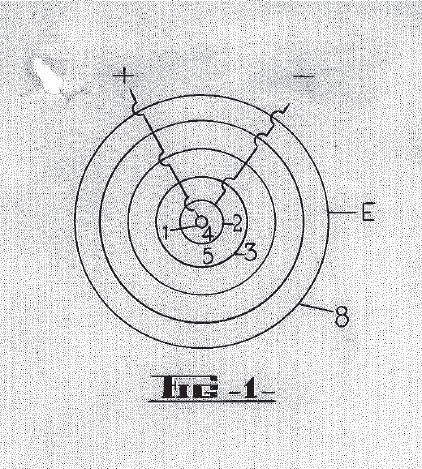
Clue Two:
Russellian Science: TEC - Part 10 - The Inert Gases, The Spiritual Elements! - YouTube
Clue Three:
Les Brown and the basic Law Of Nature. Walter Russell Motion. - YouTube
Clue Four:
Les Browns 'cube root of pi' or the Fourth root of pi( 3.141592654 ^0.25 = 1.33133) and is close to a 4:3 ratio or a perfect fourth in relation to an octave.
Using the basic law of Nature you can calculate the distance needed to find out the size or gap of the 'fifth' or outer ring based on the first for the standing wave within the device. While also ensuring that the resonance or frequency is matched and increased accordingly based on the inner ring or 'input'.
- The diameter of the fifth ring will give you the circumference of the first ring.Last edited by reddpill; 06-12-2012, 05:06 AM.Leave a comment:

Leave a comment: