
Thanks, Duncan.
I also want to thank Prof Savic for being willing to share, including tests of his Davey device. I would like to speak more of this later, with his permission.
For now, it is past midnight and I will sleep!
-
I hate it when links dry up (for whatever reason) simply to put the information back here's the videos tracked down to alternate links for your informationOriginally posted by RAMSET View Post
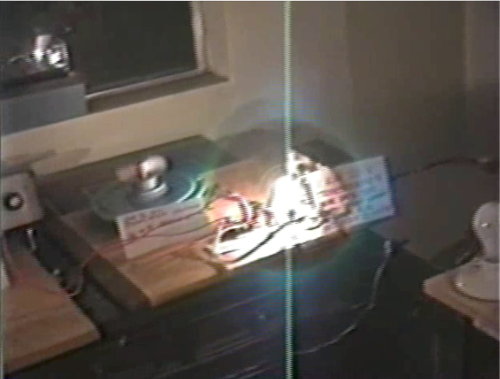
This is a still of Floyd sweets machine...

and the rest are self explanatory pretty much
New Free Energy by George Mitchell - YouTube
NEW EARTH DAY DEMO - New Multi Coil Stator Ring - YouTube
Ottawa University TORQUE PARADIGMS Regenerative Acceleration Generator vs Conventional Generator.mov - YouTube
F.M.CHALKALIS ENERGY MULTIPLIER - YouTube
and the tuner Antenna Tuning Unit
all seems a little out of context now stiill .... regards DuncanLeave a comment:
-
Attached is a drawing of the huge Kamioka Neutrino Detector in Japan, where I did research years ago.
I remember waking up in the winter in my little flat there, with ice crystals from my breath on the blanket.
Anyway, it strikes me as interesting that this Kamioka detector looks a wee bit like a DAVEY device... just VERY large! Last edited by PhysicsProf; 12-12-2012, 10:58 PM.
Leave a comment:
-
As I emailed to D just now:
Look guys, I performed experiments inside the Kamioka neutrino detector in Japan several years back. I know from experimental data how rarely neutrinos interact with water.[snip]And please don't mention neutrinos! although in the news because of the speed-of-light experiments with neutrinos, neutrinos just do not interact much with a few liters of water -- at all! Something like one interaction in a hundred years (in 3 litres of water).
One doesn't need to explain WHERE the energy is coming from -- straightforward experimental data will be compelling enough to generate interest and support. [snip]
Later we can do the experiments to find out WHERE the energy is coming from.
WE will enjoy looking elsewhere (besides neutrinos) for an explanation of this remarkable effect -- when we get it to occur repeatably and reliably.Last edited by PhysicsProf; 01-11-2012, 08:08 AM.Leave a comment:
-
Certainly an interesting article, Br D. Thanks for calling attention to it.Originally posted by daemonbart View Post
Yes, the EXPERIMENTAL DATA regarding the speed of neutrinos is currently CHALLENGING ESTABLISHED THEORY -- and I love it!
This is how the world progresses. I have been following the saga quite carefully for months.
As usual, "Theory guides, but experiment decides."Leave a comment:
-
Thank you for comments, Slovenia and Prof Savic in particular.
Sometimes I feel misunderstood -- but I guess that is understandable.
However, let me reiterate that as a scientist and well-studied in the history of science, I must re-emphasize the importance of actual EXPERIMENTS AND MEASUREMENTS.
If I am privileged to do actual tests on a device that is claimed to have COP > 1 (I prefer to say Eout / Ein > 1), then I must do careful measurements of both the input energy and output energy. My colleagues and I would use more than one method of measurement, if possible.
With regard to the Davey/Savic type of device -- Working closely with a colleague, we plan to start with a measurement of the input energy using an energy or power meter, such as the "kill-a-watt" meter described in my post of experimental results above. The output energy would be determined calorimetrically, that is, we would measure the temperature rise of the water in the water-heater, and calculate
Q = Cp X mass X (temp-final - temp-initial).
I may not understand fully the modus operandi of the device, nevertheless if the results show Eout/Ein > 1 (as measured), we must report the results to the world!
Again, as scientist, if the results turn out to be less than unity, we would feel obliged to be honest and report these results also.
That's the nature of scientific inquiry, and it is not complete until someone qualified --BESIDES THE INVENTOR-- tests the device and presents the results of the tests to the world.
I would be glad to hear comments on my approach, which I believe adheres to the scientific method.Last edited by PhysicsProf; 01-11-2012, 04:36 AM.Leave a comment:
-
If I may add my little grain of salt
a little Analogy for you
Think of water and air as two notes / elements existing on the same harmonic scale (think Walter Russel Table of Elements ) ...except that one is on a higher octave than the other
fyi: unless you live in the sun (and even the sun creates water )...there is water all around you (and in you )Last edited by MonsieurM; 01-11-2012, 03:11 AM.Leave a comment:
-
Hi,
Speed of sound in water and air:
Speed of Sound FormulasDensity - Wikipedia, the free encyclopedia
Properties of water - Wikipedia, the free encyclopedia
Density of air - Wikipedia, the free encyclopedia
Speed of sound - Wikipedia, the free encyclopedia
Underwater acoustics - Wikipedia, the free encyclopedia
There are TWO phenomenons occurring in this device, the speed of sound and the speed of light. Both will relate via wavelength harmonics, with unknown effects. The speed of sound propagates through an elastic medium, the speed of light (AC electricity) will propagate through the molecular structure(s) because electricity is an electromagnetic phenomenon the same as light. This is one reason why the gap between electrodes may be so important because light operates with wavelength on the nanoscale and a tiny tolerance may have a huge effect on the system.
Electronics 101 - Fundamentals of Electricity - Lesson 24 - Characteristics of a Sine Wave
Maxwell's equations - Wikipedia, the free encyclopediaThe Darwin Awards 2012Leave a comment:
-
New people
Sir
With all respect Your handle that you use here seems strange?
I try not to judge a book by its cover .
We are an open source community ,people that come to these pages
I have known most of them a long time ...as does Slovenia.
Persons that share their hard work here have a certain Quality that is usually reflected in how they Speak, Their handles [forum names] ETC
You seem a bit out of line with what I have come to expect from the benevolent men and women that come here to make this world a better place?
A little Off To Me...................
Can you explain your handle [forum name] Please?
Thank you
ChetLast edited by RAMSET; 01-11-2012, 02:56 AM.Leave a comment:
-
yes, my thought exactly, but then this would mean we dont have to make it resonate on 50Hz in AIR. We just have to make it thin enough to VIBRATE rather than to resonate.. correct?Originally posted by RAMSET View PostLeave a comment:
-
osamaricu_te
Sir
That is an interesting Name you have?
What does that mean??[translation]
?
Your question on Air and water....
I would suspect that is the reason the can has to be made "Razor thin"
So when it gets to the water ...... things still Move?
Just a thought?
ChetLeave a comment:
-
who can explain?
This is one thing I dont understand about this sonic boiler idea. So we get an object to resonate on 50Hz. Thing here is, we got it to resonate at 50Hz in AIR. As soon as you put that object in water, its resonance frequency has changed, so I would like someone to explain this if possible?Leave a comment:
-
Very Good
Mr.D
Thanks for the history ,The lesson......
And the Smile!!
Good for the soul!
ChetLeave a comment:
-
update
Hi all,
I tried the idea Grizli gave, feeding 2 frequencies from my amplifier. So here is what I tested:
1. I have small plates curved in a circle, like a short tube, BUT 1 cm was cut off so it doesnt complete full circle so its not a tube exactly. I like it like that, it makes more dispersed sound.
So I took 4 of them, place them on in each other, very small gap between. Nothing
2. Took tubes, placed them in one another. Nothing
3. Made 4 rings out of a "beer" can, weak repsonse.
4. made 4 plates out of a can again, I used can cause I dont have any other material so thin to vibrate. placed 4 pieces of can arranged as flat plates (well almost). Hmmmmmm, this is giving some nice reply. I put power in them on 2 different frequencies in order, first wire from left channel to first plate, the second to 3rd plate and then other channel to 2nd and 4th plate. As soon as I give power to it, it starts humming. Like powerplant humming :P
Anyway, it is humming, making instant bubbles but its not heating too much and it doesnt respond to change of frequency. In fact, it is giving stronger reply to the frequency that draws more power, nothing else.
BUT I am interested in testing more, so I will try again tomorrow, will use thin REAL plates and arrange them properly.
Will update then.Leave a comment:
-
Teamwork!
Imagine Savic and this Jeong together, Ramset could do the welding, Slovenia and me could dream up some nice suggestions
Everyone here is welcome also
Kind rgds D
Leave a comment:
Leave a comment: