Originally posted by toranarod
View Post
Announcement
Collapse
No announcement yet.
Muller generator replication by Romerouk
Collapse
X
-
Wishing you a very great time! I am looking forward to it. In the mean time, let me see if I can make new coils and do some other tests.
-
great simulation.Originally posted by Shadesz View PostHey guys I just built this simulator circuit to help us learn and design a 'lenz delay pickup circuit'.
It shows you a normal loaded circuit and a circuit with the inductor delay. Play with it and notice how the resistance and inductance effects the size of the delay and the power output. Also, look how if you keep the resistance and inductance the same but increase the frequency you can increase the delay as well.
Using this makes me think we probably don't want a full 90 degree delay... our power output would be minimal... unless we use it strictly as a drive force.. if we ever could... but if we want to draw power off it, a 90 degree shift may not be most desirable.

about your rotors. I buy PVC disc and make rotors out of them. its cheap and easy to work with. do you have any friends with a machine shop just to spin them up to round?
Leave a comment:
-
Hello eliasOriginally posted by elias View Post@Rod
I have been thinking along and thinking along and thinking along ...
We will never get FE if we rely on conventional models of electricity and coils and such, we can use them as a tool to analyze our stuff, but it is a waste of time to try to get something by phase shift or such, OUR BEST TOOL is EXPERIMENTATION. And you are the one that have built one of the best units to date, So i need to ask you do some measurements?
Because our models have been built on ideal cores and coils, we need to get FE from something that has not been accounted for, in the current model. One of them is the response time of the Iron molecules for the change in magnetic flux, I think that the effects that particularly you are showing us is related to that one! Not the phase shift by itself, the phase shift is really helping this effect manifest, but will not give you real acceleration. What you are showing us is REAL acceleration, and that is very valuable.
So I need to ask you measure the phase difference between your voltage and current in the coil to do this, you need a dual channel scope. To measure the current by the scope, I recommend you using a 0.1 ohms resistor, or a high wattage low voltage lamp, like car headlights to short the coil. Measuring the potential diff of that will give you the current phase, and to measure the voltage you can measure the voltage of the adjacent coil, and offset the phase difference, which in your case is 360/9 = 45 degrees.
See if you can measure this in different RPMs, I strongly believe that this is related to the property of Iron = Fe.
Thanks
Elias
I am out of the house at the moment on a few days with family.
I will be back home in the next 48 hours or so. with this rest I should be armed with so new enthusiasm. I have been building generators so long it can just get to point you burn out.
I will be calling on all of you to help with the experiments as I do them. We will try a verity of test and hopeful work together to come to a better understanding of what we see on the bench.
I have two duel trace scopes, 1 analog and 1 digital and lots of other test gear and all the electronic components and power supplies.
Leave a comment:
-
this is more like it.Originally posted by Shadesz View PostCheck this out.
The entire lecture is great, but the part I start you at is an actual application of the phase shift I am talking about. But instead of levitating aluminum or a woman, let's levitate magnets.

how about a test rig testing magnets and coils?
Leave a comment:
-
Hello ShadeszOriginally posted by Shadesz View PostYeah lots and lots to do.
I e-mailed you last night. I have been able to make magnetite at home out of steel wool. Not too impressed with the permeability though. I am going to try to bake it as I make it, casting it in a mold as it dries out, using a high heat coil of wire (220*C wire, I got this week) to line it up as it crystalizes. We will see how that goes... if it increases permeability and allows us to cast it without resin we might have a winner. Homemade cores would be great!
My wife and I are both full time students so I am slowly rounding up the parts I need to make my motor. More slowly than I would like.
In fact question on that, trying to save money on rotors, what is the best material to use?
I am out of the house on a few days with family interstate. So I am sorry for the delay. But I have my computer with me and are now settled at the relations, for some R and R
this is where I get a fidgety. not at my Bench with my Electronics. Great post on the lenz law thread.
Leave a comment:
-
Check this out.
The entire lecture is great, but the part I start you at is an actual application of the phase shift I am talking about. But instead of levitating aluminum or a woman, let's levitate magnets.
Leave a comment:
-
@Rod
I have been thinking along and thinking along and thinking along ...
We will never get FE if we rely on conventional models of electricity and coils and such, we can use them as a tool to analyze our stuff, but it is a waste of time to try to get something by phase shift or such, OUR BEST TOOL is EXPERIMENTATION. And you are the one that have built one of the best units to date, So i need to ask you do some measurements?
Because our models have been built on ideal cores and coils, we need to get FE from something that has not been accounted for, in the current model. One of them is the response time of the Iron molecules for the change in magnetic flux, I think that the effects that particularly you are showing us is related to that one! Not the phase shift by itself, the phase shift is really helping this effect manifest, but will not give you real acceleration. What you are showing us is REAL acceleration, and that is very valuable.
So I need to ask you measure the phase difference between your voltage and current in the coil to do this, you need a dual channel scope. To measure the current by the scope, I recommend you using a 0.1 ohms resistor, or a high wattage low voltage lamp, like car headlights to short the coil. Measuring the potential diff of that will give you the current phase, and to measure the voltage you can measure the voltage of the adjacent coil, and offset the phase difference, which in your case is 360/9 = 45 degrees.
See if you can measure this in different RPMs, I strongly believe that this is related to the property of Iron = Fe.
Thanks
Elias
Leave a comment:
-
Hey guys I just built this simulator circuit to help us learn and design a 'lenz delay pickup circuit'.
It shows you a normal loaded circuit and a circuit with the inductor delay. Play with it and notice how the resistance and inductance effects the size of the delay and the power output. Also, look how if you keep the resistance and inductance the same but increase the frequency you can increase the delay as well.
Using this makes me think we probably don't want a full 90 degree delay... our power output would be minimal... unless we use it strictly as a drive force.. if we ever could... but if we want to draw power off it, a 90 degree shift may not be most desirable.
Leave a comment:
-
Yeah lots and lots to do.Originally posted by toranarod View PostHello Shadesz
No I have never tried this type of coil I appreciate the help.
how are things going your end.
there is so much work to do, I am still working on the previous experiment.
I e-mailed you last night. I have been able to make magnetite at home out of steel wool. Not too impressed with the permeability though. I am going to try to bake it as I make it, casting it in a mold as it dries out, using a high heat coil of wire (220*C wire, I got this week) to line it up as it crystalizes. We will see how that goes... if it increases permeability and allows us to cast it without resin we might have a winner. Homemade cores would be great!
My wife and I are both full time students so I am slowly rounding up the parts I need to make my motor. More slowly than I would like.
In fact question on that, trying to save money on rotors, what is the best material to use?
Last edited by Shadesz; 10-01-2011, 04:50 PM.
Leave a comment:
-
That was really a mistake, I am willing to share any idea that is constructive with everyone. That bouncing magnet effect may or may not work, that depends on the core lag, so it was not something very constructive it had to be removed!Originally posted by Shadesz View Postlol, I'll delete mine too then.
Send me a pm about the idea though. I'm listening
Leave a comment:
-
Can someone help me analyze this?
@everyone
I have been trying to understand what really was happening on my three coil four magnet generator back in February, this is what I come up with, while connecting two of the coils together:

blue wave: phase one.
green wave: phase two, whch lags phase one by 120 degrees, because the magnets are different for each coil.
red wave: (phase one - phase two) As you see it shifts phase one forward a little bit, while amplifying the voltage.
Cyan wave: The 90 degree forward shifted current resulted in the two connected coils.
Now, remember that my rotor was a four magnet N-S-N-S rotor. And my coils are three coils at about 19mH and 0.7 ohms.
The chart above only show two of the coils connected together.
I can't wrap my mind over this, because the current is shifted about 120 degrees from coil 1(blue wave), and about 240 degrees from coil 2(green wave)
Does this mean over unity, while both coils are driving the rotor at the same time? I still can't get it.
It really did get good amount of acceleration by connecting the two, but I don't know if it was normal acceleration of something entirely different, because my cores were a bunch of welding rods, which did heat up, so they did have eddies.
EliasLast edited by elias; 10-01-2011, 10:42 AM.
Leave a comment:
-
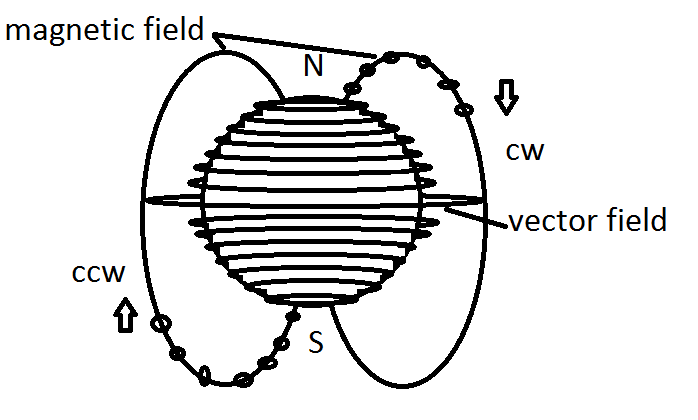
Sorry guys I didnt mean to spam the forum or hijack any thread, I just get carried away sometimes.Originally posted by Dave45 View PostThis model shows how the electric field of a planet couples with the magnetic field, it works the same with a coil.

Dave
Take care
Dave
Leave a comment:
-
Hello ShadeszOriginally posted by Shadesz View PostThanks for this. I haven't read it yet, but did you notice the cores in those Don Smith coils? He angled both the front and back, but it looks like a little differently than how I proposed? I wonder why? Does anyone know?
No I have never tried this type of coil I appreciate the help.
how are things going your end.
there is so much work to do, I am still working on the previous experiment.
Leave a comment:
-
the electrons run at a sixty degree angle,Originally posted by Shadesz View PostThanks for this. I haven't read it yet, but did you notice the cores in those Don Smith coils? He angled both the front and back, but it looks like a little differently than how I proposed? I wonder why? Does anyone know?
Leave a comment:
Leave a comment: