This forum is preserved as a permanent archive. The community continues at eMedia Press.

Announcement

Collapse
No announcement yet.

Bedini Earth Light

Collapse
X
 
  • Filter
  • Time
  • Show
Clear All
new posts

  • MonsieurM
    replied
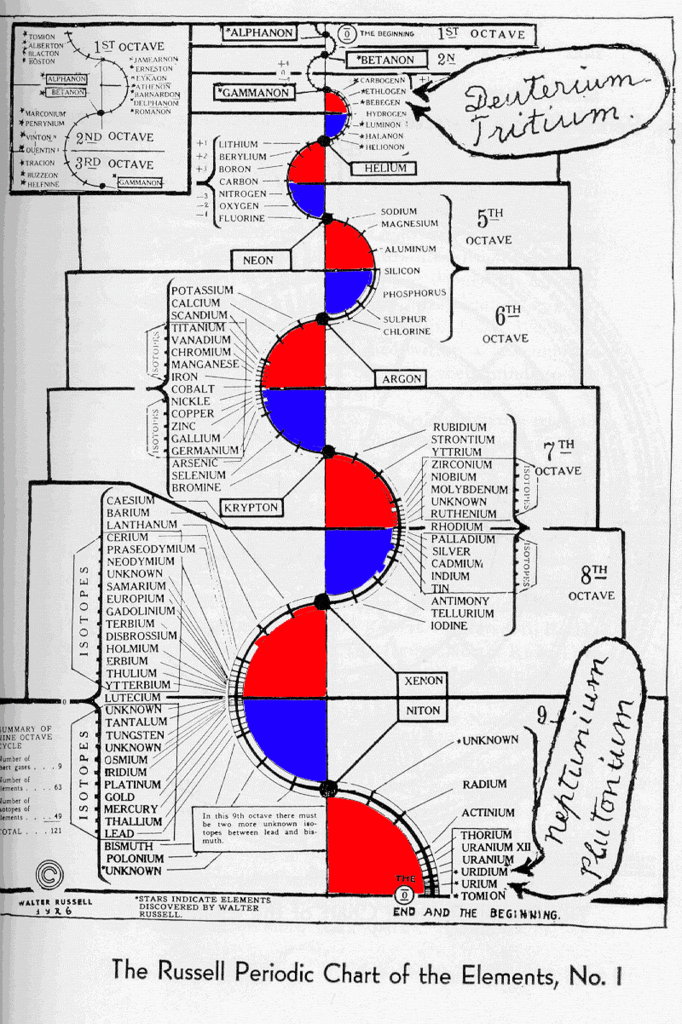
    if you couple the previous periodic table with the following (they contain exactly the same information ... just presented differently...fractal ) you will find quite a bit of inspiring info to compare with your already made mix and see what needs to be tweaked hint: find sphere of electric domination
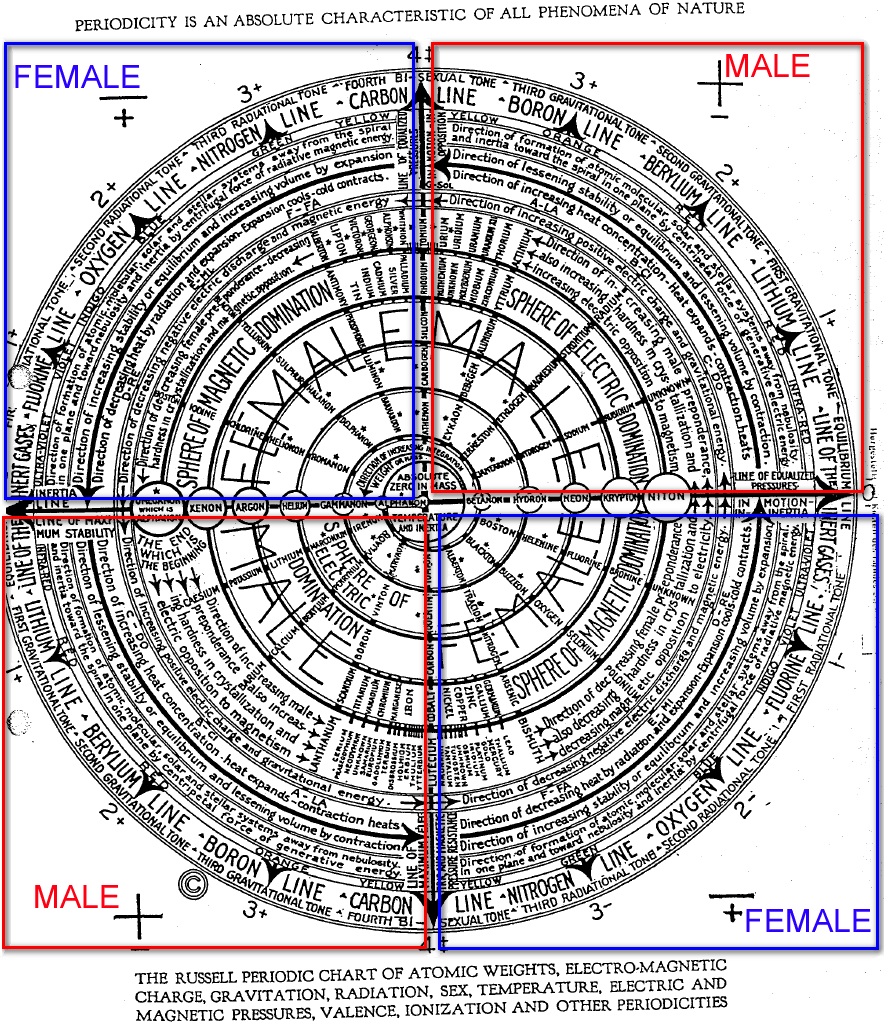


    add to it the table you are working with ... and you have a magical tryptic


    Last edited by MonsieurM; 04-13-2012, 03:45 PM.

    Leave a comment:


  • MonsieurM
    replied
    Originally posted by vintasalo View Post
    Thanks for the info... are these suppose to have the same purpose as the carbon nano-tubes (cat's)
    found the following , hope it helps


    Scaling, Corrosion and Water Treatment on
    Steam Generator Systems < 30 bar


    1.3.2
    pH-Value
    The very low dissociation of pure water defines the neutral pH of 7.0, values below pH 7 char-
    acterise acidic conditions with increasing acidity down to pH 0 and pH values above 7 that of
    basic or alkaline conditions up to pH 14. Attention: Any single pH-step results to a 10 fold con-
    centration change! For instance, if a pH of 7 corresponds to 1 mg/l, a pH of 8 corresponds to
    10 mg/l, a pH of 9 to 100 mg/l, a pH of 10 to 1000 mg/l = 1 g/l, a pH of 11 to 10 g/l etc.
    Moderate alkaline water conditions are important to protect iron from corrosion! Acid or acidic
    water dissolves the magnetite protective layer and attacks iron/steel


    allow me to add one more piece of info about the properties of Magnetite ( you should definitely experience with , you may be surprised with the results achieved as you guys heat you mix )

    Microwave melting of metals

    The microwave work was triggered by a short reference to the refining of rare earth metals, at Illawara Technology Centre, which was mentioned by a visitor to the Central Saint Martins foundry, Dennis Glaser. Since these metals melt at temperatures above 800 degrees Celcius, it seemed possible that the method could be adapted to melt and cast small objects in the workshop or studio. If this could be done a domestic microwave would, effectively, become a cheap and accessible furnace.

    Trials were begun which simply aimed to melt metals such as silver and bronze in open crucibles. However, it soon became obvious that casting to shape could also be accomplished by adapting the Reid Technique (RT) - a simplified ceramic-shell procedure for the casting of non-ferrous metals, patented in 1990. RT was first developed to avoid the problem of heat loss, which makes the the pouring of small melts very difficult - these difficulties arise however the metal is heated, and while the microwave technique set out here can be used for heating small amounts of metal in open crucibles, its greatest potential lies in its use as a flameless furnace in processes such as the Reid Technique. The crucial discovery, made during extended tests with various susceptors - materials which heat up when exposed to microwaves - was that two substances, graphite and magnetite, working together were required to achieve the kind of heating we were looking for.
    SiC (Silicon Carbide) is a good susceptor and it couples at room temperature and is good up to about 1100C. Alternatives are Magnetite, and Zirconium.
    Susceptor - Wikipedia, the free encyclopedia

    A susceptor is a material used for its ability to absorb electromagnetic energy and convert it to heat (which is sometimes designed to be re-emitted as infrared thermal radiation). This energy is typically radiofrequency or microwave radiation used in industrial heating processes, and also occasionally in microwave cooking. The name is derived from susceptance, an electrical property of materials that measures their tendency to convert electromagnetic energy to heat.
    this is just one of its properties and naturally found with tourmaline and quartz .... naturally compatible
    Last edited by MonsieurM; 04-13-2012, 09:36 PM.

    Leave a comment:


  • MonsieurM
    replied
    Originally posted by Allwest View Post
    MonsieurM,

    This chart is very interesting to me, I am trying to wrap my head into this, my business is getting busy, which is a good thing and bad, good that it make me money , bad that it takes away from my fun time

    Can you give me a brief orientation on this?


    I have been working off another table Standard electrode potential (data page) Standard electrode potential (data page) - Wikipedia, the free encyclopedia

    This tells me that Lithium is very close to the most neg −3.0401

    And Fluorine gas is the most positive +2.87

    That's why I used fluoride tooth paste as one of the test cells Allwest Power Cell # 3 - YouTube

    On this one I was testing the tooth paste, not the copper, the toothpaste was more positive than the copper

    Any ways... this is a new list for me to study up on

    Also, has any body tried silver instead of copper, it is way more positive than copper and is supposed to give allot more voltage, according to chart ?


    Best of luck to all

    There are many types of Periodic Tables available Database of Periodic Tables and each present you with a different dimension and relations each element has to other elements ( think of it as Fractal ) .... the one you are used to is what you might call "the simplest" (although crude imo ) periodic Table of elements .....the one you are Lokking at was made by a great Man : Walter Russell ( and Lea Russell ) (you can consider him in the same category as : Keely , Tesla , Moray , Schauberger ) as it shows the Elements belonging to various Octave.... It is quite an interesting as it also shows you which element is "Male" and "Female"
    if you are interested in walter russell : http://www.energeticforum.com/renewa...-his-work.html

    he is also credited

    The two newly discovered elements which formed the basis of the atomic bomb, called Neptunium and Plutonium, were published in his charts of the elements in 1926.

    Leave a comment:


  • vintasalo
    replied
    Originally posted by MonsieurM View Post
    If you are looking for a substitute ... you can make at home some Nano- Magnetite

    OSnano

    Open Source Nanotechnology


    Step 1
    : Prepare and Collect Ingredients

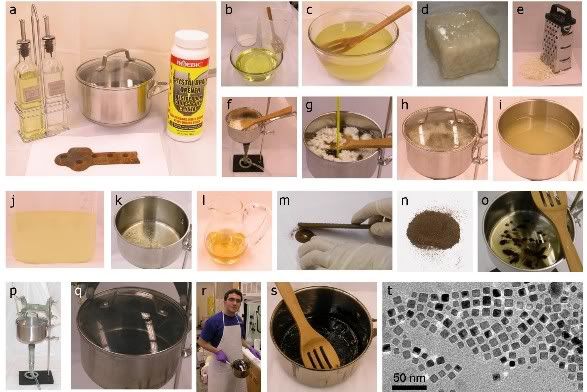
    (a) Ingredients for a typical nanocrystal synthesis include: Oil, vinegar, pan, crystal drain openerTM and rust.
    Step 2: Make your own soap.

    (b-c) Synthesis begins with soapmaking. For this the oil is mixed with crystal drain openerTM and water.
    (d) After curing for a day the soap solidifies.
    Step 3: Produce a Fatty Acid Mixture

    (e) For efficient dissolution in subsequent steps, the soap is ground to a fine powder,
    (f) then mixed with vinegar
    (g-h) while heating on a stove.
    (i-j) Once all the soap is dissolved the solution forms two layers: a yellow top layer and a cloudy white/yellow bottom layer.
    (k) The top layer is the fatty acid mixture (FAM). This needs to be heated at 110 oC to remove excess water and vinegar by-products.
    (l) Clear yellow FAM is collected.
    Step 4: Collect and Grind some Rust

    (m-n) Rust was scraped off of rusted metals and was ground to a fine powder.
    Step 5:Cook/grow your own magnetite crystals

    (o) FAM and rust were mixed.
    (p-q) Mixture was heated for 2 hours at below and near boiling temperatures. The temperature was measured using a standard mercury thermometer.
    (r-s) Magnetite (black) began to form. ..... you can add your own mix to the lot the fat will keep the oxygen out
    Step 6: Verify your Magnetite Crystals

    (t) TEM micrograph was obtained after magnetic separation in chloroform. Scale bar is 50 nm.

    step 6 (i don't think we care that much about it )

    Thanks for the info... are these suppose to have the same purpose as the carbon nano-tubes (cat's)

    Leave a comment:


  • Allwest
    replied
    Here is one of the positive electrodes I was thinking of using, or making, seems simple to make Iron filings and saltpeter


    Ferrate(VI) salts are formed by oxidizing iron in aqueous medium with strong oxidizing agents under alkaline conditions, or in the solid state by heating a mixture of iron filings and powdered potassium nitrate

    Potassium nitrate is a chemical compound with the formula KNO3. It is an ionic salt of potassium ions K+ and nitrate ions NO3−.

    Leave a comment:


  • Allwest
    replied
    Originally posted by MonsieurM View Post
    If i may suggest have a look at the following periodic table and find Potassium , Magnesium and Iron .... you'll find a common thread which can allow you to find other links as mentioned previously Boron sounds (borax ) like a good candidate


    hint: just looking at the table ... you can tell why oxygen is not so compatible
    MonsieurM,

    This chart is very interesting to me, I am trying to wrap my head into this, my business is getting busy, which is a good thing and bad, good that it make me money , bad that it takes away from my fun time

    Can you give me a brief orientation on this?


    I have been working off another table Standard electrode potential (data page) Standard electrode potential (data page) - Wikipedia, the free encyclopedia

    This tells me that Lithium is very close to the most neg −3.0401

    And Fluorine gas is the most positive +2.87

    That's why I used fluoride tooth paste as one of the test cells Allwest Power Cell # 3 - YouTube

    On this one I was testing the tooth paste, not the copper, the toothpaste was more positive than the copper

    Any ways... this is a new list for me to study up on

    Also, has any body tried silver instead of copper, it is way more positive than copper and is supposed to give allot more voltage, according to chart ?


    Best of luck to all

    Leave a comment:


  • MonsieurM
    replied
    Originally posted by vintasalo View Post
    Sorry about the triple post, but oxygen is exactly what your battling on these cells, its corrosive for oxidation of the metals.

    I still say carbon nano-tubes, but their a little expensive
    If you are looking for a substitute ... you can make at home some Nano- Magnetite

    OSnano

    Open Source Nanotechnology

    At this stage, it consists of only one project: instructions for creating magnetite nanocrystals; but we hope this project will inspire others in the future. What can you do with magnetite nanocrystals?


    Why? Magnetite Nanocrystals are good for removing arsenic from water


    Step 1
    : Prepare and Collect Ingredients

    (a) Ingredients for a typical nanocrystal synthesis include: Oil, vinegar, pan, crystal drain openerTM and rust.
    Step 2: Make your own soap.

    (b-c) Synthesis begins with soapmaking. For this the oil is mixed with crystal drain openerTM and water.
    (d) After curing for a day the soap solidifies.
    Step 3: Produce a Fatty Acid Mixture

    (e) For efficient dissolution in subsequent steps, the soap is ground to a fine powder,
    (f) then mixed with vinegar
    (g-h) while heating on a stove.
    (i-j) Once all the soap is dissolved the solution forms two layers: a yellow top layer and a cloudy white/yellow bottom layer.
    (k) The top layer is the fatty acid mixture (FAM). This needs to be heated at 110 oC to remove excess water and vinegar by-products.
    (l) Clear yellow FAM is collected.
    Step 4: Collect and Grind some Rust

    (m-n) Rust was scraped off of rusted metals and was ground to a fine powder.
    Step 5:Cook/grow your own magnetite crystals

    (o) FAM and rust were mixed.
    (p-q) Mixture was heated for 2 hours at below and near boiling temperatures. The temperature was measured using a standard mercury thermometer.
    (r-s) Magnetite (black) began to form. ..... you can add your own mix to the lot the fat will keep the oxygen out
    Step 6: Verify your Magnetite Crystals

    (t) TEM micrograph was obtained after magnetic separation in chloroform. Scale bar is 50 nm.

    step 6 (i don't think we care that much about it )

    Last edited by MonsieurM; 04-13-2012, 01:33 AM.

    Leave a comment:


  • vintasalo
    replied
    Sorry about the triple post, but oxygen is exactly what your battling on these cells, its corrosive for oxidation of the metals.

    I still say carbon nano-tubes, but their a little expensive

    Leave a comment:


  • vintasalo
    replied
    Originally posted by Allwest View Post
    Regarding the Chili powder cell

    Allwest power cell # 5b - YouTube

    The hotter the pepper the more power I get, I have tried Cayenne powder and get better results

    I guess the next step is HOTTER peppers


    I love this hot stuff, it goes good with beer

    To MonsieurM
    "If i may suggest have a look at the following periodic table and find Potassium , Magnesium and Iron .... you'll find a common thread which can allow you to find other links as mentioned previously Boron sounds (borax ) like a good candidate"

    YES! that was on the grocery list to get "Mule team" it may give it a kick


    I liked the periodic table list that you shared, thank you!


    To CrystalDipoleMatrix "@ Allwest: The magic ingrediant in chili and other peppers is Capsaicin. It's form is crystaline and it"s hydrophobic."

    Then I guess we can call this a crystal battery


    Good luck to all
    Ghosts Pepper extract is the hottest_- be extremely careful due to the fact that it can straight up kill you.. no joke, wear gloves and a mask. They cook it on food wearing gas masks

    Leave a comment:


  • vintasalo
    replied
    Ghost pepper is the hottest

    Also try some hydrogen peroxide as your electrolyte, I made a quick cell that was on the amp scale, not Ma.

    Im working on a barium titanate parallel battery, if you notice its the highest on the electrode chart. Getting the materials in soon.

    Look here for an interview with the underground company fine tuning their product.
    EEstor Dick Weir leaked interview part 1 ZENN Motor Company . ZNNMF.PK - YouTube

    He grows a barium doped material that out surpasses current batteries

    Leave a comment:


  • Allwest
    replied
    Regarding the Chili powder cell

    Allwest power cell # 5b - YouTube

    The hotter the pepper the more power I get, I have tried Cayenne powder and get better results

    I guess the next step is HOTTER peppers


    I love this hot stuff, it goes good with beer

    To MonsieurM
    "If i may suggest have a look at the following periodic table and find Potassium , Magnesium and Iron .... you'll find a common thread which can allow you to find other links as mentioned previously Boron sounds (borax ) like a good candidate"

    YES! that was on the grocery list to get "Mule team" it may give it a kick


    I liked the periodic table list that you shared, thank you!


    To CrystalDipoleMatrix "@ Allwest: The magic ingrediant in chili and other peppers is Capsaicin. It's form is crystaline and it"s hydrophobic."

    Then I guess we can call this a crystal battery


    Good luck to all
    Last edited by Allwest; 04-12-2012, 10:18 PM.

    Leave a comment:


  • b_rads
    replied
    A Must Have!

    A must have for your digital library

    http://chemistry.about.com/b/2008/08/05/banned-book-the-golden-book-of-chemistry-experiments.htm

    , written by Robert Brent and illustrated by Harry Lazarus, is a children's book published in the 1960s that was intended to explain to kids how they could set up a home chemistry lab and conduct simple experiments. Supposedly the US government had the book removed from libraries and banned for sale on the grounds that the projects were too dangerous for its intended audience. I would have to agree that you probably don't want your kids making and igniting hydrogen in the garage, but for the aspiring chemist who can adhere to the safety precautions, this remains one of the best do-it-yourself chemistry books around. You can download the pdf of The Golden Book of Chemistry Experiments

    http://chemistry.about.com/library/goldenchem.pdf

    Leave a comment:


  • CrystalDipoleMatrix
    replied
    Capsaicin

    @ Allwest: The magic ingrediant in chili and other peppers is Capsaicin. It's form is crystaline and it"s hydrophobic.
    From wikipedia: The burning and painful sensations associated with capsaicin result from its chemical interaction with sensory neurons. Capsaicin, as a member of the vanilloid family, binds to a receptor called the vanilloid receptor subtype 1 (VR1).[55] First cloned in 1997, VR1 is an ion channel-type receptor. VR1, which can also be stimulated with heat and physical abrasion, permits cations to pass through the cell membrane and into the cell when activated. The resulting depolarization of the neuron stimulates it to signal the brain. By binding to the VR1 receptor, the capsaicin molecule produces the same sensation that excessive heat or abrasive damage would cause, explaining why the spiciness of capsaicin is described as a burning sensation.

    The VR1 ion channel has subsequently been shown to be a member of the superfamily of TRP ion channels, and as such is now referred to as TRPV1. There are a number of different TRP ion channels that have been shown to be sensitive to different ranges of temperature and probably are responsible for our range of temperature sensation. Thus, capsaicin does not actually cause a chemical burn, or indeed any direct tissue damage at all, when chili peppers are the source of exposure. The inflammation resulting from exposure to capsaicin is believed to be the result of the body's reaction to nerve excitement. For example, the mode of action of capsaicin in inducing bronchoconstriction is thought to involve stimulation of C fibres [56] culminating in the release of neuropeptides. Essentially, the body inflames tissues as if it has undergone a burn or abrasion and the resulting inflammation can cause tissue damage in cases of extreme exposure, as is the case for many substances that cause the body to trigger an inflammatory response.

    Leave a comment:


  • MonsieurM
    replied
    Originally posted by Allwest View Post
    The dielectric grease I use is a Silicone base-

    Silicone grease is a waterproof grease made by combining a silicone oil with a thickener, and it seems to work fine, no big mess like petroleum

    I tried one half coating of mag with silicon grease and exposed both sides with Alum, The uncoated side showed signs of oxidation almost immediately, while the coated side stayed clean, I don't think we are stopping the galvanic decay with the grease, we are just stopping the oxidation

    More research on the chili powder cell
    Allwest power cell # 5b - YouTube

    Adding hydrogen peroxide resulted in over 500Ma

    I am trying to figure out (isolate) which compounds of chili powder make this a viable cell,The powder is very high in potassium, magnesium, and iron.


    If you add dry out to this powder it has a thermal reaction, possibly acid and caustic reaction

    Any ideas?

    If i may suggest have a look at the following periodic table and find Potassium , Magnesium and Iron .... you'll find a common thread which can allow you to find other links as mentioned previously Boron sounds (borax ) like a good candidate


    hint: just looking at the table ... you can tell why oxygen is not so compatible
    Last edited by MonsieurM; 04-12-2012, 04:32 PM.

    Leave a comment:


  • Allwest
    replied
    The dielectric grease I use is a Silicone base-

    Silicone grease is a waterproof grease made by combining a silicone oil with a thickener, and it seems to work fine, no big mess like petroleum

    I tried one half coating of mag with silicon grease and exposed both sides with Alum, The uncoated side showed signs of oxidation almost immediately, while the coated side stayed clean, I don't think we are stopping the galvanic decay with the grease, we are just stopping the oxidation

    More research on the chili powder cell
    Allwest power cell # 5b - YouTube

    Adding hydrogen peroxide resulted in over 500Ma

    I am trying to figure out (isolate) which compounds of chili powder make this a viable cell,The powder is very high in potassium, magnesium, and iron.


    If you add dry out to this powder it has a thermal reaction, possibly acid and caustic reaction

    Any ideas?
    Last edited by Allwest; 04-12-2012, 04:00 PM.

    Leave a comment:

Working...
X