Announcement

Collapse
No announcement yet.

Multifilar Generator Coil - Lenz delay Experiments

Collapse
X
 
  • Filter
  • Time
  • Show
Clear All
new posts

  • BroMikey
    replied
    Originally posted by dragon View Post
    Makes no difference how smart you are, the truth fools no one.... people fool themselves.
    There you go again thinking everyone is fooling themselves because they are
    stupid. But not you, you have been here along time, smarter than
    me and smarter than everyone, you are not going to be lied to, fooled
    or hook winked. You are the smart one.

    Insulting. I have been studying since the 60's and as for your
    slighted reasoning? Well I already said it. Like I said you need to
    rephrase and right after you learn to talk with respect, apologize.

    I know some guys think that they entitle to this condescending sentence
    structure but it's not showing others respect where respect is due.

    That is all you are going to hear from me. Shape up and fly right.

    Dave is not going to hold everybody's hand, you like the rest were told
    do some tests, no spoon feeding.
    Last edited by BroMikey; 07-20-2019, 01:48 AM.

    Leave a comment:


  • dragon
    replied
    Makes no difference how smart you are, the truth fools no one.... people fool themselves.

    How long have you been here Mikey? What have you learned? What can you do with what you've learned? What have you done with what you've learned?

    I've been powering my home with free energy for nearly 25 years now. Are you still paying an electric bill? So again I ask, what have you learned and what have you done with what you've learned?

    Leave a comment:


  • BroMikey
    replied
    Originally posted by dragon View Post
    Turion, I guess from what I can see and calculate I don't see the excess energy. The bulbs are 120 volt 300 watt units and appear to be dimly lit, even if they are getting 1.5 amps through them I'd say the voltage is dropping to around 60 volts or less by their appearance. Plug one into the wall .....[[/I]

    So you don't think Dave has had the brains to plug a light bulb into the
    wall first and compare. You are the one who is not thinking clear.
    A bulb running at 170vac will pop, Dave has been telling us and showing
    us HIS COILS and HIS COIL OUTPUT.

    The coils have been rewound over THE YEARS to get them up to 130vac
    why are you lacking this information? Have you been keeping up with
    all of these threads for the last 8 years? No? I suggest you cover some
    of the material before you begin your belittling process. I knew I was
    right the first time. You are insulting a man who has openly given all
    of the results of his years of hard work, money and time.

    I don't doubt you are one of the nicest guys when you need to be but
    this attitude is disgusting. If you can't make encouraging, intelligent or
    informed comments why are you making them?

    I'll tell you why. You are just like all the rest who don't want to admit
    that they have been surpassed by a nobody who did the experiments
    without a predetermined view as set forth by school books.

    On the other hand you are very smart and well educated on all of the
    school books from day one. Well you are like the rest who have big
    ego's and refuse to admit the obvious. A mark of a fool.

    How dare you talk this way? Meters show the number for voltage
    when the light bulb is shining, are you that dense?

    You force me to come on here with the hammer so you can be corrected
    and told to be polite, fine, you got it boys, I don't play see saw with
    words.

    Apologize.

    Last edited by BroMikey; 07-19-2019, 09:35 PM.

    Leave a comment:


  • dragon
    replied
    Turion, I guess from what I can see and calculate I don't see the excess energy. The bulbs are 120 volt 300 watt units and appear to be dimly lit, even if they are getting 1.5 amps through them I'd say the voltage is dropping to around 60 volts or less by their appearance. Plug one into the wall and put it next to the bulbs while the machine is running... my guess is there will be a huge difference in appearance noting a visual voltage drop.

    This is not meant to be an attack on you or your machine I'm simply stating the facts as I see them. Since there are no meters showing input voltage/amps or output voltage/amps we can only go by the numbers being bandied about. Even a simple volt reading with a clamp meter for amps on one of the output bulbs would help subside any skepticism. So, my skepticism stems from what I can see and calculate along with the lack of real observable data. I could very well be wrong and I hope I am but that's my evaluation based on what I see at this point.

    There are a lot of conversions going on in that machine... your taking a DC electrical input converting it to magnetic to generate a kinetic response on the rotor. Then the magnets in the rotor are creating a magnetic response on the coils converting it back to an electrical output. Each conversion process produces losses along the way.

    At this point I'd say you have a beautiful rotary inverter but not quite approaching unity.

    On some other points - you could easily make a rotor with 8 poles and use the 6 coil ( 6 each side ) arrangement currently shown. This would maintain a smaller connection to the lock up problem. The generator would then function as a 6 phase unit. Rectify each output coil and either series or parallel the rectified output dependent on what your desired use of the output would be. I would take the output and run it through an MPPT controller to charge a bank of batteries then invert it to drive any load you may want. Assuming this does produce an output greater than unity.

    Leave a comment:


  • dragon
    replied
    Basing the results on the info given so far it appears the overall efficiency of the machine shown is around 65% at that point... sounds and looks about right so far. So what is the next stage that would make the coils produce 100% or more?

    Leave a comment:


  • BroMikey
    replied
    Originally posted by Quantum_well View Post
    During a lifetime there are some memorable days like when you learn to ride a bike or the day your first child is born.
    For me one of those days was when I discovered that induction was a relativistic effect.
    If you don't get Lens's predicted sign change you don't get anything.
    I'd like to know what other's view on the subject is.
    ANSWER
    Get up off of your plus and minus sign then do the experiments. the
    lights will turn on more than in theory it will be literal. You'll have the
    power.

    Leave a comment:


  • Quantum_well
    replied
    Light bulb moment.

    During a lifetime there are some memorable days like when you learn to ride a bike or the day your first child is born.
    For me one of those days was when I discovered that induction was a relativistic effect.
    If you don't get Lens's predicted sign change you don't get anything.
    I'd like to know what other's view on the subject is.

    Leave a comment:


  • BroMikey
    replied
    Originally posted by Turion
    Dragon,
    Those are 300 watt bulbs.

    At 2800 rpm those coils put out 130 volts @ 1.5 amps. (with 6 of the 2" neos on the rotor, which is what I had.) And there are 12 coils. I know the generator in that video is doing at LEAST 2800 rpm because Lenz neutralization is evident. If there wasn't delayed Lenz with that many coils loaded, the rotor would have come to a screeching halt as the motor burnt to a crisp. Those coils REQUIRED 2800 rpm with that rotor and those magnets to get the delayed Lenz effect, so it is going at LEAST that fast. It may have been going FASTER, which would actually REDUCE the output of the coil as a generator coil. You have to remember there is a "Wind" of operation for these machines. Too slow, and you have Lenz. Too fast and you have a motoring effect and loss of power. Just right and you get NO Lenz, and MAX coil output as a generator coil. If the machine in the video is going the predetermined 2800 rpm, the output is at least 1800-2000 watts. The motor was running at 24 volts at probably about 33-34 amps since magnetic neutralization was not in the picture yet, so it was consuming almost 800 watts. That's about 2.25 times as much output as input, but it is NOT sustainable with that setup. The motor would soon burn up pulling that many watts. Gotta have that "worthless" magnetic neutralization.

    The thing about this whole setup is that it has to be tuned to do what YOU want it to do. For instance, let's say you give it a bit more voltage. Now it speeds up and the output SHOULD go up, but it DOESN'T because instead of an increase in output, you get a "motoring" effect from the speed up under load, which actually decreases the generated output of the coil. You can't have your cake and eat it too. So you have two things you can adjust. You can decrease the voltage supplied to the motor back to what it was, or you can shorten the wires on the coil. Shortening the wires on the coil SHOULD cause the voltage output to drop, but instead it raises the frequency at which the coils will delay lenz, so now lenz is delayed at this new, faster rpm, there is no motoring action at this increased speed, and the output of the coil goes up. It went DOWN because you shortened the wire, but it went up because you are operating in the window. A lot of this stuff is counter intuitive. If you haven't built it, it is sometimes hard to get your head around. The main thing to keep in mind is EVERY coil will speed up under load at the correct frequency for THAT coil.

    I spend a lot of time looking at the "effect" something has rather than trying to figure out how the laws apply, because in some situations, they do NOT. Find an effect. Figure out how to manipulate it to your benefit. Reap the rewards. Or not.

    Nobody wants to listen to me. That's ok. I know what I know.

    So think about what I just said. The MORE wire put on the coil, the slower it can run and still achieve Lenz delay. With longer wire and more strands in parallel, we get MORE output, but also LESS output because the magnets on the rotor are not going past the coils as many times per second. How do we make up for THAT? We add MORE magnets to the rotor. What does that teach us about the kind of machines we ultimately want to build. The bigger the rotor, the more magnets we can put around the outside of it so the more output we can get, and also, the bigger the rotor the more coils we can put around the outside. Since there IS no cost to us in Lenz and there IS no cost to us in magnetic drag if we are using magnetic neutralization, it may be possible to REALLY slow the rotor rpm DOWN. How slow can we go? I have NO IDEA. There are lots of things to experiment with here.

    That is a good post. I enjoy all repeats because in them you are reminded
    of things you had forgotten. For instance the 300w bulbs sometimes
    get mistook for the 100w bulbs in the other video.

    great post Dave for those of us who want to build these OU genny's.

    Leave a comment:


  • BroMikey
    replied
    @ Dragon
    Turion's coils put out 130v his bulbs are for USA grid. 120vac

    @Sky
    Great Idea, excellent brain storming.

    Leave a comment:


  • SkyWatcher
    replied
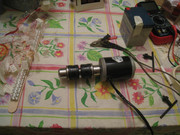
    Hi all, the double drill chuck motor adapter works nicely, it runs very true.

    Going to use this scooter motor now and remove the drill press monstrosity.

    Now the motor can easily be swapped for anything with a shaft diameter of 1/2" or less.
    And if it needs some pillow block bearings, etc., that can easily be implemented as well, as some are on my shelves.

    Also, will be able to use the motor pulse controller I built to run this motor and we can see changes in rotor speed better.
    peace love light

    Leave a comment:


  • dragon
    replied
    Turion, nice build ! Sounds sweet humming away there. What are you estimating the efficiency to be as shown in the video? Are those 220 volt 300 watt bulbs?

    Leave a comment:


  • BroMikey
    replied
    Originally posted by Turion
    That is an old version...... Kept trying to
    redo it and make the grooves deeper and the clamp tighter, but gave up after 3 tries. It had lots of problems..... so high amp draw.


    Here is a later version running with ALL coils speeding up under load
    and six 300 watt bulbs lit. Still NO magnetic neutralization in place


    In the video above, I NEEDED the 36 volts to break the magnetic lock because that rotor had six magnets and places for 12 coils, so on start up, each magnet was aligned with a coil on each side of it. Once it was running voltage could be turned down to 24 or 12. I eventually settled on 24 volts as the best input.

    In the video below, to get the machine to even start with all 12 coils on the machine, I had a button that would fire all the coils as motor coils for a split second to break the magnetic lock,

    https://youtu.be/l4Rjh0w3SuY
    Wow it is a beautiful thing to neutralize and use 12 X 1" magnets
    wow wee that's a lot of improvement and with both in place a 2000w
    machine becomes a 5000w machine. Better get a cooling scheme.


    [VIDEO]https://www.youtube.com/watch?v=l4Rjh0w3SuY[/VIDEO]

    Leave a comment:


  • SkyWatcher
    replied
    Hi all, thanks for sharing all the good and helpful information.
    Just finished connecting 25 strands in series and will be mounting the coil/core where the other large coil/core was, we shall see what happens.
    Will increase strands in series if needed, though have a feeling 25 will do it with the more powerful magnets on the drill press magnet rotor.

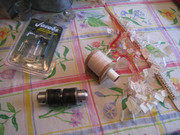
    Also, take note of me homemade back to back drill chuck, motor arbor/adapter.
    Will be using this in the near future, to use with the scooter motor that I was trying to use, and maybe get a different one, higher power scooter motor.
    peace love light

    Leave a comment:


  • BroMikey
    replied
    Originally posted by Turion
    If 2" is the average diameter, the distance AROUND a two inch diameter circle (circumference) is 6.28319 inches and 125' divided by 6.28319" would be 238.7 turns per strand x 12 strands of wire = 2,864 total turns of wire.
    https://youtu.be/A3DakXN-cR8
    That is an awesome video Dave. I wish I could see it light up the bulbs
    and say maybe 5 or 6 with the rotor turning at 2800 rpm's the motor
    amp draw might go down?

    would it run at 24vdc @ 18 amps because 36vdc X 18 amps =650watts

    3857rpm's. That is a crazy speed, do you have to run it that high to get lenz free?

    That is a beautiful machine Dave, you should be very proud of it.

    Look at all the money you have tied up in it, so incredible.

    You could put 10 or 15 LED bulbs in parallel to get what you want, a
    small price to pay considering all you have tied up.

    Let's see the average LED bulb is 12 watts and you are putting out
    say 180-220 watt so 15 bulbs is 15 X 12 = 180 watts. Or does that
    throw a damper on speed up?

    That would be dramatic wouldn't it. 15 bulbs per channel X 6 coils.

    Doing the math even at 650w input you could show 1200w output
    with only half the coils hooked up. Not bad. Are all of your coils that
    are left over not speeding up? So run 3850 r's then and use two
    bulbs in series? No? Use two 75w bulbs in series and your voltage
    will work out better.

    Just kidding on having it speed up but you know what I mean.


    [VIDEO]https://www.youtube.com/watch?v=A3DakXN-cR8&feature=youtu.be[/VIDEO]
    Last edited by BroMikey; 07-18-2019, 09:53 AM.

    Leave a comment:


  • BroMikey
    replied
    Originally posted by Turion
    I'm getting old. I wasn't exactly sure about the ohm measurement on those coils I posted about, so I scoured my old notebooks this morning until I found the proper entry. All coils were SUPPOSED to be 3 strands 800' of #23.

    I pulled all 12 coils off the big machine because some were NOT speeding up under load' They measured as follows
    1 @ 5.2 ohms Nope
    2 @ 5.4 ohms Nope
    6 @ 5.5 ohms Nope
    2 @ 5.6 ohms DID speed up under load
    1 @ 5.7 ohms WASN'T tested

    Hummm..... Very interesting, let me think about the old coils BRB.

    1000' = 20 and using 800' could be multiplied as .8 X 20ohm = 16ohms
    then using the parallel resistance calculator = 5.33 ohms

    not sure what happened there.maybe they are a little longer?

    If they were 900' each that would be .9 X 20 = comes to 6 ohms

    So I guess they are 850' this must be why you went to 1000'??

    Leave a comment:

Working...
X