
Originally posted by DrStiffler
View Post
-
Hmmm....
There has to be a way to stack the potentials like batteries or maybe raise the voltage via a coil enough to above the batteries voltage... -
Correct and another point is that the cap that is to dump into the battery requires it be at a voltage higher than the battery or the charge will move from the battery to the cap and discharge the battery.Originally posted by Zooty View PostLeave a comment:
-
I think I have some sort of success. Very impressive how this thing works. Not ALL caps works. You have to play with some until you find the correct one.
Some videos of my experiments: YouTube - Captret replication V1 - Part 1 and YouTube - Captret replication V1 - Part 2 and YouTube - Captret replication V1 - Part 3
Fausto.Leave a comment:
-
thanks for your response.
Hi Ibpointless2. Let me be the first to say that your efforts in this line of experimentation are far from "pointless".Originally posted by ibpointless2 View Post
Thanks for your interest in my device. It is very simple to build and revolves around the bedini self-osculating circuit. I have a link to my thread discussing a little about it in my signature.
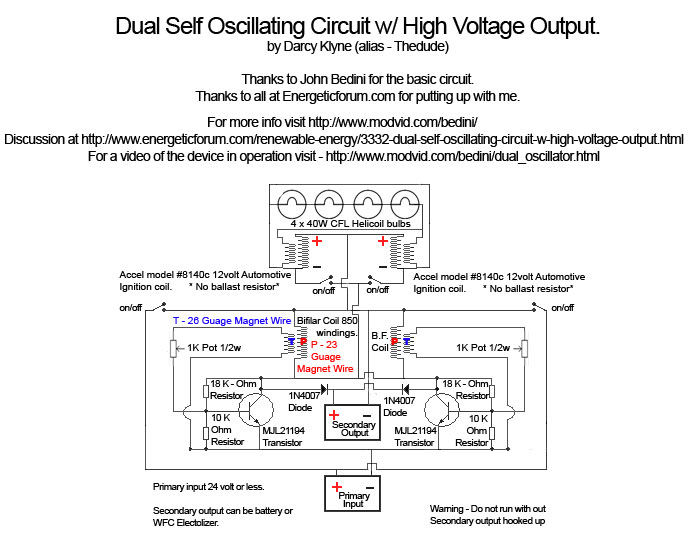
What you see in my video(here it is on youtube as well) only one half of this circuit. You can see how it is duplicated and the left is mirroring the right or vice versa. I've used 3 watt components in the unit in my video as i find it makes for a more stable device. Note- I don't believe that there is a neon in this schematic and there should be one between the collector and the emitter as a safety precaution if your secondary bank becomes disconnected. If you have an output for the ignition coil (CFL bulf with guts removed) it will tend to absorb some of the radiant spikes as well. Under normal operation i can run the two batts in the video at 12.75volts for more than a month while driving that CFL bulb brightly without depleting below 12 volts. Very low consumption due to bulb using some of the radiant flow.
That is why when i saw the effect of your Captret i decided i needed to see if I could use it to improve over all efficiency or establish a perpetual result. So far my batteries haven't moved! My primary is at 12.56 and the secondary is 12.50.
I will begin working with multiple captrets as indicated in your new schematic and hope to post more results soon. Thanks again for your swift response and to all others working on this line of experimentation.
Love and light!Leave a comment:
-
Look LED's are forward conducting diodes which emit light. The have a forward voltage drop just like a diode, although it is much higher. LED's can have a Vf of from 1.2 to 4.0 volts and vary with type (i.e. color). A Red may have a Vf range from 1.2 to 1.7 volts and would depend on who and how made. Now when you connect LED's in parallel without a leveling resistor in series (equal value resistors) with each, the lowest Vf is the dominate Vf and no other LED Vf can be greater than the lowest Vf. Also the one with the lowest Vf will draw the greatest current and in most case be the brightest. When you do this all LED's that have a Vf higher than the lowest suffer. Even though most of the time a particular run will be very close, the manufacture specifies a range over which each can very, this is the reason for the series resistors.Originally posted by Jbignes5 View Post
Now if for some reason it makes a difference what the resistance for a LED when conducting is; measure the forward voltage Vf, measure the current in series with any one of its legs, If, now derive the resistance, Rf = Vf/IfLast edited by DrStiffler; 11-11-2010, 04:45 PM.Leave a comment:
-
Maybe not directly...
What about dumping the voltage into a cap that can handle that voltage then dump it to the battery? I am also thinking we could parallel pairs of caps like you are talking about and adding the voltages together like a set of batteries then using a diode to funnel it back to the battery. I would have to use smaller caps prolly around the 16 v range like you.Originally posted by Zooty View PostLast edited by Jbignes5; 11-11-2010, 04:47 PM.Leave a comment:
-
Maybe there is enough to run a joulethief and use it's output to charge the primaryOriginally posted by Jbignes5 View Post
OR
I tried a cap in place of the LED and it measured 5.5v. If we have two captret circuits running from one battery, we might be able to series the two charging caps and charge the primary.. It probably wouldn't work but it's worth experimenting.Last edited by Zooty; 11-11-2010, 04:37 PM.Leave a comment:
-
It's going to need a few more caps to get to full brightness, not that bright at the moment but brighter than one cap. 2.4v across LED. I'ts a 3.3v blue.Leave a comment:
-
Ok..
That is why you are drawing a lower current... Now if you have a few more caps parallel them one at a time. Next would be 3 then test it and next would be 4 then test it. Lets see if we can reduce the current down to nothing...Originally posted by Zooty View Post
Note be careful that you are not going to blow that led as you add more caps in the setup. Measure the parallel voltage across the cap bank to make sure it stays withing tolerance of the led..
What I am wondering is if we add enough caps will the voltage going across the caps get stronger and maybe could be converted to a charge to be applied back to the battery via a real diode. But that means we would have to raise the voltage between the caps legs to above the batteries voltage if that is possible.Last edited by Jbignes5; 11-11-2010, 04:25 PM.Leave a comment:
-
not if...
Not if they are in parallel. Series you would expect it to double. This is the sticking point in my experiment. Also when I put the caps in parallel mode the light is brighter from the leds meaning that they should be drawing more current and they do not. Of course they are in parallel as well so I don't have the right calculations to figure this out. Since leds are diodes they drop a voltage but as to the resistance of the leds when they conduct I don't have an answer for.Originally posted by Zooty View Post
What cap are you using for sub ma operation. Mine are big caps @470 uf 200volts...Leave a comment:


Leave a comment: