
Originally posted by LaserSaber
View Post
-
Originally posted by ibpointless2 View Post
LED didn't go dim and once the LED goes up to a certain voltage it starts to go down. My got to 6.62 volts and its going down but the LED is still bright.Leave a comment:
-
I will test
@Jbig
I don't have the correct value parts ATM but I will try to get it sorted correctly this weekend. I am trying a 470uf 200v as was used in my first captret video, along with 2 small ceramic bead caps (too small markings to read) a 100k pot and a junk ups battery. Starting volts is .48 @ 8:06pm est and is steady for a few minutes now. We shall see. Keep up the good work and testing.
CheersLeave a comment:
-
It seems....
It seems to take a bit for the signal to permiate the battery. Once the signal is all the way into the battery it revs up getting bigger the longer it goes but I think there is a resonance that gets setup in the battery by the signal that might be limited by the composition of the battery.. Since we know batteries are a combination of capacitance , resistance and a certain amount of inductance it might take a bit to figure out this process by observation only. It might have a limit but only time will tell...Originally posted by ibpointless2 View PostLast edited by Jbignes5; 11-19-2010, 12:59 AM.Leave a comment:
-
Finally it is time for data. Ibp a load test has to be done if any validity is to be established. If a load is hooked and the batteries die right away than we are not be seeing real charge. Also if the loaded voltage is actually higher than the original voltage then conditioning of the battery may help it hold more charge over time. Good luck and good job.
Originally posted by ibpointless2 View PostLeave a comment:
-
Well Sort of...
Much like the Bedini chargers I believe this setup creates a flow withing the battery or allows one. Kinda like a slow leak but in reverse. The type of voltage we are putting back into the battery looks like it is very "fluffy" but this fluffy voltage allows the chemicals to remix and flow again. The o scope shows a signal present on the battery itself after exposure to the frequency even when the captret has been disconnected.Originally posted by ibpointless2 View Post
My new setup the "simulation" has a clearer signal going back to the battery. My test battery a 3.8 volt nimh 800 ah battery has this signal now after I disconnected it from the device. I made sure this new old battery didn't have the signal in the first place but now it does. I'm gonna let it sit for a few days in a metal box to see if it goes away...Leave a comment:
-
Originally posted by Jbignes5 View Post
I'm testing it now.
It lights up a LED but it doesn't seem to be the captret effect, because the voltage keeps going down instead of up.
And now i'm taking that back. Checking the voltage before i post it seems it went down to 6.01 volts and now is climbing back up. Good job!
I'm using 104 caps instead of the 103. I'm using a 220uf 50 volt cap and i'm using a 1k ohm resistor and no pot.
It seems to be working like the captret, so far.
Now up to 6.23 volts and climbing. Standing voltage was 8.14.Leave a comment:
-
I've disconnected my original captret charger and let it sit for 12 hours to see if there is any phantom voltage. Keep in mind this setup has been hooked up for over a week now, and went from a standing voltage of 17.17 to 17.30.
I get home today after letting the 2 dead 9 volt battery sit for 12 hours disconnected from the circuit and i find that battery didn't drop. Nope didn't drop one bit.
now i'm going to sound crazy but the voltage keeps going up. its now at 17.31 volts and wants to climb up to 17.32 volts. Just from sitting it wants to keep going up. The two batteries are not connected to anything, they just sit there. Could it be the captret condition the batteries to a new state, where they don't discharge when at rest but instead go up?
How can this be happening? It was hooked up for over a week, never lost a charge but gained in voltage. Can't be a phantom voltage because it would have shown within a day or two. Before the experiment was started i let the two batteries sit for a day before connecting it to the captret. I let it run for a week and in that time it went from a standing voltage of 17.17 to 17.30. This morning i disconnected it from the circuit and let it rest for 12 hours. I get home to check it and its at 17.31 and wants to climb up to 17.32. I've never seen this before. The best answer i can give is that the captret reconditions the battery to a new state.Leave a comment:
-
Could you help me with another take on this?
I think I have duplicated the effect not using the "Captret" but I need someone else to help me with it to test it out.Originally posted by automan View Post
What I have done is this. I simulated the captret by using a single electrolytic in the normal fashion. Well let me see if I can scan the schematic into my online picture file...
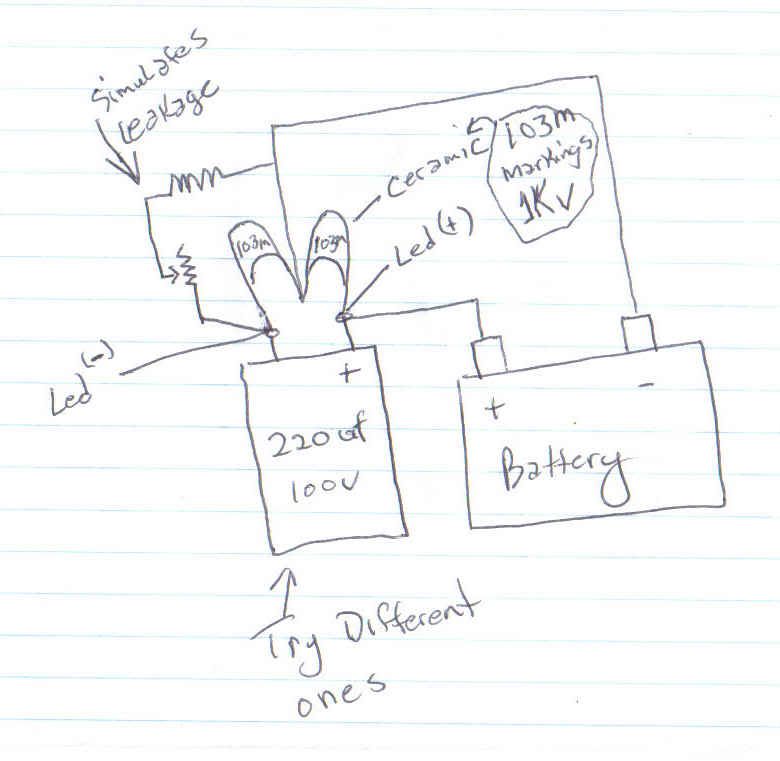
Where it says simulates leakage the total resistance is 322k plus a small pot of 100 ohms. It was all I had. I would suggest a 200k ohm hard resister with a 100-150k pot or whatever the combo would be. I can not get my setup to go down in voltage so lets see what you can do. My setup was limited.
Also from what I can see on the o scope there is a signal just like the captret. In fact it look just like it but bigger in amplitude.Leave a comment:
-
If you build it they will come!Originally posted by electricity View Post
Would you guys have believed me if i didn't make the youtube video of my captrets. Trust me, make a how to video and we will be more than happy to listen.
Leave a comment:
-
Captret powers Joule Thief (day 2)
I am testing a captret setup powering a joule thief circuit.
Here is my video YouTube - automan812's Channel
CheersLeave a comment:
-
I built one of these large capacitors. It's 4" by 18". I am not sure what to say about it. It self charges to half a volt and has around ten mA constant output. I cannot get it to hold a voltage charge like a regular capacitor. I used 50 50 antifreeze for the electrolyte. I built it exactly like a normal electrolytic capacitor so I am not sure what I did wrong. Is there a break in process that you have to do with one of these? Regardless of how it functions as a capacitor it makes a pretty cool low voltage power source as is.Leave a comment:
-
Speculation vs Tinkering
Y'all aint listening. Size matters!
Tinkering is building devises and learning, construct, observe and learn. Take what you learn and apply it to the next phase.
I told y'all that small caps ain't gonna do it, so wast away your time as it ain't mine.
I build huge electrolytic capacitors from scratch, the type that cost hundreds $ to buy, they cost a few bucks to make.
What do I use?, I told yall already. I get my Al foil and Paper from Kitchen Supply warehouse or Costco etc. I use soda cans etc for container and corrugated plastic for lid (free from election signs).
I can charge 12v lead acid and light cfl @ same time, but I aint gonna sppon feed you. Attached FilesLast edited by electricity; 11-18-2010, 07:59 PM.
Leave a comment:
-
-
The polarization...
Originally posted by ibpointless2 View Post
The polarization of the terminal to the hull for each terminal. Ones that had a positive polarity or not hooked up backwards seem to be better at this effect. I am wondering if the caps are wound differently for each type of polarity difference.
The way we are using them neg on the case and both positive and neg terminal should be positive polarity from my experiences. Just like we are using them. Of course the cap must have a light charge on the regular cap terminals. Like you I charged the cap up and then the effect shows up when checked the captret way. Ones that have differences in the polarity of voltages when measured the captret way usually will be stubborn to work in the captret fashion. Stubborn but not impossible to condition.
What I think is happening is the normal caps have two diodes already conditioned from the first energized charge they get at the factory. Some seem to loose this diode or it flips by itself. What we are doing is forcing a flip of that diode that forms between the hull and plates so that both diodes are in the same direction but different degrees. This causes a difference that the charge will build up between the hull and plates that gets boosted by the charge between the regular plates.
I have been trying to envision the flow between all the capacities and it looks like if you provide a flow on the positive plate and hull by making the hull negative that an eddy of flow forms with the negative plate and positive. This is the free flow we are using to energize the led and hence why we use zero current in that process. This is as far as I can tell.
I am trying to figure out a duplicate way we could use this in a different setup with inductors and capacitors. I think this might be the key aspect to this effect.Last edited by Jbignes5; 11-18-2010, 07:55 PM.Leave a comment:
-
I forgot to mention, around the 10-15 hour mark I realized that all the positives should be connected, and did so to all my circuits. Not much change but the LED one jumped a little. Also my marks were sporadic, some times 10 hours in between readings and other times only 15 mins... so the graphing software didn't smooth it right for me.Leave a comment:
Leave a comment: