This forum is preserved as a permanent archive. The community continues at eMedia Press.

Announcement

Collapse
No announcement yet.

Bedini Ferris Wheel Regauging Motor

Collapse
X
 
  • Filter
  • Time
  • Show
Clear All
new posts

  • John_K
    replied
    Originally posted by Aaron View Post
    Anyway, what I see here is that the more experiments are posted, the
    more that John shares.
    Hi All,

    I should have my "S1GT" running tonight, hopefully with hall switching as well. I'll post a video when it's done.

    How's everyone else going?


    John K.

    Leave a comment:


  • Aaron
    replied
    @Rubberband

    Originally posted by Rubberband View Post
    @ Aaron
    Hi I just finished resding the thread so far, feels good to be learning more about the secrets Mr. Bedini is opening minds and helping me know these things in this stage of my life. Having aq lot of fun with the riddles, wanted to ask, about your last one....are you talking about the effect that occurs when you place the north pole of a magnet to the center of a steel bar?
    Hi Rubberband,

    Interesting you mention that

    but no, it is different but related. If anyone does that experiment and
    uses a hall effect magnetic finder ALL OVER IT, please report what you
    find and why you think you find what you find. Search all over the
    magnet and bar.

    But again, what I saw is different than placing the north pole of a magnet
    to the center of a steel bar.

    Anyway, what I see here is that the more experiments are posted, the
    more that John shares.

    Leave a comment:


  • chuck H
    replied
    Pole Splitter

    @ everybody
    The pole splitter can be made! How can this be done? IT IS VERY SIMPLE. How is it done? Lets see some results...

    Leave a comment:


  • Aaron
    replied
    no vids for upload

    Originally posted by John_K View Post
    Hi Aaron,

    I don't suppose you could post a quick video?


    John K.
    Hi John,

    I don't have copies that I can upload.

    Leave a comment:


  • Rubberband
    replied
    @ Aaron
    Hi I just finished resding the thread so far, feels good to be learning more about the secrets Mr. Bedini is opening minds and helping me know these things in this stage of my life. Having aq lot of fun with the riddles, wanted to ask, about your last one....are you talking about the effect that occurs when you place the north pole of a magnet to the center of a steel bar?

    Leave a comment:


  • John_K
    replied
    Originally posted by Aaron View Post
    That was amazing to watch!

    Meter can't find it yet it affects a magnet with just as much strength
    as the opposite pole on the other end of the magnet.
    Hi Aaron,

    I don't suppose you could post a quick video?


    John K.

    Leave a comment:


  • Aaron
    replied
    just as much strength

    Originally posted by John_Bedini View Post
    he does not check it with a magnet with like poles. That is why everybody has missed it..
    That was amazing to watch!

    Meter can't find it yet it affects a magnet with just as much strength
    as the opposite pole on the other end of the magnet.

    Leave a comment:


  • Turion
    replied
    I can't believe I typed TPU....that's from something else entirely. I MEANT PMH. LOL No wonder I confused you! Maybe this will explain it. I'm D..U..M..B!

    Leave a comment:


  • Matthew Jones
    replied
    Whats a TPU? I guess I am in still in the dark.

    Matt

    Leave a comment:


  • Turion
    replied
    Interesting Matt, and I would agree.

    Now I'm way curious to see how a TPU (I meant PMH) affects an iron ring, especially if the area between the "contact points" of the TPU ( I meant PMH) is wrapped with wire. What happens to the N/S on that coil when the TPU (I meant PMH) passes coils on a rotating iron ring? Or two coils wound opposite so either North or south poles of the coils are together? Lots of things to check out.
    Last edited by Turion; 12-15-2010, 01:09 AM.

    Leave a comment:


  • Matthew Jones
    replied
    Originally posted by John_Bedini View Post
    The Rodin coils is doing it but not the same thing. you notice he does not check it with a magnet with like poles. That is why everybody has missed it..
    So if I had an Iron ring and had two coils and I energized it what would I have.
    John B
    Wouldn't you have a multi poled magnet. Say 2 north coils facing the iron ring would induce Souths at each end and a North field in the center probably directed 90 deg out or in to center. With the flux traveling at 90 deg's the tester may not be able to detect it.
    But with a solid more than than likely the flux path would stay internal to the metal used.

    Now if what you are saying is wrap the iron with 2 coils, the same would be true. The south flux would travel to the north via the iron and and the north flux would travel to the south via the air. It would appear to tester to be 2 north ends.

    But if you run a magnet into the center of the ring it still would not travel all the way through. The inside of the norths would such the north face in and it would stop in the middle. So it would be apparent that it was composed of 2 separate fields.

    I would have to say that if you can split an electrical dipole and let it run, like we do everyday it would be possible to split a magnetic one. But it seems to me that more than likely one pole is hidden by the other. Your metal is charged from the inside out. How is the question though?

    I spent some time thinking about it from previous experiments. But I have not had any success charging any metal in fashion that non linear.

    Matt

    Leave a comment:


  • cody
    replied
    Jerdee,
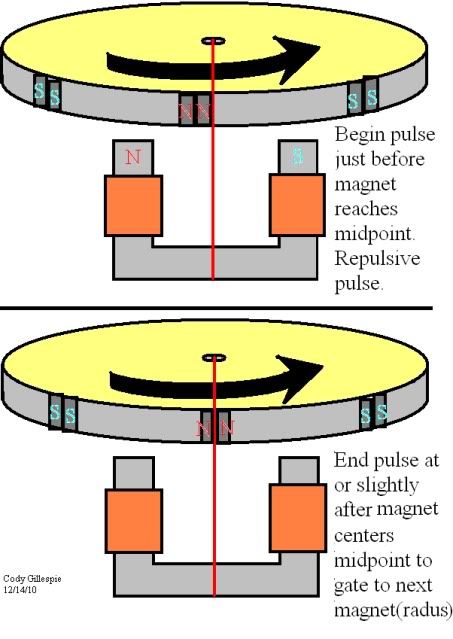
    Thanks for posting that schematic, i was looking for that exact setup, thank you. I was not at the conference so im having a hard time following what you saw on how john was switching. But i think i have a good idea on how its done. Below is a picture of what ive been doing. The point the switching should start (i believe) is just before the magnet reaches midpoint. Using a repulsive pulse going right up to midpoint or slightly after. Right at that point the next upcoming magnet should switch into the cores domain (if that makes sense) just like the radus demo. At that point the pulse ends and the magnets take over and suck themselves into the core, rotating the wheel. Then it starts all over again on the next midpoint but in the opposite polarity. Pulse width should be set as small as possible, just enough to switch the field(radus effect). By switching this way, your wheel will rotate slowly, because your not providing energy to turn the wheel, the magnets are doing the work and they work at thier own pace. This is how i see it currently but i will have a much better idea of just how well it works when i get the parts for the Bedini/Cole switch in the schematic you posted.

    In between pulses, we should be able to extract a certain percent of energy from the magnets passing the cores as well either directly with the bridge rectifier or with a shorting magneto effect.


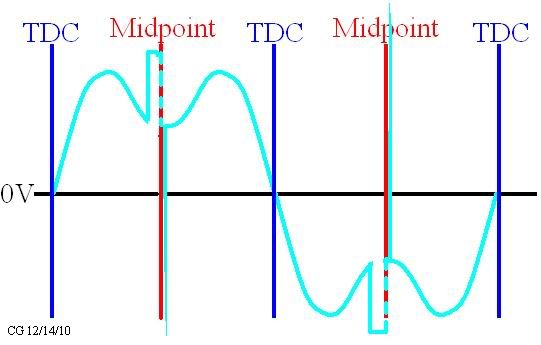
    This is what the scope shot across the coils looks like with pulse locations. My setup does not generate a perfect sign wave, so i have drawn it as it is. You can see im pulsing on both polarities.

    Leave a comment:


  • Turion
    replied
    Here is one quote we might find useful from the Davis book on magnetism...

    "Instead of a solid bar within the helix, there is an iron tube filled with wires
    of the same metal ; the tube is sawed open on one side
    throughout its whole length. By this arrangement the
    magnetism is acquired and lost with greater rapidity
    than by a solid bar."


    And something I have been thinking quite a bit about since we began this discussion...

    "It has been shown that when a galvanic current flows through
    a helix, such as De la Rive's ring, its faces acquire polarity, and if free to move,
    arrange themselves north and south."

    SO as a current passes into a coil, it "arranges" the coil to have a North and South, IF WE LET IT. How can we FORCE it to have a different arrangement, which will rearrange itself when that force goes away? We know what the benefits would be of a coil that changed polarity rapidly, so what are the methods by which we might accomplish this with little or no use of power. In the Davis book it was done with an open flame. heating the wires.
    Last edited by Turion; 12-14-2010, 06:08 PM.

    Leave a comment:


  • John_Bedini
    replied
    Bedini GT3

    Turion,
    Yes we do find quite a difference since he is talking about a Commutator with silver contacts.

    The Rodin coils is doing it but not the same thing. you notice he does not check it with a magnet with like poles. That is why everybody has missed it..

    So if I had an Iron ring and had two coils and I energized it what would I have. Think of the TPU is it not the same device and is it not started by a magnet, Magnetic Amplifier hidden from view. That is why nobody can make it, Sweet device also Magnetic Amplifier. Very easy to make the Monopole Motor that way self bias. Remember what I said it is not important to have real fast speeds. Woopy has showed this with the leds watch again how he looses the power to the leds. I could have made the motor go much faster during the conference. But then I would have lost the frequency of the energy. Chuck here at work has found out the same thing with Ricks little 3 pole kit so we are going to show you how to make it like the MonoPole 3 GT

    Jerdee very good work on all that Lucky to have you here...... You all must think out of the BOX
    John B

    Leave a comment:


  • Turion
    replied
    I have read the Davis material several times, and I believe he talks about a "Pole Changer" not a pole splitter. Quite a significant difference. Please feel free to correct me if I'm wrong. I would LOVE to be wrong!

    Leave a comment:

Working...
X