With the amount of work it takes to get one of these transformers
wound up, experimenting with wire as a core material is an endeavor
I'll be leaving to rest. Unless using professionally made toroids
composed of either ferrite or another standard core material, results
are not guaranteed... it would be pleasant to find out what the
permeability values are of a functioning BiTT.
Also it would be helpful to view a demonstration of a standalone
BiTT platform designed to be independant of complex power supply
systems and meters, running from and loop-charging a capacitor
while also connected to a Load.
-
Have you tried florist wire, its iron enamel coated, would be cheap and worth a shot.
daveLeave a comment:
-
 Guest repliedFortunately the system performs to indicate that this
particular range of steel does not have enough permeability.
What would be a suitable reluctance value for the primary cores?Leave a comment:
-
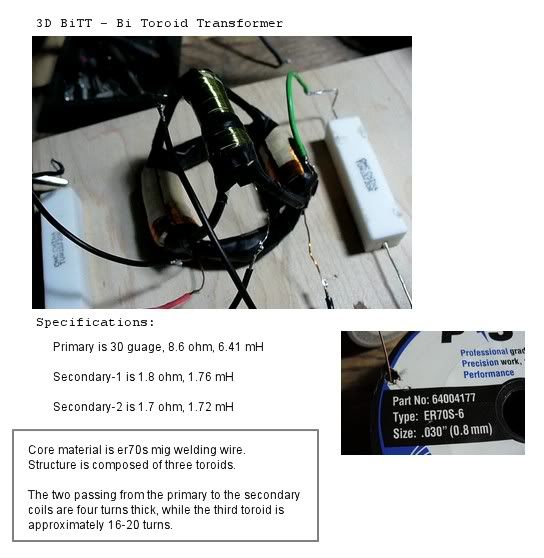
Guest replied3D BiTT
In going with the designs posted from Feb. 13th, the new
transformer is up and running. Shown as follows, it is
constructed with silicon - manganese steel alloy.
[ Performance Video ]
Leave a comment:
-
Guest repliedThe tri-toroid configuration looks workable... as for this
black wire version, it's ability to transfer magnetic flux
seems to be lacking in a big way.
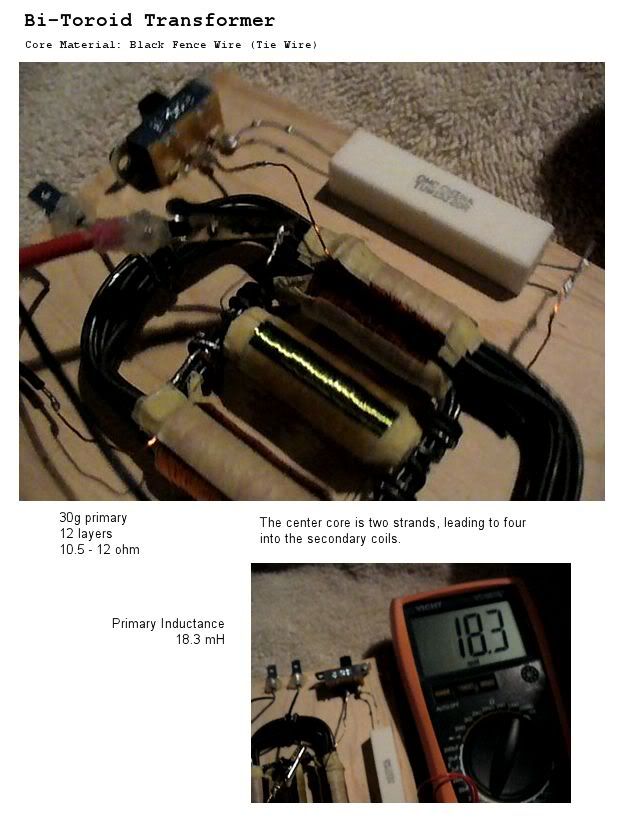
The following is my report after rewinding the primary. Having
used masking tape between the layers, an inadvertant connection
has left it a bit darkened from heat. Thankfully caught in time
to avoid producing flames, the coil has shown to be resilient.
After connecting it through a variac it has shown to have
better performance than the previous one, although does not
yet look to produce a gain in energy.
The primary core of two wires is secured to the inner toroid
of four wires by bending each sideways and then wrapping around
it with another wire. This method may be partially responsible
for the transfer performance, versus having one continuous
pathway from the primary core into each secondary coil.
It would have been extraordinary to wind this primary coil
in place between the two secondaries with the mass of wire
that it took.
Perhaps spot-welding it would improve things a little... ?
Leave a comment:
-
2D/3D BiTT & Rings BiTT
I think that 3D design would work when comparing essentially the same thing in 2D.Originally posted by broli View Post

It's basically two small rings inside one large ring.

I wonder if the rings couldn't be built out of iron wire.
Regards,
VidbidLast edited by vidbid; 02-14-2012, 06:52 AM.Leave a comment:
-
A 3d BiTT could be build using off the shelves transformer cores. I've seen a similar design before but you could use 3 identical toroidal transformer cores to do the job. They could be silicon steel, nanoperm, metglass...toroids or a combination of them. All experiment I saw deal with mW ranges surely that could be scaled up?Last edited by broli; 02-13-2012, 11:39 AM.Leave a comment:
-
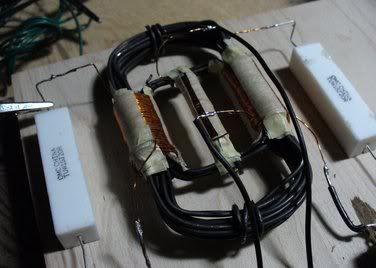
Guest repliedBlack Wire BiTT
[ Performance Video ]
Primary: .9ohm, 3 layers 25g
Secondary 1: 1.7ohm, 3.57mH, 5 layers 25g
Secondary 2: 1.8ohm, 4.14mH, 5 layers 25g
Variac used with 120VAC outlet.
Results show,
10ohm resistor into primary reads ~ 2.165 VAC
Loading the secondaries does not seem to effect it.
20ohm output resistor reads .065 VAC when both
secondary coils are connected and .063 VAC with one.
Obviously these figures do not represent the correct outcome,
and I'd like to question why this is so. Upon viewing
woopyjump's favorable demonstration of his black wire BiTT,
the only noticeable difference seems to be the much
greater impedance of his primary.
Would then increasing the impedance of my primary coil cause
a resultant leap in output? Have I mistakenly used the wrong
type of black wire? What else could be going wrong?
Leave a comment:
-
Guest repliedOutput Examination
The following video will show running values from the same
transformer as in the other two I've posted, only this time
the meters are connected directly through the primary and
secondary coils to measure AC while a 47nF capacitor is
turned on and off from the circuit. The resonation of energy
with a capacitor seems to produce a desireable effect on the
output, running from a 12V laptop adapter.
I've omitted the mig-wire decoupling cores due to their
apparent non-functionality. They will actually decrease
the output values once in place.
[ Transformer Output Experiment ]
Leave a comment:
-
Guest repliedDave45,
The core materials I've used are ferrite and er70s mig welding wire.
In woopyjump's version of the BiTT, the output is enough that it
will power lightbulbs.
[ BiTT Power Factor 3 by woopyjump ]
---------------------------------------------------------
The input to the primary of the DC-pulsed BiTT from my video was at
roughly 1.25V through 20ohms or 78mW, while the output was at 144mV or 1mW.
When driving the primary with the following resonator circuit there
was an input of 12.5V and 96mA or 1.2W, while the output being 600mV
on a 20ohm was .018 Watts.
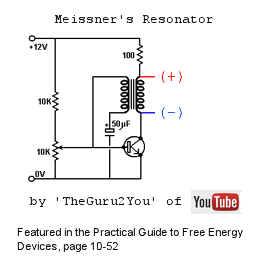
[ Video: Bi-Toroid Transformer Resonating ]Last edited by Guest; 02-02-2012, 08:48 AM.Leave a comment:
-
I believe its a third coilOriginally posted by geotron View Post
Your doing some interesting work, great vid, what are you using for a core, Im haveing the same problem finding core material,
I went yesterday and bought some three quarter weld grade round stock, would rather have ferrite or metglas but we do what we can.
daveLeave a comment:
 It looks as though my question has already been
Leave a comment: