Announcement

Collapse
No announcement yet.

Peter Daysh Davey Water Heater Query

Collapse
X
 
  • Filter
  • Time
  • Show
Clear All
new posts

  • Slovenia
    replied
    60 Hz

    Chet,

    Contact said to tune the cup to 60 Hz and the mains would take care of the 300 Hz through the ring.

    Slovenia

    Originally posted by RAMSET View Post
    Wrtner
    You say 300hz?
    Slovenia's contact mentioned 300hz!

    I don't pretend to understand these things,.......so I can try tuning for 300hz and still feed it 60hz to run it??

    Is that what you mean Wrtner?
    Thanks
    Chet

    Leave a comment:


  • RAMSET
    replied
    300hz???????????

    Wrtner
    You say 300hz?
    Slovenia's contact mentioned 300hz!

    I don't pretend to understand these things,.......so I can try tuning for 300hz and still feed it 60hz to run it??

    Is that what you mean Wrtner?
    Thanks
    Chet

    Leave a comment:


  • wrtner
    replied
    Originally posted by Slovenia View Post
    Has anyone had any luck tuning an aluminum can to either 50 or 60 Hz?

    I need a better signal from the internet for my 60 Hz beat.
    I am sure you have no hope of tuning a beer can. It would have to be
    the size of a small dustbin to ring at such a fantastically low frequency.

    You need either a very big can or to tune the can you have to a higher
    octave, 100hz, 200hz or 400hz (the last one being what Peter Davey used).

    (You could go into a music shop and ask to hear a bass guitar. Three
    frets up the thickest string is approximately 50-60 hz. Three frets up
    the smallest string on a regular guitar is about 400hz).

    As for the tuning signal, the best is the mains itself. Do you have a cheap
    noisy transformer? That will give you the note. Alternatively, get a cheap
    loudspeaker out of a dumped TV, connect a heavy resistor in series,
    and plug it across your mains. (Be very careful here and take advice from
    your local electronics shop. This way, you are tuning to what your mains
    actually is. The real McCoy).

    Paul-R

    Leave a comment:


  • Slovenia
    replied
    Cutting Method

    This can cutting is a lot easier than we were figuring it would be. I just used a pair of nice tin snips to cut my can and the cut came out very true. I just marked where I wanted to cut and put some painter's masking tape on the can to mark with the outer edge of the tape where I was going to cut the can. The tape made it really easy to see where I needed to cut and also kept the can from deforming. I didn't need to sand anything. I removed the tape from the can and then went around the inner edge of my can while placing it against a metal table with the end of my tin snips. I just turned the can while pushing the tin snips against the inner edge of the can to flatten it consistently all around the top edge of the can. It worked perfectly and made a very true edge for me. Try it and see how it works out for you.

    I tried using a smaller diameter V8 can and was never able to reach resonance with it. I was hoping to be able to use the smaller diameter can because the aluminum in it was a little more rigid than that of the pop can, plus it was a much cuter little can, and more the size of can I was looking to experiment with.
    Last edited by Slovenia; 09-16-2011, 10:01 PM. Reason: enhanced info.

    Leave a comment:


  • Slovenia
    replied
    Tuning Success

    Well, I've finally got a standard sized American 12 oz. pop can to resonate at 60 Hz. I had to cut the top of the can off 3.5" from the true bottom of the can but it does resonate now at 60 Hz. I hung a nail from the ceiling on a nylon fish line and had the nail barely touching the can. I placed one of my speakers right next to the can about 1" away from the side of the open sided pop can and hit it with 60 Hz. It resonated a little after being hit. I may need to tune it a little more, but it was a bear finding this cut position, so I might just go to the next step with the ring and try it.

    Any thoughts?
    Last edited by Slovenia; 09-16-2011, 09:45 PM. Reason: typo correction

    Leave a comment:


  • Slovenia
    replied
    Nice

    That baby would wake the dead. It might work for what I need without the gong. Thanks for sharing!!

    Originally posted by MonsieurM View Post
    Not sure this fits, but heck, bring the mountain ....

    Federal Signal 504-120 Bell, 120 Vac @ 60 Hz V


    Bell, Voltage Rating 120 VAC @ 60 Hz, Current Rating 0.08 Amp, Signal 98 dB @ 10 Feet, Height 4 Inches, Depth 2 1/8 Inches, Width 4 Inches, With Gong

    Leave a comment:


  • MonsieurM
    replied
    Not sure this fits, but heck, bring the mountain ....

    Federal Signal 504-120 Bell, 120 Vac @ 60 Hz V


    Bell, Voltage Rating 120 VAC @ 60 Hz, Current Rating 0.08 Amp, Signal 98 dB @ 10 Feet, Height 4 Inches, Depth 2 1/8 Inches, Width 4 Inches, With Gong

    Leave a comment:


  • Slovenia
    replied
    Tuning can query

    Has anyone had any luck tuning an aluminum can to either 50 or 60 Hz? I'm having a heck of a time trying to tune one to 60 Hz. I need a better signal from the internet for my 60 Hz beat. Mine is to short and sweet. Does anyone have a long drawn out 60 Hz beat? Thanks!!

    Leave a comment:


  • Slovenia
    replied
    Thanks!!

    Ah, Thanks Wrtner!!


    Originally posted by wrtner View Post
    No, this is not so.

    The figures come from your particular electricity supplier and
    is genrally the same for every country.

    For instance:
    in the USA, electricity is, indeed, 60Hz and 120volts
    in the UK, electricity is 50Hz and 50 volts.

    That is how it is in those two territories.

    But some countries could supply 250 volts at 60Hz or
    alternatively 120 volts and 50Hz. It depends on the
    electricity generating companies.

    Leave a comment:


  • wrtner
    replied
    Originally posted by Slovenia View Post
    How do we figure the frequency for various voltages such as but not limited to 12 volts?

    I know 120 volts is 60 Hz and that 230 volts is 50 Hz
    No, this is not so.

    The figures come from your particular electricity supplier and
    is genrally the same for every country.

    For instance:
    in the USA, electricity is, indeed, 60Hz and 120volts
    in the UK, electricity is 50Hz and 50 volts.

    That is how it is in those two territories.

    But some countries could supply 250 volts at 60Hz or
    alternatively 120 volts and 50Hz. It depends on the
    electricity generating companies.

    Leave a comment:


  • Slovenia
    replied
    Frequency Query

    How do we figure the frequency for various voltages such as but not limited to 12 volts?

    I know 120 volts is 60 Hz and that 230 volts is 50 Hz. But, I don't know how to figure it. Thanks in advance!!

    Leave a comment:


  • RAMSET
    replied
    Very happy your here!!

    we the people

    Thanks for the analysis and the queries ,you help bring focus to this !!

    I am glad for your comment on Tuning the length !!
    This is what I will try First!

    Thanks
    Chet

    Leave a comment:


  • WeThePeople_USA
    replied
    I scrolled up to reference one of the pics in the last post,
    and was left with a nagging sensation of missing info,
    so I left that out, and then went back and read ALL posts.

    First, I see some of the files I have posted
    have already been shared, sorry 'bout that...

    I will hold back until I have real copies from the NZ archive.


    Now about the pic we are supposed to be working from.

    I see a tuning fork essentially, abiet a cylindrical one.

    Reference the YouTube video of a crystal glass being shattered
    with high-power audio captured with a high-speed camera
    to see what the can will be doing while in use and resonating.

    Then rethink the gap between the ring and the can so it cannot touch !

    An insulated band on the ring's ID as a stop-gap measure at least.


    But that was not the nagging aspect, the lack of TWO complete paths was.

    Please remove the cathode/anode designators, this is an AC circuit,
    and the complete paths for both sources have been overlooked.

    There is no inlet tube extending into the open topped can to near the bottom of the can
    forcing the water to pass through the inside of the can back to the top to meet an outlet.

    What is shown is a water flow path that is outside of the can instead.

    The former should be considered as an improvement later perhaps.


    But the lack of a return path on two different circuits is what bothers me.

    Where does the 120-VAC neutral return go ?

    Back on page one I get the impression that the external container/vessal
    is the second conductor, and the current flows from can to vessal wall.

    Reference:
    http://www.energeticforum.com/renewable-energy/8999-peter-daysh-davey-water-heater-query.html#post155864

    "Grounding is the entrance to the exit of water and boiler water from a plastic tube separated from the plastic that goes into the radiator."

    Yeah, that translation makes my skin crawl too, heheh...

    But it would make sense for the outer vessal to be neutral,
    the can to be either L1 or L2 @ 120-VAC off of the mains.

    That would also help stop the steam-style radiators an/or baseboard heaters
    used to radiate the heat into the living space from becoming shock hazards...

    The water would flow between the "Hot" can
    and the "Neutral" vessal all is assembled in.


    Then there is the matter of applying the 300/400/480-hz,
    that seems like incomplete path #2 to me.

    What is the common lead of that signal source referenced to ?

    Is the potential difference between the can and ring,
    or between the neutral vessal the the ring... sigh ?


    And lastly, and I swear I'm trying to be helpful,
    (but it can be interpreted as project-bashing sadly
    because text in a forum has no audible acuity clues)
    the whole "sanding the can" thing is just sad, heheh.

    In the case of a thick brass bell,
    you would be able to sand the thickness.

    But in the case of the aluminum can here,
    you would be adjusting It's LENGTH by trimming.

    A pair of sheetmetal shears, or with todays ubber-wimpy beer cans,
    a pair of disposable scissors to trim a little at a time would suffice.

    And whom is drinking beer out of 2.1-mm dollhouse-thimble's anyway ?

    Thats barely over 1/8th inch american measure,
    and just over 13/16th inches if it was centimeters.

    Heck, even 2.1 inches is too small to even be a chick-beer,
    it is more like one of those smaller cans of red bull really.


    Then there is the matter of the "Tuning" of the can in question
    in the gaseious-fluid that we know as air, or the liquid called water.

    The resistance of the water does dampen resonance of course,
    but also changes the resonance frequency via same said damping.

    So if the application is to be underwater,
    it stands to reason the "Tuning" should be too, right ?

    The mounting bolt/terminal to be used would have to be in place,
    and the exact vessal to be used would need to be employed too.

    All these variables will effect the tuning proceedure greatly.


    So, we need to know:
    1 - Where do BOTH mains connections go ?
    2 - Where do BOTH 300/400/480-hz leads go ?
    3 - "Tune" can to length in or out of water ?

    I like the piezo idea as far as being the second interactive source if it is a non-magnetic interaction,
    but the simplicity and cost savings of using just an adjusted "Ring" instead wins out so far though.

    .
    Last edited by WeThePeople_USA; 09-14-2011, 01:47 PM.

    Leave a comment:


  • MonsieurM
    replied
    Originally posted by WeThePeople_USA View Post

    That is were many will have different points of thought on this,
    some will say it is the same field, I disagree humbly.

    If an external field induces a magnetic flow in the aluminum,
    and the aluminum then generates It's own eddy currents,
    which then as a result of those currents, make yet another field.


    I said all that to say this...

    If the level of current in the aluminum from the 50/60-hz mains
    is causing the can(s) to generate a magnetic field already,
    then that field is already acting on the ring before anything is applied to it.

    If what your applying to the ring is a secondary frequency different from the mains,
    then you will be creating a third frequency via beat frequency mixing,
    and the harmonics of all three together at same time too.

    So, is the ring adding and subtracting to the field in the can(s) magnetically,
    or are we dealing with a electrostatic field potential interaction instead ?

    Test results with the ring bare, then insulated, should yield that answer.


    I m thinking along the same line, water currents do the same thing

    Leave a comment:


  • MonsieurM
    replied
    WeThePeople_USA you are correct, safety always comes first

    Only experience would yield answers

    now it's pure speculation:

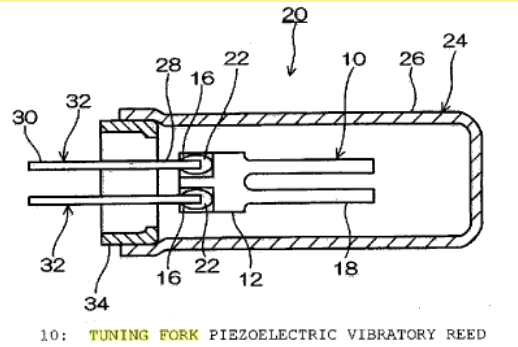
    do you think a bigger version of this would be safer:

    Tuning fork type piezoelectric resonator

    [IMG][/IMG]

    Last edited by MonsieurM; 09-14-2011, 12:01 PM.

    Leave a comment:

Working...
X