-
Information Sources for Thane Heins/Potential Difference Inc.:
Thane Heins Patents:https://patents.justia.com/inventor/thane-c-heins
Slideshare Account #1
https://www.slideshare.net/PDiCEOTha.../presentations
https://www.slideshare.net/PDiCEOTha...3240/documents
Slideshare Account #2
Slideshare Account #3
https://www.slideshare.net/ThaneNEWE...UEPR/documents
https://www.slideshare.net/ThaneNEWE.../presentations
Youtube Account #1
https://www.youtube.com/channel/UCQe...0jdgg/featured
Youtube Account #2
Youtube Account #3
https://www.youtube.com/channel/UCBs...aXNJ0x_g_ZTEew
Potential +/- Difference Inc. – Pioneering Electric Vehicle Regenerative Acceleration Technology &
Charging Ahead…
Leave a comment:
-
https://slideplayer.com/slide/4783242/
30 When the Bi-Toroid transformer is placed on load the secondary induced fluxes DO NOT enter the primary core leg due to its higher reluctance (magnetic resistance). Instead Secondary 1’s flux enters Secondary 2 and vise versa and the coils self regulate their own voltages across the loads. Real power is delivered to the loads. Primary Real Power = 0 Watts.
31 Demo Test # 4 Bi-Toroid vs. Conventional Transformer PERFORMANCE COMPARISON SUMMARY Transformer Type No Load On Load Conventional Primary draws Primary draws Transformer reactive power real power power factor mirrors load Bi-Toroid Primary draws Primary draws Transformer reactive power reactive power power factor ignores load
32 Demo Test # 5 New Bi-Toroid Transformer Design & Performance Tests July 11, 2009 The next generation Bi-Toroid Transformer design includes an additional secondary core, which provides another secondary coil induced flux path route – keeping it away from the primary core.
33 Demo Test # 5 New Bi-Toroid Transformer Design & Performance Tests July 11, 2009 Performance Data Primary Input Voltage = 58.8 volts Primary Input Current = 0.017 amps Primary Power Factor = 85 degrees / 0.087 Primary Input Power = 87.1 mWatts
34 Demo Test # 5 New Bi-Toroid Transformer Design & Performance Tests July 11, 2009 Primary voltage and current sine waves Pf = 85 degrees or cos85 = 0.087 Each mark on the X axis = 6.92 degrees (x 26 = 180 degrees)
35 Demo Test # 5 New Bi-Toroid Transformer Design & Performance Tests July 11, 2009 Performance Data Primary Input Voltage = 58.8 volts Primary Input Current = 0.017 amps Primary Power Factor = 85 degrees / 0.087 Primary Input Power = 87.1 mWatts Secondary Load = 27 ohms Secondary Load Voltage = 3.1 volts Secondary Output Power = 356 mWatts Transformer Efficiency = 409%
36 Potential +/- Difference Inc. Christopher Napior V.P. Business Development Potential Difference Inc. 613.292.7730 office 613.692.2220 fax [email protected]
 Last edited by BroMikey; 03-28-2022, 04:14 AM.
Leave a comment:
-
1 Potential +/- Difference Inc. Regenerative Acceleration Generator Technology Demonstration University of Ottawa Lab
2 Demo Test # 1 Conventional Generator vs. Regenerative Acceleration Generator Technology The Regenerative Acceleration Generator is very similar to any conventional generator but it also employs extra high voltage coils to counteract and reverse the effects of armature reaction (or Lenz’s Law) inside the generator.
3 Demo Test # 1 Conventional Generator vs. Regenerative Acceleration Generator Technology When the Regenerative Acceleration Generator delivers power to the same load (light bulb) NOW the generator causes the motor to accelerate. Now the motor is consuming the least power while the generator is delivering the maximum power. Rotor speed is maximum at 3500 RPM. When a conventional generator delivers power to a load (light bulb) the generator causes the motor (prime mover) to decelerate. In the above photo the motor is consuming the maximum power but delivering virtually no power. Rotor speed is only 100 RPM.
4 Demo Test # 1 Conventional Generator vs. Regenerative Acceleration Generator Technology INPUT POWER REDUCTION = 41% OUTPUT POWER INCREASE = 373% The Regenerative Acceleration Generator has the proven ability to increase generator output energy by more than 373% over a conventional generator while at the same time decreasing motor input energy by 41%.
5 Demo Test # 2 Regenerative Acceleration Generator Optimization Further Regenerative Acceleration Generator developments include the optimization of the high voltage coils to deliver increased generator output power with system acceleration and the elimination of the high current coils.
6 Demo Test # 2 Regenerative Acceleration Generator Optimization NO LOAD CONDITION At full speed and with no load on the generator the system’s steady state speed is 3433 RPM. The prime mover is consuming 166 Watts. The generator is turned off and delivering 0 Watts.
7 Demo Test # 2 Regenerative Acceleration Generator Optimization ON LOAD CONDITION Now the generator is turned on, delivering 31 Watts to the load (light bulbs). The generator has accelerated the motor 11 RPM up to 3444 RPM from the no load speed of 3433 RPM. The motor input power has decreased by 6 Watts down to 160 Watts from the previous 166 Watt no load condition. Currently only two coils are employed but the rotor can accommodate at least 33.
8 Demo Test # 3 Regenerative Acceleration Generator vs. Conventional Generator Now a conventional generator coil has been added (gold & green coil). The conventional generator coil is mounted on the opposite side of the rotor and employs 6 poles (magnets). We will compare the conventional generator reaction to loading vs. the regenerative acceleration generator performance.
9 Demo Test # 3 Regenerative Acceleration Generator vs. Conventional Generator NO LOAD CONDITION Motor Power = 282 Watts Steady State Speed = 3283 RPM
10 Demo Test # 3 Regenerative Acceleration Generator vs. Conventional Generator ON LOAD CONDITION CONVENTIONAL GENERATOR Conventional generator delivers 6.4 Watts to the load (light bulb). Motor power consumption increases 10 Watts to 293 Watts. Speed decreases 21 RPM to 3262 RPM.
11 Demo Test # 3 Regenerative Acceleration Generator vs. Conventional Generator ON LOAD CONDITION CONVENTIONAL GENERATOR and PEREPITEIA GENERATOR Both conventional generator and regenerative acceleration generators are now delivering power to their loads. Conventional generator delivers 6.4 Watts Regenerative acceleration generator delivers 37.4 Watts Motor power has decreased 19 Watts down to 274 Watts Speed has increased 49 RPM up to 3311 RPM.
12 Demo Test # 3 Regenerative Acceleration Generator vs. Conventional Generator CONVENTIONAL GENERATOR OFF LOAD PEREPITEIA GENERATOR ON LOAD. Now the conventional generator has been turned off. The regenerative acceleration generator output increases to 39 Watts. Motor power decreases 15 Watts down to 259 Watts. Speed increases to 3334 RPM.
13 Demo Test # 3 Regenerative Acceleration Generator vs. Conventional Generator PERFORMANCE COMPARISON SUMMARY Conventional generator on load alone delivers an output 6.35 Watts with a corresponding prime mover power input increase of 4% or 11 Watts. Regenerative acceleration generator and conventional generator on load deliver a combined output of 43.8 Watts with a prime mover input reduction of 19 Watts. This represents a 589% output power increase with a 6.5% input power decrease. Regenerative acceleration generator alone delivers a 498% output power increase over the conventional generator alone with a 11.6% decrease in prime mover input.
14 Demo Test # 3 Regenerative Acceleration Generator vs. Conventional Generator PERFORMANCE COMPARISON SUMMARY Generator Type Output Power Armature Reaction Input Increase / Decrease Conventional 6.35 W 11 Watt Generator Increase Regenerative 43.8 W 19 Watt Acceleration Decrease Generator (589% output power increase with a 6.5% input power decrease over the conventional generator)
15 Potential +/- Difference Inc. Bi-Toroid Transformer Technology Demonstration University of Ottawa Lab
16 Demo Test # 4 Bi-Toroid vs. Conventional Transformer Conventional transformer NO LOAD. Coil current = 71 mA Power factor = 0 Load voltage = 0 volts
17 Demo Test # 4 Bi-Toroid vs. Conventional Transformer Conventional transformer ON LOAD. Coil current = 139 mA Power factor = 1 Load voltage = 3.6 volts
18 Demo Test # 4 Bi-Toroid vs. Conventional Transformer Bi-Toroid Transformer NO LOAD. Coil current = 130 mA Power factor = 0 Load voltage = 0 volts
19 Demo Test # 4 Bi-Toroid vs. Conventional Transformer Bi-Toroid Transformer ON LOAD. Coil current = 130 mA Power factor = 0 Load voltage = 1.6 volts
20 Demo Test # 4 Bi-Toroid vs. Conventional Transformer ON LOAD NO LOAD ON LOAD Conventional Transformer Bi-Toroid Transformer Bi-Toroid Transformer Power Factor = 1 Power Factor = 0 Power Factor = 0
21 Demo Test # 4 Bi-Toroid vs. Conventional Transformer Primary Coil Current and Power Factor Comparison Conventional Conventional Bi-Toroid Bi-Toroid Transformer Transformer Transformer Transformer NO Load ON Load NO Load ON Load Current 71 139 130 130 mA Power 0 1 0 0 Factor
22 Demo Test # 4 Bi-Toroid vs. Conventional Transformer Bi-Toroid Transformer NO LOAD Bi-Toroid Transformer ON LOAD The above photo-data show the power factor (Pf) of the Bi-Toroid transformer with an increased 18.5 input voltage. The power factor is virtually unchanged.
23 Demo Test # 4 Bi-Toroid vs. Conventional Transformer Although it is hard to believe the above left close up scope shot is the Bi-Toroid NO LOAD and the right is ON LOAD. There is a slight 25% increase in primary coil current (100 mA) with the higher input voltage although the power factor is virtually zero.
24 Demo Test # 4 Bi-Toroid vs. Conventional Transformer Conventional Transformer ON LOAD With an increased 18.5 volt input to the primary coil, the conventional transformer’s purely resistive load dictates the primary coil’s power factor of 1 and the primary current quadruples.
25 Demo Test # 4 Bi-Toroid vs. Conventional Transformer In the conventional transformer, the primary coil delivers flux to the secondary coil via the transformer’s ferromagnetic core. A voltage is induced in the secondary coil. On no load, the primary coil’s voltage and current are 90 degrees out of phase and only reactive power exists in the primary coil. Primary Real Power = 0
26 Demo Test # 4 Bi-Toroid vs. Conventional Transformer When the secondary coil is placed on load, current flows in the coil. This current produces a secondary induced flux (blue) which couples back to the primary coil. This secondary flux reduces the primary coil’s impedance (AC resistance) and more source current enters the primary coil. The increase in primary current increases the primary flux (red) and this flux increase maintains the voltage across the load. The load power factor is transferred back to the primary and now real power is consumed in the primary coil.
27 Demo Test # 4 Bi-Toroid vs. Conventional Transformer
28 In the Bi-Toroid transformer the primary flux is divided between the two secondary coils – Secondary 1 and Secondary 2. Voltages are induced in both secondary coils. The primary coil’s voltage and current are 90 degrees out of phase and only reactive power exists in the primary coil. Primary Real Power = 0 Watts.
29 Demo Test # 4 Bi-Toroid vs. Conventional Transformer
Leave a comment:
-
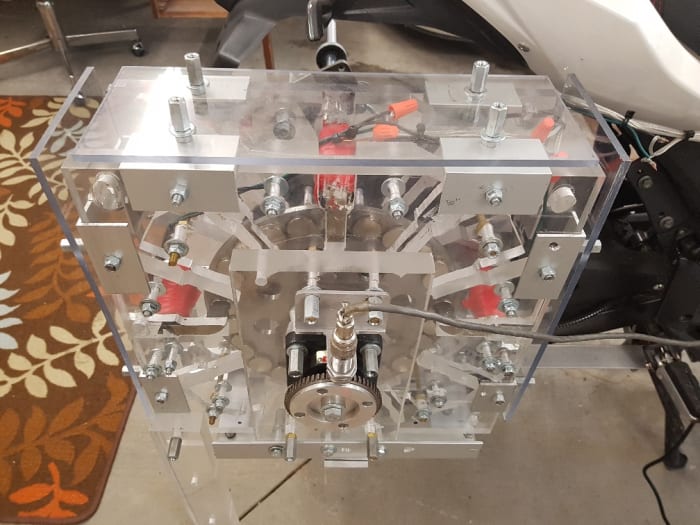
2 larger coils and one smaller. The 2 larger coils produce 5.4amps & 4.8amps while the smaller coil = 2.7amps. at one RPM in one test. Comparing the case width and tire you can see that these coils are not little.


Leave a comment:
-
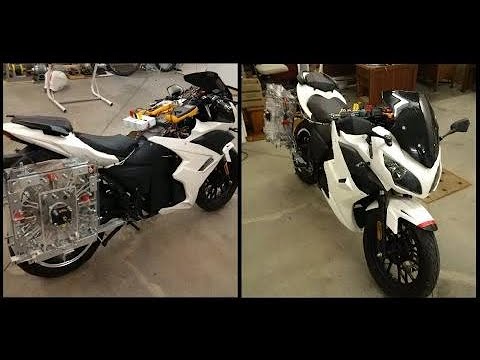
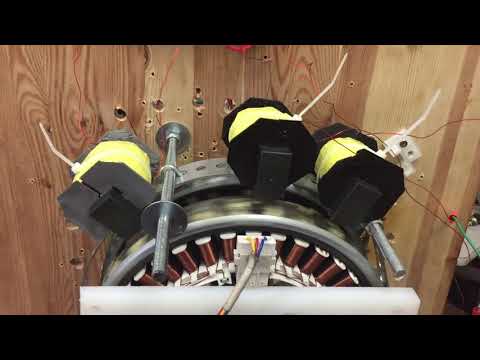
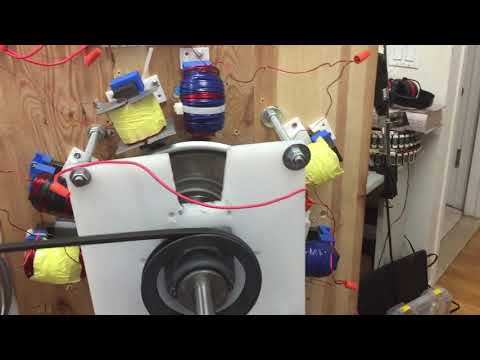
E-bike demo with (always) 3 coil each capable of 5 amps apiece delivering 13.6amps (in this case) @ approx 70vdc = 950w while the drivetrain sings, battery voltage is stable. In an earlier test 2 coils were used and the bike voltage dropped over time to 66vdc so 3 coils worked best with no rider, for unlimited range.
One coil is measured at 5.4amps another at 4.8amps and so on. These coils operate at (or near) 5amp@70vdc so multiple 5X70=350w each
 Last edited by BroMikey; 03-27-2022, 07:31 PM.
Leave a comment:
-
by Aaron Murakami
2022-03-12
Thane Heins contacted me to present his RegenX Motor and Generator technology with a claim of infinite COP. I’m aware of his work over the years, the claims, etc. and I will reserve judgement on the validity of such claims. My condition is that he allows me to pick my own experts to independently measure/validate […]

 Last edited by BroMikey; 03-26-2022, 12:30 AM.
Leave a comment:
-
Bill Alek "BiTT" "SFT" bi-toroid or split phase transformer, as you wish
Phase conjugate
http://intalek.com/ActiveVacuum/ActiveVacuum.htm


 Last edited by BroMikey; 03-25-2022, 02:35 PM.
Leave a comment:
-
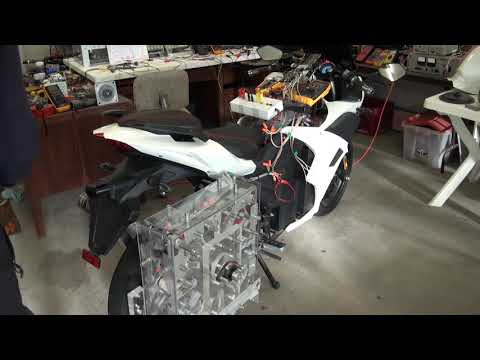
For openers misrepresentation because the e-bike drive train was shuttering all over with kinetic and the recharge current keeping the packs full at 13amps@70vdc=910watts.Originally posted by Turion View Post
How is that 40w? And you should know that. Why not wish him well? You need to go and sit thru the lesson.
Come on Dave give everybody a break. Who knows maybe Thane will be the first guy since Tesla to make any real money on this stuff without loosing his head.
Amp draw for 3 coils (not 4) at minute 8 going to a 70volt pack.Originally posted by Turion View Post
Where does Thane show 10 watts per coil? He doesn't. You are jealous bro. I know I am GO THANE
 Last edited by BroMikey; 03-24-2022, 09:59 PM.
Leave a comment:
-
40 watts is what THANE says in the video. So how is quoting HIM misrepresentation or spiteful? Before you accuse someone of something you should be sure you know what you are talking about.Leave a comment:
-
For openers misrepresentation because the e-bike drive train was shuttering all over with kinetic and the recharge current keeping the packs full at 13amps@70vdc=910watts.Originally posted by Turion View Post
How is that 40w? And you should know that. Why not wish him well? You need to go and sit thru the lesson. Come on Dave give everybody a break. Who knows maybe Thane will be the first guy since Tesla to make any real money on this stuff without loosing his head.
Originally posted by Turion View PostLast edited by BroMikey; 03-24-2022, 09:30 PM.Leave a comment:


Leave a comment: