This forum is preserved as a permanent archive. The community continues at eMedia Press.

Announcement

Collapse
No announcement yet.

Open discussion for projects on this forum.

Collapse
X
 
  • Filter
  • Time
  • Show
Clear All
new posts

  • Ufopolitics
    replied
    Hello Dear Shylo

    Originally posted by shylo View Post
    Hello,
    I've been following your work quite closely,I think I see what your doing.
    I'm not sure how this resembles your work though
    I do have a question about spherical rotors though. In fig #3 in post #53, the picture shows sections of the sphere, Q: If there were 4 sections , 2 north ,2 south, the magnetic field strenght would be more concentrated at the axis or poles???
    I built a sphere magnet rotor about 2 years ago ,but could never get anything out of the coils I wound, I was winding from top axis to bottom axis,way tooo much resistance..
    Do you feel that using steel in the build is bad?
    I think it is, because any time I held coils in my hand, some with steel some not ,the steel always created a drag=less work.
    No??
    shylo
    Hello Shylo,

    Oh that is great Shylo!
    Now, this does not reflects my work at other thread Dear, I was trying to show Citfta that there are Motors out there, that do certain operations not necessarily related to just one Axis...but in the three known so far.

    This came up from an above post,where my Statement was cited here by Citfta...and it was related to Quaternion Motors in my other Asymmetrical Machines Thread...

    I have developed Servo Motors for Robotics app's...and I also mentioned that in that statement...

    Now related to your question(s)...

    The way you lay the Magnetic Field Pattern, according to your coils design...it will lead you to very interesting discoveries...It is not just about two north and two south poles...there is more to just that...

    where are they "aiming" towards?(How are their projections set?)
    what are their angles of intersections?
    Which one is "the predominating field" in the whole set?

    There are so many ways to set just two magnets...between them...and each way will show a different pattern...

    Everything relates to just that specific development, my dear friend..."Magnetic Patterns"...They are above anything else as we all know now...just because everything we observe...depends upon them, as they come from them.


    Regards


    Ufopolitics

    Leave a comment:


  • shylo
    replied
    @ Ufo

    Hello,
    I've been following your work quite closely,I think I see what your doing.
    I'm not sure how this resembles your work though
    I do have a question about spherical rotors though. In fig #3 in post #53, the picture shows sections of the sphere, Q: If there were 4 sections , 2 north ,2 south, the magnetic field strenght would be more concentrated at the axis or poles???
    I built a sphere magnet rotor about 2 years ago ,but could never get anything out of the coils I wound, I was winding from top axis to bottom axis,way tooo much resistance..
    Do you feel that using steel in the build is bad?
    I think it is, because any time I held coils in my hand, some with steel some not ,the steel always created a drag=less work.
    No??
    shylo

    Leave a comment:


  • Ufopolitics
    replied
    Originally posted by citfta View Post
    Hi Ufo,

    Those are some pretty unique motors. Thanks for sharing.

    Regards,
    Carroll
    ...Just like Mines...Dear ...?

    All My Pleasure Carroll


    Ufopolitics
    Last edited by Ufopolitics; 07-31-2012, 02:21 AM.

    Leave a comment:


  • citfta
    replied
    Quite unique motors

    Hi Ufo,

    Those are some pretty unique motors. Thanks for sharing.

    Regards,
    Carroll

    Leave a comment:


  • Ufopolitics
    replied
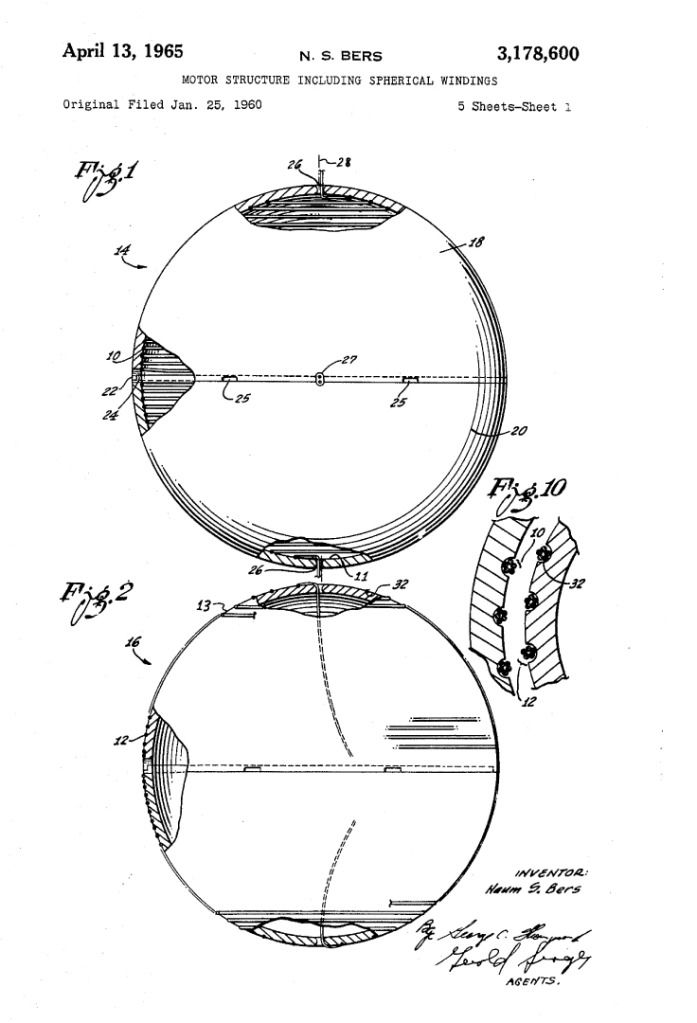
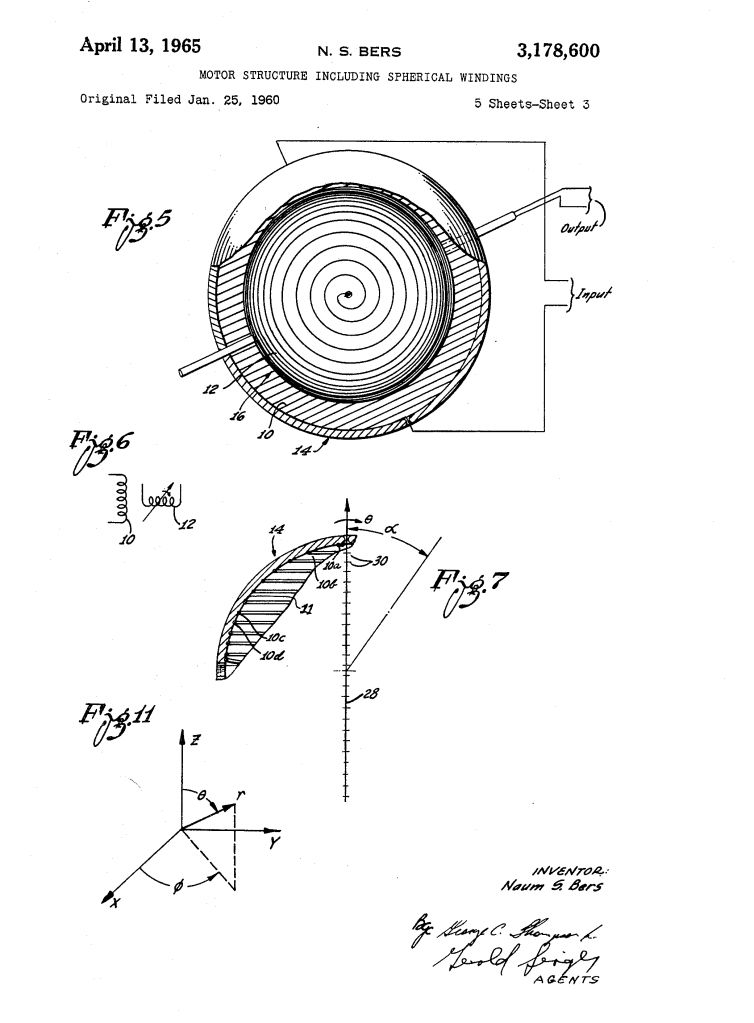
    Motor Structure Including Spherical Windings

    United States Patent: 3178600


    [IMG][/IMG]


    [IMG][/IMG]


    Regards Dear Citfta


    Ufopolitics
    Last edited by Ufopolitics; 07-30-2012, 07:33 PM.

    Leave a comment:


  • Ufopolitics
    replied
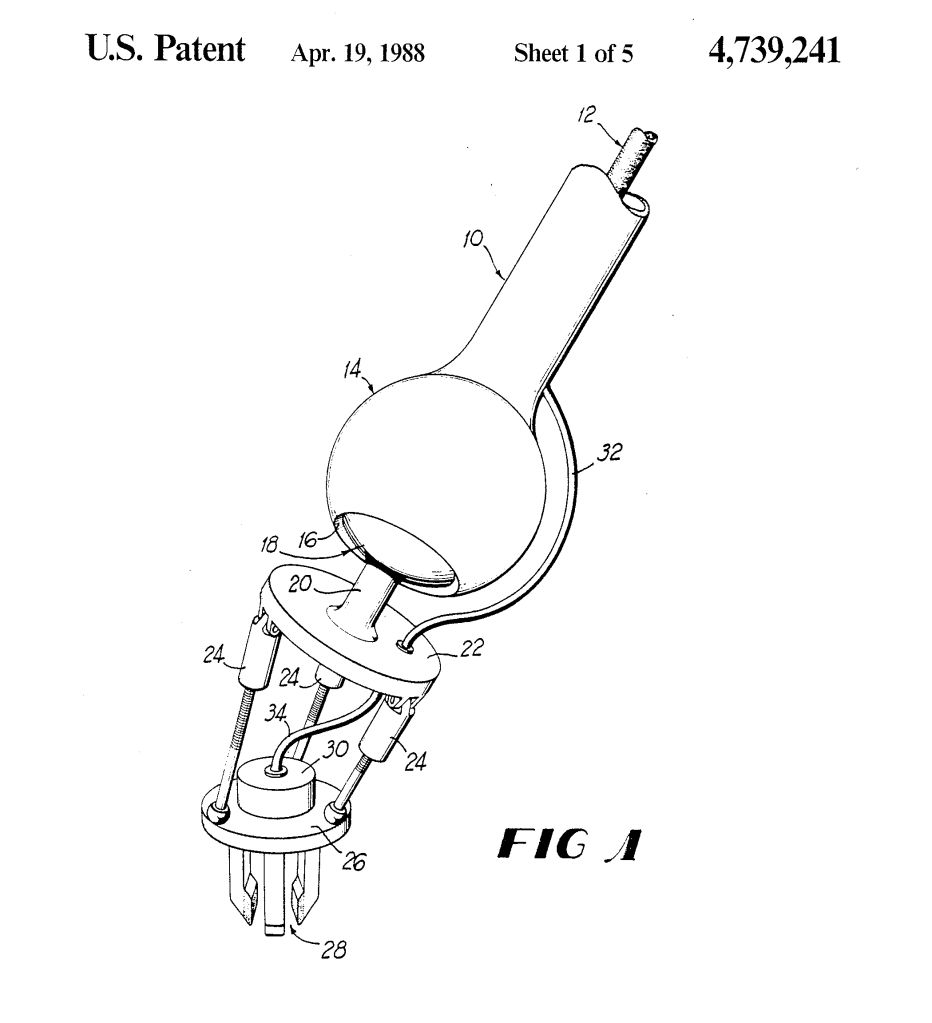
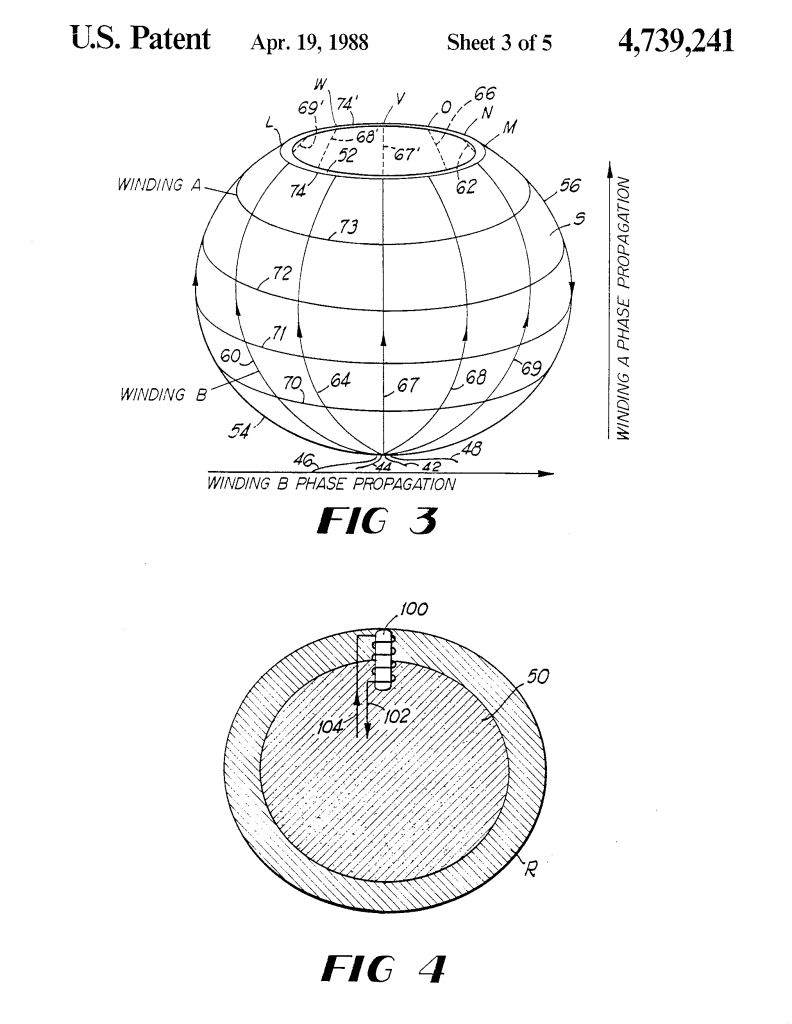
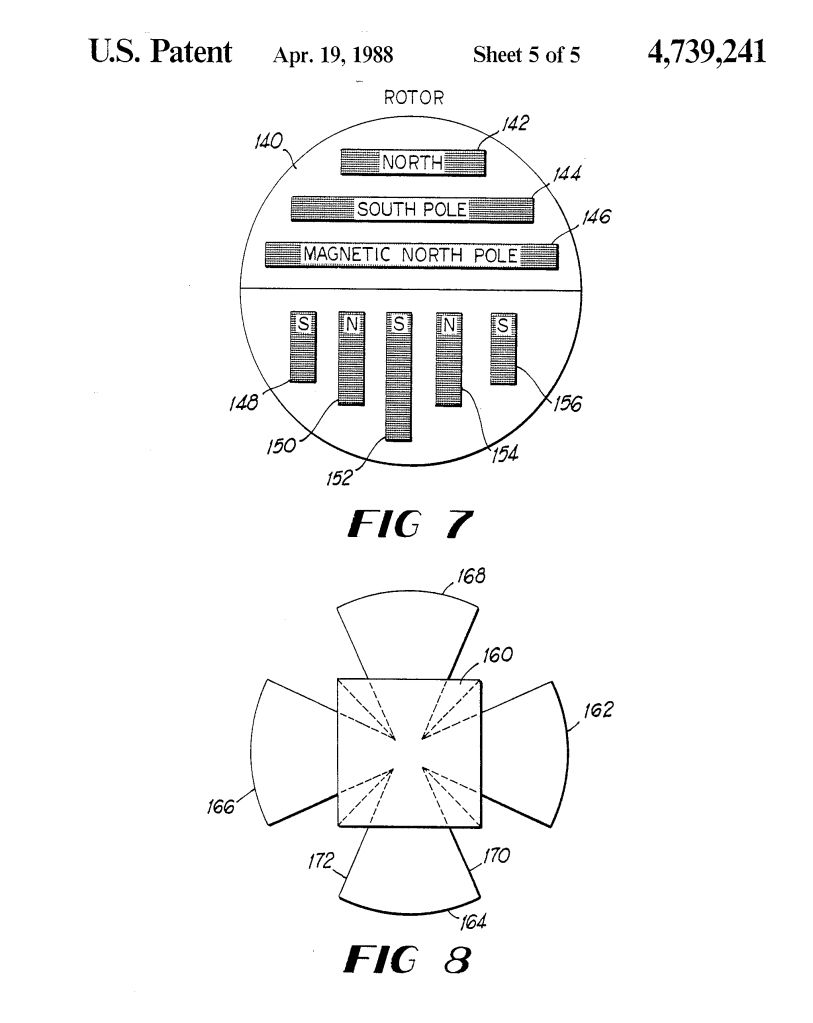
    Spherical Motor...

    United States Patent: 4739241

    Abstract

    A spherical motor particularly adapted for robotic control. The motor comprises a stator housing defining a semispherical socket having an opening of generally polar cap form with a spherical rotor rotatably received in the socket for rotation therein about three axes intersecting at the center of the rotor with one of the axes projecting through the opening and the other two axes being orthogonal thereto. A motion transmitter is carried by the rotor and aligned generally along one axis to project through the opening, and windings are carried by the stator housing in encompassing and in opposed relation to the rotor for rotating the rotor about the axis. A polyphase control selectively controls relative phase and energization of the windings to rotate the spherical rotor a substantially unlimited amount about one axis and in limited amounts about the other axes so as to maintain the motion transmitting member within the confines of the opening.

    [IMG][/IMG]


    [IMG][/IMG]


    [IMG][/IMG]


    Regards Citfta

    Ufopolitics
    Last edited by Ufopolitics; 07-30-2012, 07:45 PM.

    Leave a comment:


  • citfta
    replied
    Don't think so

    Hi Stealth,

    Thanks for the link. That is an interesting motor but I don't think that is what Ufo was talking about. This motor has two rotors but they are both turning about the same axis. If I understood right what Ufo was describing had some way for the motor to move in all 3 dimensions. Or in other words in had 3 axises of movement. I still can't visualize that in my mind unless it is something like the gimbal mounting for a gyroscope.

    Originally posted by Stealth
    Thanks for your help,
    Carroll

    Leave a comment:


  • citfta
    replied
    Hi Farmhand,

    I have gotten so tired of all the silly talk about witches and assymetrical this and that I have just about quit looking at that thread. So far I have not seen any evidence of proof to back up the claims. I asked for some references to these motors that somehow have more than one axis and as expected no references have been given. There are a lot of claims with nothing to back them up. I would really like to be wrong and see a motor that does what he is claiming but I don't think it is going to be from him.

    Later,
    Carroll

    Leave a comment:


  • Farmhand
    replied
    Patent picture not from patent.

    Hi Carroll and all, Recently there was a disagreement, the section of the patent
    drawing shown in this post.http://www.energeticforum.com/202137-post364.html
    is from patent 390 721 but the claims he quotes in this post

    and relates to his devices are from patent 390 414 which of course doesn't contain the drawing he posted.

    309721 patent
    Patent US390721 - BEST AVAILABLE COP - Google Patents

    390414 patent
    Patent US390414 - BEST AVAILABLE COP - Google Patents

    This is misleading, the drawing from the first post is from a different patent to
    the claims he quotes. I didn't pick up on it at first, but he did not mention it, I
    linked the 390 721 patent which the drawing he posted was from. At the point
    he replied I couldn't be bothered to argue because I could sense he was
    getting upset.

    My point still remains the drawing he posted is not in the patent he used to
    justify his claim of his being like the drawing, that drawing is from the
    alternating current generator patent
    .

    A tad misleading.

    Cheers

    Leave a comment:


  • citfta
    replied
    Scope shot

    Hi Farmhand,

    That is an interesting scope shot. I have thought about doing that a few times but never got around to it. It looks like you are picking up all kinds of signals as well as some noise. Is it fairly quiet there this time of year as far electrical storms go? I would have expected to see more noise than signals on an untuned length of wire. However your scope shot looks more like radio signals and less like noise. The ground wires between the hot wires may be raising the capacitance of the fence by a small amount. I wouldn't think they are close enough to make a lot of difference. On the shot you posted it looks like you have one dominant signal at 160 Hz. Is that one always there or does it come and go like the other ones? Do you have any idea where it is coming from?

    Later,
    Carroll

    Leave a comment:


  • citfta
    replied
    Special motors

    Hi Ufo,

    Your info about these special motors is very interesting. Do you happen to have any references or patent numbers so I could look some of them up? I am always trying to learn something new.

    But let me tell you something else...and believe me, I understand and respect your background in Motors and Electrodynamics ...but there are specific Servo Motors...in just One Unit, One Assembly...that could rotate in many different Degrees Of Freedom Angles...there are several patents in USPTO Washington DC related to that kind of Motors, I have conducted many deep searches in that area...they have very clever sliding mechanisms...that moves through specific Spheres Shape Spatial Frames, with channels and guides...just like a Round Rail Road track...they could deviate paths...and surround a whole spherical area of operation...They're mostly used in Aerospace applications, and repair equipment for Satellites etc...while others never made it to the production lines...


    Kind Regards


    Ufopolitics


    Thanks for sharing this info.
    Carroll

    Leave a comment:


  • citfta
    replied
    Meters

    Hi kcarring,

    Yes I agree with you about the meters. Like most everything else in electronics and many other fields understanding the limitations of your equipment goes a long way towards helping you understand your results. I am old enough to remember when digital meters came out. Of course they were an immediate hit with troubleshooters because now we could get much more accurate measurements. Or at least we thought we could. A lot of us soon discovered that they were great for stable conditions but not helpful at all for changing conditions. They were pretty useless for tuning amplifiers or RF circuits because they didn't react fast enough and it was hard to tell if the numbers were going up or down without a lot of concentration.

    As you have said they also have a problem with non-standard wave-shapes. I have found the best meters for the kind of experimenting most of us are doing is the plain old simple panel analogue meter. No electronics, just a meter calibrated to measure the voltage or current we are interested in. They are easy to use when trying to follow a changing signal and they seem to do a better job of averaging out the pulses and odd shaped waveforms of some of the circuits we deal with.

    I have several of both kinds of meters and use both of them a lot. The digital meters are really good for measuring small voltages like the bias on the base of a transistor and watching the small changes in a battery as it is slowly going down or up. They each have their place and we just have to learn to use them properly.

    Thanks for your input,
    Carroll

    Leave a comment:


  • Farmhand
    replied
    Radiant Energy Collecters

    I scoped the fence, There is many different waves on waves, like Russian dolls,
    they just kept coming, the amplitude is small, I didn't have time to clear all the
    grass and weeds from contacting the wires. Picture attached. Of course the
    wire is not a tuned length. I see similar wave forms just by scoping a ground
    connection at the house but it's 50 Hz there, I see all different frequencies at
    the fence up to 20 kHz or so. one pic attached.
    Last edited by Farmhand; 02-09-2014, 09:18 AM.

    Leave a comment:


  • Bizzy
    replied
    [QUOTE=kcarring;203390At the end of the day, very few of us own a 4 channel scope capable of multiplying inputs (1 channel for each: volts / amp draw on both input and output) such that the information can be sent via data acquisition, and therefore examined as energy consumed versus energy produced, over time.
    Which seems to be one of the few accurate methods.

    If we cannot trust our meters with these circuits, and cannot afford extensive equipment... where then do we turn?

    Cheers all.[/QUOTE]

    Hi kcarring
    I agree that most of us tinkerers don't have some of teh sophisticated equipment as do some of those out there. And I am not saying that in an envious way. It is just a fact of economics. Because we don't have many of the better tools we simply have to make due with what we have. If we have repeat experiments sevral times to study an reaction then we do it. I have had to do that many times when i realized my meter was placed wrong or I measured it incorrectly. We as amatures simply need to work with what we have and trust we will find what we are looking for or show us the way we are not supposed to go.
    Bizzy

    Leave a comment:


  • Ufopolitics
    replied
    Hello Dear Carroll,

    Originally posted by citfta View Post
    The following is a quote from Ufo about how his motors work:

    "In the Field of ROBOTICS, where I originally developed certain types of Servo Motors, which are not just motors that rotate straight forward or reverse only, and, at different speeds, but a SERVO is a Motor that "Obeys" Certain Specific Commands -ordered by its SERVER-, to move to EXACT Positioning in ALL 3D Space Coordinates, called DOF (Degrees of Freedom), then it would be much easier to understand the Flow of My Machines disclosed above..."

    I worked on industrial machine tools for about 30 years. A lot of these machines were computer controlled which means they had servo motors on them. So I do know a little about servos motors. I had to fix them when they didn't work. A motor has ONE axis. It can rotate clockwise or counterclockwise. It can go slow or it can go fast. It can move in little steps or spin like a top. But it still only has ONE axis. We can put a bunch of them to together and make a multi-axis machine. I have worked on machines that had as many as 5 axises that could all be moving at the same time for machining very complex curves. But the motors still only had ONE axis. Most of the machines I worked on had an accuracy of .0001 inch. that is one ten thousandths of an inch. Some of them had an accuracy even closer than that. I had to test the machines to verify that accuracy and had to repair them if they lost that level of accuracy. I have also worked on some industrial robots. They have the same kind of motors.

    Ufo has some very interesting design ideas about motors and he has a lot of people trying to build them. I don't understand why he insists on coming back time and time again making statements like the one above that only serve to confuse people. I think he probably meant that the robot can have 3D movement but the way he wrote it makes it seem like the motors somehow had 3D movement. And what in the world does this have to do with how his motors are supposed to work?

    Respectfully,
    Carroll

    Hello Dear Carroll,
    And Hello to all,

    Great thread, great idea!!!

    First, I promise I will "behave" here...
    But I been reading this interesting thread, and My name (Well... a UFO is something very common nowadays ...people are seeing them almost everywhere)

    I feel I should be the one to respond to your doubts, related to my statement above in Blue...

    The Machines I am displaying in My Thread, I was referring to their "Virtual Axis of Rotation", and that relate to their Center Flow Axis of either electrical currents or magnetic flux, as also translations and rotations of such ... I have used the Robotics DOF term , just to set it as an example, a comparison to be understood as the 3D Space Math behind them both are similar...

    Now, about Robotics DOF, relates to "3D Space Joints" that rotates in different axis, as they also are mounted on other arms and brackets, that rotates on other Axis...but it does not relates to just one servo motor...sometimes dozens - like you have said- to configure just an Arm...to obtain multiple DOF's..
    I do have developed Servo Motors...as I also have Patents granted on such, as also on Motors and Generators of different Architectures than we all know so far...But they are not disclosed here, no need to, they are just "different structures"...

    But let me tell you something else...and believe me, I understand and respect your background in Motors and Electrodynamics ...but there are specific Servo Motors...in just One Unit, One Assembly...that could rotate in many different Degrees Of Freedom Angles...there are several patents in USPTO Washington DC related to that kind of Motors, I have conducted many deep searches in that area...they have very clever sliding mechanisms...that moves through specific Spheres Shape Spatial Frames, with channels and guides...just like a Round Rail Road track...they could deviate paths...and surround a whole spherical area of operation...They're mostly used in Aerospace applications, and repair equipment for Satellites etc...while others never made it to the production lines...


    Kind Regards


    Ufopolitics

    Leave a comment:

Working...
X