
Originally posted by cgalvisardila
View Post
Huifang XU, et al -- Zn Oxide photoelectrolysis
Abstract: Materials scientists at the University of Wisconsin-Madison have designed a way to harvest small amounts of waste energy and harness them to turn water into usable hydrogen fuel. The process is simple, efficient and recycles otherwise-wasted energy into a usable form.
"This study provides a simple and cost-effective technology for direct water splitting that may generate hydrogen fuels by scavenging energy wastes such as noise or stray vibrations from the environment," the authors write in a new paper, published March 2 in the Journal of Physical Chemistry Letters. "This new discovery may have potential implications in solving the challenging energy and environmental issues that we are facing today and in the future."
The researchers, led by UW-Madison geologist and crystal specialist Huifang Xu, grew nanocrystals of two common crystals, zinc oxide and barium titanate, (piezo like quartz ) and placed them in water. When pulsed with ultrasonic vibrations, the nanofibers flexed and catalyzed a chemical reaction to split the water molecules into hydrogen and oxygen. UW-Madison Mechanical Engineering Professor Xiaochun Li lent theoretical and experimental expertise to the ultrasonic vibrations part of the research.
When the fibers bend, asymmetries in their crystal structures generate positive and negative charges and create an electrical potential. This phenomenon, called the piezoelectric effect, has been well known in certain crystals for more than a century and is the driving force behind quartz clocks and other applications.
"This study provides a simple and cost-effective technology for direct water splitting that may generate hydrogen fuels by scavenging energy wastes such as noise or stray vibrations from the environment," the authors write in a new paper, published March 2 in the Journal of Physical Chemistry Letters. "This new discovery may have potential implications in solving the challenging energy and environmental issues that we are facing today and in the future."
The researchers, led by UW-Madison geologist and crystal specialist Huifang Xu, grew nanocrystals of two common crystals, zinc oxide and barium titanate, (piezo like quartz ) and placed them in water. When pulsed with ultrasonic vibrations, the nanofibers flexed and catalyzed a chemical reaction to split the water molecules into hydrogen and oxygen. UW-Madison Mechanical Engineering Professor Xiaochun Li lent theoretical and experimental expertise to the ultrasonic vibrations part of the research.
When the fibers bend, asymmetries in their crystal structures generate positive and negative charges and create an electrical potential. This phenomenon, called the piezoelectric effect, has been well known in certain crystals for more than a century and is the driving force behind quartz clocks and other applications.


 [IMG]
[IMG] [/IMG]
 .... and in a way it explains why the Shaman's crystal shot a laser like light .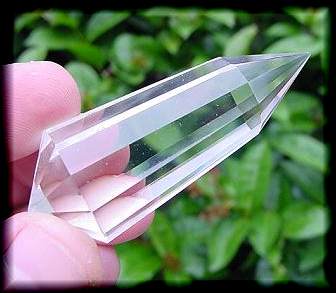

 ....but more to increase your understanding of the ingredient your are using
Leave a comment: