Besides the input to my primary coil being pulsed DC, does my system
seem to be on the right track? My goal with it was to use the
thickness of the cores to prevent the bEMF from reaching the primary
while keeping the permeability of the materials at a level conducive
to producing lots of output.
Otherwise it has become a matter of expense and little availability
in finding the correct core parts to build a working system with
dual-reluctance materials.
My guess is ideally the transformer might be constructed from four
U-shaped ferrite cores and a thin primary, by comparison to my
current system with the extraordinary amount of .03 mig wire
accounting for the decoupling pathways.
-
 Guest replied
 -
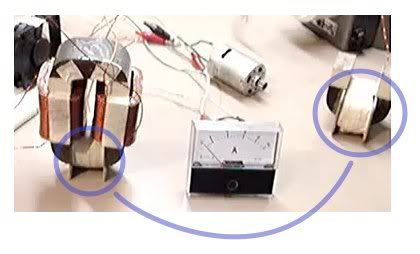
Guest repliedDave45,
Awesome video, looks promising. The input looks to be
pulsed DC. The following looks to be either a support
base allowing it to stand, or some kind of third coil.
Any additional info on this?
Here's another video, using a Bi-Toroid frame.
Its a bench test of the famed arrangement, with
a mysterious result.
[ Bitoroid BiTT Transformer - Unsolved Mystery - ]Leave a comment:
-
The Canadian patent office issues patents for transformer efficiency above 100%.look at the first part of the patent.
Interesting, doubt you will see that on a US patent any time soon.
AshLeave a comment:
-
yes, the way he explains it, the bemfs only pass or complimnt each other... because the flux path is larger between secondaries and it take path of least reluctance... much like electrical resistance, but magnetically..Leave a comment:
-
Does the BITT primary return BEMF to the power source?
Good question. I do know that his power source is an AC supply.* If I'm not mistaken, after watching one of his videos, and I'm not sure which one it was, so I guess you might have to watch them all to find this reference, but I seem to remember that he indicated that the secondaries don't return counter induced voltage flux paths to the primary as per the purpose of the outer legs.Originally posted by Allen Burgess View Post
They follow the outer legs to their corresponding secondaries and are additive to those secondaries. I read somewhere that neither do they cancel each other out in the outer legs (as one might expect opposing emfs to do) but merely pass each other by like ships passing in the night.
Woopyjump shows in bitt power factor 3 .wmv - YouTube what happens when you disconnect one of the loads from the system. Interesting video.
*Bob Teal used DC to power his induction coil and then used the counter emf spike to drive a secondary load. See Dr Peter Lindemann's Electric Motor Secrets.
*Also, check out Op-Amps, PWM and Ignition Coils Tutorial (Part 3/3) - YouTube for info on v = L(di/dt)
Regards,
VidbidLeave a comment:
-
Bitt
@Vidbid,
Does the BITT primary return BEMF to the power source?Leave a comment:
-
BiTT Power Factor Video by a Replicator
bitt power factor 2 .wmv - YouTube
Interesting video on BiTT power factorLeave a comment:
-
Magnetite Cores?
Has anyone considered magnetite cores with the Thane C. Heins Perpetia generator? in place of steel? Is anyone else working on replicating that project?
Sorry to ask so many questions...
Leave a comment:
-
The Boss is having fun............
ThaneCHeins's Channel - YouTube
A real world test!
Looks like a little green meany from the old beatles "yellow submarine" movie.
ChetLeave a comment:
-
Did anyone replicated the bi-toroid transformer and have a movie to post it here with the replication ? If yes how much power could he/she draw from the transformer ?Leave a comment:
-
Leave a comment:
-
Splitcore Design
I was looking on some other forums and found this design.

Leave a comment:

Leave a comment: