This forum is preserved as a permanent archive. The community continues at eMedia Press.

Announcement

Collapse
No announcement yet.

Captret - Perpetual Light with Dead Batteries

Collapse
X
 
  • Filter
  • Time
  • Show
Clear All
new posts

  • Jbignes5
    replied
    Yeah...

    Originally posted by skaght View Post
    Thanks for the updated design. I should be able to build lots of those together in my ice cube tray! I'll see if that works better in series and leave out the battery for now. I did use aluminum tape in my design, but the aluminum foil itself was definitely what was being consumed. There was grey scummy oxidized aluminum all around the plate and the tip of the foil was almost completely dissolved.

    Thats what happens when you power it with a battery. Something in your tap water is reacting with the aluminum.
    Leave a comment:


  • skaght
    replied
    Thanks for the updated design. I should be able to build lots of those together in my ice cube tray! I'll see if that works better in series and leave out the battery for now. I did use aluminum tape in my design, but the aluminum foil itself was definitely what was being consumed. There was grey scummy oxidized aluminum all around the plate and the tip of the foil was almost completely dissolved.

    Leave a comment:


  • ibpointless2
    replied
    Originally posted by skaght View Post
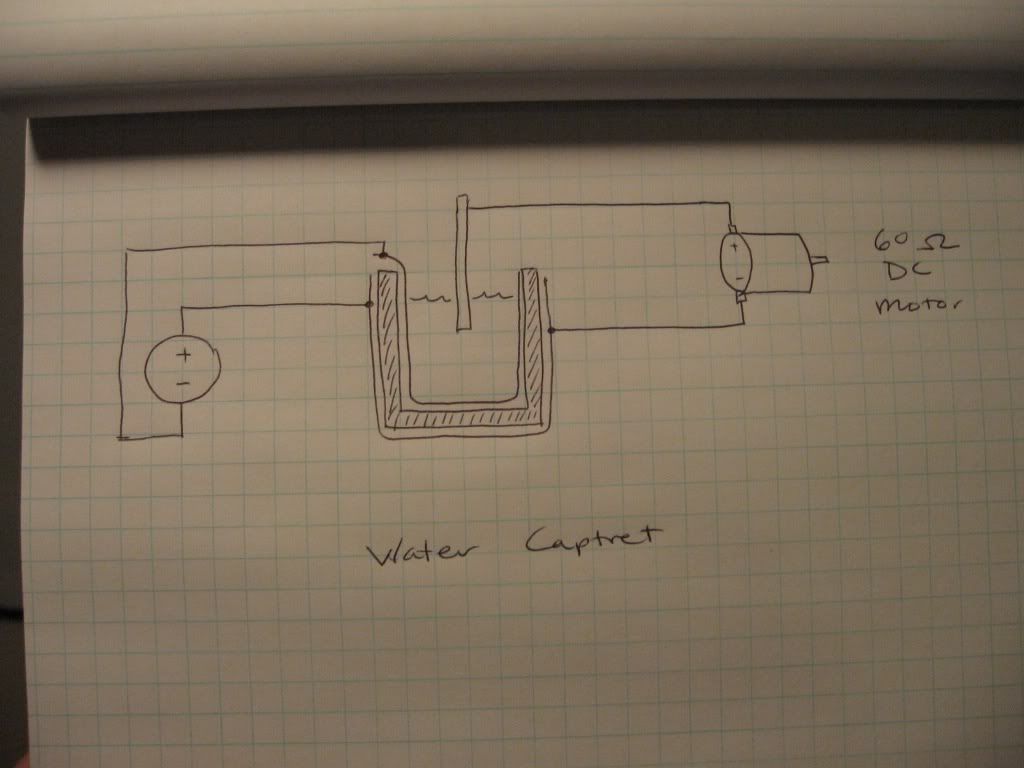
    I ran the captret as follows with my 1.5 volt NiMH. Captret was made from a single cup in an ice cube tray and aluminum foil and aluminum tape. Let me know if you think I hooked something up wrong.
    Is the aluminum tape acting like a plate or are you using aluminum foil for both plates? The sticky material could causing the clouding water, and make sure to use aluminum foil for both pates.

    One reason why i think the plates are being destroyed is because of the battery, its causing oxidation to forum on the plate which eats away at the foil.

    I've also noticed that you're using the old water captret design, i've made a simplifed version but it gives the same effect. Look for the attachment below.
    Click image for larger version

Name:	Water Captret 2.0 simplified.JPG
Views:	1
Size:	969.9 KB
ID:	449983


    Also i've come to find out that the Water captrets themselves can be used as batteries. I'm not fully sure but hooking a battery to the water captret could destroy them, i will test that soon.

    Leave a comment:


  • skaght
    replied
    I ran the captret as follows with my 1.5 volt NiMH. Captret was made from a single cup in an ice cube tray and aluminum foil and aluminum tape. Let me know if you think I hooked something up wrong.

    Leave a comment:


  • ibpointless2
    replied
    Originally posted by skaght View Post
    I ran the water captret overnight with the 1.3 volt NiMH. My load was a 60 ohm low voltage dc motor. The motor ran, albeit rather slowly. The water bubbled and after the overnight run, it became cloudy. The aluminum foil also began to disintegrate. I think for some reason, the water captret turns the two plates into a normal battery and they then begin to charge and degrade with use.

    I would guess it's similar to lead acid batteries where you start with two identical lead plates and then apply a voltage across them to condition the battery. One plate becomes oxidized the other reduced as the lead acid battery is formed. The voltage difference in the captret appears to do the same thing to the aluminum as it creates a new battery with the aluminum foil. That would explain why with shorting and with continual use, the water captret effects become stronger. There could be another explanation, but that makes sense from what I'm seeing...

    In my opinion, the most interesting thing about the water captret is where does the increased voltage come from. I'd like to look for other tri-plate capacitors (without water) that can replicate the effect.


    I don't get why your aluminium plates started to disintegrate with only a 60 ohm load. I've run my water captrets with 100K ohm resistor and some are completely shorted out and my plates are like new and the water is still clear.

    Are you hooking the Water captret up to a battery or are you using the water captret as a battery itself? Again i don't understand how you can have cloudy and disintegrating water captrets when i got ones that are shorted out for weeks that still look like new.

    Leave a comment:


  • skaght
    replied
    I ran the water captret overnight with the 1.3 volt NiMH. My load was a 60 ohm low voltage dc motor. The motor ran, albeit rather slowly. The water bubbled and after the overnight run, it became cloudy. The aluminum foil also began to disintegrate. I think for some reason, the water captret turns the two plates into a normal battery and they then begin to charge and degrade with use.

    I would guess it's similar to lead acid batteries where you start with two identical lead plates and then apply a voltage across them to condition the battery. One plate becomes oxidized the other reduced as the lead acid battery is formed. The voltage difference in the captret appears to do the same thing to the aluminum as it creates a new battery with the aluminum foil. That would explain why with shorting and with continual use, the water captret effects become stronger. There could be another explanation, but that makes sense from what I'm seeing...

    In my opinion, the most interesting thing about the water captret is where does the increased voltage come from. I'd like to look for other tri-plate capacitors (without water) that can replicate the effect.

    Leave a comment:


  • ibpointless2
    replied
    I woke up today to see the water captret has increased its amp output. Last night i was about .386 volts across the 100k resistor now i'm .586 volts across the 100k resistor. It seems when given a load the water captret performs better overtime. Unlike a normal load when given to a battery where the power will go down the water captret goes up. So to preserve a water captret its best to short it out because it likes to be given loads and thats how you keep it performing its best. This is truly amazing to see a battery gain power over time when given a load.

    I'll post a video of it soon.

    Leave a comment:


  • Jbignes5
    replied
    The reason for the stable voltage.

    I don't believe they can be multiplied like normal batteries. Since we are dealing with surface area when we add more it only increases the force behind this voltage, just like in our original experiment. The more captrets we add together the more force the voltage gets but the voltage stays the same based on the original surface area. Well this is what my results are giving me. Think of it in terms of a flow. Once the voltage is established like in our original experiment the more you parallel of the cells the better the flow capability but the voltage stays pretty much the same. What we are doing here is increasing the push behind the voltage without creating a real current in the traditional sense.

    We have to understand that this effect is purely potential (Voltage) only. Yes paralleling them increases the capability to push harder or maintain the light voltage we are seeing but it is not a real current. I think what we have been seeing rising on the batteries is the real current being transformed into pure potential and reapplied to the battery through a back fill method. Any rise in battery voltage is superficial and fluffy but the way we are using the voltage is with very little consumption of the real current. I suspect it gets converted and a conditioning effect happens to the battery. Much the same way that Bedini uses in his system. After this conditioning of the battery, normal means to charge the new battery don't work as well.

    I think the key aspect of this technology will be for led lighting. That would be better suited to this new aspect we are finding.

    Here is a related video showing the same effect. I believe the spacer used for the dell computers are made of aluminum.

    YouTube - Water Battery - Quest For Free Electricity Part 1
    Last edited by Jbignes5; 12-31-2010, 02:26 PM.

    Leave a comment:


  • skaght
    replied
    1st attempt, series connection

    I used a plastic ice cube tray and aluminum tape and foil to try and make a series captret. I placed the ice cube tray right side up on a sheet of aluminum foil and then molded that foil to the individual cups on the bottom of the tray. I then used aluminum tape to line the insides of the cups on the top side and had the tape curl over into the next ice cube cup to touch the water. I used a NiMH 1.5 volt batter, with a current charge of 1.3 volts as my source.

    Using one ice cub tray cup, the little captret with filtered tap water jumped the voltage to 1.6 Volts!

    When I tried to series connect it into the next cup, the voltage stayed at 1.6 volts. There may be another way to series connect them, but my current design didn't increase past the initial 1.6 V. Still, my design is quite small and produced a significantly higher voltage. This is a cool little device...

    Leave a comment:


  • ibpointless2
    replied
    Is anyone else making the water captret and if so what voltage do you get when you put two in series.

    Leave a comment:


  • gravityblock
    replied
    Originally posted by plengo View Post
    the aluminum foam is a brilliant idea. It should increase the surface area and therefore the voltage.

    Fausto.
    I agree.

    GB

    Leave a comment:


  • Jbignes5
    replied
    Yeah it should.

    Originally posted by plengo View Post
    the aluminum foam is a brilliant idea. It should increase the surface area and therefore the voltage.

    Fausto.
    Yeah it should increase it many fold. It looks like they are already making it in South Korea and that will make it easier to get. The pdf shows more about the density of the material and how fine the pores can go. Only tinkering with this material will tell. I bet they send out samples to interested parties. We could get a sample and start testing this out after we do some surface area tests with the normal foils.

    Leave a comment:


  • plengo
    replied
    the aluminum foam is a brilliant idea. It should increase the surface area and therefore the voltage.

    Fausto.

    Leave a comment:


  • Jbignes5
    replied
    Yeah this is an issue..

    Originally posted by ibpointless2 View Post
    Once again i'm not dealing with diodes or rectifiers. The Wiki says that they used same plates as rectifiers in AC currents and in lighting arrestors. My Water Captrets have polarization which makes them batteries and not diodes. The mystery is that why does the same metal plates put in the same water give us voltage?

    The Captrets and Water captrets are batteries, that for some odd reason last a good amount of time even when left shorted out for days. The mystery has nothing to do with diodes but the battery effect.
    The term diode in my opinion is only a directional thing when dealing with polarities. The only reason I brought it up again was to prove the point that size difference in the plates is the reason for the diode effect. The diode effect is in fact a surface area relation to each plate submersed in the medium (water). Not oxides or anything else since we are using only water in this case and not an electrolytic. This proves they were wrong about what creates the polarity and "Virtual" diode. It is all about the surface area you present to the medium. Everything else is mere coincidence and in most cases causes the destruction of the plates.

    Lets narrow this down and do comprehensive tests with real numbers to show this effect better. Make your plate sizes very accurate and record the voltages to see if there is a correlation between the surface area and the difference when compared to each plate. Lets try to rule out these alternate explanations and focus on the real event.

    My guess is that Tesla was absolutely right about surface area relations between two plates and the medium it is in. One avenue of discovery could be making the surface area in the extreme sense by shredding the aluminum and mixing it with an more material to still allow a flow of the water to each plate and keep the connected conductivity of the shredded material. This was done in the case of the Edison batteries by putting the material in a steel tube with many many perforations in the tubes walls. This could also be done on the nano scale if we could get real scientists to see the value of such a process. This would open up much more capabilities of the aluminum to present it's enhanced surface area to the medium (water). Maybe there is a process that would turn the aluminum into a sponge like plate with tremendous amount of surface area to get a better effect.

    Actually they have done the foam type aluminum already. Check this out. Pay attention to 15 and 21 of the uses this stuff has...

    aluminium foam

    And this one tells about the process. It also says that it can be used for other materials as well.

    Last edited by Jbignes5; 12-30-2010, 06:52 PM.

    Leave a comment:


  • kippered
    replied
    Emf

    Is it possible that the voltage increases you are seeing are just a product of EMF from surrounding electrical devices? Just a thought because when at my workbench I notice that even my steel shelf in relation to ground has a voltage induced on it and a measurable freq. of 60Hz.

    Keep up the good work there are some interesting ideas to explore here!

    Leave a comment:

Working...
X
