
Originally posted by sampojo
View Post
The above statement is True, however, we still have "problems"...generator gates do NOT pick Up/collect ALL Energy...and that IS a problem, and it gets worst by increasing speed...because, if it is not picked up in a higher percentage then we get it crashing at Input Gates, therefore showing a very High Amperage "presence"...that is why we have to play with the angles where to locate the output brushes, till we find a suitable angle...plus, we need to have a Cap Bank at Output gates to collect and store charges...or a load.
S2: Inserting a PWM, it controls power input by pulsing the current to the motor. Apparently the monster Pulser has frequency control and pulse width control which will vary the width from 0~ to 100% of any given frequency cycle. (T/F?)
My question is about an idea of synchronizing the the frequency of pulse action with the motor rpm. I am wondering if there is any detrimental action if the pulse action is not in sync with the rpm, more precisely B]NO MORE THAN[/B] one pulse per COMMUTATOR SEGMENT. Wouldn't multiple trailing edges within a commutator segment put radiant energy in a symmetric-type situation where it will be fighting the leading edge, hot electricity pulses?
My question is about an idea of synchronizing the the frequency of pulse action with the motor rpm. I am wondering if there is any detrimental action if the pulse action is not in sync with the rpm, more precisely B]NO MORE THAN[/B] one pulse per COMMUTATOR SEGMENT. Wouldn't multiple trailing edges within a commutator segment put radiant energy in a symmetric-type situation where it will be fighting the leading edge, hot electricity pulses?
So now, our Asymmetrical Motor is conceived (so far) just like a Fuel Engine I described above...and our "Fuel Supply" is our Monster Pulser, Oscillator/Controllers...
Now, related to Radiant Energy here...really forget it, when we are running at very high RPM's...SHE "Vanishes"...becomes very weak...remember, both Energies work Inversely and not that proportional either...but, still...the more Hot...the less Radiant flow.
Hope you see my point here.
When you guys are using the PWM now do you operate at frequencies well under RPM x #commutator segments? Imperial has 36? 36x5000rpm=180kcs, as a nominal value.
Does the Monster pulser have the ability to get its frequency setting from a hall switch measuring motor rpm and then get its timing from the motor?
Does the Monster pulser have the ability to get its frequency setting from a hall switch measuring motor rpm and then get its timing from the motor?
Before I have posted about this "Communication Protocol Networking"...and yes we could be able to "Sync" our supply with Machine RPM's...and it is fairly simple...we get a "signal" right out of our Generator Gates...a low amperage signal that could be read in Hertz...as we could easy install a speed sensor at back shaft (many motors have that "Universal kit" available) in order to process our "Data Flow" [Hertz/RPM's] back to the Supply or Input side...then we get I/O looped and processed.
So far we have been playing with Machines that run "Ad Libitum" (Randomly) as we feed them...just like any typical motor out there, however, Asymmetrical Systems allow Us to also play with very accurate networks (I cited that aspect on my ABSTRACT in my first Post on the Motors Thread), like when getting into Servo Motor for Robotics applications.
And, by the way, Imperial have 28 Poles at rotor, 56 Elements in Commutators...

Regards
Ufopolitics
 I was thinking about how to get the high power in and out without covering the rest of the circuit and make it easy to repair. I was also just seeing if a third fet would fit as machine was talking about. Not that I will do it but just toying with things. This circuit is also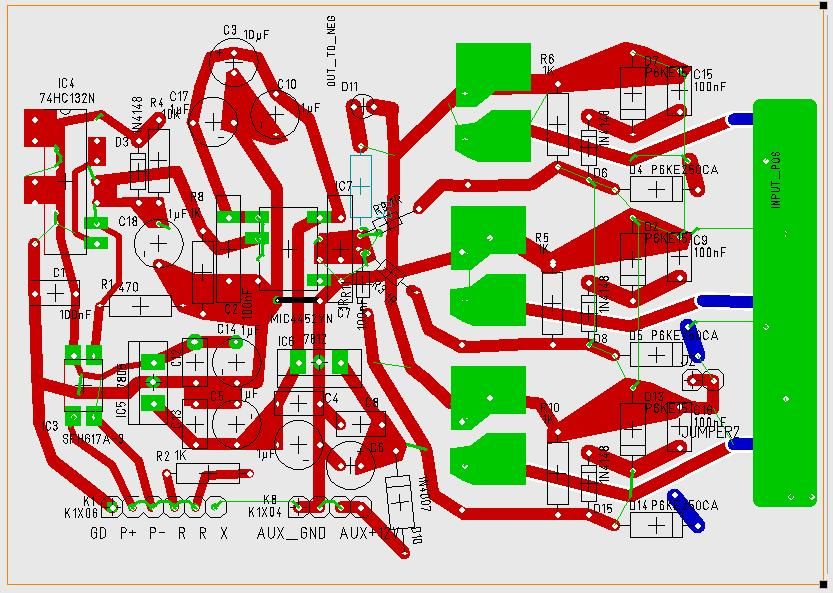
Leave a comment: