This forum is preserved as a permanent archive. The community continues at eMedia Press.

Announcement

Collapse
No announcement yet.

The Electric Field.

Collapse
X
 
  • Filter
  • Time
  • Show
Clear All
new posts

  • #61
    Heat could be eliminated in a coil and we would be dealing with potentials instead of heat.

    the possibility's

    dang I have to go to work

    Half of the Answer is knowing the right Question

    Comment


    • #62
      Hi Jbignes5, Could there be a way to "dope " a plate "p" in all of this ? And is aluminium (Australian spelling) the best metal for the plate. I have tried completely insulating the plate with polyester spray on insulation, but that just stopped it working. So it's obvious that isolation from the ground is all that is needed. Completely covering the plate with insulation is no good.

      I have seen video's of people laminating thier plate "p" in plastic.
      Anyway so Tesla says his plate "p" must be insulated so I say that means just isolated from the ground.

      He also says the plate can be amalgamated, now this is an entirely different thing and not spoken of, or theorised very much from what I can tell. An amalgamation is basically an alloy when talking of metals. Or a non pure metal when talking of an amalgamation of metal with another substance, such as steel (iron, carbon and silicone mostly with some magnesium) the magnesium allows it to be called an alloy, in my opinion.

      So what would be the best alloy for a plate "p" if not a grade of aluminium ? All aluminium except pure aluminum is an alloy or an amalgamation.

      And how could we dope a plate "p" as in change it's crystaline structure to improve it's performance ?

      Back to the lamination, maybe Tesla alluded to a lamination to only one side or a lamination of several plate's separated by a dialectric, or maybe a lamination of aluminium one side and a different metal the other side.

      Who knows but I would like to try some different laminations and amalgamations in a plate "p" arrangement, the plate "p" arrangement could be the perfect tool to test the effects of these things.

      Originally posted by Jbignes5 View Post
      Yes I imagine they make tons of different types of copper coated stuff. Even if they don't it would be very easy to plate the iron wire ourselves through electrolysis method.

      I think your original idea of an alloy of copper and iron would be the best. Something hit me earlier about the alloys. What if we used an electric field to energize the alloy as it is cooling????? Not a magnetic field but just the electric field..... Hmmm....

      I would also like to show you guys something. Since metals are a phase transient matter then it should show the same effect as water freezes. Take a loo at this acid etched plate:


      As the metal solidifies it hardens around the internal network and kinda takes a picture of that network.. I have shown this picture many times before but since we are admitting there is the electric field this is proof that the metal is organized into this pattern by the underlying network of that metal..

      Here is iron:

      File:Widmanstatten hand.jpg - Wikipedia, the free encyclopedia

      I know this one is from a meteorite but it still should be the same principle.
      Chhers

      Comment


      • #63
        I think you could change or alter the structure by annealing as they do with mo metal or with high voltage as they do with magnets. Keely done it with sound frequencies, he heated the metal allowed it to cool slowly in sand an subjected the metal to specific frequencies.
        Half of the Answer is knowing the right Question

        Comment


        • #64
          Looking for wire, one possibility China tinned copper clad steel manufacturer , factory ,supplier - 702

          Another JLC Electromet - Dumet Wire: Copper-Clad Ni-Fe Alloy Wire
          Last edited by Dave45; 02-04-2011, 02:05 AM.
          Half of the Answer is knowing the right Question

          Comment


          • #65
            Hi Dave, yeah thats what I meant, maybe heat the plate to a temp a fair bit
            below melting but hot then pass HV DC Pulses through it. By using the
            connection and wire that usually go's to the cap to ground the plate well.
            Then I could connect an electric fence energiser positive to a point on the
            opposite side of the plate and pulse it with 8 Kv capacitive pulses from the
            fence enrgiser. Or something like that.

            I'm thinking copper will work better. Maybe.

            Perhaps this would set up a good "inductive" path or something.

            Any thoughts.

            Comment


            • #66
              Well if they do it for ferrite materials....

              Originally posted by Farmhand View Post
              Hi Dave, yeah thats what I meant, maybe heat the plate to a temp a fair bit
              below melting but hot then pass HV DC Pulses through it. By using the
              connection and wire that usually go's to the cap to ground the plate well.
              Then I could connect an electric fence energiser positive to a point on the
              opposite side of the plate and pulse it with 8 Kv capacitive pulses from the
              fence enrgiser. Or something like that.

              I'm thinking copper will work better. Maybe.

              Perhaps this would set up a good "inductive" path or something.

              Any thoughts.
              I would say yes that we can do the heat treating of the metal and expose it to the electric field. That would do it just like a magnet is formed. It should work the same way. But we have to know how metals react to the field in order to create the e-field in the right configuration to expose it to the cooling metal.

              Maybe several toroids around the stock of metal would be sufficient to line up the threads in a more organized manner.

              Comment


              • #67
                Hi i am not sure using one wire for 2 equal but different direction current is the engineering way to go .

                First it would be time and money consuming .

                Here is how to do it .
                Method of making iron-copper alloy - Patent 3918957 patent on how to do it .

                Also see Cunife - Wikipedia, the free encyclopedia


                Second it may make it harder to design electronic around it because of the duality of the current , if you receive as much current as you send they will look like they cancel them self , cruel mistake made by the tools we use .

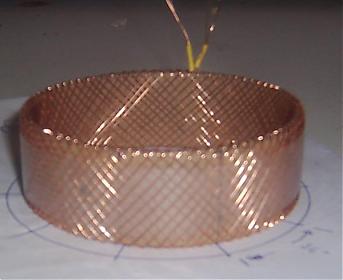
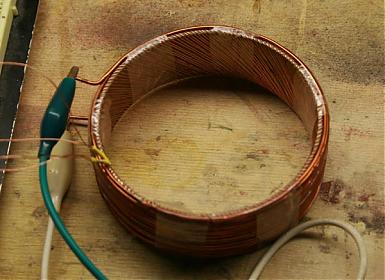
                While i was making my coils i made one (picture) that gave me 0 V on the secondary with or with out rectification . Still i could light 24 bright leds at over 4.5 volts . However successful in practice was limited in improvements and understanding , because it just would not show on my meter .

                I turned the coil back over so i could work on improving it

                The coil was going it the opposite direction around the circumference and the opposite winding direction .

                The whole episode it self feels like a dream but there are the pictures .

                Second picture is the coil redone parallel coils secondary added.

                My conclusion is that you need to do exactly that to simulate the action of both direction current , the emphasis is on simulate .

                If we can't read it with our tools maybe it starts to look like gravity


                Mark
                Attached Files

                Comment


                • #68
                  Originally posted by Jbignes5 View Post
                  I would say yes that we can do the heat treating of the metal and expose it to the electric field. That would do it just like a magnet is formed. It should work the same way. But we have to know how metals react to the field in order to create the e-field in the right configuration to expose it to the cooling metal.

                  Maybe several toroids around the stock of metal would be sufficient to line up the threads in a more organized manner.
                  Yes thats correct we need to find refence material or go on purely
                  observational and measured data with intuition and insight as guides. Haha

                  I'm a boilermaker/metal fabricator by trade and had some metallurgy theory
                  in training. Mastered many different welding processes, I can say i've seen
                  quite a bit of molten, oxidised, electrified and beaten metal by my own hand.

                  I've also had some "old school" blacksmith training just a bit of crow bar
                  hardening and spring making ect. So i'm prepared and able to perform such
                  experiments. I just have no scientific way of "seeing" the actual results
                  to the structure of the metal or the differences, as in which way to go.

                  Frustrating. I can only envision it for now that the electric field would line up
                  things one way for better "flow" and the magnetic the opposite, maybe.

                  But how to apply it. I'm almost ready with materials, need suggetions. Have to
                  clean a big aluminium plate yet about 500mm square, then I will be ready.
                  I think. All I can do is try what I think will work, with some testing before
                  and after.

                  Cheers

                  P.S. When I say almost ready I mean it could be days if i get distracted, I
                  like to work slowly.
                  Last edited by Farmhand; 02-04-2011, 02:41 AM.

                  Comment


                  • #69
                    Ok here's what I think when we us conventional materials a coil builds a magnetic field around it when energized, when that field is turned off the magnetic field enters the coil and we get back emf, I know they say this isnt whats happening but it is.

                    If you run a negetive current through the coil the field around the coil will be positive and when that coil is turned off you get a positive field collapsing into the coil, since currents run in opposite directions it runs back down the negetive wire and we call it bemf.

                    That bemf is a positive current so we use a diode to divert the current into the positive pole of our battery.

                    Positive current can be useful but it doesn't run to ground so it is weaker than negative current, not so much that its weaker it just doesn't run to ground.

                    AC current runs to ground because of the negative current thats in the wire the positive current thats in the same wire resists running to ground and thats what causes the oscillation in ac current.

                    Our appliances run on negative current so we need to produce negative current.
                    Unless you want to make a ufo

                    So if we build an iron coil and pulse it with positive current the bemf should be negative current, and that we can use.
                    Last edited by Dave45; 02-04-2011, 03:37 AM.
                    Half of the Answer is knowing the right Question

                    Comment


                    • #70
                      What if we took an iron wire and a copper wire twisted them together wound our coil bifilar and made a core of copper and iron would we produce a stronger electromagnet.

                      Could we capture both fields, would the bemf run in the right directions.
                      Half of the Answer is knowing the right Question

                      Comment


                      • #71
                        Dave45 said,
                        Our appliances run on negative current so we need to produce negative current.
                        Unless you want to make a ufo
                        I'm not keen on flying myself. But it would be good to study or at
                        least theorise about these possibilities.

                        That way if some aliens landed on my property, I might be able to talk to them about thier craft. If they seen I was intereted in thier rig they might take me for a spin. Could be fun.

                        But seriously, a twisted copper and iron coil both insulated would be interesting.
                        Maybe one or the other could be shorted to itself. Like a PMH.
                        Last edited by Farmhand; 02-04-2011, 04:18 AM.

                        Comment


                        • #72
                          Farmhand
                          We can do it

                          MK1
                          I read your thread and watched your vids, awesome work, well documented.
                          I think if you used iron wire in your primary's the results would be very revealing. Im not sure how transistor's will react to a positive current, time will tell.
                          Be careful negative current isnt as forgiving as positive current.
                          Last edited by Dave45; 02-04-2011, 12:05 PM.
                          Half of the Answer is knowing the right Question

                          Comment


                          • #73
                            I read a story a few years back about a small town that produced its own electricity using a Wimhurst machine, I think they figured out how to use the positive current to make negative current.
                            I always though the story was far fetched but now Im not so sure.

                            Positive current running through a conductor will open a lot of doors.
                            Last edited by Dave45; 02-04-2011, 12:12 PM.
                            Half of the Answer is knowing the right Question

                            Comment


                            • #74
                              Originally posted by Dave45 View Post
                              Farmhand
                              We can do it

                              MK1
                              I read your thread and watched your vids, awesome work, well documented.
                              I think if you used iron wire in your primary's the results would be very revealing. Im not sure how transistor's will react to a positive current, time will tell.
                              Be careful negative current isnt as forgiving as positive current.

                              Well , thank you and you are welcomed . I only do my best , i don't have the tools i wish i had , but as long as there is a will .

                              I pretty much done on that coil design and learned much , i see in a near future a quadpole Rodin JT , with possible DC secondary output ( or taste like DC ).

                              My next testing angle will be 22.5 ...

                              Those coil are really useful to catch radian /eddy current . I even managed to light a led on a toroid that theoretically as no field outside the core it self.

                              Mark

                              Comment


                              • #75
                                This would be the wrong assumption.

                                Originally posted by Dave45 View Post
                                Ok here's what I think when we us conventional materials a coil builds a magnetic field around it when energized, when that field is turned off the magnetic field enters the coil and we get back emf, I know they say this isnt whats happening but it is.

                                If you run a negetive current through the coil the field around the coil will be positive and when that coil is turned off you get a positive field collapsing into the coil, since currents run in opposite directions it runs back down the negetive wire and we call it bemf.

                                That bemf is a positive current so we use a diode to divert the current into the positive pole of our battery.

                                Positive current can be useful but it doesn't run to ground so it is weaker than negative current, not so much that its weaker it just doesn't run to ground.

                                AC current runs to ground because of the negative current thats in the wire the positive current thats in the same wire resists running to ground and thats what causes the oscillation in ac current.

                                Our appliances run on negative current so we need to produce negative current.
                                Unless you want to make a ufo

                                So if we build an iron coil and pulse it with positive current the bemf should be negative current, and that we can use.
                                If we energize a coil it has a field of the same polarity as our circuit. When the field gets switched off or the source is blocked then the collapse is instantaneous. The ambient field or environments field collapses into that space and compresses itself getting smaller and smaller but having the same ambient value. This looks like it is gaining in potential because of the surface area is getting smaller and smaller. This is a boundary or surface condition of that bubble relative to the size of that surface of the bubble.

                                Tesla figured this out. He did that by exposing different shaped coils to the electric field. This reversed the process but gave the same outcome. He called this type of a setup a zero current coil but the coil still showed the effects that something was going on. This coil was actually conical in shape and he found that it focused the e-field and compressed the potential twords the smallest end showing effects of a high voltage system when the circuit was not capable of showing this effect on it's own.

                                You could say that upon energizing the coil we use a heavy current and the bubble expands. When we stop that heavy current the environments field comes crashing into the central point where the field started. Since the ambient field is not of heavy current we receive a different kind of voltage. This voltage is of the e-field and not of the magnetic. You got to remember this field is like being under water. It has the same properties and rules of being in a fluid but has a few additional (reversed) rules of the magnetic field.

                                High voltage or pure potential (current-less) is one aspect that we have to use. Pay attention to the Current-less part. Space is nothing but division of the energy field we are talking about. It gives you the ability to measure two spaces and compare their value to one another. Because it has dimensions it must have division of those dimensions. This division is the ability of the natural to move. If everything had the same value then nothing would move. Nothing would gain in speed and nothing would be any different then two thousand miles away.

                                This brings up the network issue. Since we are seeing further in then anything I have ever dreamed of before we are starting to see that things gets simpler is shape then get very complex again then simpler then complex. This is because of matter. I like to call it a focus issue. as we peer in, we are changing our viewpoint and smooth surfaces definitely become rough and textured. But the further we look then the rough texture goes smooth again and then rough. This is called the resolution of that viewpoint and we need to change our rule set every time we go further in. This is a scalar issue. I don't know if I'm using that term correctly but it seems to me that the network is finer then anything we could imagine. This could only come from a fluid. If we back our viewpoint or change the scale of our view we can see the fluidic flow on the mass scale of our galaxy. If we change the scale again one way either way the same rules apply. All the way down to the closest of resolutions that we can go. So matter must truly be afloat in this fluid. I don't know if there are surface tensions in this mass of fluid. At least not in a traditional sense. It seems we can make ripples in this fluidic field. But the ripples propagation is an extremely local event. Meaning it moves in relation to it's neighbor on a 3 dimensional basis.

                                Maybe a Good experiment to see how this works would be to have two fluids with different densities in the same container. The surface would be between the two densities and we might see how this works better.

                                Comment

                                Working...
                                X