Announcement

Collapse
No announcement yet.

ReGenX Coils and ReGenXtra switching

Collapse
X
 
  • Filter
  • Time
  • Show
Clear All
new posts

  • BroMikey
    replied
    Originally posted by bistander View Post
    This is paragraph 7 from the post above:


    It is false.

    Therefore the main premise of the argument is invalid and rest falls apart and is total garbage.

    bi
    so you are the one smarter than all of the patent office scientists. Next to you they are all
    flunkys? Yet Thane's engineering thesis has passed inspection. It must hurt BYEManufacturers are picking up the innovation. Unlimited range
    Last edited by BroMikey; 05-18-2020, 12:32 AM.

    Leave a comment:


  • bistander
    replied
    This is paragraph 7 from the post above:

    The magnetic field created around the coil is dissipated into free space and lost when the current direction is reversed.
    It is false.

    Therefore the main premise of the argument is invalid and rest falls apart and is total garbage.

    bi

    Leave a comment:


  • bistander
    replied
    Originally posted by BroMikey View Post
    Click image for larger version

Name:	2018_06_20_11_51_30_revisedschematic3ccoreaxialfluxsalientpolepmregenxmotorprototype3.jpg
Views:	63
Size:	262.3 KB
ID:	498466
    Adding the verbage and source to the previous post:

    The Create the Future Design Contest was launched in 2002 by the publishers of NASA Tech Briefs magazine to help stimulate and reward engineering innovation. Th


    All electric motors convert Electrical Input Power to Mechanical Output Power.

    The ReGen-X Stepper Motor is a unique patent pending new motor design which delivers Mechanical Output Power AND Electrical Output Power at the same time.

    The ReGen-X Stepper Motor also converts electrical input power to mechanical output power just like any electric motor but it also delivers electrical output power in a two stage approach..

    The ReGen-X Stepper Motor employs; 1) the ReGenX Generator Coil, which produces a Complementary-Electromagnetic-Torque when delivering electric power to a load in concert with 2) Magnetic Field Flyback Collection Motor Control Circuit such that the motor delivers mechanical drive shaft output power while also delivering more output current than the motor coils consume.

    When electric current is passed through a current bearing wire which makes up a motor coil an electromagnetic field is created around the coil which performs work and changes the kinetic energy of the motor's magnetic rotor (accelerating it).

    The rotor is usually made up of altering magnetic poles and the current direction in the motor coil is continually and rapidly altered so the electromagnetic fields produced around the coil interact correctly with the rotating rotor pole(s) and performs the desired motor action.

    The magnetic field created around the coil is dissipated into free space and lost when the current direction is reversed.

    The ReGen-X Stepper Motor has a unique motor control circuit which allows; 1) the magnetic field created around the motor coil to collapse back into the coil, 2) to be converted back into electric current in Magnetic Field Flyback Collection Mode and then 3) delivered to a battery before the next DC pulse occurs.

    Magnetic Field Flyback Collection and normal Generator Action in a Motor are caused work together in concert to deliver more electric current to the battery than was delivered to the motor coil initially.

    Generator Action in a Motor occurs when the motor's rotor pole moves away from the motor coil, causing undesired current to be produced in the motor coil. Now this current is harnessed in a novel way to produce a positive and desired result along with the recycled and reclaimed input current.

    Illustration #1 shows the ReGen-X Motor Circuit Diagram where the DC motor pulse is provided to the motor coil and then switched once the DC pulse has ceased to allow the collapsing magnetic field and Generator Action in a Motor to collectively recharge a battery.

    The ReGen-X Stepper Motor is designed to be employed in electric vehicles (EVs) to provide EV battery recharging during vehicle acceleration in Regenerative Acceleration Motor Mode, during coasting in Regenerative Acceleration Mode, and during breaking in Regenerative Braking Mode.

    "Electric Vehicle Regenerative Acceleration" Generator Operation is explained here: http://contest.techbriefs.com/2018/e...portation/8864

    The ReGen-X Motor is used an an EV Traction Motor to accelerate the EV up to cruising speed and then any number of coils can be converted to Regenerative Acceleration Generator Coils as dictated by the CPU to provide optimal EV battery recharging and vehicle performance.

    Leave a comment:


  • BroMikey
    replied
    Click image for larger version

Name:	2018_06_20_11_51_30_revisedschematic3ccoreaxialfluxsalientpolepmregenxmotorprototype3.jpg
Views:	62
Size:	262.3 KB
ID:	498466

    Leave a comment:


  • BroMikey
    replied
    Originally posted by bistander View Post

    OK. It's irrelevant to your big claim of an OU generator anyway. ;It's all a silly distraction, isn't it?

    bi

    Regenerative Acceleration

    Featured snippet from the web

    What is Electric Vehicle Regenerative Acceleration? Electric Vehicle Regenerative Acceleration is a new US patented innovation that allows electric vehicles to recharge themselves as they drive. The innovation accelerates the EV while recharging the vehicles batteries and is the exact opposite of regenerative braking.Mar 31, 2019


    Electric Vehicle Regenerative Acceleration History and Future...
    • 1. Electric Vehicle Regenerative Acceleration History and Future...
    • 2. Introduction... What is Electric Vehicle Regenerative Acceleration? Electric Vehicle Regenerative Acceleration is a new US patented innovation that allows electric vehicles to recharge themselves as they drive. The innovation accelerates the EV while recharging the vehicles batteries and is the exact opposite of regenerative braking. How does it do that? Electric Vehicle Regenerative Acceleration introduces a Load Current Delay into generator coil operation which reverses the electric vehicle regenerative braking paradigm. How long has it been around? The original discovery was made in 2007, the backing theory was developed at the University of Ottawa from 2007 – 2010.5 and the innovation has been under development since then. 3 US patents have been granted and 4 more are pending. Commercially manufactured EV Regenerative Acceleration coils now exist which can deliver in excess of 60 Amps (1 kW) of recharge current per coil. What does it mean for electric vehicles? Electric vehicles can now begin recharging themselves as they drive starting at 30 km/hr. The more recharge current sent to the EV's batteries the more the EV is accelerated, the more the EV's range is increased and the less plug-in recharging is required.
    • 3. History of Electric Vehicle Regenerative Acceleration... Shortly after 9/11 Potential Difference Inc. decided to investigate if Generator Armature Reaction (Motor Action in a Generator) could be reduced by 10% in order to make electricity generation slightly more efficient. Generator Armature Reaction / Motor Action in a Generator is a Counter Electromagnetic Torque which is created inside all electric generators when a Load Current flows in the generator coil - it is referred to colloquially as EV regenerative braking.
    • 4. Motor Action in a Generator. The the prime mover is rotating the generator in a clockwise direction, and the fields set up by the induced currents in the armature windings attempt to drive the generator as a motor in a counterclockwise direction. This tendency to oppose the prime mover is called MOTOR ACTION IN A GENERATOR. The higher the current in the armature windings, the stronger the motor action. What is EV regenerative braking? EV regenerative braking is caused by Motor Action in a Generator and is explained in a Law of Physics called Lenz's Law.
    • 5. The generator's load current induces a magnetic field (B induced) which produces a counter torque on the generator's rotor which works against the inertia of the EV and reduces its kinetic energy (decelerating the EV) while recharging the EV's batteries.
    • 6. . What is Generator Armature Reaction / Motor Action in a Generator (EV Regenerative Braking) Demonstration Video: https://youtu.be/j1tZDSZtXq0
    • 7. The original idea was to physically divert the resistive induced magnetic (B Field) out of the air gap from between the generator coil and the approaching magnetic field in order to reduce the effects associated with Lenz's Law (aka Newton's Third Law for generators).
    • 8. In 2007 it was discovered that Generator Armature Reaction (parasitic) Motor Action in a Generator could actually be reversed by introducing a Load Current Delay into the generator coils' performance. If the load current induced in the generator coil could be delayed sufficiently in the time domain, it would also delay the production of the induced B Field and in fact, reverse its effects. The normal resistive effects could be reversed in order to produce assistive "motor action" in a generator.
    • 9. Reversing Generator Armature Reaction / Motor Action in a Generator (EV regenerative braking) with a Load Current Delay Demonstration Video: https://youtu.be/pyO8FUTDX68 A load current delay of 45 degrees is sufficient to reverse Generator Armature Reaction but a 90 degree delay can also be produced.
    • 10. The innovation was called ReGenX which is short for ReGenXtra. The backing theory for the ReGenX Generator Coil was developed and performance validated countless times in the Power Lab at the University of Ottawa from 2007 - 2010.5 right after being initially validated at MIT. Deliberately misleading, unfounded and false media and internet claims that the innovation was a perpetual motion machine have never been substantiated.
    • 11. The greater the magnitude of load current in a ReGenX electric generator the greater the magnitude of the Complementary Electromagnetic Torque that is produced. In an Electric Vehicle this means; the more recharge current delivered to an EV's batteries in Regenerative Acceleration mode the faster the EV is accelerated and the less plug-in recharging is required. The initial ReGenX Generator patent was issued in the USA in 2018. The ReGen-X Motor patent was granted in 2019. Generator and Improved Coil Therefor Having Electrodynamic Properties US20140111054A1 United States https://patents.google.com/patent/US20140111054A1/en
    • 12. The problem with early ReGenX Generator Coils were that they could not produce any suitable electric output power. Ongoing R&D efforts continued for the next 11 years and in 2018 commercially manufactured ReGenX Generator Coils were produced which could successfully deliver in excess of 60 Amps of EV battery recharging per coil with EV acceleration.
    • 13. Birth of Electric Vehicle Regenerative Acceleration When current flows through a ReGenX Coil, the Delayed Load Current produces beneficial Motor Action in the generator or a Complementary Electromagnetic Torque which works in concert with the inertia of the EV and increases the kinetic energy of the EV (accelerates it) while recharging the EV's batteries. Electric Vehicle Regenerative Acceleration Integration Demonstration Video: https://youtu.be/3hRYOxabdXs
    • 14. Current opportunity for EV automakers... EV automakers can now produce EV traction motors which produce virtually any magnitude of battery recharge current magnitude as required to increase EV driving range while simultaneously reducing the EV's plug-in recharge requirements. A 100 coil ReGenX EV Traction Motor could produce 6,000 Amps of battery recharging (96,000 Watts) with vehicle acceleration beginning at just 30 km/hr in Regenerative Acceleration Mode while continuing throughout including 96,000 Watts with vehicle deceleration below 30 km/hr in regenerative braking mode.
    • 15. Thane C. Heins President and CEO, Potential +/- Difference Inc. Email 1: [email protected] Cell: 613.898.1131 Potential +/- Difference Inc. - Pioneering Electric Vehicle Regenerative Acceleration Technology & Charging Ahead... “Innovation distinguishes between a leader and a follower” ~ Steve Jobs
    Click image for larger version

Name:	electric-vehicle-regenerative-acceleration-history-and-future-1-638.jpg?cb=1554041693.jpg
Views:	46
Size:	67.8 KB
ID:	498464


    Last edited by BroMikey; 05-17-2020, 03:50 PM.

    Leave a comment:


  • bistander
    replied
    Originally posted by Turion View Post
    Not going to happen bi. Not now. Not ever.
    That series of videos, along with the output of the coils is what we started sending to Aaron before Greyland got sick, and will not be shared anywhere else until after the conference. And NEVER here. Just the links sent to people who are actually building.
    OK. It's irrelevant to your big claim of an OU generator anyway. The fellow in the video did a nice job of presenting evidence supporting what I've always said about your 'speed up under load'. All that is really happening is that you increase your open circuit (no-load) loss substantially but have negligible, if any, affect on loaded performance compared to using the conventional winding.

    True, he used only the bifilar and single wire coils. I see no reason why similar results, or trends, would not occur using trifilar or any multifilar coils.

    At least his experiment confirms the motor generator will speed up under load (actually short circuit output) which I never denied could happen. This speed-up is when comparing RPM with coil shorted versus RPM when the coil is open (leads not connected). The RPM using the bifilar coil on the 10W load was actually the same as the RPM when the single wire coil was tested with a 10W load.

    ​​​​It's all a silly distraction, isn't it?

    bi
    ​​​​
    ​​​​​

    Leave a comment:


  • Treacle
    replied
    if you compare a conventional and modern automobile generator (with segment winding), then any of them has a counter-action to the rotor rotation under load, it will be the same (with all other things being equal), the consumption of one that does not stick and that one with sticks, and the amount of energy delivered will not be different (reaction according to the Lenz rule)! The difference is only when rotating without load!
    With the ReGenX device, sticking is a condition for the impossibility of increasing the efficiency above 100%. In the absence of a modern automobile generator has an efficiency of 39% ... ...

    Leave a comment:


  • Turion
    replied
    Not going to happen bi. Not now. Not ever.
    That series of videos, along with the output of the coils is what we started sending to Aaron before Greyland got sick, and will not be shared anywhere else until after the conference. And NEVER here. Just the links sent to people who are actually building.
    Last edited by Turion; 05-17-2020, 07:37 AM.

    Leave a comment:


  • bistander
    replied
    Originally posted by Turion View Post
    Good for you bi! You found a video of someone who actually does some testing that will support your conclusions! That’s awesome!!

    Now if only those results really mattered! In the test, he measured the input to the motor with a single strand coil in place and with a bifilar coil in place. I’m not using EITHER of those kinds of coils, but I know you need SOMEONE to do the work for you since you never do it yourself.

    BUT, A critical step was left OUT.

    First you need to measure with No coil in place. Measure the input to the motor as well as the RPM. That gives you a baseline. NOW put your single strand coil in place with it “open” and see what your input to the motor is, and what the motor RPM is. Short out the coil and measure both again. Then put the 12 strand #23 AWG Tesla connected coil in place “open” and see what the input is and what the RPM is. Then short that coil out and see what the input is and the RPM is. When you have done that, then I will listen to what you have to say about coils.

    I should also like to know if the number of feet of wire on the bifilar coil was the same as on the single strand coil. Hint: there’s a reason I don’t use bifilar coils.
    Please post the data you got when you ran the test as you describe.

    bi

    Leave a comment:


  • Turion
    replied
    Good for you bi! You found a video of someone who actually does some testing that will support your conclusions! That’s awesome!!

    Now if only those results really mattered! In the test, he measured the input to the motor with a single strand coil in place and with a bifilar coil in place. I’m not using EITHER of those kinds of coils, but I know you need SOMEONE to do the work for you since you never do it yourself.

    BUT, A critical step was left OUT.

    First you need to measure with No coil in place. Measure the input to the motor as well as the RPM. That gives you a baseline. NOW put your single strand coil in place with it “open” and see what your input to the motor is, and what the motor RPM is. Short out the coil and measure both again. Then put the 12 strand #23 AWG Tesla connected coil in place “open” and see what the input is and what the RPM is. Then short that coil out and see what the input is and the RPM is. When you have done that, then I will listen to what you have to say about coils.

    I should also like to know if the number of feet of wire on the bifilar coil was the same as on the single strand coil. Hint: there’s a reason I don’t use bifilar coils.
    Last edited by Turion; 05-17-2020, 02:05 AM.

    Leave a comment:


  • BroMikey
    replied
    Steel rotor cancellation upgrade FAILURE, I told ya so?Forgot to tighten the motor bolts, duh.
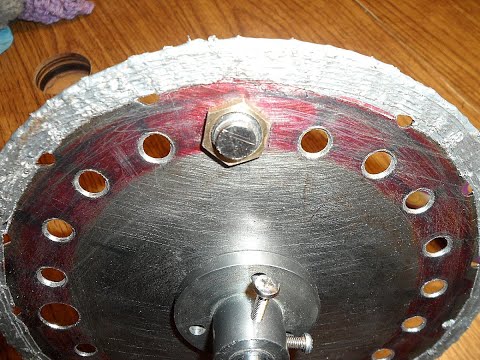
    Last edited by BroMikey; 05-17-2020, 01:16 AM.

    Leave a comment:


  • bistander
    replied
    Originally posted by Treacle View Post
    ...
    Researchers:
    ...

    ETC Or am I wrong?
    Hi Treacle,

    What does ETC stand for?

    And I would like to see comments from Turion regarding the video demonstration of the bifilar generator coil. It confirms what I have said was the reason he sees 'speed up under load'.

    Thanks,

    bi


    ​​​​​

    Leave a comment:


  • BroMikey
    replied
    Steel rotor does not work the same as a liquid plastic non magnetic material. The spaces in between the magnets attract during opposition cancellation and repulse over the magnet counteracting one another. Does not show any improvement using steel rotors as a place holder for magnets. Fiber glass sheets would work well, also carbon fiber GLASS structurally is not considered a liquid. The price for such a plate? Unknown as most only sell 1/8" thick. If you do find some figure $5000 per sq. ft. On the other hand you can buy fiber clothes for little or nothing, mating, resins

    Leave a comment:


  • BroMikey
    replied
    Did some testing after putting the generator back together for Monday class. I notice without the magnets 1 core drag can not go above a higher speed than I have been using to see what happens. As it turns out when I try getting past 1200-1300 rpm's without counter magnets I can turn the amps way up and it won't go faster. On the other hand she goes up to the higher speed with the opposing magnets for only a slight increase. It seems I need to go to the new 28vdc scooter motor for faster speeds and for making more accurate measurements. I can only imagine what 10-12 coils and core would be like if one throws a fit getting past 1300 rpm's

    Leave a comment:


  • BroMikey
    replied
    Originally posted by Treacle View Post
    In fairness, it should be noted that any generator has a counter-action of the rotor with the stator only for the good ones, it is very smooth and for the cheap ones with sticking, when the rotor rotates, this interaction takes away drive energy in any case... Modern generators and motors make of higher quality iron capable of working at 400 or more hertz.

    Models with a core winding almost do not create losses at idle, although even under minimum load they slow down. It would be fair to make a comparative test of ReGenX with just such a generator
    Yes I agree, amorphous material suitable 1000 hz is what the ReGenX man uses. I use 60hz core very bad

    Leave a comment:

Working...
X