This forum is preserved as a permanent archive. The community continues at eMedia Press.

Announcement

Collapse
No announcement yet.

COP 17 Heater | Rosemary Ainslie

Collapse
This topic is closed.
X
This is a sticky topic.
X
X
 
  • Filter
  • Time
  • Show
Clear All
new posts

  • Michael John Nunnerley
    replied
    New Test

    Hi all

    I had a thought last night about what Harvey said about sharp on and off, soooooo I connected a 12v relay to work off the AC outlet from the phasing transformer, which would find its own frequency. It worked and I checked the frequency before we went up in flames. Yes I had a fire, one of my 0.01 caps thought it was fire work night. Soooo I changed both the 0.01 caps to 1mf at 240v, removed the relay and set the frequency on my PWM to the same as the relay, guess what, no fire but powering my 12v 5w bulb, PWM and circuit from my 12v battery.

    These are the great results:-

    Start run voltage on battery 11.72v
    Amp draw total circuit 0.602a
    Battery AFTER 30min run 11.73v and still running

    Before placing the loop back to the battery the voltage was over 1000vac into the FWBR. After the loop connected dropped to 18.7vac (this is under load so there is a very good charge to the battery)

    Below the multiple frequency shot and the wave form

    Mike
    Attached Files
    Last edited by Michael John Nunnerley; 12-10-2009, 05:33 PM. Reason: wrong wattage and amperage

    Leave a comment:


  • witsend
    replied
    Fuzzy's Test #16

    Hi Fuzzy. Did the analysis - finally. The average watts delivered is 7.667. Again we'll have to wait for the heat profile on that new resistor to establish any gains. I notice that the harmonic is evident EVERYWHERE. Nice stuff Fuzzy. And the battery draw down per the data seems zero? I'm intrigued that we are possibly therefore not actually getting the battery draw down rate in these numbers? Something for Harvey to work out. We need that heavyweight intellect!!!!

    But what also stands out in this test is that the MOSFET is cooking? Let us know if there was anything significant in that draw down number - please Fuzzy. And THANK YOU YET AGAIN FOR SUCH IMPECCABLE DATA PRESENTATIONS.


    BTW - the emailed zip number works. Maybe we could stick to this format? If it's not too much trouble. Actually managed to save the files at last. LOL
    Last edited by witsend; 12-10-2009, 03:21 AM.

    Leave a comment:


  • witsend
    replied
    Originally posted by EgmQC View Post
    @witsend

    I had some time ago the same problem as you when i was opening any zip file it was all corrupted. I found the problem, was one of my RAM who was faulty.If you have more than one computer look if both computer have the same type of ram and switch it, re download the same zip file and look if it solve the problem, im about sure its just that but that i can be wrong too, anyway it cost you nothing to try that if you have another computer or a friend who can give you some to test.

    Best Regards,
    EgmQC
    Hi EgmQC. I was sent 3 of the same zips - the first showed up long after the second was posted. Somehow did'nt register in my postbox. The second - I seemed to have posted a correction that registered on all the files including that very first file that came up second. The third file duplicated/triplicated that copy which meant that the first incorrect correction was now all over the place. I think I should have deleted the previous two to access the third without the corruption. I can't copy over from Skype as I don't have Skype on the second computer. That's why I'm asking Fuzzy to send it email. But what is stranger and stranger is that there are a couple of messages in my post box to Fuzzy - that I'm reasonably certain I did not put there? Can't be sure. I'm more than a little absent minded. So odd. It's one thing to have gremlins and hackers - but I'm beginning to think that I'm possibly doing their job - pretty competently I might add - and all on my own. LOL

    Thanks for the advice anyway. I get it that you know about these things. I wish I did.

    Leave a comment:


  • EgmQC
    replied
    Originally posted by witsend View Post
    Hi Mike - and welcome back. Sorry to hear about the difficulties with the family. And sorry I wasn't more help with wire. You may note Aaron's suggestion to get hold of german silver. I'm not sure how easy this is to access - but it's marginally more inductive than the usual wire - I think. I know that Tesla apparently used this in preference to other types.

    And Fuzzy - more problems with that zip file. Somehow the first corruption has taken on a life of it's own. Every zip file I down load now simply opens up with those erroneous values. So sorry to impose - can you please send it to me via email? That way it won't access that corrupted file. Strange happenings on Skype at the moment - but this last problem was entirely my fault. Abject apologies Fuzzy - to impose yet again.
    @witsend

    I had some time ago the same problem as you when i was opening any zip file it was all corrupted. I found the problem, was one of my RAM who was faulty.If you have more than one computer look if both computer have the same type of ram and switch it, re download the same zip file and look if it solve the problem, im about sure its just that but that i can be wrong too, anyway it cost you nothing to try that if you have another computer or a friend who can give you some to test.

    Best Regards,
    EgmQC

    Leave a comment:


  • witsend
    replied
    Hi Mike - and welcome back. Sorry to hear about the difficulties with the family. And sorry I wasn't more help with wire. You may note Aaron's suggestion to get hold of german silver. I'm not sure how easy this is to access - but it's marginally more inductive than the usual wire - I think. I know that Tesla apparently used this in preference to other types.

    And Fuzzy - more problems with that zip file. Somehow the first corruption has taken on a life of it's own. Every zip file I down load now simply opens up with those erroneous values. So sorry to impose - can you please send it to me via email? That way it won't access that corrupted file. Strange happenings on Skype at the moment - but this last problem was entirely my fault. Abject apologies Fuzzy - to impose yet again.

    Leave a comment:


  • Michael John Nunnerley
    replied
    I'm back

    Hi all

    I'm back, but could not find the wire, oh well, my wife's toaster he he.

    I have my daughter with the flue, my wife fell in a hole in the street, just waiting for something to happen to me!!

    I have been thinking about the wire, I have ss wire which is just about the same and the resistance is good, so I think I will make up a coil with this and try it out, let you know the results.

    Mike

    Leave a comment:


  • FuzzyTomCat
    replied
    Test #16

    Hi everyone,

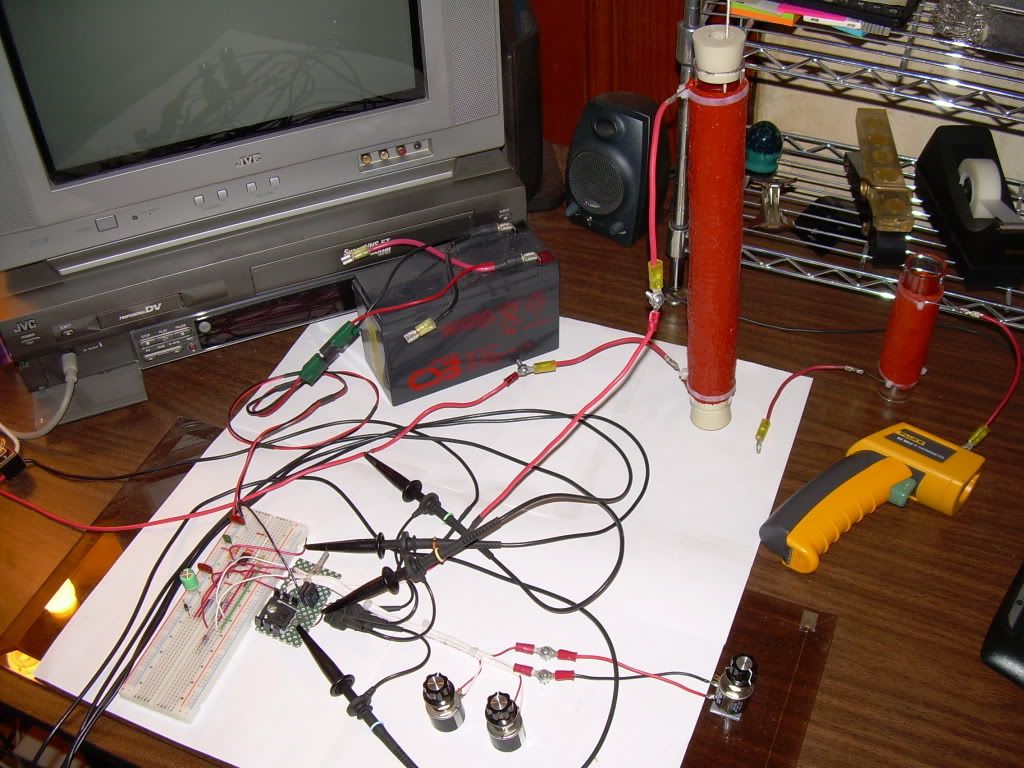
    Here is TEST #16 .... This is a re-test of the experimental prototype borosilicate (32mm OD) tube 10 Ohm load resistor that the coil is 32mm inside Diameter x ten (10) inches long with 48 turns of #20 AWG Ni-Cr Type "A" wire with a calculated 8.64 uH of inductance. This is another one (1) hour test with 40us and 20us readings taken every six (6) minutes for a total of eleven (11) readings or twenty two (22) Image and Data files for one (1) hour.


    TEST #16

    Rosemary Ainslie COP>17 Heater Circuit
    "Quantum" October 2002

    Replication Components -

    1)
    w/ Sil-Pad insulator between Mosfet and Heat Sink

    2) Fairchild Semiconductor - NE555N Timer

    3) Vishay Spectrol - SP534 Percision Potentiometer/ 10-turn 2-Watt

    4) Exide Technologies Battery "Liquid Lead Acid" Model # GT-H - TRACTOR 12V 12Ah CCA 235

    5) CSB Battery Company "Gel Lead Acid" #GP 1270 F2 / 12 Volt 7.0 Ah

    6) Prototype 76mm Load Resister 10 ohm + - 5%

    7) "Shunt" - Caddock High Performance Film Resistor "non-inductive" 30 watt type MP930-0.25-1%


    Temperature Measurements -

    Fluke 62 "mini" IR Themometer ( used maximum reading on each componenet )

    Digital Multi Meter -

    Fluke 87 DMM true RMS

    ************************************************** *******

    Channel 1 - Mosfet source shunt
    Channel 2 - Mosfet drain
    Channel 3 - 555 Timer pin #3
    Channel 4 - 24 VDC "Liquid" Lead Acid Battery Bank


    Original Test #16 12-08-09.zip Image & Data Files


    1_40us

    1_40us_12-08-09.png Image File
    1_40us_12-08-09.CSV Data File
    1_20us
    1_20us_12-08-09.png Image File
    1_20us_12-08-09.CSV Data File


    2_40us

    2_40us_12-08-09.png Image File
    2_40us_12-08-09.CSV Data File
    2_20us
    2_20us_12-08-09.png Image File
    2_20us_12-08-09.CSV Data File


    3_40us

    3_40us_12-08-09.png Image File
    3_40us_12-08-09.CSV Data File
    3_20us
    3_20us_12-08-09.png Image File
    3_20us_12-08-09.CSV Data File


    4_40us

    4_40us_12-08-09.png Image File
    4_40us_12-08-09.CSV Data File
    4_20us
    4_20us_12-08-09.png Image File
    4_20us_12-08-09.CSV Data File


    5_40us

    5_40us_12-08-09.png Image File
    5_40us_12-08-09.CSV Data File
    5_20us
    5_20us_12-08-09.png Image File
    5_20us_12-08-09.CSV Data File


    6_40us

    6_40us_12-08-09.png Image File
    6_40us_12-08-09.CSV Data File
    6_20us
    6_20us_12-08-09.png Image File
    6_20us_12-08-09.CSV Data File


    7_40us

    7_40us_12-08-09.png Image File
    7_40us_12-08-09.CSV Data File
    7_20us
    7_20us_12-08-09.png Image File
    7_20us_12-08-09.CSV Data File


    8_40us

    8_40us_12-08-09.png Image File
    8_40us_12-08-09.CSV Data File
    8_20us
    8_20us_12-08-09.png Image File
    8_20us_12-08-09.CSV Data File


    9_40us

    9_40us_12-08-09.png Image File
    9_40us_12-08-09.CSV Data File
    9_20us
    9_20us_12-08-09.png Image File
    9_20us_12-08-09.CSV Data File


    10_40us

    10_40us_12-08-09.png Image File
    10_40us_12-08-09.CSV Data File
    10_20us
    10_20us_12-08-09.png Image File
    10_20us_12-08-09.CSV Data File


    11_40us

    11_40us_12-08-09.png Image File
    11_40us_12-08-09.CSV Data File
    11_20us
    11_20us_12-08-09.png Image File
    11_20us_12-08-09.CSV Data File


    IMAGE - DATA - THERMAL KEY


    CHANNEL IMAGE SNAP SHOT DATA

    Channel-1 Snap_Shot_12-08-09.png

    Channel-2 Snap_Shot_12-08-09.png

    Channel-3 Snap_Shot_12-08-09.png

    Channel-4 Snap_Shot_12-08-09.png


    100_ns


    100ns_12-08-09.png Image File

    400ns_12-08-09.png Image File

    200ns_12-08-09.png Image File

    4ms_12-08-09.png Image File


    All Images and data by a Tektronix TDS 3054C from the Tektronix Corporation

    Glen

    Leave a comment:


  • ashtweth
    replied
    Fuzzy what a long haul effort there, i will never get tired of making these grateful and thank you posts Bro.

    Leave a comment:


  • FuzzyTomCat
    replied
    Originally posted by witsend View Post
    Hi Fuzzy - many thanks for this data. Not sure of the heat profile on that resistor arrangement - so difficult to get a clear indication of wattage dissipated. I get it that an equivalent heat would probably represent a greater wattage dissipated. Is there a way we can guage how much more? I think Harvey worked it out at a little above 6 watts delivered. Did you still get that harmonic?

    I notice you ran at a slower frequency - and one really interesting value showing a mean average below Zero? Golly. Also, the battery spike looks like a strong recharge - and no evident loss to the battery.

    Thanks again Fuzzy. Looking really good.

    Hi Rosie,

    The results from Test #15 and Test #14 also needs to have a "Temperature Profile" done on the prototype 76mm x 10 Ohm load resistor when I can acquire another 30 Volt variable power supply to get some figures we can go by. The circuit Harmonics were there as strong as ever but when running at a lower frequency the TDS 3054C sampling needs to be at around 200us to see it clearly.

    Glen

    Leave a comment:


  • witsend
    replied
    Test 15

    Hi Fuzzy - many thanks for this data. Not sure of the heat profile on that resistor arrangement - so difficult to get a clear indication of wattage dissipated. I get it that an equivalent heat would probably represent a greater wattage dissipated. Is there a way we can guage how much more? I think Harvey worked it out at a little above 6 watts delivered. Did you still get that harmonic?

    I notice you ran at a slower frequency - and one really interesting value showing a mean average below Zero? Golly. Also, the battery spike looks like a strong recharge - and no evident loss to the battery.

    Thanks again Fuzzy. Looking really good.

    Leave a comment:


  • FuzzyTomCat
    replied
    Test #15

    Hi everyone,

    Here is TEST #15 .... This is a re-test of the experimental 10 Ohm load resistor that is 76mm Outside Diameter with 18 turns of #20 AWG Ni-Cr Type "A" wire with 1mm gap spaceing. The 76mm Borosilicate Tubing has a inside diameter of 66.5mm so the wall thickness is 4.75mm or about 3/16" inches ( a lot to heat ) and will have to do a resistor "thermo profile" to see what the actual results are. This is another one (1) hour test with 40us and 2us readings taken every six (6) minutes for a total of eleven (11) readings or twenty two (22) Image and Data files for one (1) hour. This experiment was the second time testing the "HUGE" 76mm load resistor with a smaller 10 Ohm 100 watt "Wire Wound" resistor with a GE #T464 28 volt lamp connected for tuning, varying in brightness at different frequency's .....


    Test15_Resistor_Set-up_12-07-09.jpg Image File


    TEST #15

    Rosemary Ainslie COP>17 Heater Circuit
    "Quantum" October 2002

    Replication Components -

    1)
    w/ Sil-Pad insulator between Mosfet and Heat Sink

    2) Fairchild Semiconductor - NE555N Timer

    3) Vishay Spectrol - SP534 Percision Potentiometer/ 10-turn 2-Watt

    4) Exide Technologies Battery "Liquid Lead Acid" Model # GT-H - TRACTOR 12V 12Ah CCA 235

    5) CSB Battery Company "Gel Lead Acid" #GP 1270 F2 / 12 Volt 7.0 Ah

    6) Prototype 76mm Load Resister 10 ohm + - 5%

    7) "Shunt" - Caddock High Performance Film Resistor "non-inductive" 30 watt type MP930-0.25-1%


    Temperature Measurements -

    Fluke 62 "mini" IR Themometer ( used maximum reading on each componenet )

    Digital Multi Meter -

    Fluke 87 DMM true RMS

    ************************************************** *******

    Channel 1 - Mosfet source shunt
    Channel 2 - Mosfet drain
    Channel 3 - 555 Timer pin #3
    Channel 4 - 24 VDC "Liquid" Lead Acid Battery Bank


    Original_Test__15_12-07-09.zip Data File


    1_40us

    1_40us_12-07-09.png Image File
    1_40us_12-07-09.CSV Data File
    1_20us
    1_20us_12-07-09.png Image File
    1_20us_12-07-09.CSV Data File


    2_40us

    2_40us_12-07-09.png Image File
    2_40us_12-07-09.CSV Data File
    2_20us
    2_20us_12-07-09.png Image File
    2_20us_12-07-09.CSV Data File


    3_40us

    3_40us_12-07-09.png Image File
    3_40us_12-07-09.CSV Data File
    3_20us
    3_20us_12-07-09.png Image File
    3_20us_12-07-09.CSV Data File


    4_40us

    4_40us_12-07-09.png Image File
    4_40us_12-07-09.CSV Data File
    4_20us
    4_20us_12-07-09.png Image File
    4_20us_12-07-09.CSV Data File


    5_40us

    5_40us_12-07-09.png Image File
    5_40us_12-07-09.CSV Data File
    5_20us
    5_20us_12-07-09.png Image File
    5_20us_12-07-09.CSV Data File


    6_40us

    6_40us_12-07-09.png Image File
    6_40us_12-07-09.CSV Data File
    6_20us
    6_20us_12-07-09.png Image File
    6_20us_12-07-09.CSV Data File


    7_40us

    7_40us_12-07-09.png Image File
    7_40us_12-07-09.CSV Data File
    7_20us
    7_20us_12-07-09.png Image File
    7_20us_12-07-09.CSV Data File


    8_40us

    8_40us_12-07-09.png Image File
    8_40us_12-07-09.CSV Data File
    8_20us
    8_20us_12-07-09.png Image File
    8_20us_12-07-09.CSV Data File


    9_40us

    9_40us_12-07-09.png Image File
    9_40us_12-07-09.CSV Data File
    9_20us
    9_20us_12-07-09.png Image File
    9_20us_12-07-09.CSV Data File


    10_40us

    10_40us_12-07-09.png Image File
    10_40us_12-07-09.CSV Data File
    10_20us
    10_20us_12-07-09.png Image File
    10_20us_12-07-09.CSV Data File


    11_40us

    11_40us_12-07-09.png Image File
    11_40us_12-07-09.CSV Data File
    11_20us
    11_20us_12-07-09.png Image File
    11_20us_12-07-09.CSV Data File


    THERMAL - IMAGE - DATA KEY


    TEST #15_Key_12-07-09.jpg Image File


    Channel-1_Snap_Shot_12-07-09.png Image File

    Channel-2_Snap_Shot_12-07-09.png Image File

    Channel-4_Snap_Shot_12-07-09.png Image File

    Channel-3_Snap_Shot_12-07-09.png Image File


    100ns

    100ns_12-07-09.png Image File

    4us_12-07-09.png Image File

    2us_12-07-09.png Image File

    400ns_12-07-09.png Image File

    All Images and data by a Tektronix TDS 3054C from the Tektronix Corporation

    Glen
    Last edited by FuzzyTomCat; 12-09-2009, 10:00 AM. Reason: Added Information

    Leave a comment:


  • ashtweth
    replied
    Good points Rose thanks for posting this helps us make the case for more help /awareness and sponsorship, i can present this to our area down here with Fuzz's rep to support ALL. CSIRO and Uni are not the only places we have in mind.

    Will also be a the top of the PDF (The forums Uni one) and will update with H and Fuzzies amendments.

    Leave a comment:


  • witsend
    replied
    Guys - this post is to answer a slew of questions that I'm getting from our lay public.

    The experiment that Fuzzy has completed shows that it's theoretically possible to run the average household heating requirements at anything up to and less than 75% of the current that you normally use. This also means that you can reduce your electricity bill by this amount. And also, it means that theoretically, we could reduce global carbon pollution that results from the way we're using electricity, by at least that amount. In fact, with fine tuning, we are not sure of the upper levels of efficiency that can be reached. But the numbers seem to get better with each test.

    The problem is that we needed to prove this which meant that Fuzzy's measurements had to be accurate. Tektronix rallied and we were privileged to use their TDS3054C DPO which, as Fuzzy describes it, - is to measuring - what a Ferari is to driving. Brilliant and perfect. But all oscilloscopes have a limit in the voltages they can measure. This meant that tests had to be kept to 'smallish values'. So. Nothing was tested at really high values. But enough was evidenced to show 'proof of concept'.

    In other words, plenty research still needs to be done. This especially relates to the kind of heating elements which are needed - and the way to make those elements 'resonate' - which is tricky. But notwithstanding this, the facts are that there is early and uniquivocal evidence that we can use electricity very much more economically than we are doing at present. Which is good news, as mentioned, both for the pocket and for the planet.

    The down side is that these results are not really 'allowed' in terms of classical and quantum physics. It's to do with the laws that state - you can only get out what you put in. Something like that. They're known as Thermodynamic Laws and they've been in force and effect since the days of Newton. So. Our academics are justifiably sceptical. In fact they have entirely disassociated themselves from these tests and these claims for upwards of 10 years. We have repeatedly tried to bring them demonstrations and submitted papers that were rejected outright. But we're hoping that this 'open source' application may carry more justification for review as it's sort of 'public'.

    The other thing of interest is that academics may need to revisit those thermodynamic laws. There are plenty of competing theories that account for this 'effect'. But I'm reasonably sure that our learned and revered will come up with an explanation that somehow reconciles these anomalies.

    I'm writing this in the hopes that it'll explain the position better to our lay public - and hope this helps clarify things. And Harvey, Fuzzy, anybody, if I've left out anything critical please do your thing here.

    Hope this helps.

    Leave a comment:


  • Aaron
    replied
    Open Source Evaluation of Power Transients Generated to Improve Performance Coefficie

    PDF http://www.feelthevibe.com/free_ener...ourcepaper.pdf

    DOC http://www.feelthevibe.com/free_ener...ourcepaper.doc

    "This work has been submitted to the IEEE for possible publication. Copyright may be transferred without notice, after which this version may no longer be accessible."


    It's required by ..... http://www.ieee.org/web/publications.../policies.html

    8.1.9 Electronic Information Dissemination

    B. Electronic Preprints. Upon submitting an article to the IEEE for review and possible publication, the author must add the following notice to the first screen of any of his/her previously posted electronic preprint versions of the paper:

    "This work has been submitted to the IEEE for possible publication. Copyright may be transferred without notice, after which this version may no longer be accessible."

    When IEEE accepts the work for publication, the author must add the IEEE copyright notice shown in Section 8.1.9A above to any previously posted electronic versions of the particular paper submitted and provide IEEE with the electronic address (URL, ftp address, etc.) of the primary electronic posting.

    When IEEE publishes the work, the author must replace the previous electronic version of the accepted paper with either (1) the full citation to the IEEE work or (2) the IEEE-published version, including the IEEE copyright notice and full citation. Prior or revised versions of the paper must not be represented as the published version.
    Last edited by Aaron; 12-07-2009, 09:46 PM.

    Leave a comment:


  • witsend
    replied
    Guys - this is some more good wishes.

    "Once again - well done for everything, and please tell the others from me that there must be thousands of people out there, who like me, are rooting for you all".

    Thanks Peter Petes, and - while I'm at it thaelin and rave154 as well. Often seen the two of you on the thread - and good to get some feedback from one of our guests as well as from the two of you.

    It's been said but I guess it could manage a little more repetition. A small list of some of the 'miracles' - Fuzzy's experimental aptitudes, Harvey's breadth of knowledge, Ash and Andews' amazing work in Panacea and in the field, Jibbguy's flair for journalism - DDMDragon's hard work on the earlier papers. That's a winning combination. I might add that I did my fair bit towards the effort by some extensive editing to the wrong document. Still. Every little helps - even if it simply honed the stress levels. LOL

    Leave a comment:

Working...
X