
 Tweet
Tweet
Law of Electro-Magnetic Induction, Seven (1 of 3)
(1) Magnetism is a product of two factors;
One, the Magneto-Motive Force, is, in Ampere-Turn,
Two, The Magnetic Inductance, L, in Henry.
Variation of one or both of these factors results in the variation of the quantity of magnetism. In turn this variation in magnetism develops and E.M.F. in direct proportion to the time rate of this variation. This E.M.F. is developed thru Parameter Variation.
Variation of the parameter magneto-motive force is brought about by the variation of the current, i, in ampere which produces this M.M.F. The M.M.F. and its current are related by,
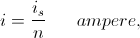
Or,
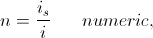
Where
n = Number of Turns.
This number, n, is the ratio of M.M.F. to its current, and it serves as a magnification factor for current flow.
Variation of the parameter Inductance is brought about by the variation of the factor
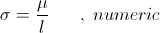
Where
 is the magnetic permeability, in centimeter
 is the magnetic path length, in centimeter.
This factor, , is the effective permeability of the magnetic circuit. The magnetic permeability is a characteristic of the medium which supports the magnetic induction. This is not to be confused with the relative permeability. The magnetic permeability
, centimeter
is an Aether constant derived from One Over c Square. The relation is given by,

Where

c is the Velocity of Light.
Hence the relation is given as

This is the magnetic permeability. In order to simplify mathematical expression the relative permeability is often used. It is given by the relation

Where
 is the magnetic permeability of free space or the Aether. Here then exists three expressions for permeability;
One, Magnetic Permeability,
, Centimeter,
Two, Effective Permeability,
, Numeric,
Three, Relative Permeability,
 , Numeric.
(1) Magnetism is a product of two factors;
One, the Magneto-Motive Force, is, in Ampere-Turn,
Two, The Magnetic Inductance, L, in Henry.
Variation of one or both of these factors results in the variation of the quantity of magnetism. In turn this variation in magnetism develops and E.M.F. in direct proportion to the time rate of this variation. This E.M.F. is developed thru Parameter Variation.
Variation of the parameter magneto-motive force is brought about by the variation of the current, i, in ampere which produces this M.M.F. The M.M.F. and its current are related by,
Or,
Where
n = Number of Turns.
This number, n, is the ratio of M.M.F. to its current, and it serves as a magnification factor for current flow.
Variation of the parameter Inductance is brought about by the variation of the factor
Where
is the magnetic permeability, in centimeter is the magnetic path length, in centimeter.This factor,
, is the effective permeability of the magnetic circuit. The magnetic permeability is a characteristic of the medium which supports the magnetic induction. This is not to be confused with the relative permeability. The magnetic permeability , centimeteris an Aether constant derived from One Over c Square. The relation is given by,
Where
c is the Velocity of Light.
Hence the relation is given as
This is the magnetic permeability. In order to simplify mathematical expression the relative permeability is often used. It is given by the relation
Where
is the magnetic permeability of free space or the Aether. Here then exists three expressions for permeability;One, Magnetic Permeability,
, Centimeter,Two, Effective Permeability,
, Numeric,Three, Relative Permeability,
, Numeric.

 is the total flux inter-linkages between the current, i, and the magnetic induction,
  .
.

 , is called the Reluctance of the magnetic circuit. This reluctance is a mathematical fiction given to give an analogy between the magnetic circuit, and the electric circuit. Where it is resistance in an electric circuit, it is a reluctance in a magnetic circuit. Reluctance is hereby a magnetic resistance. This analogy does not recommend itself. It has become commonplace to express parameter variation in terms of Variable Reluctance. Such is the “Variable Reluctance Generator”. The factor,









 .
.
 Search for "LC100-A" on ebay to find it. It's cheap but very sensitive so pretty good even for measuring the capacitance between the top terminal and the ground plane (although the accuracy of that hasn't been verified, as long as it's constant then it will do nicely for reference).




 . Here the Resistance is the Reaction of the Inductance to the constantly variable current,




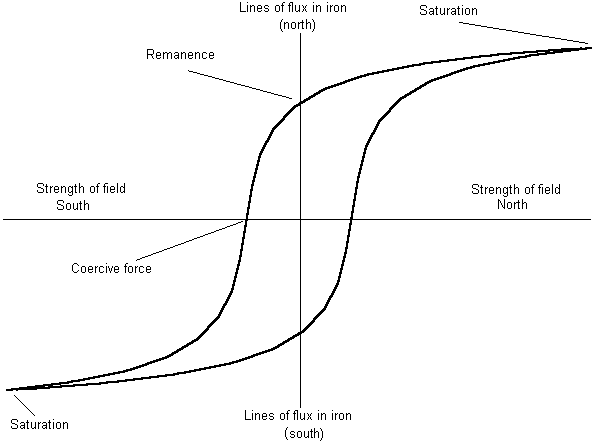
 , expressed the Angle of Hysteresis,
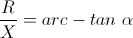
 , is a Positive Impedance but now the Resistance has become an imaginary quantity. Likewise for the opposing quadrant the relation is given as,




Comment