This forum is preserved as a permanent archive. The community continues at eMedia Press.

Announcement

Collapse
No announcement yet.

Stingo Solid State Battery Charger

Collapse
X
 
  • Filter
  • Time
  • Show
Clear All
new posts

  • sucahyo
    replied
    Originally posted by 7imix View Post
    I have been performing some measurements with my little scope and my nice new high voltage probe. With the spark gap running I have measured up to about a megahertz. With no load I was able to get way up high above audible range, something like 25mhz. I will measure again and take more accurate notes.
    That is very high. That is not a typo?

    How many volts at low voltage side?

    Originally posted by 7imix View Post
    Thanks again sucahyo! Your circuit is great!
    Thank you. I really glad if my circuit is usefull .

    Leave a comment:


  • 7imix
    replied
    Godfrey, thanks for starting this thread, and sucahyo, thanks for discovering the stingo. :-)

    The stingo is absolutely my favorite thing to experiment on, and I anticipate it will continue to be. I have had so much fun building a couple and experimenting with them. The stingo sparker is my favorite. I have tried replicating the modification with a brushed dc motor but I don't have exactly the right parts and it is not working as it should.

    I have been performing some measurements with my little scope and my nice new high voltage probe. With the spark gap running I have measured up to about a megahertz. With no load I was able to get way up high above audible range, something like 25mhz. I will measure again and take more accurate notes.

    I measured about 2000 volts off the high voltage side, which seems a bit low to me. I will go back and double check my measurements. Also, I measured about 800 volts with the probe just in the air, a few feet away from the apparatus! It diminishes as I move the probe radially outwards. I will take a movie of this. It's quite interesting.

    I also did some experiments hooking up some capacitors and bars, hairpin style. I was able to get it to light a couple of neon bulbs. Will definitely do more experiments with this! Awesome.

    I need to get my camera charged and take some video. I have lots of observations to share.

    Thanks again sucahyo! Your circuit is great!

    Leave a comment:


  • SeaMonkey
    replied
    Originally posted by sucahyo View Post

    Sorry, I can't explain it either. I found it by accident. That is more efficient than using the PNP in a normal way. Harvey suggest an SCR to replace it but for me, TIP32C is more obtainable and cheaper.

    To increase efficiency, to prevent too much normal electricity flowing to the load.
    The PNP Transistor is connected to operate in what
    is known as "inverse mode." The Collector is functioning
    as the Emitter and the Emitter is functioning as the
    Collector.

    By working in "inverse mode" it effectively reduces the
    base drive to the NPN Switching Transistor thereby
    preventing it from being overdriven.

    The Current Gain (Beta) of a transistor in inverse mode
    is approximately 10% of normal gain.

    To attain the same effect with the PNP Transistor
    in normal mode a variable resistor could be connected
    in series with the NPN Base lead in order to "tune"
    base drive for maximum efficiency.

    There is nothing wrong with "inverse mode" operation.
    It is seldom used but a good "trick" to remember when
    it can be taken advantage of.

    Leave a comment:


  • sucahyo
    replied
    Originally posted by Godfrey View Post


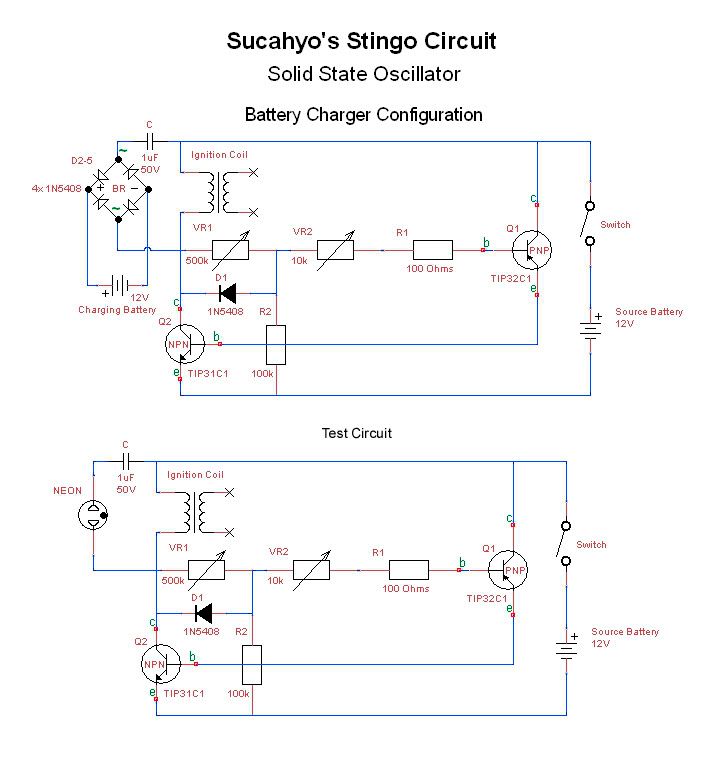
    The second circuit is a test configuration. If everything’s working, it should light the neon, right? Please let me know if you see anything amiss.
    It suppose to lit but you don't need capacitor. You have to put atleast a diode if you intend to charge battery.

    My capacitor is rated for 250V too.

    Originally posted by Godfrey View Post
    If it’s all about generating and collecting the maximum back EMF, the secondary of the car ignition coil is not used, right?
    Yes. I wound my coil without secondary. For safe operation, short the secondary.

    Originally posted by Godfrey View Post
    What is the working source battery voltage range for driving a typical car ignition coil?
    From 3V to 24V, what ever you have and what ever output you need.

    Originally posted by Godfrey View Post
    What is the frequency range? I remember you said it can get very high. What’s appropriate for this type of coil?
    Above audible range down to 50Hz depend on load, coil and resistor value.

    Originally posted by Godfrey View Post
    It’s a type of complimentary multivibrator that I’m not familiar with. Can you describe its two states? I’m confused in particular as to how the emitter of the PNP transistor feeds the base of the NPN one. It would make more sense to me if it were the collector instead.
    Sorry, I can't explain it either. I found it by accident. That is more efficient than using the PNP in a normal way. Harvey suggest an SCR to replace it but for me, TIP32C is more obtainable and cheaper.

    Originally posted by Godfrey View Post
    What exactly does the capacitor do? Is it a low frequency filter? Won’t it give the output wave a sinusoidal shape?
    To increase efficiency, to prevent too much normal electricity flowing to the load.

    In my opinion, the spike is bouncing, so by using FWBR I get the weaker reverse bounce too and I use capacitor to prevent the load from getting powered by the source battery.

    Originally posted by Godfrey View Post
    For charging smaller batteries, it would need a different coil that could be driven on smaller voltages than 12V, right?
    I am using same circuit to charge any kind of battery between 1.5V to 12V. I don't think you can make 1.5V nicad overheat if you only use one stingo
    Last edited by sucahyo; 09-27-2010, 06:17 AM.

    Leave a comment:


  • Godfrey
    started a topic Stingo Solid State Battery Charger

    Stingo Solid State Battery Charger

    Last edited by Godfrey; 09-27-2010, 04:01 AM.
Working...
X