This forum is preserved as a permanent archive. The community continues at eMedia Press.

Announcement

Collapse
No announcement yet.

Single Wire Power - A Search for Ambient Power to do Wwork

Collapse
X
 
  • Filter
  • Time
  • Show
Clear All
new posts

  • DavidE
    replied
    dR-Green

    I think you will find that in fact the light output measured in watts is less than the power you input to run the circuit. No amount of Tesla coiling or spark gaps or increasing the voltage or number of turns or anything else will change this.
    Pulsed DC and its link with the environment is the new black. Don't agree with me, just write a little note somewhere very secret... and watch the world change. I won't have to do or say anything more.


    Leave a comment:


  • mikrovolt
    replied
    Originally posted by dR-Green View Post
    I'm talking about single wire transmission, and I believe I've already said the radiant energy patent is based on receiving energy from the environment. Also that you may use natural activities to your advantage.

    There is nothing to suggest that energy comes from the environment to cause a load to work with one wire.

    From Colorado Springs Notes


    Capacitors are used in high pass filters and for DC blocking because DC can't pass through the open circuit. But AC quite readily passes through. Bigger capacitance allows lower frequencies through. Cutoff frequency increases as capacitance is decreased. You hear it in effect every time you listen to music, as it's all filtered and EQ'd. That's how the electronic audio equipment works.


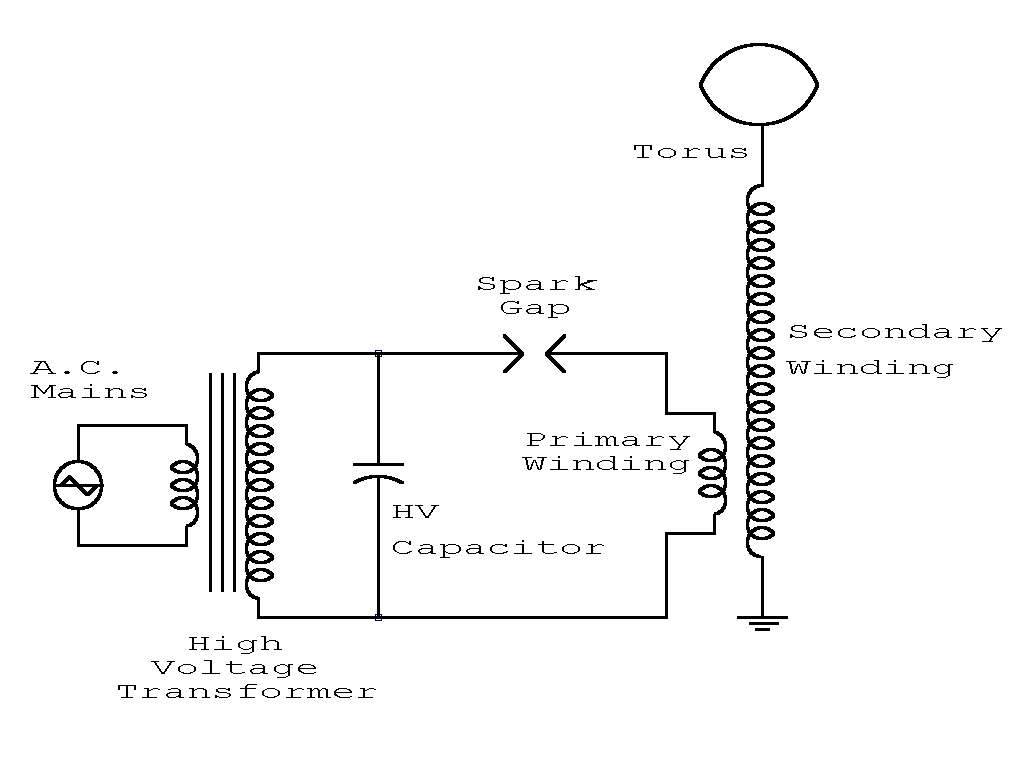
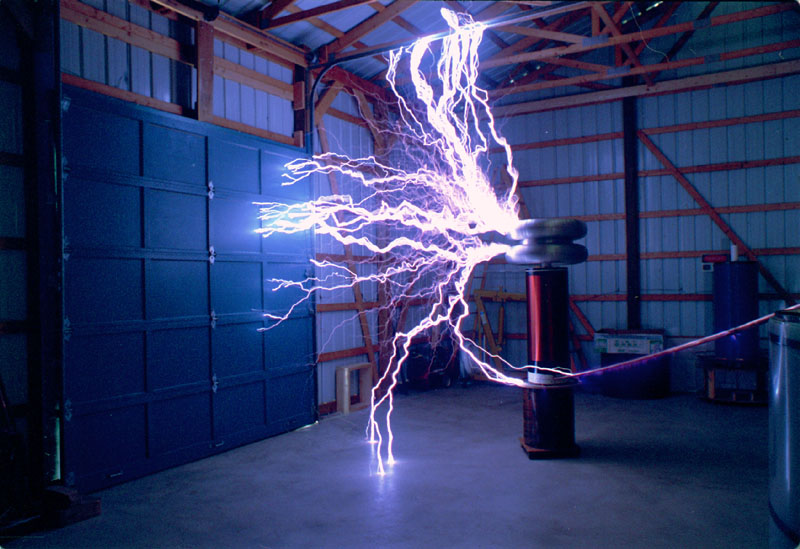
    1/4 wave resonance (for example) is possible because a standing (quarter) wave distributes itself along the length of the conductor. There are different potentials at every given point along the conductor despite the fact in your mind you think it's a short circuit or it should all be at the same potential. It's not at the same potential 5cm down the line because the potential is distributed according to the standing wave. That's also why sparks appear at the top of a Tesla coil and not along the whole thing. There's a potential gradient from ground potential to the terminal potential.


    The picture illustrates in a neon tube what occurs on the stout copper bars or supposed hairpin circuit. Light and dark, or energised regions, appear according to the driving wavelength/frequency. Connect your bulb to the high potential point and it will light. Connect your bulb to the low potential point, and it won't.

    Tesla explains it all very well in his article on the experiment.
    Within the parameters of the transmission system very conservative models
    where derived.

    In Tesla's study of how to convey power through the atmosphere Tesla mentions dielectric charecteristics of gases being insulator prone unless rarified or under terrific electrical stress.
    He does describe the (ambient) yet unobservable charecteristics under such conditions.
    looking at patent line 85 of page 1.


    Study of spider webs Brazil where water droplets form on the silk it is now understood that
    such drops have significant NET charge.

    Nasa study of water droplets around a knitting needle in zero G show analogous
    properties easily misundertood but simular to electromagnetic but is a charge field.
    Orbits and static electrical forces around dielectrics in natural low density enviroment.
    Last edited by mikrovolt; 06-12-2015, 05:35 PM.

    Leave a comment:


  • dR-Green
    replied
    Originally posted by DavidE View Post
    dR-Green

    "The so-called "hairpin" portion can be considered a load across the Tesla coil secondary. It's a closed loop when the far end is closed or a bulb connects both sides."

    Not to parse, but this tells me that you personally have not done much work with this circuit. Leave off the shunt, either side individually will power a load.
    Originally posted by dR-Green View Post
    use portions G, S and P. That essentially makes up a Tesla coil which is all you need to produce the single wire effects.
    ..........

    Leave a comment:


  • dR-Green
    replied
    He did not say that single wire transmission = radiant energy or ambient energy or gaining energy from the environment or whatever the case may be.

    I think you will find that in fact the light output measured in watts is less than the power you input to run the circuit. No amount of Tesla coiling or spark gaps or increasing the voltage or number of turns or anything else will change this.

    Leave a comment:


  • DavidE
    replied
    dR-Green

    "The so-called "hairpin" portion can be considered a load across the Tesla coil secondary. It's a closed loop when the far end is closed or a bulb connects both sides."
    Not to parse, but this tells me that you personally have not done much work with this circuit. Leave off the shunt, either side individually will power a load.
    Last edited by DavidE; 06-12-2015, 05:32 PM.

    Leave a comment:


  • DavidE
    replied
    So what did Peter say anyway?

    Radiant Energy

    Leave a comment:


  • dR-Green
    replied
    Originally posted by DavidE View Post
    dR-Green

    Who said anything about Free Energy? There are always costs.

    Look at the schematics - both the Tesla Coil and Hairpin circuit ARE SWP SYSTEMS. If you say not, then where are the thousands of volts of potential coming from?

    Have you ever reviewed Don Smith's Tesla Coil with collection circuits?

    Don't blame Peter - he is innocent.
    Well, the stout copper bars experiment is a loop rather than a single transmission line. You could do away with all that and simply use portions G, S and P. That essentially makes up a Tesla coil which is all you need to produce the single wire effects.

    The so-called "hairpin" portion can be considered a load across the Tesla coil secondary. It's a closed loop when the far end is closed or a bulb connects both sides.

    I'm not sure what the thousands of volts potential has to do with it being one wire or not.

    I'm not blaming Peter as such. If you give someone a brick you're not responsible for what they build with it. He could never have envisioned which way it would go. I've explained something to people and they immediately think I mean something else or apply their own explanation to twist it around to match what they already had in mind. You can cause a big mess no matter how good your intentions may be.

    Leave a comment:


  • DavidE
    replied
    Spark Gap... Abrupt Discharges = Radiant Energy (Ambient)


    From that point there are countless variations, but the results are mostly the same.

    Don't accept this claim, but do research the inventors that you dare not mention. Or not.

    Leave a comment:


  • DavidE
    replied
    dR-Green

    Who said anything about Free Energy? There are always costs.

    Look at the schematics - both the Tesla Coil and Hairpin circuit ARE SWP SYSTEMS. If you say not, then where are the thousands of volts of potential coming from?

    Have you ever reviewed Don Smith's Tesla Coil with collection circuits?

    Don't blame Peter - he is innocent.

    Leave a comment:


  • dR-Green
    replied
    Tesla started some research. But he never claimed that his single wire or wireless transmission devices produced free energy, or radiant energy for that matter.

    Tesla's use and definition of radiant energy is discussed in the radiant energy patent. Enough to reproduce it and get the job done.

    U.S. Patent 685,957 - Apparatus for the Utilization of Radiant Energy | Tesla Universe


    To expand on Carroll's question, who is it that thought they knew better than Tesla and decided it would be a good idea to merge all these different things into one mush of (mis)understanding?

    We have a boat with wheels because some bright spark didn't realise that the boat and the car were meant to be two different kinds of vehicles. The propeller prevents it from working on land, and the doors are below the water line.

    Leave a comment:


  • DavidE
    replied
    dR-Green

    Tesla started this in 1889. I am surprised that you are not willing to accept the broader interpretation of his discovery.

    <just finishing putting peanut butter on my toast>

    Leave a comment:


  • DavidE
    replied
    Per Bedini

    RADIANT ELECTRICITY

    Leave a comment:


  • dR-Green
    replied
    Originally posted by citfta View Post
    Where did the idea come from that there was something special about either of these circuits? Does anyone know?
    Good question. Personally I can only conclude that it's a result of what was unwittingly began by Peter Lindemann concerning the radiant energy lecture/video he made. That has spawned all kinds of stuff that it's now impossible to undo.

    Then "youtube experts" take it further and speak as an authority, which thousands of people watch to get educated. And so it becomes the gospel.

    Everything is explained by "radiant energy", so we can start the club. But unfortunately, no one knows what "radiant energy" is. So the explanation that satisfies the mind is a non-explanation.

    P.S. radiant energy exists. If it didn't then the sun would be ineffective and your house central heating system would be pointless. Where there is radiation, energy is radiated, and so it is radiant energy. Radiant energy toasts your bread in the morning.

    ... But I'm guessing that's not what you meant.

    Leave a comment:


  • DavidE
    replied
    citfta

    Your contributions relative to ARRL information has been noted and most assuredly holds a measure of potential.

    Do you ride a horse to work?

    <electrostatic potentials and the subsequent release of kinetic Radiant Energy from the omnipresent ether>

    Of all the great inventions and discoveries of Nikola Tesla, nothing stood out with greater potential benefit to the whole of humanity than his discovery of Radiant Energy in 1889. The series of observations that led to the discovery of Radiant energy initially grew out of experiments that Tesla had conducted in an attempt to duplicate the results that Heinrich Hertz had claimed to achieve in affirming the existence of electromagnetic waves, the discovery of which Hertz announced in 1887. While replicating Hertz’s experiments, Tesla experimented with violently abrupt DC electrical discharges and discovered a new force in the process. Only after conducting exhaustive experimental trials for the next three years, did Tesla announce this stupendous discovery in a paper published in December, 1892, entitled “The Dissipation of Electricity”. Incredibly, most academicians of the day completely missed the mark in understanding the true significance of his paper. Noted scientists such as Sir Oliver Lodge, mistakenly thought that Tesla was referring to high frequency AC electricity in the operation of the Tesla Transformer, a huge blunder that remains to this day in the misnaming and misinterpretation of the Tesla Coil. The transformer that Tesla referred to in the 1892 paper did not operate on magnetic/electric field induction created by alternating currents. It operated in an entirely new domain of physics based on abrupt discharges of electrostatic potentials and the subsequent release of kinetic Radiant Energy from the omnipresent ether. Tesla was now operating under entirely new rules which he referred to as “dynamic” electro-static forces and had, by now, completely abandoned any further interest in the AC waveform. The genesis of the Lodge misunderstanding, however, began a few years earlier with the publication of certain mathematical formulas by a brilliant Scotsman named James Clerk Maxwell.
    Spark Gap... Abrupt Discharges = Radiant Energy (Ambient)


    Last edited by DavidE; 06-12-2015, 03:22 PM.

    Leave a comment:


  • citfta
    replied
    I am going to add my 2 cents worth to this discussion. It seems there are two points of view in this thread. Some believe there is something special about single wire transmission and the "hairpin" circuit and others do not. If I am not understanding these two points of view then someone can correct me later.

    I have already suggested that those looking at this single wire transmission idea should study about SWR and in particular the ARRL amateur radio operators handbook. Apparently that advice has been ignored.

    If those who really want to understand about single wire transmission and the hairpin circuit would take the time to actually study they would understand why there is really nothing special going on with either circuit. But I guess they don't want to risk destroying their belief in something they believe is special.

    If you were going to try and build a better race car engine would you ignore all the engineering efforts that had already been done? How can you possibly expect to build a better circuit if you won't even take the time to learn how circuits work from a conventional point of view. You have to start from some kind of solid foundation before you can even hope to build something better.

    I have been accused many times on this forum of not being a believer in OU or free energy or what ever you want to call it. I am a firm believer that OU is possible but I hate to see people wasting their time looking at something that is not what they think it is.

    As far as radiant energy goes I think it does exist. I have seen some very interesting things happen when hitting an inductance with short high energy pulses. If you want to work with radiant energy try pulsing the input to a transformer with short pulses and see what the output will do with different kinds of loads. You will not find any radiant energy in the single wire circuit or the hairpin circuit.

    My only goal in posting this is to help people see they are wasting their energy and time looking at the one wire circuit or hairpin circuit if they are looking for some kind of free energy. Both these circuits are good learning tools but not OU in any way.

    Respectfully,
    Carroll

    PS: I am curious about something. Where did the idea come from that there was something special about either of these circuits? Does anyone know?
    Last edited by citfta; 06-12-2015, 11:48 AM.

    Leave a comment:

Working...
X