-
Let us not forget the classic sine waveform actually represents a helix and not the two dimensional representation we see even when it represents a standard sine wave -
I think the point is that we can get caught up in minutiae and end up going in circles, instead of moving forward.Originally posted by thx1138 View Post
What I can take away from the last page or so is an affirmation that we indeed live in an electric universe, and that no electrical system is a completely closed system, while some are deliberately designed as open systems. The electric universe or aether can supply additional energy to an electrical system under the proper conditions, particularly when a pulse is involved. And the energy output of a pulsed system (drawing on the ambient) is equal to the cube of its frequency - doubling the frequency of a pulse can increase the aether's charge response by a cubed factor of that doubling (i.e., 2x2x2 = 8).
There's a vast reservoir that can be tapped with the right wave forms and coil arrangements. This reservoir will supply a circuit, particularly one using a lead acid battery, with a huge amount of charge which does not behave like ordinary voltage (or current), and is difficult to measure.
Now, keeping in mind that the aether's response to an open system produces a different kind of charge than that which is conventionally measured, we need different terminology to account for its movements in supplying a system.
One of our contributors has talked about charge density and its relationship with voltage in a pulsing system. I'll defer to him to perhaps say something when he's ready, or if he prefers, I'll take a crack at it from our exchanges.
BobLeave a comment:
-
Like biology the nomenclature had to be revised many times.
They finally got it down to a hierarchy charts and now computers use genes.
The electric universe has some interesting beginnings and interesting scientist.
To compare Tnx images to planet surface scaring.
"If we could just make an I-Max movie of this I think we could make it "Last edited by mikrovolt; 11-18-2015, 11:00 PM.Leave a comment:
-
I didn't make it up so what's your point? If you can't comprehend how the motion of a piston can be represented by a sine wave or at least a triangle wave, and that sine waves don't automatically and exclusively imply electromagnetic waves, and prefer to dispense insults claiming that it's (I'm) wrong then there's nothing more to say. The fact that you are able to hear different waveforms and pitches proves it for a start. You are the one who's missing the point so all the more that you don't understand.Originally posted by DavidE View PostLeave a comment:
-
dR-Green
Wait for it...
dR-Green said:
At least we agree relative to your black and white attitude - and you demonstrate it beautifully, "That's just how it is."That's just how it is.
Might you hold open a small space of possibilities that you are not yet able to comprehend?Leave a comment:
-
https://www.youtube.com/watch?v=3yE4d7O17wE – The best overview of fractal geometry I’ve seen.Originally posted by Duncan View Post
Note in that video the role computers played in the development of fractal geometry. It could not be useful until the advent of the computer. Euclidean geometry served mankind well but I think its time has passed in development of power systems that extract energy from the environment.
The only things I've seen that get near fractal geometry are the antennas said to be fractal antennas yet they too are built with three dimensional geometry with straight lines and sharp corners.
I was looking at natural fractal patterns of river beds the other day and it occurred to me how similar they are to lightning and Lichtenberg figures. That got me thinking about things that flow and there are a lot of similar patterns, like the circulatory systems of plants and animals and, to some extent, the neuron networks in brains. That is somewhat interesting because the second presentation in the longitudinal wave video linked above mentions these thing but doesn't get into fractals. That might be because they weren't commonly known at the time the video was made.
Trees
Lichenteberg Figures
Lightning
Google Earth Rivers
More later. This is probably too long now.Last edited by thx1138; 11-18-2015, 11:35 PM.Leave a comment:
-
It's not my interpretation. Sine waves don't imply transverse waves. Longitudinal waves can be sine or of any other conceivable waveform. Wavelength is not the unit of the electromagnetic wave. That's just how it is.Originally posted by DavidE View Post
Being limited to seeing something according to one's limited momentary frame of reference doesn't escape me. I'm witnessing it right now.Leave a comment:
-
dR-Green
And you are acting as though your interpretations are somehow universal law. Man in this age can only see according to their momentary frame of reference. This somehow escapes you.You're mixing up terms and components.Leave a comment:
-
Categories of Waves
When Dollard made that video he was adapting the lecture on math equivalents for
a ham radio club distracted by audience member. It may have been more accepted at that time if expressed something like this:
The oscillating current (mode) of the impulse waveform
used by Tesla was utilized in units of cycles decibels per second.
Note the non-asymptotic attribute on a graph dips below zero.
Here is the hyperbolic expression...
What is important is that he stated the idea that probably someone with
RCA helped in his learning long ago and we get a mix of his own math and research.
Using a current probe type instrument would be inherent to antenna design
radio enthusist spark gap transmitters a favorite subject was the best voltage and velocity
for ham transmission such as 80 and 160 meters. In making strong reference
I can tell you his talk off air was more radio philosophy from a math research.Last edited by mikrovolt; 11-17-2015, 11:24 PM. Reason: hyperbolic acoustics of nickel core from a sine to pulse forming networkLeave a comment:
-
Leave a comment:
-
I don't agree that what are often referred to as longitudinal "waves" are actually waves at all. It is my understanding that they are more like vectors or impulses.
I believe these longitudinal impulses are what we are looking for with single wire power, and that standard electrical measuring equipment is unable to measure them. Graham Gunderson seems to allude to this here:
BobLeave a comment:
-
You're mixing up terms and components.Originally posted by Duncan View Post
A longitudinal wave has a wavelength. Wavelength is the distance between any one point and the same point in the next repeating cycle. That is the length of the full wave, or one whole cycle.
If a longitudinal wave didn't have wavelength and frequency then there would be no such thing as music as it would be impossible to play any pitch (frequency).
A sine wave can be representative of anything. It's a value that changes over time.
A picture of a sine wave represents a longitudinal wave just as well as it represents a transverse wave. The compression and rarefaction zones are distributed as a sine wave.

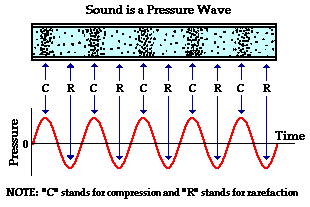

A longitudinal wave can be sine or anything else, which is how it's possible to produce different sounds.
If you press a button softly and increase the pressure gradually before easing off the pressure again, the pattern it produces when pressure vs time is plotted on a graph is a sine wave. Switch the button on and off and the graph gives you a square wave. Vary it in any given fashion and you produce all kinds of waveforms. Value over time.
acoustics - How can a sine wave represent a longitudinal wave? - Physics Stack Exchange
AT&T Archives: Similiarities of Wave Behavior (Bonus Edition) - YouTube
Sine waves have nothing to do with propagating through space while still looking like a sine wave. It's a visual representation of how the value of some variable changes over time.Last edited by dR-Green; 11-17-2015, 04:20 PM.Leave a comment:
-
Originally posted by Duncan View Post
Don't give up, even I (EVEN ME ) am starting to understand what Eric had stated years ago. Thanks DUNCAN
 Listening again now!!!!
It is so hard to out do the chirping bit of the university drill, burning through
the cerebral cortex. After graduation comes the chomping.
Last edited by BroMikey; 11-17-2015, 07:51 AM.
After graduation comes the chomping.
Last edited by BroMikey; 11-17-2015, 07:51 AM.Leave a comment:
This forum is preserved as a permanent archive. The community continues at eMedia Press.
- If this is your first visit, be sure to check out the FAQ by clicking the link above. You may have to register before you can post: click the register link above to proceed. To start viewing messages, select the forum that you want to visit from the selection below.


 . Wavelength is the unit of the electromagnetic wave. It certainly isn't the unit of the longitudinal wave . although it may be said to have a period. As I'm asking you to consider the electrical (equivalent) affects of this wave after what you may consider the (equivalent) of demodulation it is essential that you grasp the nature of it.


Leave a comment: