
NO 1:
[QUOTE]
Originally posted by cikljamas
View Post

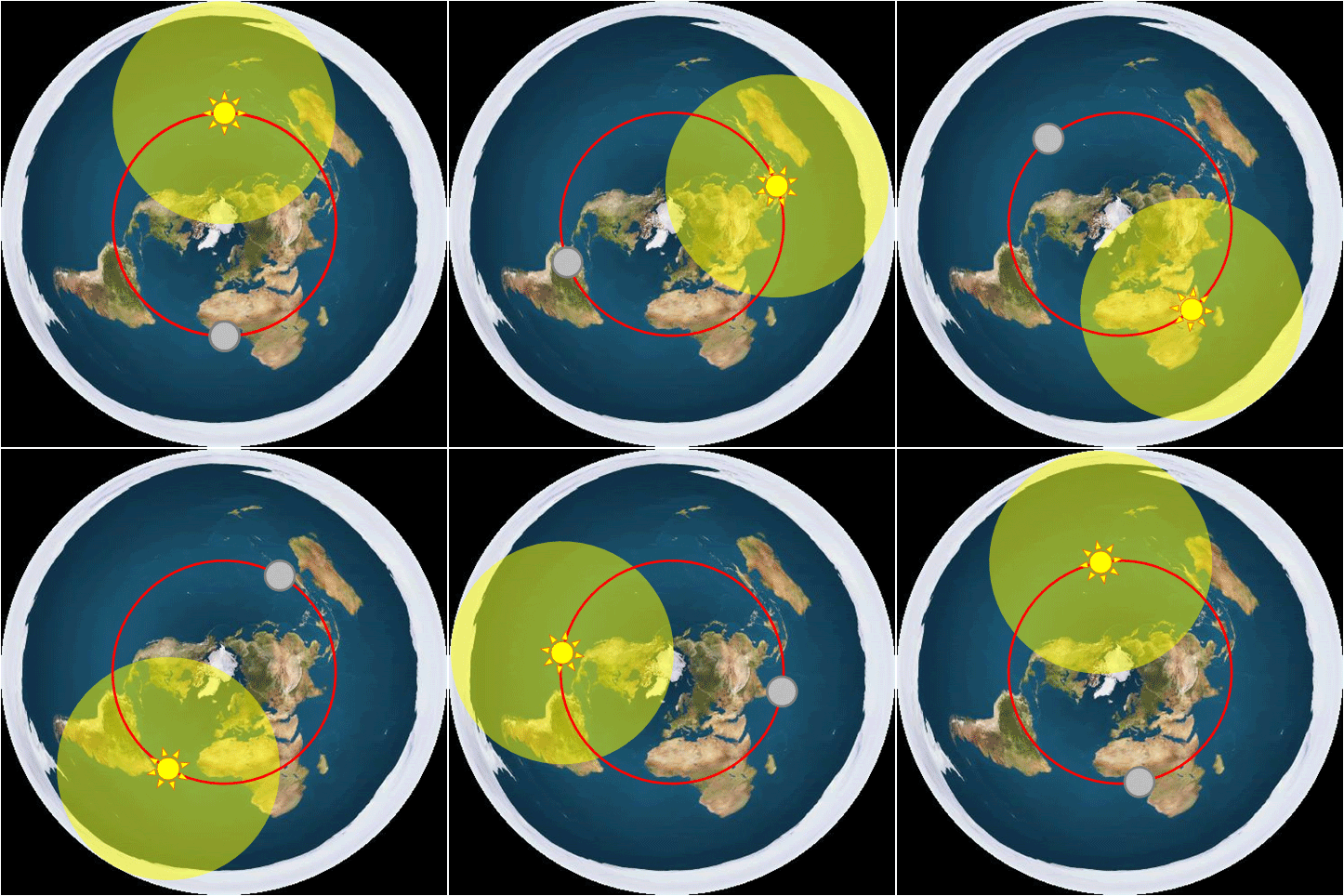
 (Nice animation also!)

Beside maintaining the Earth's alleged rotation at a constant speed they should also adjust (which they can't) Earth's orbital speed so to be constant (not variable) as well.
Now, let's do some math:
January (perihelion): 30,300 km/s * 3600 = 109,080 km/h
July (aphelion): 29,300 km/s * 3600 = 105,480 km/h
January: 109,080 * 24 = 2,617,920 km per day
July: 105,480 * 24 = 2,531,520 km per day
Difference: 86,400 km per day * 30 = 2,592,000 km per month
Now, compare this difference with next excerpt:
So, we are off for one whole day (4 min) per month! HC is really tragically funny theory with no basis in reality whatsoever!!!
The Earth's orbit is not perfectly circular. As a result its velocity changes slightly over the course of the year. At its closest to the Sun in January, the Earth is moving 30,300m/s, while at its furthest it is moving 29,300m/s.
Although 1km/s is a large change of velocity, it occurs gradually over 6 months, so we feel no real acceleration from it. The acceleration that is present is dwarfed by that of Earth's gravitational pull.
Although 1km/s is a large change of velocity, it occurs gradually over 6 months, so we feel no real acceleration from it. The acceleration that is present is dwarfed by that of Earth's gravitational pull.
January (perihelion): 30,300 km/s * 3600 = 109,080 km/h
July (aphelion): 29,300 km/s * 3600 = 105,480 km/h
January: 109,080 * 24 = 2,617,920 km per day
July: 105,480 * 24 = 2,531,520 km per day
Difference: 86,400 km per day * 30 = 2,592,000 km per month
Now, compare this difference with next excerpt:
A sidereal day is the amount of time it takes for the stars to go once around the sky, equal to 23 hours and 56 minutes. The word sidereal means "relating to the stars." The difference in length between the solar and sidereal day causes the rising and setting times of stars to change throughout the year. If the star Rigel, for example, rises at noon today, it will rise at 11:56 tomorrow. In six months, it will rise at midnight. Because the difference between solar days is tied to the orbit of the Earth, there is exactly one more sidereal day in a year than there are solar days.
Can this help us to have better insight into this issue:
Longyearbyen experiences midnight sun from 19 April through 23 August, polar night from 27 October through 14 February and civil polar night from 14 November through 29 January.
So, these numbers are very interesting:
1. Midnight sun from 19 April through 23 August = 123 days
2. Polar night from 27 October through 14 February = 110 days
3. Civil polar night from 14 November through 29 January = 76 days
123 - 110 = 13 days
NO 3:
[QUOTE]
 Maybe you think that you could use FET videos as a proof against it (FET), i just don't see how? Maybe you could explain it to us with your own words?.




Leave a comment: