This forum is preserved as a permanent archive. The community continues at eMedia Press.

Announcement

Collapse
No announcement yet.

The Brain is an Advanced Fractal Antenna

Collapse
X
 
  • Filter
  • Time
  • Show
Clear All
new posts

  • The Poetic Edda: Voluspo

    part II

    37. Northward a hall | in Nithavellir
    Of gold there rose | for Sindri's race;
    And in Okolnir | another stood,
    Where the giant Brimir | his beer-hall had.

    38. A hall I saw, | far from the sun,
    On Nastrond it stands, | and the doors face north,
    Venom drops | through the smoke-vent down,
    For around the walls | do serpents wind.

    40. The giantess old | in Ironwood sat,
    In the east, and bore | the brood of Fenrir;
    Among these one | in monster's guise
    Was soon to steal | the sun from the sky.

    41. There feeds he full | on the flesh of the dead,
    And the home of the gods | he reddens with gore;
    Dark grows the sun, | and in summer soon
    Come mighty storms: | would you know yet more?

    43. Then to the gods | crowed Gollinkambi,
    He wakes the heroes | in Othin's hall;
    And beneath the earth | does another crow,
    The rust-red bird | at the bars of Hel.

    44. Now Garm howls loud | before Gnipahellir,
    The fetters will burst, | and the wolf run free;
    Much do I know, | and more can see
    Of the fate of the gods, | the mighty in fight.

    46. Fast move the sons | of Mim, and fate
    Is heard in the note | of the Gjallarhorn;
    Loud blows Heimdall, | the horn is aloft,
    In fear quake all | who on Hel-roads are.

    47. Yggdrasil shakes, | and shiver on high
    The ancient limbs, | and the giant is loose;
    To the head of Mim | does Othin give heed,
    But the kinsman of Surt | shall slay him soon.

    49. Now Garm howls loud | before Gnipahellir,
    The fetters will burst, | and the wolf run free
    Much do I know, | and more can see
    Of the fate of the gods, | the mighty in fight.

    50. From the east comes Hrym | with shield held high;
    In giant-wrath | does the serpent writhe;
    O'er the waves he twists, | and the tawny eagle
    Gnaws corpses screaming; | Naglfar is loose.

    52. Surt fares from the south | with the scourge of branches,
    The sun of the battle-gods | shone from his sword;
    The crags are sundered, | the giant-women sink,
    The dead throng Hel-way, | and heaven is cloven.

    53. Now comes to Hlin | yet another hurt,
    When Othin fares | to fight with the wolf,
    And Beli's fair slayer | seeks out Surt,
    For there must fall | the joy of Frigg.

    55. Hither there comes | the son of Hlothyn,
    The bright snake gapes | to heaven above;
    . . . . . . . . . .
    Against the serpent | goes Othin's son.

    56. In anger smites | the warder of earth,--
    Forth from their homes | must all men flee;-
    Nine paces fares | the son of Fjorgyn,
    And, slain by the serpent, | fearless he sinks.

    58. Now Garm howls loud | before Gnipahellir,
    The fetters will burst, | and the wolf run free;
    Much do I know, | and more can see
    Of the fate of the gods, | the mighty in fight.

    59. Now do I see | the earth anew
    Rise all green | from the waves again;
    The cataracts fall, | and the eagle flies,
    And fish he catches | beneath the cliffs.

    61. In wondrous beauty | once again
    Shall the golden tables | stand mid the grass,
    Which the gods had owned | in the days of old,
    . . . . . . . . . .

    62. Then fields unsowed | bear ripened fruit,
    All ills grow better, | and Baldr comes back;
    Baldr and Hoth dwell | in Hropt's battle-hall,
    And the mighty gods: | would you know yet more?

    64. More fair than the sun, | a hall I see,
    Roofed with gold, | on Gimle it stands;
    There shall the righteous | rulers dwell,
    And happiness ever | there shall they have.

    65. There comes on high, | all power to hold,
    A mighty lord, | all lands he rules.
    . . . . . . . . . .
    . . . . . . . . . .


    Signs and symbols -Confucius.

    Comment


    • one more North Poem

      Poetic Edda/Hymiskviða

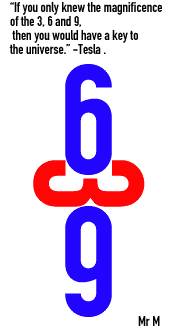
      will keep it as whole but color the two version 369 and the rest


      3. The word-wielder toil | for the giant worked,
      And so revenge | on the gods he sought;
      He bade Sif's mate | the kettle bring:
      "Therein for ye all | much ale shall I brew."


      4. The far-famed ones | could find it not,
      And the holy gods | could get it nowhere;
      Till in truthful wise | did Tyr speak forth,
      And helpful counsel | to Hlorrithi gave.

      5. "There dwells to the east | of Elivagar
      Hymir the wise | at the end of heaven;
      A kettle my father | fierce doth own,
      A mighty vessel | a mile in depth."


      Thor spake:

      6. "May we win, dost thou think, | this whirler of water?"

      Tyr spake:
      "Aye, friend, we can, | if cunning we are."

      7. Forward that day | with speed they fared,
      From Asgarth came they | to Egil's home;
      The goats with horns | bedecked he guarded;
      Then they sped to the hall | where Hymir dwelt.

      8. The youth found his grandam, | that greatly he loathed,
      And full nine hundred | heads she had;
      But the other fair | with gold came forth,
      And the bright-browed one | brought beer to her son.


      9. "Kinsman of giants, | beneath the kettle
      Will I set ye both, | ye heroes bold;
      For many a time | my dear-loved mate
      To guests is wrathful | and grim of mind."


      10. Late to his home | the misshapen Hymir,
      The giant harsh, | from his hunting came;
      The icicles rattled | as in he came,
      For the fellow's chin-forest | frozen was.

      11. "Hail to thee, Hymir! | good thoughts mayst thou have;
      Here has thy son | to thine hall now come;
      (For him have we waited, | his way was long
      And with him fares | the foeman of Hroth,
      The friend of mankind, | and Veur they call him.


      12. "See where under | the gable they sit!
      Behind the beam | do they hide themselves."
      The beam at the glance | of the giant broke,
      And the mighty pillar | in pieces fell.


      13. Eight fell from the ledge, | and one alone,
      The hard-hammered kettle, | of all was whole;
      Forth came they then, | and his foes he sought,
      The giant old, | and held with his eyes.

      14. Much sorrow his heart | foretold when he saw
      The giantess' foeman | come forth on the floor;
      Then of the steers | did they bring in three;
      Their flesh to boil | did the giant bid.


      15. By a head was each | the shorter hewed,
      And the beasts to the fire | straight they bore;
      The husband of Sif, | ere to sleep he went,
      Alone two oxen | of Hymir's ate.

      16. To the comrade hoary | of Hrungnir then
      Did Hlorrithi's meal | full mighty seem;
      "Next time at eve | we three must eat
      The food we have | {illegible}s the hunting's spoil."

      17. ...
      Fain to row on the sea | was Veur, he said,
      If the giant bold | would give him bait.

      Hymir spake:


      18. "Go to the herd, | if thou hast it in mind,
      Thou slayer of giants, | thy bait to seek;
      For there thou soon | mayst find, methinks,
      Bait from the oxen | easy to get."

      19. Swift to the wood | the hero went,
      Till before him an ox | all black he found;
      From the beast the slayer | of giants broke
      The fortress high | of his double horns.

      Hymir spake:

      20. "Thy works, methinks, | are worse by far,
      Thou steerer of ships, | than when still thou sittest."
      ...
      ...


      21. The lord of t
      e goats | bade the ape-begotten
      Farther to steer | the steed of the rollers;
      But the giant said | that his will, forsooth,
      Longer to row | was little enough.

      22. Two whales on his hook | did the mighty Hymir
      Soon pull up | on a single cast;
      In the stern the kinsman | of Othin sat,
      And Veur with cunning | his cast prepared.

      23. The warder of men, | the worm's destroyer,
      Fixed on his hook | the head of the ox;
      There gaped at the bait | the foe of the gods,
      The girdler of all | the earth beneath.

      24. The venomous serpent | swiftly up
      To the boat did Thor, | the bold one, pull;
      With his hammer the loathly | hill of the hair
      Of the brother of Fenrir | he smote from above.


      25. The monsters roared, | and the rocks resounded,
      And all the earth | so old was shaken;
      ...
      Then sank the fish | in the sea forthwith.

      26. ...
      Joyless as back | they rowed was the giant;
      Speechless did Hymir | sit at the oars,
      With the rudder he sought | a second wind.

      Hymir spake:


      27. "The half of our toil | wilt thou have with me,
      And now make fast | our goat of the flood;
      Or home wilt thou bear | the whales to the house,
      Across the gorge | of the wooded glen?"


      28. Hlorrithi stood | and the stem he gripped,
      And the sea-horse with water | awash he lifted;
      Oars and bailer | and all he bore
      With the surf-swine home | to the giant's house.

      29. His might the giant | again would match,
      For stubborn he was, | with the strength of Thor;
      None truly strong, | though stoutly he rowed,
      Would he call save one | who could break the cup.


      30. Hlorrithi then, | when the cup he held,
      Struck with the glass | the pillars of stone;
      As he sat the posts | in pieces he shattered,
      Yet the glass to Hymir whole they brought.


      31. But the loved one fair | of the giant found
      A counsel true, | and told her thought:
      "Smite the skull of Hymir, | heavy with food,
      For harder it is | than ever was glass."

      32. The goats' mighty ruler | then rose on his knee,
      And with all the strength | of a god he struck;
      Whole was the fellow's | helmet-stem,
      But shattered the wine-cup | rounded was.

      Hymir spake:


      33. "Fair is the treasure | that from me is gone,
      Since now the cup | on my knees lies shattered;"
      So spake the giant: | "No more can I say
      In days to be, | 'Thou art brewed, mine ale.'

      34. "Enough shall it be | if out ye can bring
      Forth from our house | the kettle here."
      Tyr then twice | to move it tried,
      But before him the kettle | twice stood fast.

      35. The father of Mothi | the rim seized firm,
      And before it stood | on the floor below;
      Up on his head | Sif's husband raised it,
      And about his heels | the handles clattered.

      36. Not long had they fared, | ere backwards looked
      The son of Othin, | once more to see;
      From their caves in the east | beheld he coming
      With Hymir the throng | of the many-headed.


      37. He stood and cast | from his back the kettle,
      And Mjollnir, the lover | of murder, he wielded;
      ...
      So all the whales | of the waste he slew.

      38. Not long had they fared | ere one there lay
      Of Hlorrithi's goats | half-dead on the ground;
      In his leg the pole-horse | there was lame;
      The deed the evil | Loki had done.


      39. But ye all have heard,-- | for of them who have
      The tales of the gods, | who better can tell?
      What prize he won | from the wilderness-dweller,
      Who both his children | gave him to boot.


      Signs and symbols -Confucius.

      Comment


      • continuing on our knowledge gathering :


        The I Ching, Legge tr. Index

        The I Ching, or Book of Changes


        I. The Khien Hexagram
        II. The Khwăn Hexagram
        III. The Kun HexagramVI. The Sung HexagramXV. The Khien HexagramXXI. The Shih Ho Hexagram
        Text Section II

        XXXI. The Hsien Hexagram
        XXXII. The Hăng Hexagram
        XXXIII. The Thun HexagramXXXIX. The Kien Hexagram
        XL. The Kieh Hexagram
        XLI. The Sun Hexagram

        XLVI. The Shăng Hexagram
        XLVII. The Khwăn Hexagram

        XLIX. The Ko Hexagram
        L. The Ting Hexagram
        LI. The Kăn Hexagram
        LII. The Kăn Hexagram
        LIII. The Kien Hexagram
        LIV. The Kwei Mei HexagramLVII. The Sun HexagramLX. The Kieh Hexagram
        Signs and symbols -Confucius.

        Comment


        • Let's go a little more in depth ( Jules Vernes like )


          . THE KUN HEXAGRAM


          Kun (indicates that in the case which it presupposes) there will be great progress and success, and the advantage will come from being correct and firm. (But) any movement in advance should not be (lightly) undertaken. There will be advantage in appointing feudal princes.

          1. The first NINE, undivided, shows the difficulty (its subject has) in advancing. It will be advantageous for him to abide correct and firm; advantageous (also) to be made a feudal ruler.

          2. The second SIX, divided, shows (its subject) distressed and obliged to return; (even) the horses of her chariot (also) seem to be retreating. (But) not by a spoiler (is she assailed), but by one who seeks her to be his wife. The young lady maintains her firm correctness, and declines a union. After ten years she will be united, and have children.

          3. The third SIX, divided, shows one following the deer without (the guidance of) the forester, and only finding himself in the midst of the forest. The superior man, acquainted with the secret risks, thinks it better to give up the chase. If he went forward, he would regret it.

          p. 63

          4. The fourth SIX, divided, shows (its subject as a lady), the horses of whose chariot appear in retreat. She seeks, however, (the help of) him who seeks her to be his wife. Advance will be fortunate; all will turn out advantageously.

          5. The fifth NINE, undivided, shows the difficulties in the way of (its subject's) dispensing the rich favours that might be expected from him. With firmness and correctness there will be good fortune in small things; (even) with them in great things there will be evil.

          6. The topmost SIX, divided, shows (its subject) with the horses of his chariot obliged to retreat, and weeping tears of blood in streams.

          ---------------------------

          THE SUNG HEXAGRAM


          Sung intimates how, though there is sincerity in one's contention, he will yet meet with opposition and obstruction; but if he cherish an apprehensive caution, there will be good fortune, while, if he must prosecute the contention to the (bitter) end, there will be evil. It will be advantageous to see the great man; it will not be advantageous to cross the great stream.

          1. The first SIX, divided, shows its subject not perpetuating the matter about which (the contention is). He will suffer the small (injury) of being spoken against, but the end will be fortunate.

          2. The second NINE, undivided, shows its subject unequal to the contention. If he retire and keep concealed (where) the inhabitants of his city are (only) three hundred families, he will fall into no mistake.

          3. The third SIX, divided, shows its subject keeping in the old place assigned for his support, and firmly correct. Perilous as the position is, there will be good fortune in the end. Should he perchance

          p. 70

          engage in the king's business, he will not (claim the merit of) achievement.

          4. The fourth NINE, undivided, shows its subject unequal to the contention. He returns to (the study of Heaven's) ordinances, changes (his wish to contend), and rests in being firm and correct. There will be good fortune.

          S. The fifth NINE, undivided, shows its subject contending;--and with great good fortune.

          6. The topmost NINE, undivided, shows how its subject may have the leathern belt conferred on him (by the sovereign), and thrice it shall be taken from him in a morning.

          --------------------------


          1. The first NINE, undivided, shows its subject returning and pursuing his own course. What mistake should he fall into? There will be good fortune.

          2. The second NINE, undivided, shows its subject, by the attraction (of the former line), returning (to the proper course). There will be good fortune.

          p. 77

          3. The third NINE, undivided, suggests the idea of a carriage, the strap beneath which has been removed, or of a husband and wife looking on each other with averted eyes.

          4. The fourth SIX, divided, shows its subject possessed of sincerity. The danger of bloodshed is thereby averted, and his (ground for) apprehension dismissed. There will be no mistake.

          5. The fifth NINE, undivided, shows its subject possessed of sincerity, and drawing others to unite with him. Rich in resources, he employs his neighbours (in the same cause with himself).

          6. The topmost NINE, undivided, shows how the rain has fallen, and the (onward progress) is stayed;--(so) must we value the full accumulation of the virtue (represented by the upper trigram). But a wife (exercising restraint), however firm and correct she may be, is in a position of peril, (and like) the moon approaching to the full. If the superior man prosecute his measures (in such circumstances), there will be evil.

          .....you can continue till the last sign and the same pattern / Resonance will appear .....and others as well
          Last edited by MonsieurM; 06-06-2012, 06:18 PM.
          Signs and symbols -Confucius.

          Comment


          • 3 THE KUN HEXAGRAM
            Last edited by MonsieurM; 06-06-2012, 06:23 PM.
            Signs and symbols -Confucius.

            Comment


            • 6 THE SUNG HEXAGRAM
              Signs and symbols -Confucius.

              Comment


              • In line 6, the idea of the hexagram has run its course. The harmony of nature is restored. The rain falls, and the onward march of the strong lines should now stop. But weakness that has achieved such a result, if it plume itself on it, will be in a position of peril; and like the full moon, which must henceforth wane. Let the superior man, when he has attained his end, remain in quiet.
                Signs and symbols -Confucius.

                Comment


                • here is a nice website to play with the Iching .... all you need : Three Coins


                  I Ching Online - the Online Book of Changes


                  Principle of Mentalism: All is Wave / Source field

                  got this : Cast Hexagram: 31
                  Last edited by MonsieurM; 06-06-2012, 07:02 PM.
                  Signs and symbols -Confucius.

                  Comment


                  • How is your mood Swing lately ,


                    Ray Bradbury Made Us Think, and Helped Me Learn to Blog


                    Kenny Wayne Shepherd - Every Time It Rains - YouTube

                    Everytime It Rains lyrics

                    The dust can dry
                    The rust takes hold
                    See it in the sky
                    You're gonna go
                    Everytime it rains
                    Everytime it rains

                    Clouds come, they're standin' in the doorway
                    You run, why you wanna run away
                    Sky falls, take it as a sign
                    Who knows what I'm gonna find
                    Everytime it rains

                    And the rivers rise
                    You watch it all come down
                    See it in your eyes
                    It doesn't amke a sound
                    Everytime it rains
                    Everytime it rains

                    Clouds come, they're standin' in the doorway
                    You run, why you wanna run away
                    Sky falls, take it as a sign
                    Who knows what I'm gonna find
                    Everytime it rains
                    Everytime it rains

                    Clouds come, they're standin' in the doorway
                    You run, why you wanna run away
                    Sky falls, take it as a sign
                    Who knows what I'm gonna find
                    Everytime it rains

                    Everytime it rains

                    The dust can dry
                    The rust takes hold
                    See it in the sky
                    You're gonna go
                    Everytime it rains

                    Everytime it rains

                    Clouds come, they're standin' in the doorway
                    You run, why you wanna run away
                    Sky falls, take it as a sign
                    Who knows what I'm gonna find
                    Everytime it rains

                    Everytime it rains


                    You are the Soul of the Soul of the
                    Universe and your name is Love
                    .


                    Last edited by MonsieurM; 06-07-2012, 12:06 AM.
                    Signs and symbols -Confucius.

                    Comment


                    • Shall we continue


                      The Rig Veda Americanus is a collection of hymns addressing the pantheon of Aztec gods and presenting a small fraction of their mythology. At the end of the fourteenth century, the Aztecs established themselves as the leading nation in the region of modern-day central Mexico. Their power grew over the next 150 years, until their empire extended from the Atlantic to the Pacific. The Aztecs were warriors who conquered neighboring nations, but they themselves believed in the overwhelming influence wielded by the gods on earth and its inhabitants. In order to appease the gods, the Aztecs built monumental temples, where they committed sacrifices; like most Mesoamerican gods, the Aztec gods fed on human blood.

                      The Aztec religion is characterized by several peculiarities: It was not constructed at once but is a conglomeration that emerged over several centuries as taken from various religions and myths from Central American tribes and nations. The mythology is extremely mysterious...


                      Introduction
                      I. The Hymn of Huitzilopochtli.
                      II. War Song of the Huitznahuac
                      III. Hymn of Tlaloc
                      IV. Hymn to the All-Mother.
                      V. Hymn to the Virgin-Mother.
                      VI. Hymn to the God of Fire.
                      VII. Hymn of Mixcoatl.
                      VIII. Hymn to the God of Flowers.
                      IX. Hymn to the Goddess of Artists
                      X. Hymn to the God of Fishing.
                      XI. Hymn of the Otomi Leader.
                      XII. Hymn to the Goddess of Childbirth.
                      XIII. Hymn to the Mother of Mortals
                      XIV. Hymn at a Fast.
                      XV. Hymn to a Night-God.
                      XVI. Hymn to the Goddess of Food.
                      XVII. Hymn to the Gods of Wine.
                      XVIII. Hymn to the Master of Waters.
                      XIX. Hymn to the God of Flowers.
                      XX. Hymn to the God of Merchants.

                      Signs and symbols -Confucius.

                      Comment


                      • III The Hymn of Tlaloc.

                        The god Tlaloc shared with Huitzilopochtli the highest place in the Mexican Pantheon. He was the deity who presided over the waters, the rains, the thunder and the lightning.
                        1. In Mexico the god appears; thy banner is unfolded in all directions, and no one weeps.

                        2. I, the god, have returned again, I have turned again to the place of abundance of blood-sacrifices; there when the day grows old, I am beheld as a god.

                        3. Thy work is that of a noble 1 - Magician ; truly thou hast made thyself to be of our flesh; thou hast made thyself, and who dare affront thee?


                        4. Truly he who affronts me does not find himself well with me; my fathers took by the head the tigers and the serpents.

                        5. In Tlalocan, in the verdant house, they play at ball, they cast the reeds.

                        6. Go forth, go forth to where the clouds are spread abundantly, where the thick mist makes the cloudy house of Tlaloc.

                        7. There with strong voice I rise up and cry aloud.

                        {p. 25}

                        8. Go ye forth to seek me, seek for the words which I have said, as I rise, a terrible one, and cry aloud.

                        9. After four years they shall go forth, not to be known, not to be numbered, they shall descend to the beautiful house, to unite together and know the doctrine.

                        10. Go forth, go forth to where the clouds are spread abundantly, where the thick mist makes the cloudy house of Tlaloc.

                        ------------------------

                        VI. Hymn to the God of Fire.

                        1. In the Hall of Flames let me not put to shame my ancestors; descending there, let me not put you to shame.

                        2. I fasten a rope to the sacred tree, I twist it in eight folds, that by it I, a magician, may descend to the magical house.

                        3. Begin your song in the Hall of Flames; begin your song in the Hall of Flames; why does the magician not come forth? Why does he not rise up?

                        4. Let his subjects assist in the Hall of Flames; he appears, he appears, let his subjects assist.

                        5. Let the servants never cease the song in the Hall of Flames; let them rejoice greatly, let them dance wonderfully.

                        6. Call ye for the woman with abundant hair, whose care is the mist and the rain, call ye for her.

                        ------------------------

                        IX. Hymn to the Goddess of Artists


                        Xochiquetzal, "plumage of flowers," was the deity of the artists, the painters, weavers, engravers on metal, silver and goldsmiths, and of all who dealt in fine colors. Her figure was that of a young woman with gay garments and jewelry (Duran, Historia, cap. 94). In the Codex Telleriano-Remensis she is assigned as synonyms Ichpochtli, the Virgin, and Itzpapalotl, literally "the obsidian butterfly," but which was probably applied to a peculiar ornament of her idol.
                        1. I, Xochiquetzal, go forth willingly to the dancing place by the water, going forth to the houses in Tamoanchan.

                        2. Ye noble youths, ye priests who wept, seeking Xochiquetzal, go forth there where I am going.

                        1 + 2 = HM 3

                        ------------------------ continued
                        Last edited by MonsieurM; 06-07-2012, 01:34 PM.
                        Signs and symbols -Confucius.

                        Comment


                        • Part II

                          Rig Veda Americanus: Index

                          XII. Hymn to the Goddess of Childbirth.


                          The name of Ayopechcatl does not appear among the divinities named by Sahagun, Duran or the other authorities at my command. Her name indicates her function as the goddess of the child-bed and the neonatus, and the above hymn establishes her claim to a place in the Aztec pantheon.
                          1. Truly in whatever house there is a lying-in, Ayopechcatl takes charge of the child.

                          2. Truly in whatever house there is a lying-in, Ayopechcatl takes charge of the child, there where it is weeping in the house.

                          3. Come along and cry out, cry out, cry out, you new comer, come along and cry out.

                          {p. 48}

                          4. Come along and cry out, cry out, cry out, you little jewel, cry out.

                          ----------------------------

                          XV. Hymn to a Night-God.

                          There is slight mention of the deity Xipe Totec in the Spanish writers. He was the patron divinity of the silversmiths,
                          1. The nightly drinking, why should I oppose it? Go forth and array yourselves in the golden garments, clothe yourselves in the glittering vestments.

                          2. My god descended upon the water, into the beautiful glistening surface; he was as a lovely water cypress, as a beauteous green serpent; now I have left behind me my suffering.

                          3. I go forth, I go forth about to destroy, I, Yoatzin; my soul is in the cerulean water; I am seen in the golden water; I shall appear unto mortals; I shall strengthen them for the words of war!

                          4. My god appears as a mortal; O Yoatzin, thou art seen upon the mountains; I shall appear unto mortals; I shall strengthen them for the words of war.

                          ----------------------

                          XVIII. Hymn to the Master of Waters.

                          The Hymn of Atlaua ( vague resemblance to Atlantis.

                          1. I Chalmecatl, I Chalmecatl, I leave behind my sandles, I leave my sandles and my helmet.

                          2. Go ye forth and follow the goddess Quilaztli, follow her

                          3. I shall call upon thee to arise when among the shields, I shall call upon thee to arise.

                          4. I boast of my arrows, even my reed arrows, I boast of my arrows, not to be broken.

                          5. Arrayed in priestly garb, take the arrow in thy band, for even now I shall arise and come forth like the quetzal bird.

                          6. Mighty is my god Atlaua; truly I shall arise and come forth like the quetzal bird.

                          Atlaua, mentioned by Olmos, who translates the word "Master of waters," is a divinity of whom little is known. The derivation from atlatl


                          the Emerald Tablet :

                          Four is it in qualities,
                          shining in each of the planes of existence,
                          but thirteen in one
                          the mystical number.
                          Based on the qualities of man are the Brothers:
                          each shall direct the unfoldment of being,
                          each shall channels be of the Great One.
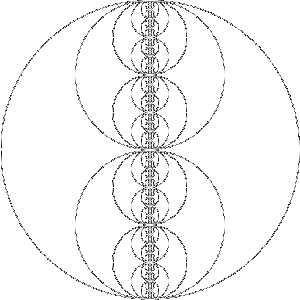
                          ps: Fractal


                          a fractal construct has an 'efficient function', it has a fractal ergonomy to them, they function on multiple levels and in multiple dimensions:
                          Last edited by MonsieurM; 06-07-2012, 01:41 PM.
                          Signs and symbols -Confucius.

                          Comment


                          • from: http://www.energeticforum.com/renewa...tml#post196817

                            Originally posted by Ufopolitics View Post
                            THE SYMMETRY OF DARKNESS - YouTube

                            Thanks for watching it!


                            Regards


                            Ufopolitics
                            thank you for the vid

                            --------------------------- also:

                            The Origin of Esoteric Knowledge - YouTube

                            Last edited by MonsieurM; 06-07-2012, 04:56 PM.
                            Signs and symbols -Confucius.

                            Comment


                            • info update:

                              New property of flames sparks advances in technology

                              Chemists at UCL have discovered a new property of flames, which allows them to control reactions at a solid surface in a flame and opens up a whole new field of chemical innovation.
                              Published in the journal Angewandte Chemie, authors of the new study have discovered their previous understanding of how flames interact with a solid surface was mistaken. For the first time, they have demonstrated that a particular type of chemistry, called redox chemistry, can be accurately controlled at the surface.

                              This finding has wide implications for future technology, for example in detection of chemicals in the air, and in developing our understanding of the chemistry of lightning. It also opens up the possibility of being able to perform nitrogen oxide and carbon dioxide electrolysis at the source for the management of green house gases.

                              Results of the study show that depending on the chemical make-up of the flame, scientists can record a distinctive electrical fingerprint. The fingerprint is a consequence of the behaviour of specific chemical species at the surface of a solid conducting surface, where electrons can exchange at a very precise voltage.
                              did you know

                              List of Nikola Tesla patents - Wikipedia, the free encyclopedia

                              U.S. Patent 0,396,121 - Thermo Magnetic Motor - 1888 January 15 - Widely known that heat applied to a magnetic body will lessen its magnetizing ability; High enough temperatures will destroy the magnetic field; Mechanical power by a reciprocating action obtained from the joint action of heat, magnetism, and a spring or weight (or other force); In this patent, the application of heat to a body that is magnetized by induction or otherwise to the action of heat until the magnetism is neutralized to allow a weight or a spring to give action and lessen the
                              Tesla's US390721 Patent for a "Dynamo Electric Machine"
                              action of the heat to restore the magnetic effect to move the body in the opposite direction.
                              ps: I wonder how this Thermo Magnetic Motor would work with an HHO flame : How to build a simple, yet effective, HHO generator - YouTube / HHO Generator or Joe Cell construction - YouTube

                              caution flames are not to be played with respect the experiment and be cautious


                              --------------------------------------

                              Breaking the limits of classical physics

                              (Phys.org) -- With simple arguments, researchers show that nature is complicated. Researchers from the Niels Bohr Institute have made a simple experiment that demonstrates that nature violates common sense light has quantum mechanical properties. The new method could be used to study whether other systems behave quantum mechanically. The results have been published in the scientific journal, Physical Review Letters.
                              Last edited by MonsieurM; 06-07-2012, 06:48 PM.
                              Signs and symbols -Confucius.

                              Comment


                              • Originally posted by MonsieurM View Post
                                Being a big fan of Manga ( mostly the golden age 80's / 90's )

                                Kamui no Ken OST 01. Kamui Densetsu - YouTube

                                ....Ninja's have a similar mystical approach


                                Ninja Mind Control


                                Kamui no Ken OST 11. Go_kaku no ****ou - YouTube
                                ONE MUST KNOW

                                To develop the talents associated with the mystic side of Ninja training, in addition to pos-
                                sessing strength, one must "know." To know means to have intelligence. This does not refer to the I.Q. so often quoted as a measure of intellect, but rather to an understanding or ability to learn.

                                Many people limit themselves to leading boring, dull lives by accepting the judgment of others that they are of low intelligence. This is not so. Just because one does not process sensory information and replay it the same way as everyone else-which in any case would be boring in the extreme and mark the extinction of creativity-does not mean that there is a lack of comprehension or interest. Just because a person does not understand another's purpose does not mean that he is confused

                                The Ninja possess mental powers of an informational, offensive, or defensive nature; but it is only during the latter stages of training that these techniques actually become effective in hand-to-hand combat. That is to say, after much practice one is able to defeat the enemy with- out physical contact. By that time, the student has mostly transcended motives that would land him in a situation where these paranormal powers would be warranted.

                                Ninja mysticism may take many forms. The simple form makes it possible to deflect negative vibrations and defend oneself against psychological assault merely by maintaining one's emotional balance. The more complex forms require mantras, somatic components, and elaborate rituals for maximum efficiency. The individual must first determine the methodology of his or her own psychological thought forms or constructs. Since one of the primary attributes of the spy has always been a good memory, most agents have never written down their techniques, although some tora-maki , or sacred scrolls, do exist.

                                Through the study of the mind, the Ninja hopes to gain wisdom and become a man of knowledge. As such, he attains an almost spiritual level of dedication to his art, which confers upon him a high degree of skill at arms. Many such accomplished Ninja are known by the eternal symbols they have adopted to signify their quests, but in time even these are put aside. At this level, the reverence for life becomes so great that the Ninja will no longer kill, and their powers are directed only toward revitalizing, protecting, and encouraging the efforts of others.

                                The goal of the true seeker is to become a sage, or superior man. There are certain immutable laws of the universe, which the sage must be in harmony with. Different Ninja sects espouse some laws in particular, according them greater significance than the others. But each law is essential in its own right, and must be considered equal to the rest

                                -------------continued kodo - lion - YouTube
                                Last edited by MonsieurM; 06-07-2012, 08:10 PM.
                                Signs and symbols -Confucius.

                                Comment

                                Working...
                                X