This forum is preserved as a permanent archive. The community continues at eMedia Press.

Announcement

Collapse
No announcement yet.

Peter, whatever happened with Eric P. Dollard?

Collapse
This topic is closed.
X
This is a sticky topic.
X
X
 
  • Filter
  • Time
  • Show
Clear All
new posts

  • QuarterPole
    replied
    Originally posted by Logical American View Post
    Unfortunately as a mathematician, there has to be a consensus on terms,
    Not so unfortunate. If a thing is going to be useful, one is going to need an idea of how to use it.
    Originally posted by Logical American View Post
    In examining the terms, we find flux is measured as some type of quantity per area element.
    These would be the lines of force. Magnetic and dielectric field lines.
    So, I think, Psi, Phi, and Q are all just "numbers" that exist at right angles to each other. Maybe we can use Planck's constant and the existing definitions to work backward and see just how many lines are in a Coulomb?

    I don't think you need to be apologizing. Nobody else seems to have stood up and said, "I totally understand!" So it can be nothing but helpful if people can ask the right questions.

    Peace.
    Leave a comment:


  • Logical American
    replied
    Acknowledgement

    Eric:

    I would like to forward to you a work that I believe you will recognize, so how can I do that?

    Quarterpole:

    Your point is well taken, the search engine brought me in around page 21 or so, so thanks for asking me to back up and reread. There are dozens of questions I could ask, but I had to start somewhere, and thought when Eric was laying a foundation that we could move forward from there.

    Unfortunately as a mathematician, there has to be a consensus on terms, and so this is a difficulty that Eric will face, if he wishes to use his definition of Planck. I already referenced the conventional understanding, because I was trying to ferret out the problem with dimensional homogenuity which exists. If we are going to have a discussion with the conventional scientists in an attempt to get them to change their minds (and following the math will do it) then we do need to have the mathematical definitions nailed down.

    Pault:

    Thanks for causing me to back up to previous posts, the product is indeed Planks/cm^4 as Eric states. However there is something that I need to ask, if (quoting) "The total electrification Q in Plancks is a resultant of the union, of PRODUCT, of a pair of inductions, the total dielectric induction, Psi and the total magnetic induction, Phi", are we not assuming that the orientations are parallel? In examining the terms, we find flux is measured as some type of quantity per area element. If we take a direct product, are we not assuming that the two area elements are parallel? I would appreciate some clarification here on just what exactly union means. Once again, the math will provide the crucial distinctions.

    I appreciate everyone's patience.

    Leave a comment:


  • pault
    replied
    Originally posted by Logical American View Post
    ...
    I feel it is important to point out that Q is of the dimensions energy-seconds, a quanta of energy * seconds.
    Eric does not define Q in energy-seconds. Q (Planck) is weber-coulomb. The product of psi and phi.

    Rewind to the post entitled "Energy Defined", wherein Eric discusses the difference between his Q and the "Einsteinischen dimensions of the Planck" (energy-time).

    Also can we keep length as dimension 1, knowing that space is of dimension 3?
    Rewind to "Continuing with Variation of a Dimension with Respect to Time".

    ...
    pt

    Leave a comment:


  • QuarterPole
    replied
    Randall, forgive me for assuming, but your reference to this last post by Mr. Dollard as "a" or "the" presentation gives me the impression that you are not aware of the rest of it. I, unfortunately, cannot answer your questions myself, and my experience with math only goes one imaginary layer deep, so I would just ask you whether you have read though the compilation here, and the references cited as "necessary."
    Hopefully, we can all help each other to understand this work. I'm still waiting to see who gets the gold star for the Magnetic/Dielectric field ratio question.

    Leave a comment:


  • Logical American
    replied
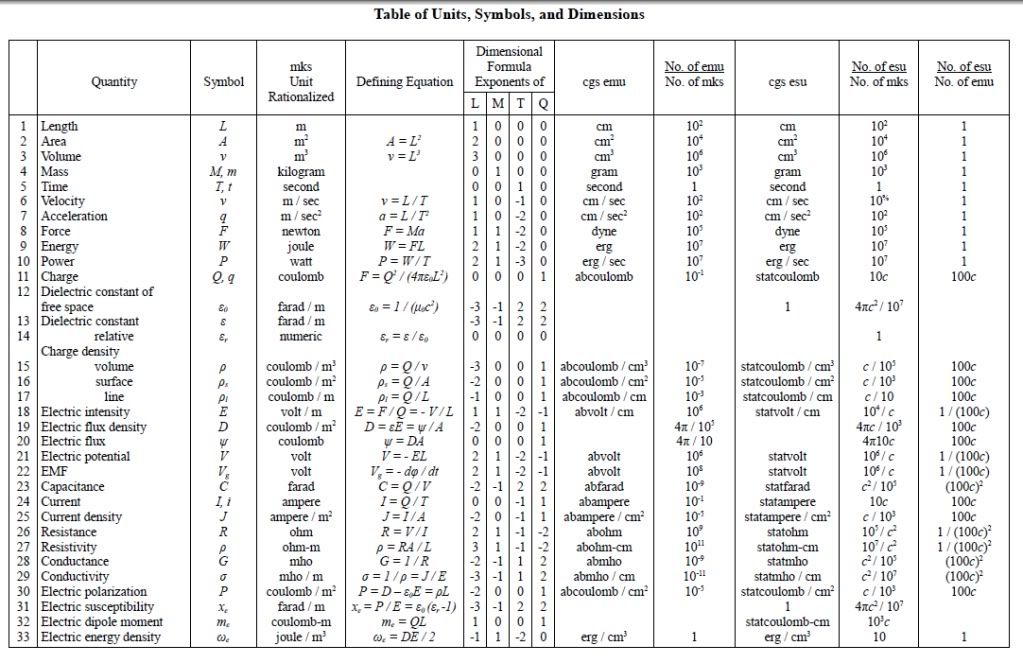
    Some questions regarding units

    I would like to ask some questions about the presentation "The Eagle Has Landed" because there are particularly critical points that need to be examined and I would like to fully understand what Eric is presenting. I think his ideas are important to properly understand electricity.

    One point which is crucial to this is Fourier's principle of Homogenity, which simply states that the dimensions must match. This is so crucial that I mention that even James Clerk Maxwell's 1864 paper, or subsequent revisions as done by Heaviside and Gibbs and others suffer from this problem, but I don't wish to deter from the course of the present discussion.

    Eric writes, quoting
    --------------
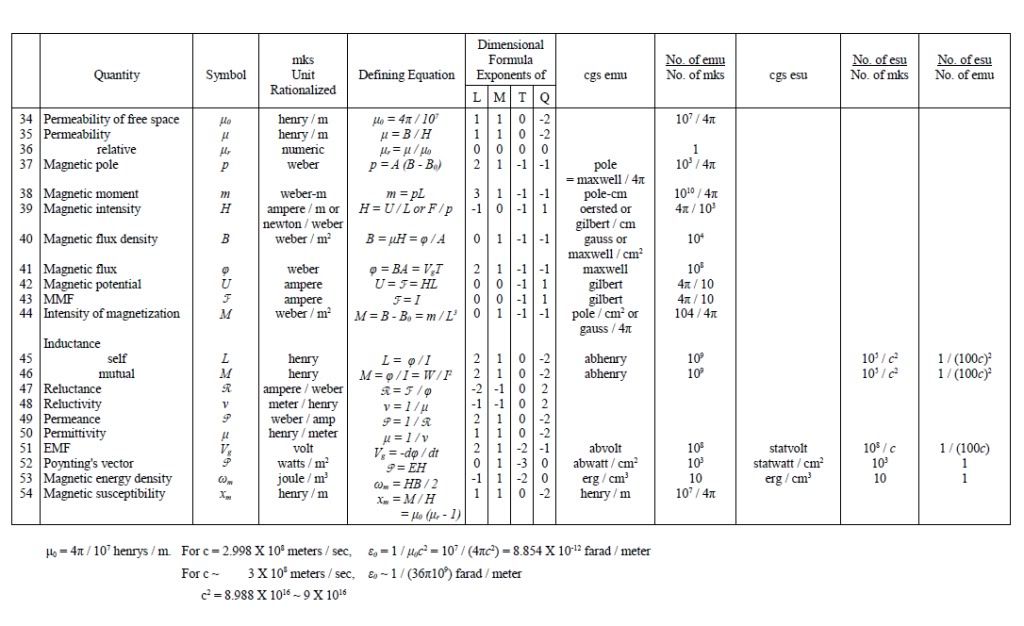
    Three dimensions form the primary basis for subsequent relations:
    (1) Q, Total Electrification, Planck,
    (2) t, Time, Second,
    (3) l, Space, Centimeter.
    ----------------
    end quote (abridged)

    Let's assume this for the moment and keep homogenity intact. I feel it is important to point out that Q is of the dimensions energy-seconds, a quanta of energy * seconds. Now these are nit-picks, but can we divorce Q of the dependency upon seconds, and keep it pure energy? Also can we keep length as dimension 1, knowing that space is of dimension 3? I trust we can agree on a Cartesian 3d definition at the moment for space. (I am trying to stay mathematically precise here, not be critical of what is written, and I fear that my comments will be mistaken.

    It is important to lay a foundation of definitions.

    At this moment, I do not understand how Total Electrification applies to energy, but I set that aside.

    Eric continues...
    quoting
    ----------------------
    Subsequently established has been a series of dimensions and dimensional relationships, save yet Inductance, Capacitance, and the Electric Force. Two primary substantial dimensions were established by divorce from Q.

    (1) ?, Total Dielectric Induction, Coulomb,
    (2) F, Total Magnetic Induction, Weber.

    Derived then are four secondary, or compound, dimensional relations:

    (1) I, Displacement Current, Ampere,
    (2) E, Electro-Motive Force, Volt,

    The laws of induction; and,
    (3) e, Electro-static Potential, Volt,
    (4) i, Magneto-Motive Force, Ampere,
    ------------
    end quote

    Okay, I admit that I am now confused. We have the Coulomb and Weber introduced, then the Ampere and Volt is introduced subsequently and in pairs. I do not have the actual dimension units of energy/time/length connected in anyway to these 4 or 6 terms. I would prefer to use 6 terms, not 4 to avoid the possible confusion later on.

    First question:
    Can we define the Coulomb and Weber and Ampere and Volt in terms of our 3 fundamental units?

    Eric continues...
    quoting
    -----------------------------------------
    The laws of proportion.

    Hereby it is we have two Volts and two Amperes:

    Volt; Weber per second, E,
    Volt; Coulomb per Farad, e,

    And

    Ampere; Coulomb per second, I,
    Ampere; Weber per Henry, i.
    -----------------
    end quote

    Now two new terms are introduced, Farad and Henry.

    Second question:

    Can we get a formal definition of Farad and Henry?

    Eric mentions that energy is Planks per second, but that means that the Plank unit has dimension of energy*seconds. I want to argue that we divorce energy from seconds, and keep it strictly energy units (following Fourier's homogenity principle)

    It is mentioned that energy is Plank/second and Power is thought of energy expressed per second or Plank/second^2 so I agree with the definitions as they are dimensionally sound.

    Eric mentions the need to cleanse the system of units and dimensions. Might I first introduce the SI base units, so we can make sure that we are not missing or omitting anything?

    From NIST (webpage http://physics.nist.gov/cuu/Units/index.html)

    Leave a comment:


  • t-rex
    replied
    Volt; Weber per second, E,

    Volt; Coulomb per Farad, e,

    And
    Ampere; Coulomb per second, I,

    Ampere; Weber per Henry, i.

    A principle dimensional relation in the makeup of the Bogo is given as,
    Multiplied by,
    b, 4*pi times ten to the negative ninth power

    Hence the application is given by
    On the dielectric side of the dimensional relations it is for example,
    Farad, C, Numeric.

    And properly,
    Per Velocity of Light Square,

    Substituting the relation,
    c, Second Square per Centimeter Square

    Gives the complete dimensional expression as,PerPer
    Weber per Coulomb, or Ohm

    This has yet to be proven, however by intuition it must be correct.

    Magnetic force is the product of the following,
    (1) Magnetic Permeability, Mu,

    (2) Magneto-Motive Force, i,

    (3) Displacement Current, I,

    These are defined by the dimensional relations,
    (1) Mu, Centimeter

    (2) Ampere, i, Weber per Henry

    (3) Ampere, I, Coulomb per Second

    And also
    (4) Henry, L, Centimeter Square

    The magnetic force is thus expressed by,
    In dimensional expression this magnetic force is given asPer

    Substituting the relation
    Mu per Henry, or Per Centimeter

    And also
    Gives the dimensional relation for Magnetic Force as,
    Substituting the relation
    Planck per Second, or Joule

    Gives the final form in dimensional representation for magnetic force as,
    Joule per Centimeter, or Dyne.

    Likewise for the Dielectric Force,
    Substituting
    e, Coulomb per Farad

    E, Weber per Second

    And
    ϵ, Second Square per Centimeter Cube,

    Gives the complete dimensional expression asPer
    Substituting the relation
    Epsilon per Farad, or per Centimeter

    And the relation,
    Gives the Relation,
    And substituting,
    Planck per Second, or Joule.

    Arrived at is the final dimensional expression for dielectric force,
    Joules per Centimeter, or Dyne.

    It is hereby shown that the magnetic force and the dielectric force are dimensionally equivalent since it is,
    Mu per Henry,

    Equals
    Epsilon per Farad,

    Or
    Per Centimeter.

    Where it is,
    Expanding gives,
    The Electro-Magnetic Force is given by the relation
    Taking the ratio of mechanical electrical force, it is, or
    (m/Q)*(l^2)*(t^-1)

    Dimensionally it is given as,Per
    And the relation for mass equivalency is given as,
    m = Q*t*(l^-2)

    Likewise the quantity equivalence relation
    Q = m*(l^2)*(t^-1)

    The dimensions of Physics and the dimensions of Electricity are hence shown in comparison.


    73 DE N6KPH SK
    Last edited by t-rex; 12-13-2011, 06:56 PM.

    Leave a comment:


  • t-rex
    replied
    Prelude, Quadra-Polar Electricity

    It has been repeatedly observed in the previous writings that any given dimensional relation, say Volt, Ampere, and etc always exist in a dual relation. This is known since it is e, in volts and E, in volts. The geometric archetype of the electric phenomena is four polar. This polar quadrantal form is well expressed in Native American art forms. These serve as their "Versor Diagrams" for the four polar seasons and lunar positions. These are important for those that "live outside". See "When Stars Look Down" for a good popular, not technical, description of this topic. The quadra-polar concept in the mind of Nikola Tesla resulted in the polyphase motors and generators of todays AC technology.

    It is likewise, Inductance and Capacitance are a pair of co-efficients representing a pair of fields, and in turn each representative co-efficient in itself exists as a pair, hence giving the four co-efficients total.

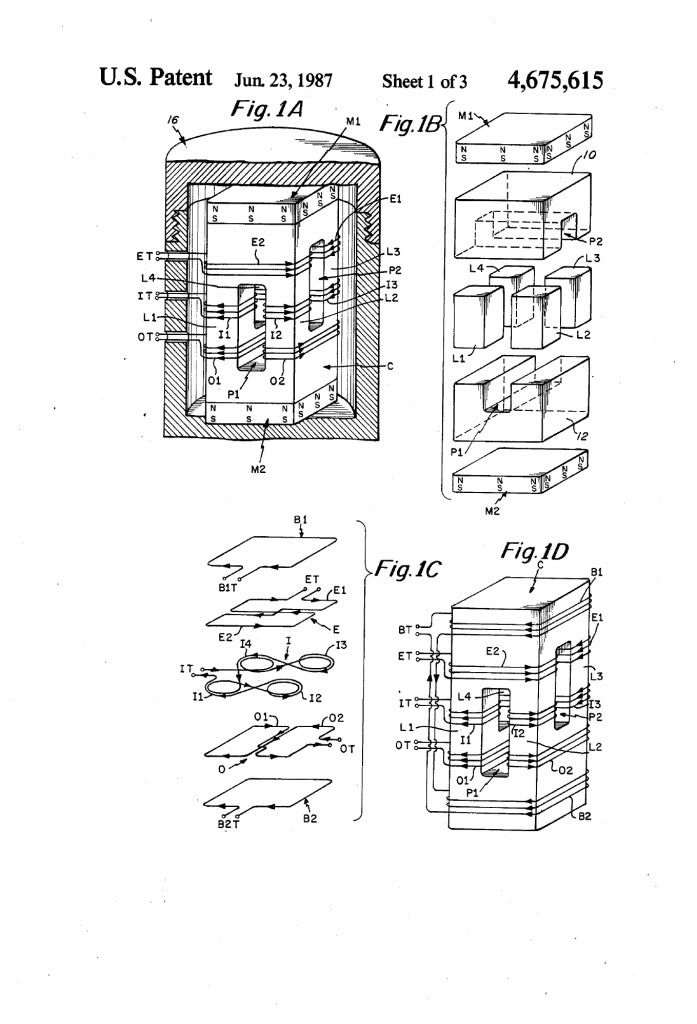
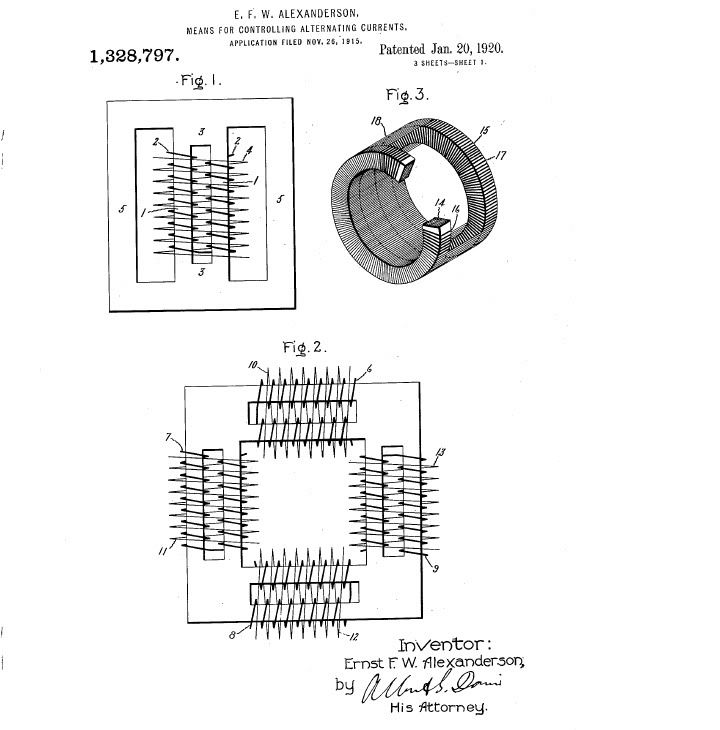
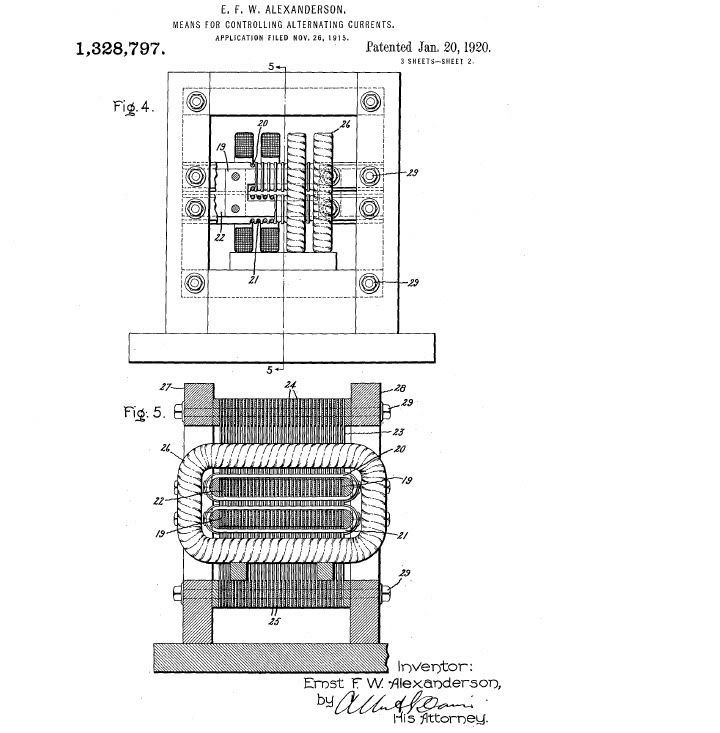
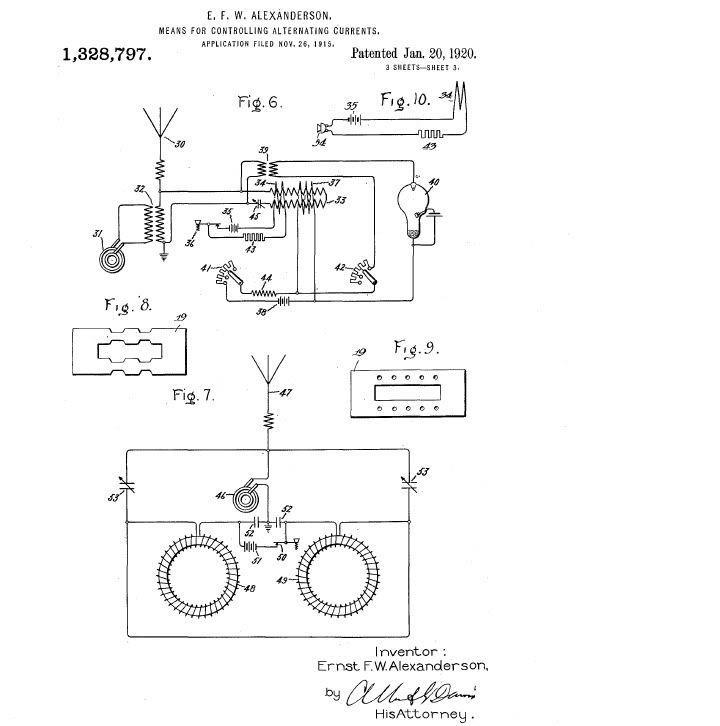
    Steinmetz first noticed this quadrature pair of inductances in his study of the AC power transformer. This inductance now exists as a pair of inductances: the Leakage Inductance, L, and the Mutual Inductance, M. The lines of induction for L are at right angles (Space Quadrature) to the lines of induction for M. So it is L and M do not "see each other". Alexanderson utilized this is his magnetic amplifier. Here the saturation flux must be in space quadrature with the power flux. It is then that the two are separated but in the same core. In a metallic-dielectric form it is given as a torroidal magnetic circuit, wound with a pair of metallic circuits, one in winding around the core cross sectional area, the other winding at right angles to the torroidal windings, this being circumferal around the core. (See Alexanderson Patents). Here derived is a "Quadrapolar Inductance Coil". This quadrapolar inductance, LM, serves as a first step towards understanding tesla type transformers. Needless to say P.E.E.E. Pupin rudely declared Steinmetz as un-Maxwell. So Here we go again.

    With regard to parameter variation only the first step has been taken. For example:
    Henry per 1, or Henry

    Henry per 1 second

    That is to say
    Henry per second, or Ohm

    But what about Henry per second square, or what?

    Hueristic (see Guillimen) dimensional relations will be utilized as before.


    To quote Maxwell "Electricity and Magnetism" volume 1, page 2;

    "A knowledge of the dimensions of the units furnishes a test which ought to be applied to the equations resulting from any lengthened investigation. The dimensions of every term of such an equation, with respect to the three fundamental units must be the same. If not, the equation is absurd, and contains some error, as its interpretation would be different according to the arbitrary system of units which we adopt."

    Here utilized are the "Three Fundamental Units":

    1. Planck

    2. Second

    3. Centimeter

    See "Theorie de Chaleur" by Fourier

    Parametric oscillator - Wikipedia, the free encyclopedia

    Application of power multiplication to electric power distribution

    ......Break more to follow .......


    Last edited by t-rex; 12-13-2011, 06:55 PM.

    Leave a comment:


  • madhatter
    replied
    Lamare, this was a point I brought up a couple pages ago and was soundly trounced for it. Eric has mentioned his concern over the loss of proper dimensions, I understand his concern and feel that quaternions hold the key. Hopefully you get a better response, I was chastised for the suggestion.

    Leave a comment:


  • lamare
    replied
    Originally posted by T-rex View Post
    At this time I am engaged in the study of details for the continuation of Inductance and Capacitance series of writings. The established dimensional relations are N.F.G., even in the writings of C.P. Steinmetz. Too many canceled dimensions thru unit values, and lots of missing versors in space. For example, in Inductance calculations the radius of a circle is a line, the circumference of a circle is a circle. Here we have two distinct co-ordinate systems, or vector expressions, a kind of space quadrature. Thus
    c = 2(pi)r Centimeters

    is not vectorally complete, it is
    c = 2(pi)kr Centimeters
    where k is a versor operator. Hence it is that c and 2πr are not interchangeable. Here is an important complication in the dimensional relations for Inductance and Capacitance.
    Hi Eric,

    First of all, thanks for your reply and input. I am quite busy at work at the moment, because I have only 4 days left before I have vacation and I have to finish some stuff now.

    Anyway, I have been studying your "Symbolic Representation of the Generalized Electric Wave" recently and I am beginning to see what you are talking about with your dimensional relations, but I still can't get to the bottom of it.

    You wrote:
    The established dimensional relations are N.F.G., even in the writings of C.P. Steinmetz. Too many canceled dimensions thru unit values, and lots of missing versors in space.
    You definately have a point here, but until I can paint a picture in my head about what is going on, I can't get this stuff straight.

    I just looked at what a versor is. Never been thaught about that:
    Versor - Wikipedia, the free encyclopedia

    Interestingly, this refers to Quaternions, which I have also never been taught about:
    Quaternion - Wikipedia, the free encyclopedia

    Here we find an interesting detail:
    In mathematics, the quaternions are a number system that extends the complex numbers. They were first described by Irish mathematician Sir William Rowan Hamilton in 1843 and applied to mechanics in three-dimensional space. A feature of quaternions is that the product of two quaternions is noncommutative. Hamilton defined a quaternion as the quotient of two directed lines in a three-dimensional space[1] or equivalently as the quotient of two vectors.[2] Quaternions can also be represented as the sum of a scalar and a vector.
    This appears to be very similar to what you do in your "Symbolic Representation of the Generalized Electric Wave".

    About the scalar part:

    Scalar and vector parts

    A number of the form a + 0i + 0j + 0k, where a is a real number, is called real, and a number of the form 0 + bi + cj + dk, where b, c, and d are real numbers, is called pure imaginary. If a + bi + cj + dk is any quaternion, then a is called its scalar part and bi + cj + dk is called its vector part. The scalar part of a quaternion is always real, and the vector part is always pure imaginary. Even though every quaternion is a vector in a four-dimensional vector space, it is common to define a vector to mean a pure imaginary quaternion. With this convention, a vector is the same as an element of the vector space R3.

    Hamilton called pure imaginary quaternions right quaternions[9][10] and real numbers (considered as quaternions with zero vector part) scalar quaternions.
    So, here we have a definition of "scalar" that differs from your definition:

    So, in quaternion notation, the whole term "(RG + XB)" is called "scalar". Clearly, with such a definition, you can have "scalar quaternion waves" consisting of the longitudinal XB component.....

    This quaternion 4 dimensional algebra appears to have some particular property along with real and complex numbers, which is that these are isomorphic:
    Frobenius theorem (real division algebras) - Wikipedia, the free encyclopedia

    In mathematics, more specifically in abstract algebra, the Frobenius theorem, proved by Ferdinand Georg Frobenius in 1877, characterizes the finite-dimensional associative division algebras over the real numbers. According to the theorem, every such algebra is isomorphic to one of the following:

    R (the real numbers)
    C (the complex numbers)
    H (the quaternions).

    These algebras have dimensions 1, 2, and 4, respectively. Of these three algebras, the real and complex numbers are commutative, but the quaternions are not.

    This theorem is closely related to Hurwitz's theorem, which states that the only normed division algebras over the real numbers are R, C, H, and the (non-associative) algebra O of octonions.
    Since I had no idea what that is, I looked it up:
    Isomorphism - Wikipedia, the free encyclopedia
    Isomorphisms are studied in mathematics in order to extend insights from one phenomenon to others: if two objects are isomorphic, then any property that is preserved by an isomorphism and that is true of one of the objects, is also true of the other. If an isomorphism can be found from a relatively unknown part of mathematics into some well studied division of mathematics, where many theorems are already proved, and many methods are already available to find answers, then the function can be used to map whole problems out of unfamiliar territory over to "solid ground" where the problem is easier to understand and work with.
    So, this quaternion stuff seems to be well worth studying. It appears to be very similar to what you do in your "Symbolic Representation of the Generalized Electric Wave", while at the same time it appears to be even more general and may even be capable of being extended to the dimension of time, because this is a 4 dimensional algebra...


    BTW, did you note that the Russian paper he referred to about parameter variation has recently been translated into English?

    Leave a comment:


  • Kokomoj0
    replied


    I added a couple more as they are "very" interesting!

    Leave a comment:


  • Raui
    replied
    Great to hear from you Eric. Here are the references for the above;
    Explosion at the Shipyard References.zip
    Travelling Waves on Transmission Systems
    Electromagnetic Theory Volume 3

    Sorry everyone for my absence, I'm very busy trying to get the house finished off with my father because the majority of the family is coming over from NZ for new years. I'll probably be absent for at least 2 weeks but I'll pop in as much as I can.

    Raui

    PS: Lessismore I had a quick look at your equations and I think that might be it but I'll let Eric be the judge

    Leave a comment:


  • t-rex
    replied

    Leave a comment:


  • lessismore
    replied
    DC Transmission Line II (6 of ?)

    So do the computed Inductance and Capacitance from part 1 give the same answer as part 4 when plugged into equation for characteristic impedance?


    Close, but not as good as I would have expected.

    The equation used for L was:


    The term

    is the inductance from the magnetic flux inside the conductor. Notice when the magnetic force was being computed in part 2 that this term dropped out of the calculation. The term does not cause L to vary as s varies so it does not contribute to the magnetic force. What happens when this term is left out of the L calculation?


    Which does give 645KV for a 1000A current.

    This is a fair match! But it also demonstrates that I have assumed that the transmission line is lossless.

    Last edited by lessismore; 12-13-2011, 06:43 AM.

    Leave a comment:


  • Kokomoj0
    replied

    So I read that, that the aether then would have a specific density that may be considered as a frictional element to movement like water to a boat, air to a bullet.

    So with the presumption nothing can move without friction it stands to reason that the aether has some hysteresis effect on induction, as both magnetic lines of force and electric corpuscles polarize it through induction, c in the case of magnetiic induction and pi/2*c in the case of dielectric induction. is that possible or must it be independent or external to the boundary medium?

    For the difference in speed I presume we can make an analogy to a razor sharp slender boat-tail bullet (dielectric induction) moving through water versus a flat nose bullet (magnetic induction), through water, the latter as quadrature has more frictional loading.

    Now we can also shoot a bullet through water, air and outer space and (by a very loose widely expansive analogy) generically label those mediums a state of aether, each having a different frictional loading dependent on what is being accelerated through it, which begs the question just how many states of aether are possible.

    It would appear that if we are looking toward the lumped sum, that any design for LMD transmission would start with maximizing the impulse response, first and foremost, as the main design criteria, and that the terms LC would be based on the permissivity with respect to the desired (loading) capacity, of the sum of the series and system capacitance, whereas the inductance serves mainly as a required element to create the boundary for minimizing losses, the self resonant pump, and provide for the impedance matching function to manage and produce an ideal or maximized impulse transfer and electrostatic to current conversion between mediums? That is a rather oversimplification and touches on the hilites but is this close for horseshoes throw. . . point to start?

    So presuming that is correct, proper design, application etc is yet another story completely that I have far more questions than answers on where to begin.

    Then of course there is monopole versus dipole, which is very hard to wrap my brain around as it has the appearance to remove the duality concept that literally everything in the universe is based on.
    Last edited by Kokomoj0; 12-03-2011, 11:55 PM.

    Leave a comment:


  • t-rex
    replied
    (1) Coulomb, Psi, substantial

    Farad, C, metrical

    Volt, e, compound, substantial and metrical.
    (2) Weber, Phi, substantial

    Henry, L, metrical

    Ampere, I, compound, substantial and metrical
    (3) Volt per Centimeter, d

    (4) Ampere per Centimeter, m
    (a) Self Inductance in Henry, L

    (b) Self Capacitance in Farad, C

    (II) The Magneto-Dielectric co-efficients;
    (a) Mutual Inductance, in Per Henry, M

    (b) Mutual Capacitance, in Per Farad, K

    And for the Law of Dielectric Proportion,
    The gradients of the Inductance and the Capacitance, are given as, for the magnetic,
    (9) Henry per Centimeter, or Mu,
    And for the dielectric,
    (10) Farad per Centimeter, or Epsilon.

    Hereby taking the Inductance gradient, Mu, and the Capacitance gradient, Epsilon, and substituting these into the Law of Magnetic Proportion and the Law of Dielectric Proportion, respectively, the product of the resulting magnetic and dielectric relations gives
    Equals
    Substituting the following relations
    And substituting (12) and (13) into (11) gives
    Since it is that
    Substituting (15) into (14) and canceling the Plancks, produces the dimensional relation
    (16) Per Centimeter Square
    Equals

    Rearranging this relation, the product (11) gives the definitive metrical dimensional relation
    (17) Gamma Square

    Equals
    Second Square per Centimeter Square
    Or thus
    (17a) Gamma Square, or one over Velocity Square

    Leave a comment:

Working...
X