This forum is preserved as a permanent archive. The community continues at eMedia Press.

Announcement

Collapse
No announcement yet.

Harvesting Energy From the Sun Using Crystals

Collapse
X
 
  • Filter
  • Time
  • Show
Clear All
new posts

  • MonsieurM
    replied
    Not only that but this posted here: Guys you are going to like this

    Originally posted by mk1 View Post


    Also i spoke of this before Magnetricity

    Crystals of Spin Ice | Wired Science | Wired.com
    from the link

    Electricity has a new little sister: magnetricity.

    A team of physicists in England has created magnetic chargesBut the magnetic molecules that make up a crystalline material called spin ice are arranged in triangular pyramids that prevent them from lining up comfortably with all of their poles pointing in the same direction. In an awkward compromise, each pyramid tends to have two magnets pointing inward and two pointing outward.
    I posted this in http://www.energeticforum.com/renewa...netism-11.html


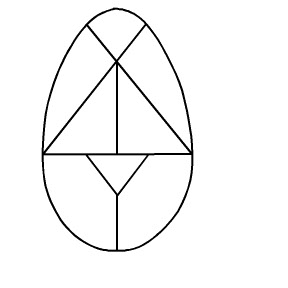
    it's called an Egg Tangram, with the Cut out of the pieces you make birds with it

    you can see the birds here: nrich.maths.org :: Mathematics Enrichment :: Making Maths: Birds from an Egg

    I do recall Egyptian having sacred birds and pyramids

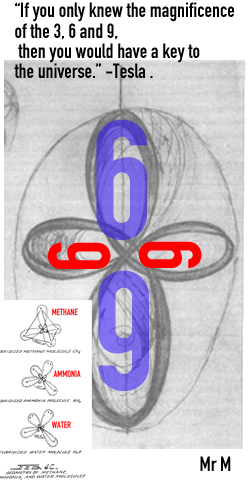
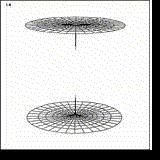
    I am now sure that if you want high efficiency Crystal Battery ; grow it between to Yin and Yang Coils (6 3 9 )
    Last edited by MonsieurM; 09-23-2011, 10:29 PM.

    Leave a comment:


  • MonsieurM
    replied
    petar113507 incredible work...and the column impressive

    thank you

    -------------

    As i was reading http://www.energeticforum.com/renewa...tml#post158744 ; the idea that it is all in the geometry kept nagging me; i went on some digging and found this:

    Epsom Salt is often mentioned in the thread; so i figured i'd check some info on epsom salt:

    In inorganic chemistry, a sulfate (IUPAC-recommended spelling; also sulphate in British English) is a salt of sulfuric acid.

    Sulfates are important in both the chemical industry and biological systems:
    The lead-acid battery typically uses sulfuric acid.
    Some anaerobic microorganisms, such as those living in sediment or near deep sea thermal vents, use the reduction of sulfates coupled with the oxidation of organic compounds or hydrogen as an energy source for chemosynthesis. These are known as sulfate-reducing bacteria.
    Copper sulfate is a common algaecide.
    Magnesium sulfate, commonly known as Epsom salts, is used in therapeutic baths.
    Gypsum, the natural mineral form of hydrated calcium sulfate, is used to produce plaster.
    The sulfate ion is used as counter ion for some cationic drugs.


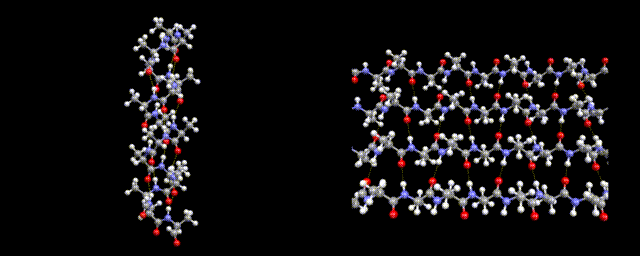
    now here is the fun part: the image below are two representations of alpha quartz (Helical like the Tesla Coil ) and the Beta Quartz


    now add a helical coil to a tetrahedral what do you get

    Last edited by MonsieurM; 09-23-2011, 10:14 PM.

    Leave a comment:


  • petar113507
    replied
    This is my best coil wind yet.
    I put the coil around a clear plastic tube. At the time it was just what was available to me to wind my coils around -- but it seemed to be a good "accident" .

    Coil wrapped around the tube -- the tube is a flourescent light bulb protector, cut a little short.


    Now, as the ice froze in the center -- there was some serious pressure going on in there. I wish I had taken a picture of it while it was freezing. Basically, the outside froze long before the middle of it froze. The tube acted sort of like a barrier for the inside of the ice -- I don't quite know why it didn't freeze for such a long time -- but when it did, it looked pretty incredible.

    The colum before (the straw), was able to push the water up the straw. Inside this one -- the tube was submerged, and pushed up with enough force to crack the upper layer clean off.


    Close up of the tube shoving the top layer clean off.


    The tube was useful -- as it allowed me the chance to melt the outside ice off, without melting the structured core ice

    I became fascinated with the coil winds, and their relation to the freezing pillar's structuring.


    Different angle.


    Another angle


    I'm seeing similarities in the form of how the ice freezes -- and the spinning vortex inside the wine bottles AND the shape of vogel's crystals....

    This particular freeze got me thinking -- Instead of a 1/1 in/out of the same energy of a cubic form -- why vogel cut his crystals that way, might have been to be a step up/down transformer of his energy.

    In this sense -- Think of magnetite as a 50/50 soft iron transformer -- where the primary, and secondary wires have the same number of turns. However, like most step up/down transformers -- like vogel's crystal has a wider primary, and a longer secondary.

    I'm trying to figure out how to produce that exact same effect in the ice structure -- since I will be hitting it with 10 KV -- Does anyone else see what I trying to say here?

    Neon sign transformer arrived yesterday. Time to plan building that tesla coil...
    Different types of Tesla coils acting as receiving antennaes....


    ==Romo

    Leave a comment:


  • Dave45
    replied

    notice the A vector field
    I froze one with no electrical input with copper screen covering everything but the ends, then fired up the coil overnight the vector field penetrated the ice at the ends where there was no screen, Im using copper screen because thats what I have but I think any metal screen will shield the coil, If we can shield the coil an make the vector field connect with the structured column I think it will eliminate bemf in the coil.
    I havent been experimenting alot here lately, will get back to it soon

    Leave a comment:


  • Dave45
    replied
    Hey guys glad to see your experimenting, something Iv been thinking,but havent tried yet,
    hot water freezes faster than cold, why, I think its because the water is already in an expanded state try freezing the water hot it may stop busting your containers, like I said I havent tried this, but worth checking out

    Leave a comment:


  • MonsieurM
    replied
    Showing more he shape of the colum. The ice cracked between where the opposing wires were. Shape of coil was an effort to produce a solid pillar.
    I'm gonna need a bigger freezing container.
    this one is proof of concept next up would be two opposing coil to see this :


    Leave a comment:


  • MonsieurM
    replied
    Fantastic job petar113507 , I've had similar effect with the frozen caduceus...good thing

    the tree image is perfect

    Leave a comment:


  • petar113507
    replied
    Cracked the glass, and the straw got pushed OUT of the coil


    Ice froze up to here in the straw


    And the ice in the straw froze the bubble cavities in this shape....


    Looks like the center "<>" shape


    Solid ice colum


    Showing more he shape of the colum. The ice cracked between where the opposing wires were. Shape of coil was an effort to produce a solid pillar.
    I'm gonna need a bigger freezing container.


    Pancake coil made of magnet wire on the bottom of this cup, with a bifilar coil wrapped around the side.
    Ice crack began, and went deepest into the ice, where the magnetic "null was" from the pancake coil -- coil around the sides didnt seem to have much effect.


    So far I've only used a few different gauge wires, all of them only solid... Gauge wire might have effect on the shaping of fractures?

    ==Romo

    Leave a comment:


  • IndianaBoys
    replied
    Originally posted by MonsieurM View Post
    you can use the above method to reproduce the same experiments as was shown in the documentary on water

    IndianaBoys, you do have a microscope, you could a drop freeze colloidal gold in water with this method

    vortex water, magnetized water ect....
    MonsieurM,

    What steps would you use in creating the sample?

    IndianaBoys

    Leave a comment:


  • MonsieurM
    replied
    you can use the above method to reproduce the same experiments as was shown in the documentary on water

    IndianaBoys, you do have a microscope, you could a drop freeze colloidal gold in water with this method

    vortex water, magnetized water ect....
    Last edited by MonsieurM; 09-20-2011, 06:34 PM.

    Leave a comment:


  • MonsieurM
    replied
    The following relates to our work; but also the glue crystal battery

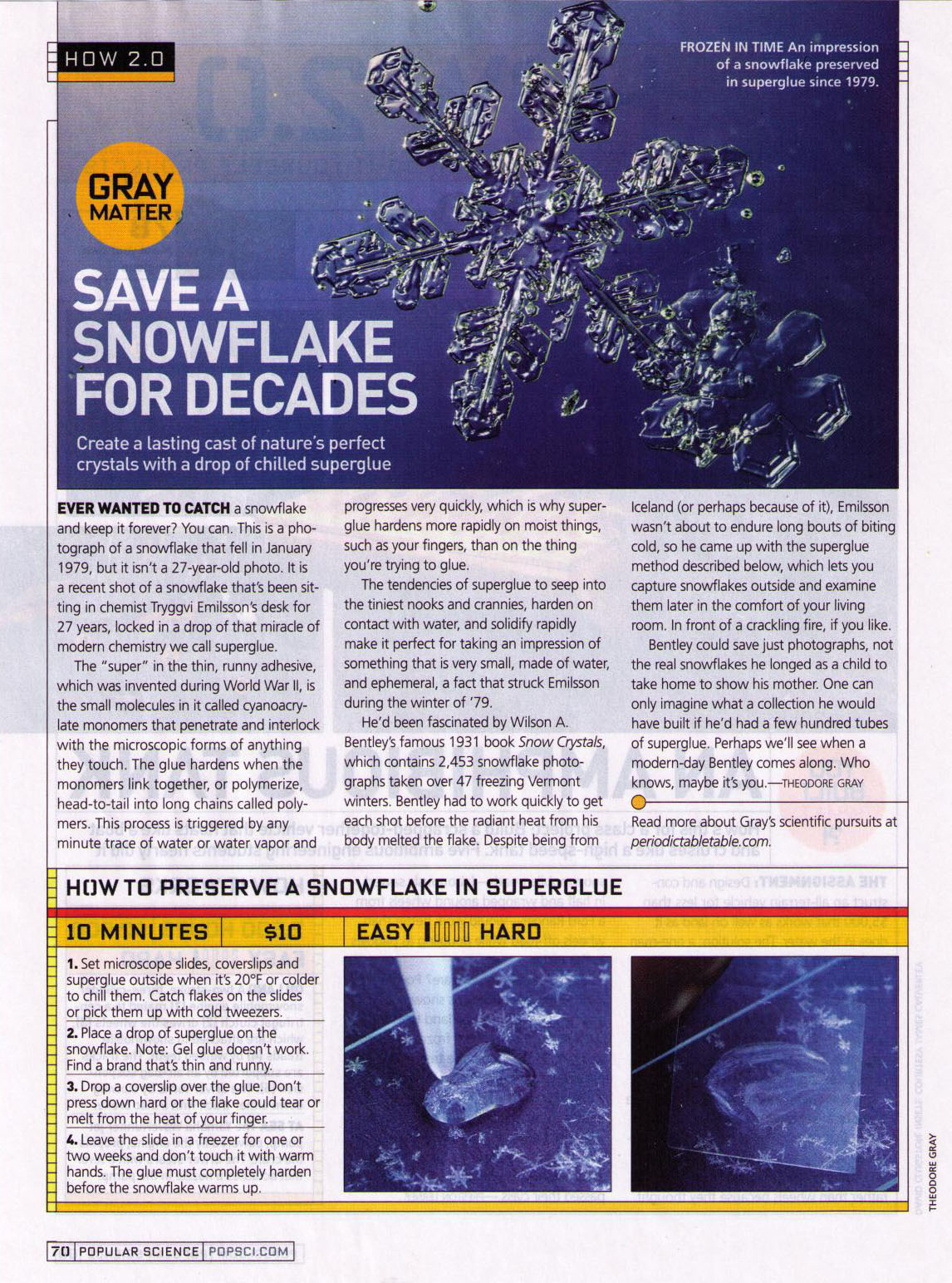
    Save a Snowflake for Decades

    Ever wanted to catch a snowflake and keep it forever? You can. This is a photograph of a snowflake that fell in January 1979, but it isn't a 27-year-old photo. It is a recent shot of a snowflake that's been sitting in chemist Tryggvi Emilsson's desk for 27 years, locked in a drop of that miracle of modern chemistry we call superglue. The 'super' in the thin, runny adhesive, which was invented during World War II, is the small molecules in it called cyanoacrylate monomers that penetrate and interlock with the microscopic forms of anything they touch. The glue hardens when the monomers link together, or polymerize, head-to-tail into long chains called polymers. This process is triggered by any minute trace of water or water vapor and progresses very quickly, which is why superglue hardens more rapidly on moist things, such as your fingers, than on the thing you're trying to glue.

    The tendencies of superglue to seep into the tiniest nooks and crannies, harden on contact with water, and solidify rapidly make it perfect for taking an impression of something that is very small, made of water, and ephemeral, a fact that struck Emilsson during the winter of '79.

    He'd been fascinated by Wilson A. Bentley's famous 1931 book Snow Crystals, which contains 2,453 snowflake photographs taken over 47 freezing Vermont winters. Bentley had to work quickly to get each shot before the radiant heat from his body melted the flake. Despite being from Iceland (or perhaps because of it), Emilsson wasn't about to endure long bouts of biting cold, so he came up with the superglue method described below, which lets you capture snowflakes outside and examine them later in the comfort of your living room. In front of a crackling fire, if you like.

    Bentley could save just photographs, not the real snowflakes he longed as a child to take home to show his mother. One can only imagine what a collection he would have built if he'd had a few hundred tubes of superglue. Perhaps we'll see when a modern-day Bentley comes along. Who knows, maybe it's you.
    the whole article, save it on your pc


    Leave a comment:


  • petar113507
    replied
    36 Point Rodin Coil Windings | Energy Research

    I think MM shared this site/pictures from this site before.

    I see the rodin making the intersecting (canceling) layer (blue line) -- and how the smith coil would also make a same layer.

    You keep referring to these two, in this configuration as an antenna. I thought antenna's were dealing with could only interceve the imbalanced state of electric waves -- making the "load", or whatever you wanted to power, also interceve that flux.

    Then it struck me, What if we aren't trying to get that flux? If our spine is also the "antenna" as the neutral center between the two halves of our body, and our two halves of our bodies are counterbalanced in action -- our consciousness would seem to use our body "puppets" through this type of signal.
    For that reason, I think the expression of energy we would be looking to use would be the balanced 6 and 9 of the rodin, using the neutral center as its fulcrum for the "real" power.

    Spike the smith coil, induce dielectric breakdown in the center -- and use the rodin as a "harvesting" coil, is one thing I'd like to see.

    Or, MM -- you've usually been one step ahead of me in the unfolding of this idea -- so, assuming (your suggestion) that we would pulse the rodin, and the smith coil at the same time -- the induced cancelling region would be the "shape" of our antennae?

    I am also seeing that you don't need very strong magnetic effects to polarize the structure of the ice.

    If the cancelled region gets sucked into the wire to produce a magnetic feild a "moment" after -- what happens when we "pump" the region where the Rodin coil draws its power from? (read: the rodin coil's fulcrum -- Still center )

    I think I would have to wind a very tight smith coil for the center to properly "pump" it.

    Anyways, If you don't feel like responding, as this is one of my "hunches", I understand.
    I mean that -- I must use my own consciousness to make decisions -- referring to others only for their technical skills, or encyclopedic information -- what we must DO with it is up to our consciousness. I beleive what you have been trying to avoid, is making the decisions for us -- as that would hinder our development. You have shared much information, and so I see you are provoking us in the direction to understand their inter-relations, and encouraging us to decide for ourselves. The purpose of providing such information -- is that we DO decide ourselves how to interpret it. Thank you

    With that, I have already decided on how to wind the smith -- we will be able to see both the coils in ice soon

    ==Romo
    Last edited by petar113507; 09-20-2011, 06:09 PM.

    Leave a comment:


  • petar113507
    replied
    Will post pictures as I get home. In class at school currently.

    Mobius fermat spiral froze very nicely.

    Also, magnet wire worked marvelously for wrapping the coils and holding their shape. Pancake coils produce an interesting ice structure as well.

    Have not put aluminum in the cups as a "ground" to see if I can direct the cracks. Will try that next. my freezer isn't too big -- that is actually the limiting factor on the ice experiments

    Best wishes,

    ==Romo

    Leave a comment:


  • MonsieurM
    replied
    Originally posted by Dave45 View Post
    Iv been looking at Floyd Sweet's vta, I believe he successfully separated the electric field from the magnetic field.
    It can be done and when done the magnetic field is cold.
    Rodin coil / Sweet's VTA? - YouTube


    now that i think about it ,Dave wouldn't a Rodin coil work as a primary in Don Smith's Set up (it is perfect as an antenna ); anyway just a thought inspired by the vid i posted
    Last edited by MonsieurM; 09-20-2011, 02:34 PM.

    Leave a comment:


  • Dave45
    replied
    Iv been looking at Floyd Sweet's vta, I believe he successfully separated the electric field from the magnetic field.
    It can be done and when done the magnetic field is cold.

    Leave a comment:

Working...
X