
Posted in the last few days
Well I posted in the last few days about circuits recharging themselves and I can't remember where I posted it but I will explain again, and it works try it.
"IF" you have a circuit that can feed back to the source battery to recharge it, then you need to put in series with that battery, more batteries, to the value of the recharge returning voltage, but still take the drive voltage from the front battery, this way you are using the full voltage of the return and the front battery will not see directly this voltage, as in a loop, but will recharge along with the rest of the batteries. This has been tested and works, I may put a video together to show this happening given a little time which is a bit thin on the ground at the moment
Mike
-
I believe the word "use" is the operative word to look at here. To use any charges means resistance. Charges interact with the conductors matter that has gathered to that particular node network and resistance is always gonna play a role in charges when matter is associated with the network. But it doesn't play with potentials or the aether in general since matter is not effecting the network when it is just a separation of the dielectric medium. So we must change the rules to include not a stationary network but mobile and self organizing based on the geometry of the mediums individual components in relation to the environmental charges position.Originally posted by boguslaw View Post
Remember that potential or voltage is the pulling force of the charges. As charges collect balancing that pull they block or resist other charges via the balancing mechanism that nature uses. You could say that the underlying network dictates the capabilities of the surrounding matter. The thicker the network the more capability the matter has to attract charges and guide them through the matter.
Lets go through a small example. Lets say we present a potential from a battery to our circuit. The circuit instantly becomes energized with the potential of the battery. The dielectric sea around the circuit forms a network instantly to the surrounding environment allowing for charges to be picked up and pulled into the circuit. This network is fractal based because of the underlying dielectric medium and much resembles corona discharges from a high voltage (extreme) event. This is not the extreme around our circuit so it is relatively small and invisible but this does not mean it is small in the way of pulling charges for use in our circuit. This new virtual network is now rigid in a sense as long as the circuit maintains potential. If we let the charges go through our circuit and into the source it breaks the potential difference down. This is the secret. Don't let the source ever attain a balance and you have an infinity of charges to use through a tap before the source. Shut the source off and then the charges through inertia continue through the tap to load and back out to the environment. A clever bit of trickery is needed to have this happen and I suspect that resonance and impedance play in that. I still have not worked that part out yet but it is very plausible that is the case.
In effect we are separating the positive from the load and only using the drawing to start a flow that we can harvest charges or real force to use in the load. But this is on a delay as evident from the statement that voltage leads current per experimental results.Last edited by Jbignes5; 09-10-2010, 08:49 PM.Leave a comment:
-
My idea is that energy flows outside copper but inside flow is interrupted at high rate so it lags and we see energy as difference between external and internal flow.Byproduct is also resistance but I'm not sure yet how it is related.
Interesting is that we can use it only when there is resistance.Leave a comment:
-
If that was the case then all you would need was to make a circuit and let nature take over. That doesn't work. All our provided flows come from the rush of real charges into our systems that are attracted to our circuits solid form or antenna. The conductors are just solid organized networks of trapped conductors of the charges within the conductors bound matter which is neutral and guides the charges twords the attraction source Voltage.Originally posted by lamare View Post
This is also why voltage leads current in such the way it does. The charges take a bit to start movement and movement is acceleration of that charge.
I will refer back to the copper etched disk to show the internal network that charges flow around. Take the picture of the disk and that is one slice of a wire.
Copper - Wikipedia, the free encyclopedia
You also assume the charge carriers do the motion of charge in a solid conductor. But by looking at the transition (From solid to liquid to solid again) metal (copper), one can see that as the charges exit the material radiatively, they form a network of the aligned carriers and when this metal has cooled it locks in that network. In the case of a solid the carriers do not move and act much like iron does when exposed to a magnetic field except the field in this case is a bunched group of charges. It is the charges that move and nothing else in matter because the matter has formed around the charge carriers in a static fashion holding them into place. The charges then enter the metal and flow through the metal following the charge carriers network and then subset of additional rules follow the material like resistance to the flow and heating of the material.
In the aether it doesn't conform to part of these rules because the charge carriers are mobile. The only thing that holds spacial charges into a network is the flow itself. once the flow stops it disperses and when the source is then recharged it forms on the fly. This is the fractal nature of it all. A base form that modifies everything that comes from it if the source can be maintained. And this is where the don't destroy the dipole comes in. The dipole is the network that is formed from the sea of separation (dielectric). Once you destroy that connection you have to pay to reestablish that connection again. That is what Bearden was talking about and is proofed by magnets.Last edited by Jbignes5; 09-10-2010, 05:36 PM.Leave a comment:
-
This is not completely how I understand it. I agree with you that we don't supply current to our devices. But I don't think we normally "attract real static charges" [...] or do anything with charges "outside of our physical systems".Originally posted by Jbignes5 View Post
The way I see it is that the flow we are talking about, the static electric field, is a real flow in a real ether. And since the ether is so thin, this flows trough anything (See the chapter "SHOCKING DISCOVERY" over here: Nikola Tesla - The Complete Patents of Nikola Tesla - The Man who invented the 20th Century).
So, what I think this flow in this ether does, is push the charge carriers already existing in our circuits around. So, it acts like the wind on a sailboat...
In other words: no charge carriers come in nor leave our circuit. They are just traveling around inside our circuits, pretty much like traditional models describe. The only essential difference between traditional, Newtonian models and my view is that in my view the charge carriers are pushed around by a dynamic, flowing kind of force/energy, while the Newtonian model assumes a static, pressure-like kind of force/energy.Leave a comment:
-
Not a source but a connection to the pressure of space. Much like the back emf we see when pulsing a coil. In itself the back pulse is the motivator rushing back into the coil and because it is going inward (generative,multiplying) it appears to be extremely high voltage or pressure. Pulsing can be a great way to get a maintaining static pressure to use as a virtual pump of the charge carriers. This process is not new and it is exactly what Tesla used eventually in the unsubstantiated but credible report of the Pierce arrow experiment.Originally posted by Farrah Day View Post
All Mr. Tesla did was create a pulsing source to charge a layden jar. Then through the use of a new transformer and possibly another layden jar used that potential to attract a flow of the charge carriers twords that source. Once the attraction happens he quickly switched the flow through the load and out the exit of his circuit for the flow of charges. It seems to me that if this electrical event that happens has flow to it one could create a wake and ride(load) it for a bit.
Seeing that Mr. Bedini almost did the same thing although the methode was quite different. The wakes that Bedini used were actually setup in the flow of the batteries and a liquid was used to to facilitate inertia on a higher degree or a super flow. Everyone has seen the water is bent by static charge as the water flows from a faucet right? Same premise....
Dr. Stiffler did the same thing with a diode and water with a virtual connection to the diode by banding outside of the water. This had a two fold effect. One is that you get a higher voltage or pressure when you focus into a single point. Surface area does that alone. The second thing is that a flow will be created from the inducing portion of the diode (banded from the outside) through the water dragging the charges through the water inducing the same process that a battery uses. He creates that flow or imbalance by using a diode with the banding focuser/virtual connection part of the setup. It is in all intensive purposes a pump that has a virtual connection That can separate water by yanking the charges that bind the water away from the solid or physical portion of water. Kinda like yanking the table cloth from under Grandma's best china. If done right with the right timing one could get a instant separation of the medium at the, either flow start or ending, that is very rich in both charges or dielectric conductors. These two tend to compliment each other in the medium of water. It is after all why water phase changes from a fluid to a solid. When the charges leech out of the waters physical portion the only thing left is the real energy(charge) carriers or conductors. This leaves the waters left over structure to be charge deficient and seeking balance. The balance is motivated by the now super rich energy/charge conductors network to retain it's own normal charge via surface capacitance of the static charges on the dielectric conductors.
Why we never looked more into the static portion of the electrical phenomina astounds me. There were so many great men that tried but no one payed any attention to them and we lost out on that one. The men that tried showed empirical results that just got buried or taken back in the case of Tesla.
Everyone is getting confused over this situation because we have our basic understanding of what this invention of ac is and have confused it with what everything else is or operates in the universe. We don't supply current to our devices. What we do is attract real static charges into becoming dynamic flows in our systems. The energy or charges have always been outside of our physical systems. Batteries are just a static pump that can maintain it's attraction through the liquid between the plates. It uses the inertia of the flow to continue to be able to maintain a load. Once the load attains maximum usage of that flow it can not go any further and visa versa. Meaning that it would draw down the sources ability to provide a potential difference and stop the flow. This would be considered a short.
We must rethink our whole understanding of the natural because as Tesla said "AC is most unnatural"! Now why would the inventor do a 360 on one of the most important invention that we can think of today?
Here is what Tesla was thinking.
"The Eternal Source of Energy of the Universe, Origin and Intensity of Cosmic Rays"Leave a comment:
-
I did try to explain this in my article:Originally posted by Farrah Day View Post
Article:Free Electric Energy in Theory and Practice - PESWiki
Take a look at this simple oscillator:So, where does all this leave us? We can spend the effort of turning the shaft of a generator, which will separate the charges in the system we want to power and creates a dipole. When we do this, we do not actually store energy in the dipole, we change the configuration of the electric field. When we subsequently send those same charges trough the system we want to power, it is the active vacuum, the environment, which is kind enough to provide us with the energy that is needed to kill the dipole we have created to be able to power our load and with the energy to actually power our load as well. As we have seen, this is an exercise with a closed wallet from our point of view. The load receives the exact same amount of energy that we have put in the system ourselves as mechanical energy, apart from the losses. So, all things considered, the Newtionian analogy we use in electrical engineering is perfectly valid and applicable. Except for one tiny little detail.
We change the configuration of the electric field when we operate an electrical circuit and since we eventually get the same amount of energy back trough our load while doing this, this means we can actually manipulate the electric field for free, just by powering our circuits the way we always do. Get the point? While we are opening and closing our fandoor, we influence the airflow in our neighbourhood without having to pay a dime for that in terms of energy!
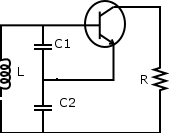
In this circuit, the charge is continously flipped back between the coil and the capacitors. Meanwhile, the voltage across the coil varies, which gives you an electric field which extends beyond the circuit itself. So, this is a dynamic dipole emitting electric energy all the time in the form of a varying electric field. Of course, there are also losses (electro-magnetic radiation and heat, for example) and for these you have to pay. And that is what you have to put into this circuit trough the transistor.
So, we have our dipole across the coil. If we can find a way to use the voltage over there without drawing any current, we're in business. One way to do that is to connect one terminal of a second coil to the coil, such that the resonance frequency of our oscillator matches to a higher order resonance frequency of this second coil.
You see, with the normal quarter wave resonance, you get high voltage, zero current at one terminal but high current, low voltage at the other terminal. So, if you double that frequency, you get high voltage, zero current at both terminals. And this is what is being done in the SEC exciter circuits:

Now there's a bit more to say on these exciter circuits, but this is the basis. What happens in these circuits, is that the transistor is steered such that it is either "on" or "off", so you get a very high bandwith. It switches very fast, so you actually get a summation of multiple resonance waves in there, all resonating at a multiple of the natural resonance frequency of the coil, in this case L1.
It is clear that this way, you get quite a bit of energy available at the coil. Enough to light a fluorescent tube fom a battery....
From this base, we can continue. For example, we can make coil L1 longer and longer, without us having to feed more current into the system, because of the way the electric energy propagates trough the coil. The coil acts as a LMD (Longitudinal Magneto-Dielectric) transmission line as well as a normal TEM (Transverse ElectroMagnetic) transmission line:
The L.M.D./T.E.M.Test
The difference between the two is the magnetic component, which is more or less akin to the current going trough the coil. The higher the frequency you use, the more the coil acts like a longitudinal transmission line and the more electric energy you can pull out of the environment. See Naudin....
So, resonating coils in series is relatively easy to do, as long as you match the coils. If you want to go beyond that, you have to make sure you only use the field without drawing current. And so you need some more tricks, one of which would be the use of a rectified carrier wave, preferably in combination with a high pass filter.Last edited by lamare; 09-10-2010, 01:27 PM.Leave a comment:
-
Hi Lamare
If we assume that any and every dipole is a source of untold energy flowing in and out of the dipole source from the aether, how then do we use this energy given that you state that we cannot interfere with - or disturb it?
If I'm understanding this correctly, it is case of getting the field produced by the dipole to influence a remote system into doing work. And if we can do this while maintaining (and without depleting) the source dipole, then - from our perspective at least - we are effectively getting something for nothing.
But am I also to understand that the source dipole must remain static... ie, no pulsing allowed?Leave a comment:
-
Great Material
Lamare,
Thanks for sharing the links. You have a collection of some great material.
Best Regards,
SloveniaLeave a comment:
-
I think I'll leave this chew for a later moment.Originally posted by Jbignes5 View Post
To me, it is very interesting to figure out what actually goes on eventually. But at the moment I am focussing on how Gray, Meyer and Puharich were able to extract energy from the vacuum. In order to explain that, all I need to know is that the electric field we are used to work with is a dynamic force, a flow of energy, and that we can use that energy with some trickery. For that purpose, Turtur's story is more than sufficient, because I don't need to know how/where the energy eventually comes from in order to be able to engineer working circuits that make use of this free energy source.
--::--
For those interested in the theories by Eric Dollard, I have uploaded some documents to my website I got my hands on some time ago:
Bestandsoverzicht van /pdf/Eric_Dollard_Document_Collection/
This one is very interesting. Here he explains Tesla's transmission technology, like his magnifying transmitter, the way I think it should be done:
Theory of Wireless Power by Eric Dollard.pdf
I also uploaded the pdf made by Slovenia and a new pdf for my article to:
Bestandsoverzicht van /pdf/
Here you can also find an OCR'ed version of Mueller's report on the Kromrey Converter and the "Tesla switch" with some updated photo's from Bedini's site, etc.:
Leave a comment:
-
One of the most important things to realize is that the electric field is the cause for currents to occur. Aaron calls this "potential", but IMHO it is better to call it "the electric field", because that's what it is. The term "potential" suggests we are talking about a static force akin to "pressure" in hydraulics, the Newtonian analogy we basically use in our normal circuit analysis.Originally posted by Aaron View Post
There is a significant difference between the static analogy we are used to work with and the actual physical situation. In the actual situation the force we consider to be a static pressure-like force is a dynamic force, it's a flow of energy. To call this flow of energy "potential" is confusing IMHO, because a propagating electric field is just not the same thing as a pressure-like "potential".
I explain this in my article as follows:
Article:Free Electric Energy in Theory and Practice - PESWiki
So there we are. The electric field (the airflow in our fandoor analogy) is on the one hand powered by the vacuum and on the other hand it powers the vacuum. So, at least part of the energy in space / the vacuum, referred to with names as "Zero Point Energy" (ZPE), virtual particle flux, the Dirac sea, Orgone, etc. is not only fueled by the electric field, it is continuously converted back into an electric field by each and every charged particle in the universe, which makes the electric field a source of energy. The implications of that are staggering. It means that the law of conservation of energy does not apply to electrical systems, because they are not isolated. After all, Turtur shows without a shadow of a doubt that energy is being extracted from the active vacuum by each and every charged particle and thus every electrical system in existence in the Universe.
Based on all this, it is clear that we need to look at electrical systems in a different way, we need a way of thinking that does account for the energy source that is really powering our systems. In a way, we need a similar change in our models as the change from Newton to quantum mechanics. While Newtonian mechanics can still be used in mechanical engineering most of the time, at some point they are no longer valid, for example in the calculation of satellite orbits. In the same way, the current electrical engineering model is fine for most applications where it suffices to consider only the door part of our fandoor analogy, that is, by considering electrical systems basically as an analogy of hydraulics, which is literally just a variation of Newtonian mechanics. However, if you want to be able to utilize the energy source the electric field provides, there just ain't no way to do that without taking the energy exchange between an electrical system and the vacuum completely into account.
So, let's do that. In the old Newtonian model, we consider the voltage across an impedance to be the cause for a current to occur, which in our fandoor anology would be the pressure that the door "feels" being enacted by the airflow on its surface, while in reality it is the airflow (the electric) field that acts upon the door and not the pressure itself. In other words it seems like the "pressure" the electric field enacts on our components is static, hence the name "static electric field", while in actual reality this force is a dynamic force, something flows along the surface that creates the pressure. [...]
There is an essential difference between the Newtonian analogy we use in electrical engineering (closed circuits) and the actual reality. The analogy of a capacitor in hydraulics (Newtonian analogy) is a piston moving back and forth in a closed cylinder wherein gas is pressurized. And here's the difference: Imagine moving the piston inwards, pressurizing the gas, and put the thing on your workbench. The piston will immediately move back, because of the gas pressure. Now charge a capacitor and put it on your workbench. See the difference? The capacitor will just sit there, keeping it's charge. In other words: our hydraulic analogy is unstable, it 'wants' to release it's energy, while our actual electrical component is stable when 'pressurized'. It will only 'release' it's energy when something external is being done. It has to be disturbed, because the charges in a capacitor actually attract one another, which makes them like to stay where they are. So, when 'discharging' a capacitor, as a matter of fact, these attraction forces have to be overcome. And that does not release energy at all, it costs energy to do that. So, it actually takes the same amount of energy to charge a capacitor as the amount of energy it takes to discharge the capacitor.Leave a comment:
-
potential differences
Hi Dave, thanks for the comment.Originally posted by Web000x View Post
The idea that "electron current" charges a cap by piling electrons on
a plate, etc... is just a popular model with flaws so it can never even
be a real theory even though it is treated as one by conventional wisdom.
"Unfortunately, to a large extent in dealing with dielectric fields the
prehistoric conception of the electrostatic charge (electron) on the
conductor still exists....and makes the consideration of dielectric fields
unnecessarily complicated." - Charles Proteus Steinmetz
"The misconception that capacitance is the result of accumulating
electrons has seriously distorted our view of dielectric phenomena."
- Eric Dollard
If it isn't too far off topic, here is one highly qualified perspective of
capacitance from Eric Dollard:
Eric Dollard Notes (1986--1991)
You can see pages 26-29.
What is your personal take on Eric Dollard's explanation?
Anyway, if the battery voltage does not drop - if it can be tricked
so it doesn't drop, that is an accurate analogy of a solar panel with
a non-stop source of light. It is no different. That means the voltage
potential is able to be maintained.
You take the cap, hook it to the 24v on the solar panel, remove the cap,
and dump it to a battery. Then reconnect the cap to a solar panel,
it gets to 24v, remove cap and dump to battery. Repeat. There is no
connecting a load directly to the solar panel at all and the 24v will be
maintained at the leads without it dropping down.
Let's say for example I have a capacitor that has been modified into
being an electret. For example 9 volts at 33,000 uf. I can short the
terminals of the capacitor, the voltage drops to zero. If I un-short
the terminals, the voltage pops right back up to 9 v and of course at
33,000 uf. If I take another cap, a regular 60v 33,000uf cap and connect
it to that "electret" cap, it will get the voltage of that second cap to 9v.
I can remove that cap and dump it to a 6v battery for example or
hook it to a few led's to make them flash (or burn them out), etc...
I can take the cap after the "charge" is gone and reconnect it to the
electret cap and it is back up to 9v and then remove the cap and put
back to some load and repeat.
Even though if you short the leads on the electret cap for example, it
pops back up, but the main point is that you can put a cap to it to get
it "charged" remove it and apply to load. Put back to electret cap to
charge it remove and power load, repeat.
The electret cap is simply not depleting or reducing any amount of
anything anymore than a magnet depletes by having it do work. Basically,
it is simply a dipole that breaks the symmetry of the vacuum and all
the potential to "charge" the secondary cap comes from external, that
is what a dipole does. The electret cap simply is not transferring a unit
of electrons from itself to the secondary cap. A potential difference is
being established by not by this electron piling idea.
The current you measure when you charge a cap is not what is charging
the cap, that is just a measurement of your losses - that is all the
meter measures - and it does so not by measuring electron current, it
does it by measuring the voltage difference across a resistor inside of that
amp meter or multimeter.
We know the pressure of the aetheric gas is measurable as voltage
and that is all we're measuring in order to assume there is x amount of
associated "electron current."
If the capacitor is being filled, then why can I put another cap to it,
"charge" that cap remove it and apply that secondary cap to a load and
get work? All the while the primary cap maintains it's voltage potential
difference at the terminals?
The same thing can be accomplished with some of my concentric tubes
in a water cell. Once they are conditioned with the calcium and/or
magnesium oxide type coating, whatever it really is, it establishes a
permanent voltage potential difference when submerged in water. Usually
2-3 volts. I can short it all day long and it always pops back and attaching
a cap to it "charges" the cap to 2-3 volts - whatever voltage the cell
is at. The water cell isn't running out of anything.
Of course this concept is much easier with caps than batteries, I'm not
going to argue it is easy to do with a battery but it can be done. I've done
it in quite a few experiments with batteries where not only the voltage
was maintained but sometimes even rose while powering a load and not
with fluffy voltage on top, but with maintaining the real load powering
capability of the battery. One was a variation of the Tesla Switch that
John showed - not exactly that but similar.
I've also damaged a handful of batteries in the tests and wound up with
some electret batteries that just won't die. Hooking a load with any kind
of resistance to them flat-lines the voltage and when releasing, the
battery pops back up. BUT, it will charge a cap to the same voltage
without dropping the "source dipole's" voltage.
If we want to lump a self runner or any circuit into the mix and consider
that an authentic way to maintain a dipole so it provides potential for work
but doesn't decrease then there are actually quite a few other things that
have worked.
The very first Ainslie circuit I did had a 10 ohm resistor - a small one
compared to the others I used and for a current sensing resistor,
I also used a 10 ohm resistor because it was the smallest I had and
didn't want to parallel a bunch of them. I wound up using later a 0.25
for those measurements.
Anyway, being that there was so much resistance in series and at the
frequencies I was switching that mosfet at, the circuit was basically a
gas pump (for the Heaviside gas - positive potential of the vacuum, etc...).
Which is what all circuits are anyway in my opinion, but the point was that
the voltage was taken out of its regular ratio with the normally associated
current. The power battery climbed above the resting voltage for about
24 hours and when it started to come down a bit, it took about 18
or so more hours before it dropped back down to the voltage where it was
at before I started the test. The high resistance of 20 ohms worth
of resistance coupled by the fact that the magnetic field of the
inductive resistor choked off more current - it was nearly a pure radiant
charge in the truest sense.
The battery voltage did wind up dropping below the initial resting voltage
but not much and I stopped the test soon after because it took too long.
Already waited about 2-3 days and it didn't hardly move. So it all comes
down to tuning the timing and balancing the gas pressure throughout
the circuit (having the correct amount of impedance where you want
it).
As a distinction, I think getting a circuit to "take" from the battery
in a way that doesn't kill it is WAAAAY more elegant and desirable
than to have the battery give power in a way that drains it that
provides the potential to cause another potential difference elsewhere
and so on multiple stages that eventually winds up with enough to
send back to the front. It is apparent that authentic solutions
along these lines are going to be popping out of the woodwork
especially over the next couple years.
The Velijko 2 stage oscillator is such a device that allows for a very
long sustaining of the dipole. It is all about creating the potential
differences. Yes, it goes down, but who cares if the amplification is
many times? If we can move 1 pound to move 10 pounds, the system
is built in a way that doesn't quickly kill the dipole.
The pendulum is swinging. You then short circuit the machine's load
by holding down the hammer, the thing doing the intended work. When
you hold it down, the pendulum, the oscillating part that has periodic
changing relationships with the downward push of the aether, continues
to swing. The pendulum is the timer being run almost completely on
free gravitational potential and just partly on our initial lift.
Anyway, you short circuit the oscillator and maintain an equilibrium at
that point (hammer held firmly on anvil) yet the dipole is maintained. Yes,
it dwindles down with each swing, that is supposed to happen obviously,
but you simply do NOT flat line it such as you would experience if you
short circuited a conventional electric motor or other circuit. Short
circuiting the load or what it comes down to is you're short circuiting
the source dipole and trying to flatline the voltage like NOW.
But in an open circuit, or one that is at least open part of or even most of
the time to external environmental input, gravitational potential here,
you short circuit the load (keep hammer motionless on top of anvil),
and the source dipole is maintained for a LOOOONG time.
The input and output are not locked - a machine like a grasshopper
oil well pump does have the front and back locked to each other. The large
weight is not benefiting from free gravitational potential, it is only
there to balance the system. But don't want balance, at least I don't.
If you stopped the weight, it would stall the motor. If you stall the
motor, you stop the weight from moving.
So the mechanical oscillator is 100% consistent with the concept of
having a non-equilibrium system being able to maintain it's source dipole
by having a non-fixed relationship between the input and output.
The electret caps, solar panel, etc... all have non-fixed relationships
between input and output.
Lamare, I apologize if this is too off topic. Please let me know.Leave a comment:
-
Aaron,Originally posted by Aaron View Post
I have read many of your posts and your two publicized books, and do think that you are very intelligent. I must say that I don't see where the usable power is coming from out of this conversation.
I don't understand what exactly is being claimed when you add a capacitor to the output of your solar panel other that what is already known in conventional engineering. In most DC power supplies, there is a rather large capacitor that helps regulate the voltage when a load is present.
I understand that conventional electrical engineering is a load of crap, but the observation of displacement current is very real.
Displacement current is responsible for keeping the capacitor refilled. I see how the 24 volts would be maintained in your solar setup, but if you loaded your solar panel -> cap -> load setup down with anything SUBSTANTIAL, you would drop back down to your 12 volts rated. There is always some amount of power (V x I) being drawn if you continue draining the capacitor.
But won't we still have displacement current charging the capacitor and killing the dipole of the battery since it doesn't have a "source of light" to maintain its dipolarity?We can do similar things with batteries, etc...
I am not claiming that there are not ways to preserve a dipole. Only that my observations have always been that dipoles provide current when charging a capacitor thus killing the dipole. It always draws current to charge and recharge.
If you have experimental data that I should see that suggests otherwise, please let me know. I am all ears for a replication.

DaveLeave a comment:
-
maintaining the dipole
Hi Gyula,Originally posted by gyula View Post
Please reread my post, I think you may be misunderstanding what I'm
saying.
First of all, a battery is not filled up with energy and therefore cannot
supply energy to charge a cap. It is a dipole meaning it has a potential
difference at the terminals. The terminals having a different potential
difference breaks the "homogenous" symmetry of vacuum potential in
its vicinity.
When that symmetry is broken, you then have a potential difference.
The polarized vacuum potential moves TOWARDS the terminals of
the battery and then over the wires. Positive potential flows from
the vacuum, to the positive terminal and over the wire towards a lower
potential ground or the negative terminal. And the same thing happens
in the opposite direction with the negative potential. The electrons
in the 3rd electron field of the copper atoms that make up the wires
are most loosely bound and these are yanked out of orbit and are
attracted towards the positive terminal. The positive potential flowing
over the wire (Heaviside flow) is what is pulling these electrons out of
orbit - they get yanked out and move towards the positive terminal and
then drop into the orbit to replace the hole left by the electron that left.
It performs this hopping and jiggling down the wire and this is what the
current loss on a circuit is. And that is if electrons even exist.
The potential that "charges" a capacitor did NOT come from inside the
battery, it came from the environmental vacuum potential.
If the loop is closed between a cap and battery, bulb and battery, etc...,
half of the potential is used to supply the potential do do work and the
other half of the potential is "killing the dipole" by having the positive
potential for example that is moving over the wire to the negative terminal
and as it moves towards the negative terminal that positive potential is
repelling the positive "charges" of the polarized electrolytes inside the
battery and that causes them to disorder at a certain rate and that
disordering is what reduces the potential difference at the terminals. And
not because the battery ran out of something.
So when you charge a battery, you're not filling it up. You're polarizing
the electrolytes again so there is a larger potential difference at the
terminals. It didn't get filled up with "charge."
This is just like a magnet, as Dr. Stiffler mentions is a dipole. And the
vacuum potential that has its symmetry broken by the polarized material
of the magnet establishes a magnetic field around the magnet. When you
do work with a magnet, it doesn't run out of anything because the
substance that the magnetic field is made of doesn't come from the
material of the magnet, it also comes from the vacuum potential or aether.
Slowing down the "killing" of the battery is desirable and isn't in itself
"not killing the dipole". However, there are ways to do this where the
battery is not slowly being killed but the potential differences are
completely maintained.
Yes, impulse is what you're talking about and this is how you can get
a million watt pulse from small potential, etc... by compressing the entire
potential discharge into a small unit of time. Time IS what is locked up
in the impulse discharge.
Now with the solar cell, you have to really understand the point. Let's
say you have a fixed light source on the cell that does not change. Let's
say that the voltage potential at the terminals of the cell is 24v, you
can maintain that 24v potential forever by simply putting that 24v to
a very low impedance "container" like a capacitor. You are simply using
that potential at 24v to establish another potential difference of 24v
which does NOT reduce the 24v at the solar cell.
Having a fixed light source on the cell would be like having a battery that
you have the voltage potential maintained without dropping it while being
able to utilize that 12v battery potential to establish other 12v potentials
or 24v by charging 2 X 12v caps in parallel then connecting them in series,
etc... such as the Tesla Switch concept, etc... When doing it properly,
you essentially have a fixed light source or a fixed potential difference
at the battery, which does not change.
This goes beyond simply pulsing the battery to a cap.
This is an application as you describe just to prove the point in one of
many ways.
YouTube - Self Running Bedini Oscillator
That circuit works with or without the ground rod - just better with.
I have done many variations of that circuit and they all work and the
capacitor on the front maintains it's potential difference or voltage.Leave a comment:

Leave a comment: