This forum is preserved as a permanent archive. The community continues at eMedia Press.

Announcement

Collapse
No announcement yet.

Attention to all Gravity and Aether Researchers

Collapse
X
 
  • Filter
  • Time
  • Show
Clear All
new posts

  • Thank You Stevend,

    That is some very interesting stuff and the panel of investigators and advisors is quite impressive - even Buzz Aldrin is there

    I would be very interested in whether there is anything documented yet in support of propulsion by HFGW other than a "star undergoing asymmetric octupole collapse". That seems a bit dramatic

    I am always interested in learning new things
    "Amy Pond, there is something you need to understand, and someday your life may depend on it: I am definitely a madman with a box." ~The Doctor

    Comment


    • joules to lift

      Hi Harvey,

      At the peak, for my examples, the apple would be at zero velocity.
      It goes up and comes to a stop. When it reaches that height, for a
      short moment, the velocity is zero - it is neither going up or down.

      Just to paraphrase what I think you're saying... if there is this situation:

      If there is an object like a cube of pure lead, a small one that weighed
      2 ounces. The joules required to lift it to 1 meter would be:

      1.0m * (2 ounces or 0.0567kg * 9.8m/s sq) = 0.55566 joules

      Is that right?

      What about if I lift it 1/2 that height:
      0.5m * (2 oz or 0.0567kg * 9.8m/s sq) = 0.27783 joules

      So the same weight to 1/2 the height is exactly 1/2 the joules
      required to lift it twice that height.

      If I were to then assume these proportions stay, I could then guess
      that if I lifted the lead cube to 0.25 meters then I could simply
      divide 0.27783 joules in half to get the required joules to lift that
      object to 1/2 that height or 1/4 meter:

      0.27783 / 2 = 0.138915 joules

      If I used the whole formula to double check that, I could use:
      0.25 meters (0.0567kg * 9.8) = 0.138915

      Please tell me if that is the basic concept. Thanks!
      Sincerely,
      Aaron Murakami

      Books, Videos, ESTC Conference Info, Blog, etc. https://emediapress.com

      Comment


      • calculating work

        Here is one simple site that also seems to explain it:
        Energy and Work

        Calculating Work
        Work = Mass * Gravity * Height
        Work
        =
        M
        *
        G
        *
        H
        =
        2
        *
        9.8
        *
        0.75
        =
        14.7
        Joules
        If you lift 100 kg of mass 1-meter, you will have done 980 Joules of work.
        Work
        =
        M
        *
        G
        *
        H
        =
        100
        *
        9.8
        *
        1
        =
        980
        Joules


        While the book sits on the table, no work is being done because no object is moving, even though forces are involved. If a force (like gravity) is applied to an object (like the book) but it does not move, no work has been done.

        Work
        =
        M
        *
        G
        *
        H
        =
        2
        *
        9.8
        *
        0
        =
        0
        Joules

        Which of the following will result in more work? Running straight up hill, or taking a zigzag path up the hill?
        The work will be the same for both paths. The direct path requires more force, but less distance, while the zigzag path requires less force but more distance.

        Work = Mass * Gravity * Height


        Imagine you open a door by pushing near the hinges. Now imagine you open the same door by pushing near the handle. Which will result in more work? Again, the work done is the same. As you push the door near the hinges, the force needed to move it is greater, but the distance traveled is less. Pushing near the handle, the force is less, but the distance traveled is greater.

        Another Equation for Calculating Work:
        One can calculate the work done by an airplane by using the equation: W = F x D
        For instance, if a model airplane exerts 0.25 Newtons over a distance of 10 meters, the plane will expend 2.5 Joules.


        W
        = F x D

        = 0.25 * 10

        = 2.5 Joules

        If you apply a force over a given distance - you have done work. In general, the energy transferred depends on the amount of force and the distance over which that force is exerted. If the object doesn't move, you have not done work, even though you may have expended a great deal of energy! Oh well.
        Sincerely,
        Aaron Murakami

        Books, Videos, ESTC Conference Info, Blog, etc. https://emediapress.com

        Comment


        • Ideas:

          "high frequency gravity waves" matches the concept "propulsion"

          "propulsion from hfgw" matches "propulsion from propulsion"

          if you grab something, say a outcrop of rock, you can gain momentum of your body forwards or upwards by gripping the rock-outcrop and pushing back with the further-away part of your hand and forwards with the nearer part of your hand. As you vary the pressure of front and near parts of your hand gripping the rock, you can propel your body forwards. A "propulsion backwards" or backwards pressure generated into the rock allows you to transmit force to your body assisting forwards movement.

          I think 1 joule is energy to raise 1ml of water at 4 C by 1 degree C

          Comment


          • Advanced propulsion systems use the atmospheric pressure of a planet to defy gravity. They create an external vacuum around the spacecraft in the direction of travel. The spacecraft experiences no friction or heat due to always moving inside a vacuum or low pressure. How to create an external vacuum? With cathode rays (Lenard Rays). The cathode rays will intersect the anode rays at an angle of 45 degrees. The vacuum creating effect is, however, not strictly due to the intrinsic speed of the ion, but to the atmosphere's ability to absorb ionized particles. While negative ions are absorbed by the atmosphere, the positive ones move towards the negatively charged surface of the saucer, at which point the electrons pass into the vacuum.

            In an ordinary cathode ray tube the electric current reaches a saturation point which shows that all the atmospheric particles contained within the tube have been ionized. This is due to the limited amount of electrolyte within the confines of the tube. In the case of the flying saucer the electrolyte is made up of the whole atmospheric envelope of the Earth which never reaches saturation point. The ionized "bubble" surrounding the saucer is attracted and absorbed by the surrounding atmosphere with tremendous force and in its place only a vacuum is left, into which the saucer moves, impelled by the atmospheric pressure of 1.033 kg. per cm2. The whole of the outer edge of the craft acts as a cathode ray emitter. The intensity of the vacuum is proportional to the current used and is controlled by a rheostat.

            GB
            Last edited by gravityblock; 08-24-2010, 08:54 PM.

            Comment


            • Terrestrial radius (6,378 km) * speed of revolution (106,000 kph) / Speed of rotation of the globe (1,660 kph) = 407,269 km. This gives a value of 407,269 km. for the radius of the total gaseous envelope. If we subtract from this figure the radius of the Earth (6,378 km.) we see that the terrestrial ether extends 400,891 km. beyond the solid surface of the planet. The Moon lies within the fringes of the etheric covering, so that the various phenomena connected with it take place within this covering.

              The etheric covering acts as a fulcrum by virtue of which the two opposing forces of attraction and repulsion are able to act upon the Earth. We see, then, that the same force which causes rotation, moves the body through space. In the case of Earth, the rotational force is applied to the solid surface at a distance of 6,378 km. from the axis, but the effect of its movement through space occurs at 407,269 km. from the axis, at which point the surface of the etheric covering attains a speed of 106,000 km. per hour.

              Having explained this, we can understand why planets of large volume are situated at a considerable distance from the Sun. By taking note of their distance from the Sun and their volume, we can discover their true density, and this will also give us the magnetic force of its poles. Thus the planet Jupiter is of low density and, having a large diameter, it is more subject to the force of repulsion than that of attraction. If it were true that matter attracted matter in direct proportion to the mass of the bodies, Jupiter, with a volume 1,330 times greater than Earth and 331 times as much mass, should be much closer to the Sun than Earth is.

              GB

              Comment


              • "Amy Pond, there is something you need to understand, and someday your life may depend on it: I am definitely a madman with a box." ~The Doctor

                Comment


                • @Harvey,

                  Is the sun the center of the solar system, or is there a magnetic center within the solar system in which the sun and the planets orbit? I will wait for your response, then I will show how the sun is not the center of the solar system. The earth loses a year every time it completes a cycle, or in other words it loses one day in every seventy years. When the cycle of the spiral movement is completed every 25,784 years, a complete calendar year is lost.

                  This great spiral that the Earth describes is not only responsible for the 1,223 seconds difference between the tropical and sidereal years, but it also affects every other body in the system, including the Sun. Even the Sun, which is looked upon as the center of the system, itself revolves around a magnetic center, and this center also has a spiral movement of its own which corresponds to the movement of the planets.

                  The Sun moves around the magnetic center in an orbit of 6,250,000 miles in diameter and completes one revolution in 355 days. Thus it is that the ancient astronomers based their calculations on a year of 355 days. which is the true solar year, and not the movement that the Earth describes around the magnetic center, which takes 365 days.

                  GB
                  Last edited by gravityblock; 08-24-2010, 10:32 PM.

                  Comment


                  • Originally posted by gravityblock View Post
                    @Harvey,

                    Is the sun the center of the solar system, or is there a magnetic center within the solar system in which the sun and the planets orbit? I will wait for your response, then I will show how the sun is not the center of the solar system. The earth loses a year every time it completes a cycle, or in other words it loses one day in every seventy years. When the cycle of the spiral movement is completed every 25,784 years, a complete calendar year is lost.

                    This great spiral that the Earth describes is not only responsible for the 1,223 seconds difference between the tropical and sidereal years, but it also affects every other body in the system, including the Sun. Even the Sun, which is looked upon as the center of the system, itself revolves around a magnetic center, and this center also has a spiral movement of its own which corresponds to the movement of the planets.

                    The Sun moves around the magnetic center in an orbit of 6,250,000 miles in diameter and completes one revolution in 355 days. Thus it is that the ancient astronomers based their calculations on a year of 355 days. which is the true solar year, and not the movement that the Earth describes around the magnetic center, which takes 365 days.

                    GB
                    Am I being setup?

                    Ok, I like a bit of fun just like the next guy so I'll bite

                    Do to the compound motion of celestial bodies there is no absolute center of any orbit over any given period of longevity as there is no stationary reference with regards to any celestial framework.

                    This combined with the fact that the orbits are elliptical in our solar system forces us to acknowledge that the true center of orbit is different for each body and is a function of the foci used to map the elliptical orbits.

                    But I still want to see all the very interesting data you have regarding the solar system cycles as it passes through the galactic plane - it sounds quite informative
                    "Amy Pond, there is something you need to understand, and someday your life may depend on it: I am definitely a madman with a box." ~The Doctor

                    Comment


                    • 2 joules from one

                      Harvey,

                      I'm with you so far...

                      With the apple example, what do you think about Wiki's second part...
                      that the one joule of energy is released when that same apple falls to
                      the ground. And it was 20cm, not a meter, but that doesn't matter for
                      the conceptual examples.

                      -------------------------

                      Practical examples

                      One joule in everyday life is approximately:
                      • the energy required to lift a small apple 20 cm straight up.
                      • the energy released when that same apple falls 20cm to the ground.
                      -------------------------

                      When lifting an apple with 1 joule, we USE 1 joule to get it to 20cm.
                      If 1 joule is released when it hits the ground, then 2 joules of work total
                      were done. 1 joule worth of WORK to lift it and 1 joule of work in air
                      resistance and impact.

                      That is a cooperation with nature.

                      What is your take on it?
                      Sincerely,
                      Aaron Murakami

                      Books, Videos, ESTC Conference Info, Blog, etc. https://emediapress.com

                      Comment


                      • Hi Aaron,

                        There should be air resistance lifting and falling so some of the energy must be applied to that even during the lift. Likewise, we are moving the mass a given distance, and even if we were in deep space where gravitational effects were negligible, we would still expend some energy to move the mass, and therefore that too is part of the energy making up that 1J. The rest of the energy making up the 1J is that portion that is used to counteract gravity - so we can view it as pushing the apple against the Aether flow upstream if we like.

                        The same energy must be applied to overcome drag and move the mass the given distance during the fall as was required during the lift. The kinetic energy in the fallen Apple can be calculated then by subtracting those two parts from the 1J, and we can consider it to have come from the Aether flow pushing the apple back Earth if we like.

                        There are very specific characteristics with regards to gravitational force the prevent us from accurately applying other forms of conservative force. For example, a spring acts with a conservative force - we push it and it pushes back. But the tension curve is much different than gravity so it just isn't a good analogy. A magnetic field acts very similar, with opposite poles attracting. But a true normalized magnetic field falls off with the inverse cube of the distance rather than the inverse square and gravity as we know it is a unipolar force. So using magnetism has its drawbacks as far as analogy goes. The Aether flow into the Earth's center is a good one because it solves those analogy problems and can be easily demonstrated with any object placed 'upstream' even if it enters from outside our atmosphere from some other source of creation

                        The reality that energy is released is just another way of saying that the stream accelerated it and put energy into it. And the reality that energy is viewed as being stored, is simply a way of saying that we placed the object into the stream so it could be acted on by that stream.

                        Now what would be cool, is if we could walk along the stream, throw our raft in and ride it back home without having to swim upstream For us, the stream is all around us. But for a rafter, the stream is confined in channels. So for us, with the Aether, we must move upstream, if possible, in channels where the Aether does not flow - so it is a bit inverse of how we are used to seeing water flow. It is more like we are in a constant downpour and looking for a dry spot, a hole in the clouds, so to speak.
                        Last edited by Harvey; 08-26-2010, 06:51 AM.
                        "Amy Pond, there is something you need to understand, and someday your life may depend on it: I am definitely a madman with a box." ~The Doctor

                        Comment


                        • Energy is disturbance in time flow.That means you have two way to increase energy : by making bigger disturbance or by manipulating time.
                          Our current energy conservation laws eliminated time dependence.
                          As Bearden said , we should rather speak about mass-time then mass.
                          Do something faster and you have energy gain.

                          Comment


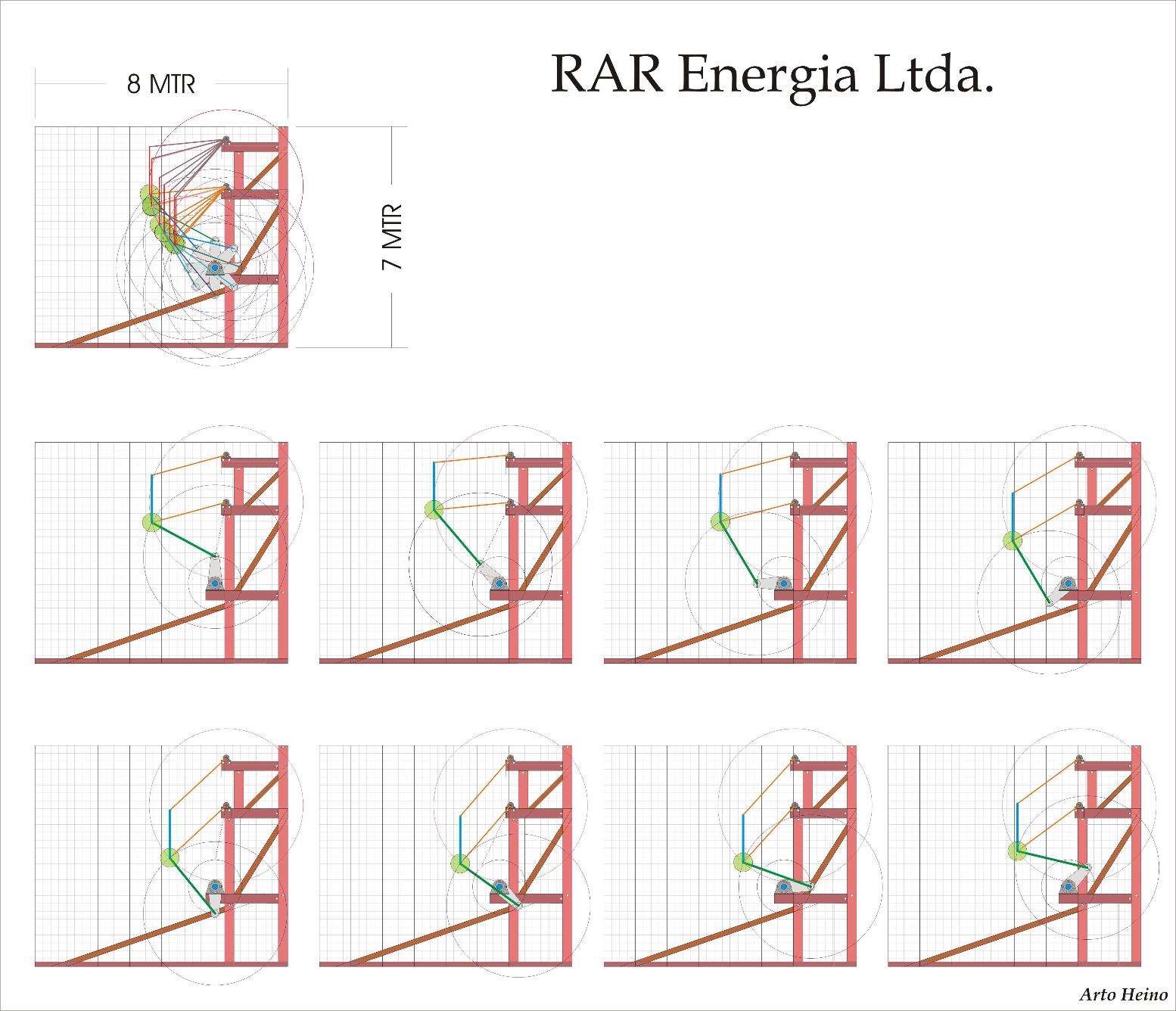
                          • Rebooting this old thread with a fascinating device that says it runs and generates power with only gravity once it has been started.
                            RAR Energia Ltda

                            I have to believe that anyone putting that much money into a huge construction like that has down their homework and have built smaller working prototypes. They say they will building one in Illinois this year also.
                            There is no important work, there are only a series of moments to demonstrate your mastery and impeccability. Quote from Almine

                            Comment


                            • Big Machine

                              Thanks for finding this one Ewizard, I can see they have not finished the unit, but here is some sequential pics anyway. Regards Arto

                              Comment


                              • An interesting build for sure! Also a fantastic thread. Aaron and Harvey's thoughts on gravity and aether are great. I really like Harvey's thoughts on pressures and gradients. A pleasure to read it all.

                                Comment

                                Working...
                                X