Announcement

Collapse
No announcement yet.

F.M.Chalkalis gravity system a donation!

Collapse
X
 
  • Filter
  • Time
  • Show
Clear All
new posts

  • Originally posted by Dingus View Post
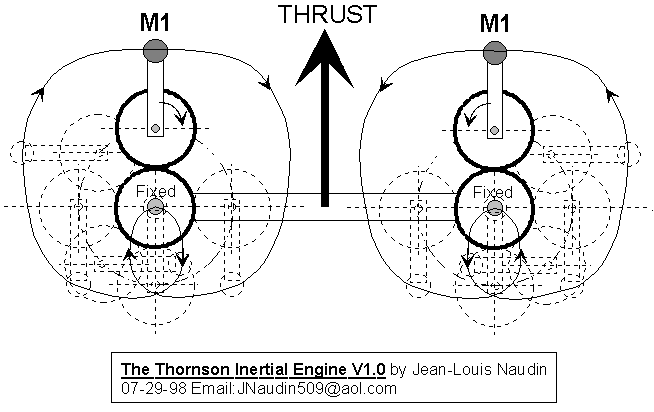
    The first instance I saw the diagram for Chalkalis' device I mistook it for Thornson's Internal Engine. Than I realized that it might actually benefit from this design change.

    I tried to make a diagram of what the idea looks like, but it's pretty bad. (posting it anyway)

    Take the left-hand side of this, rotate it 180 & 135 degrees clockwise (to achieve largest falling radius & smallest rising radius, but I have no idea what angle would be best) and that's pretty much what my drawing was supposed to be.
    http://www.energeticforum.com/renewa...um-hammer.html
    The pendulum takes advantage of the second pendulum to thrust it up and probably we will have some free energy from the hammer hit or from some shaking magnets battery charger installed in the triangle frame.
    We need to use some kind of latch and locks controlled by infrared switch.
    It is one idea that may work.
    It belongs to the world, your opinion is important.
    David

    Comment


    • Originally posted by elias View Post
      Hi Cloxxki!

      It might not work for so many reasons, but I don't know how you see the radius increased? maybe my diagram is not clear enough. It is only a bar or a disc, with free arms which are able to rotate around the contact points to the bar. As the bar gains speed, the arms are straight out because of CF. and that is the total radius the system operates on (radius of the bar or disc+arm length). I have named it the centrifugal assister, because if it works, it only shows up under load.

      Even if the radius of the system increases, we may lose some speed, but if we decrease the radius again the system will speed up again. It is because of the conservation of angular momentum. I have verified this fact personally.
      So there is no problem with increasing the radius or decreasing it, if it affects the RPM.

      I have started a new thread for this and we can continue our discussion over there.


      Elias
      Hi Elias,
      I think you're exploiting the ice dancer's pirouette effect, it's amazingly beautiful :-)
      The center of mass of your outer parts define "radius" as I meant it.
      You have a wonderful radial inertia gearbox there. Might have great commercial applications, if not in fact already used as such. OU however, I no longer expect to find there.
      CF is a destructively strong force, but it can't perform any kind of work (distance) without an equal cost. Oh, how I wish to be proven wrong about this...

      Comment


      • Originally posted by Ted Ewert View Post
        Like in the Milkovic oscillator, any gain would have to be realized indirectly.
        http://www.energeticforum.com/renewa...ted-wheel.html
        David

        Comment


        • Originally posted by Cloxxki View Post
          Hi Elias,
          I think you're exploiting the ice dancer's pirouette effect, it's amazingly beautiful :-)
          The center of mass of your outer parts define "radius" as I meant it.
          You have a wonderful radial inertia gearbox there. Might have great commercial applications, if not in fact already used as such. OU however, I no longer expect to find there.
          CF is a destructively strong force, but it can't perform any kind of work (distance) without an equal cost. Oh, how I wish to be proven wrong about this...
          It is not meant to decrease or increase the radius, the outer arms act as a pull to the main bar with CF, to keep it rotating at the desired speed. It is designed such that it resists decrease of speed.
          Humility, an important property for a COP>1 system.
          http://blog.hexaheart.org

          Comment


          • Hi folks, really nice ideas. There is one thing that I think is most important with the Chalkalis' device which this thread is about and that is the leverage aspect. He is inputting his force with a mechanical advantage and very large abrupt kicks, like a capacitor dump almost. That is where part of a gain is likely to originate. Folks, if your all using scientific methods here, then I would recommend to examine all the factors in this device. I firmly believe his device works exactly as claimed and let's examine it from the angle it does work, which seems a more productive avenue to the truth.
            peace love light
            Tyson

            Comment


            • Originally posted by SkyWatcher View Post
              Hi folks, really nice ideas. There is one thing that I think is most important with the Chalkalis' device which this thread is about and that is the leverage aspect. He is inputting his force with a mechanical advantage and very large abrupt kicks, like a capacitor dump almost. That is where part of a gain is likely to originate. Folks, if your all using scientific methods here, then I would recommend to examine all the factors in this device. I firmly believe his device works exactly as claimed and let's examine it from the angle it does work, which seems a more productive avenue to the truth.
              peace love light
              Tyson
              I hope your beliefs will be proven correct. However, I fear that if a man like Chalkalis, with obviously excellent builder skills cannot loop the system, the gain is only present in an incorrect calculations.
              I agree though, that if he is on to something with this invention, it will liekly be all in the angles he says work best. This would offer tremendous insight to the level of Bessler's mystery achievements.

              Comment


              • The only way I see to efficiently extract energy from this device is indirectly. By indirectly I mean at 90 degrees to the circumference of the arc; along the radius.
                Harvey made a good point in another thread. He mentioned the work done by the tides. The orbit of the moon around the Earth is not effected, yet a tremendous amount of work is constantly done moving water along the axis of the radius.
                Milkovic does the same thing with his device. He has proved that more work can be extracted using this method than is used to keep the velocity of the pendulum constant.
                There is obviously a practical limit to how much energy can be taken out of the system before it starts to slow down. Nevertheless, this is the only way I can see to realize a net gain from this device.
                If designed properly, I think this device could be a legitimate generator.

                Comment


                • Answers to your questions & how I would go on
                  W32

                  Comment


                  • Attached Files
                    Last edited by sebosfato; 07-15-2010, 04:16 PM.

                    Comment


                    • Hello Mr. F.M.Chalkalis,

                      I wrote that post with the info and knowledge i discovered on my own during the research i did about resonance and energy multiplication...

                      However now that you are here you may have more information about the principle of functioning. Could you please en light us... Could you please tell us where the idea came from too?

                      Thanks a lot and sorry to have become a bit realistic regarding mechanics systems.

                      Best Regards

                      Comment


                      • Hello Mr Chalkalis,

                        Thank you for joining this forum and offering to help us understand your device. I understand that the best place to extract the energy is at the axis as you stated, but I wasn't sure if we should extract the energy continuously or should we extract it at only a certain portion of the rotation? For example, assuming the 0 degrees is at 12 O'clock, should we extract energy from 90 degrees to 180 degrees? Or, from 180 deg to 270 deg? Where in the rotation is the best range in degrees to extract energy?

                        -Brian

                        Comment


                        • I read the post again, and it looks like we can extract energy continuously on the shaft. He mentions rotation speeds of 1000 rpm and gear speed reduction to 200 rpm for a generator. Wow! a mass of this magnitude spinning at 1000 rpm surely would need to go underground. Imagine what would happen if the arms or bearings gave out at this speed. You would have a cannon ball that could penetrate several houses in the neighborhood. Sorry, don't mean to scare everyone. Just being safe.

                          -brian

                          Comment


                          • Hello world,
                            Please accept my apologies but I am not Mr. Chalkalis.
                            Sorry to disappoint you but I just posted the letter from his blog.
                            W32
                            W32

                            Comment


                            • Open letter to Mr Chalkalis...
                              Our discussion here has revealed a few serious problems which call into question your claims.
                              1. The most glaring is the most obvious: If your device actually gained energy, why is it not self rotating? Where does all that extra energy go when the power is removed? There can't be that much bearing friction and wind resistance to overcome.
                              2. You suggest that the power be taken off the main shaft. Why haven't you simply attached a cheap alternator to the shaft and measured it's output? You have a pulley right on the shaft! Use a 24 volt model and you could run your drive motor and measure how much extra you have left over.
                              3. Your math proves nothing. Do you know the difference between torque and horsepower? You calculate torque based on a no load situation, then compare it to input power. Apples and oranges my friend.
                              If you can't manage a generator, it's very simple to construct a Prony break which will give you a fairly accurate measurement of your actual power out.

                              After working on this concept for 28 years, it's hard to believe you built that whole device and didn't take some simple output power measurements. I see a pulley right on your main shaft for Pete's sake! Why are you withholding this information?
                              You immediately start whining about people pointing out legitimate errors in your statements, and asking perfectly reasonable questions (red flag). Yet, without answering anything you still want us to go to all the expense and trouble of building a replica just based on your opinion? I don't think so.
                              None of this adds up Chalkalis, and you know it. We are more than willing to extend the benefit of the doubt, and I think we have here, but we don't appreciate being played for fools.
                              What is your real reason for doing all of this?

                              Ted Ewert

                              Comment


                              • Originally posted by sebosfato View Post

                                As we know that his Q factor is around 12 this tells us that his efficiency is only close to 90%

                                !
                                Hi Sebosfato:

                                Thank you for sharing the efficiency graph of your experience with resonators.
                                Efficient e very advanced electrical power backup flywheels are in the market and I am not aware that they have to be installed underground.
                                It must be elaborated to synchronize the drive of a 600Kg, 30.000 RPM flywheel.
                                Very efficient gear boxes, and i am wonder what is the Quality Factor of it.

                                Can you take a look at the thread http://www.energeticforum.com/renewa...ted-wheel.html

                                Comment

                                Working...
                                X