
That book make me come up with a couple of question.
- How the vortex created in a tubular magnet. If it keep changing position, then tubular core is the worst design of making magnet out of electric. Should we make them flat or square instead?
- How do force / make sure the biggest magnetic vortex in one corner of an electromagnet.
- Getting the most electricity out of a magnet have to be angled according to the location of biggest vortex?
- Would star with 4 corner shaped magnet better than square or circle?
-
Yes, sucahyoOriginally posted by sucahyo View Post and
and 
Who would have thought that many kinds of vortexes are observed in magnets.. (
( )
)
That's what I've been thinking has been going on around electric circuits ..
many kinds, big/small, interacting with each other. I didn't know they happened in PMs also.
I'm floating around with sooo many browser windows open, one lead / web
page brings up 5 more web pages, so I sometimes miss following up on obtaining documents.
I missed following up on The Secret World Of Magnets.
I'm glad you shared this with us.
I will have to read "The Secret World Of Magnets" now that I have it.
Link to Errata for The Feynman Lectures on Physics
It's not the VORTEX that's important, it's the effects caused by the vortex:
implosion, compression , suction, frictionless, soundless, limitlessness.
These are the magic. (nature's way of creation)Leave a comment:
-
Howard Johnson - The Secret World Of Magnets
I attach some in case some of you can't see imageshack picture, first one from the book, other from
The Tom Bearden Website
read howard johnson note at:
DISCOVERING QUANTUM MECHANICAL MOLECULAR ENERGY


Three kinds of Amperian currents we have observed are:
1. The double vortex where opposite spins are found along side each other.
2. The double vortex where one vortex is inside the other.
3. The third form is the flat vortex.
Dr. Feynman recorded finding some of these in his Vol. 2 Physics lectures 37 - (12 - 13).
The interaction of the momentum of these currents is the basis of our patent work for the last number of years.
"Ampere was the first investigator to propose that the magnetism observed in permanent magnets is caused by tiny electric currents circulating within the molecules of magnetic material." Scientific American Jan. 89.
"Magnetism - more specifically ferromagnetism - in a material is associated with cooperative interactions between individual atoms tending to align the magnetic moments of those atoms parallel. The magnetic moment of an atom arises from the orbital and spin angular moments of its electrons.
Only some elements have unpaired electrons - hence magnetic moments - and even fewer show the cooperative interaction necessary for ferromagnetism.
"A permanent magnet (PM) is a piece of a material that has stored within it magnetic energy - by alignment of magnetic moments - supplied by an electric field during the initial process of magnetization. The magnet retains this energy indefinitely - it is permanent. The material can be a metallic element, a metallic alloy, or even an oxide.
"There is a growing tendency to replace electromagnets by PMs because of major improvements in PM properties. The increasing cost of energy and the trend towards miniaturization are other reasons. The samarium-cobalt series of magnetic materials until recently provided the strongest PMs known.
However, recent discoveries with alloy systems based on iron and neodymium promise even better performance.
"The two basic parameters used to define properties are the remanence, Br, and the coercivity, Hc, the vertical and horizontal axes respectively on the Lanthology diagram. The remanence arises from the cooperative alignment of magnetic moments. The coercivity measures the resistance to demagnetization of the material; a high value is essential in devices where the magnet will be subject to strong demagnetizing fields such as in motors.
"The coercivity depends not only on the underlying crystal structure but also on the microstructure of the material, on the domain morphology within the bulk magnet.
"Demagnetization is resisted when a large energy is needed to reverse the aligned magnetic moments within a crystallite. In some crystal structures certain directions - determined by the orbital moment of the minor component together with crystal-field effects and exchange interactions - provide an exceptional resistance. A great deal of energy will be required to reorient the magnetic moments from one easy direction to another. The crystal is said to have a high magnet-crystalline anisotropy.
"The role microstructure plays in giving high coercivity is related to the existence of domains - regions of common direction of magnetization - within a practical PM material. The movement of domain walls - separating domains - must be inhibited. This is often done by incorporation of another phase within the material. Much of the art of producing PMs lies in this microstructure control.
"The Neodymium-Iron systems, the latest and most powerful permanent magnets, seemingly provide the best yet approaches to the two mechanisms outlined above for high coercivity. They are being intensively studied by many research groups." "Neodymium, Iron, a Pinch of Boron and Permanent Magnets" Union Molycorp.Last edited by sucahyo; 03-13-2009, 01:36 AM.Leave a comment:
-
Leave a comment:
-
diamagnetic bodies
More about diamagnetic bodies:
Quote Link
When we remember that against all this no
single experimental fact 1 or theoretic argument which can
in any degree be considered as conclusive, has ever been
brought forward, nor do I believe can be brought forward,
the conclusion seems irresistible, that we have in the
agency by which bodies are repelled from the poles of a
magnet, a force of the same dual character as that by which
bodies are attracted; that, in short, 'diamagnetic bodies
possess a polarity the same in kind but the opposite in
direction to that possessed by magnetic ones.'Leave a comment:
-
Food for thought
A visual you don't get to see much of.
Ferrofluid
Why do you suppose Bismuth increase in volume upon solidification, like water.
It is the most diamagnetic of metals and has the second lowest thermal conductivity.
Connect the Dots ... Heat & Magnetic relationship .
.
Fire/Flame is diamagnetic. (it's Heat, not the "contents" of flame)
magneticflame
This web page tries to tell you oxygen rushing inward cause high pressure and pushes the flame away. .. Oh, REALLY?
Heat changes magnetic properties.
Connect the Dots.
Heating a magnet past its Curie temperature - the molecular motion destroys the alignment of the magnetic domains.
This always removes all magnetization. Which is another example of: "here's the fact Jack" without the why.
Heat and Magnetism effect each other, directly connected, joined at the HIP.
Twins
Everything interacts via Heat with Magnetics, doesn't it.
Ref link: A Dictionary of Chemistry and the ... - Google Book Search
Page 772.
food for thought and just
RandyLeave a comment:
-
Okay
So, two magnets repealing each other make;
--------------------------
n s n
n == s s == n
n s n
--------------------------
What does that do to the energy induced in a coil indicated by --- at it's peripheral, in terms of actual current and magnetic field?
I ask this because I don't know, and because it is pertinent to what I am about to try doing.
:-)Leave a comment:
-
Only a Suggestion.
Hows about you replace the Word Aether with Electrostatic.
That what what most did see a long Time ago as they did describe Aether, and seems it s allways the Saucer for any Cup
Lately seems Aether is good for all unknown Effects.
I am pretty sure beside, when someone would find soemthing like Aether, they would give the Child anyway a different Name.Leave a comment:
-
Jetjis, nice pictures and links for the twisting aether magnets. What I had in mind was almost the same. When I put a magnet on the TV, I did get those patterns too. When I turned the magnet, I then saw the individual and different N and S pole, how the textbook was wrong.
since a motor running develops backEMF, and all forces have an equal and opposite reaction ,I would imagine that the generation of one direction vortex would create the opposite direction vortex as a result, or out of balance. I always imagined the magnetic field as a very fine mist or spray constantly spinning around a center, which would hit anything not aligned with its spin and force them to line up. Seeing how a magnetic field is a good example of a quantum "imaginary number", and normal unmagnetized space is 100% equally chaotic, multiple fields in a single place could still exist and be coherent, as potentials, but we would need a new method other then looking at some iron sprinkles direction to really see.
Anyway, Good luck with that monopole. I don't think you're going to have success looking for a solid object that displays that characteristic, (unless you can use some of Bedini's negative time to bring a stronger future N pole ontop of a now current S pole) but what you might look into is transient phenomena along a magnetized plasma. something about entrained gas orbs. Anyway..
Peace!
Leave a comment:
-
The fellow from nanomagnetics.us was on this forum at one time, maybe he's still reading. He found my post about the lens and joined.
I think there's still a thread about the lens or viewing the magnetic fields (I might have even started that thread)...just search.Leave a comment:
-
Sorry, I have not made any tests on magnetic fields around my moe joe cell. It is just theory.
Have a look at this thread:
And look at this PDF:
Some interesting info and pictures there
Hope this helps.Leave a comment:
-
Wow I was exactly thinking of this too. "What happens with the spin of free electrons moving along an E-field". The thing I was wanting to get is that the electrons spin moment align with the electric field but I saw no reason why this would happen on its own. Sure they can spin radially along the electric field but they can also spin tangentially to the electric field. So they form nice circles around/in the spheres. Or they do nothing at all and remain chaotic.
Did experiments show this? Because there must be a reason why you said that. On the other hand this would have been big news as it would be a true 3d spherical monopole.
I'm confused now....
I used to say to people "Whatever you think of has been already thought of by someone else." This can't be much truer in this thread for myself.Leave a comment:
-
Broli,
here's how I see it. I have read that magnetic field is actually a twisting/vortex motion of aether. A typical cylindric magnet has an vortexlike aether flow around it something like this:
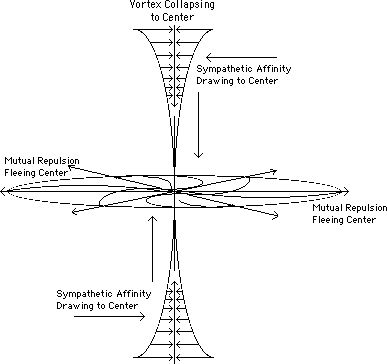
Here's another picture:

Those aether movements manifest themselves physically as a magnetic field.
So, now let's look at an electron. An electron not only moves around the athom but is also spinning on it's axis, just like planets. When it spins, it also twists the surrounding aether along with it, just like a rotating ball in a bucket of thick liquid:

Electrons also have their north and south poles, just like earth. When a conductor is potentialized, the electron not only starts to move in a certain direction, but also aligns its poles with the rest of the electrons depending on the direction of the movement (voltage polarity). So, here is how the aether would look like if electron would travel through it in a straight line:

Now, imagine how the aether twist would look like if the electron travels though a coil.

The resulting twist in aether would create a vortex like movement with one end where the aether is sucked in and other end where it comes out. Those are the magnetic poles. So if an electron truly does this aether twisting, imagine what the resulting field would look like if you had a sphere connected to a negative terminal of the battery inside a bigger sphere that is connected to the positive terminal of the battery. If there is a conductir between the spheres, water, for example, electrons will start to travel from the inner sphere in all directions to the outer sphere. They all are spinning in the same direction, it is somewhat hard to imagine how the field would look like. It is easier to imagine it if we look at cylindrical type joecells, there we get a rotating magnetic field
Of course, I can be wrong. This is just how I think it is happening.
Leave a comment:


Leave a comment: