-
-
$
So you believe the ConFlow works as claimed? Seems like you should put some $ on it.
Comment
-
ConFlow
I know it is possible to get out significantly MORE than you put in. So I know that what ConFlow is doing is possible.
As for investing in this technology, I already am.
bi, right now YOU know everything you need to know to have a working free energy device that does not violate a SINGLE one of the laws of thermodynamics sitting on your bench. You just haven’t put it all together. Some day you will, or you will see it operating somewhere and you will be kicking yourself. I know you will say that getting out more than you put in violates their laws, but ONLY when applied to closed systems, not OPEN ones. Think of it this way. We are creating an energy “sail” that captures energy rather than wind.Last edited by Turion; 10-29-2019, 02:57 AM.Comment
-
Answer.
I think you'll find the answers in the name
ConFlow..,.......Con trick!Comment
-
Closed Minds
Just because YOU don't know how to do it doesn't mean it can't be done. You guys are stuck in a box. It is so unfortunate that those of us outside the box have to listen to all the noise you make because it is evident you will never escape.Comment
-
Box
Hi Turion,Originally posted by Turion View Post
What makes you think you're outside the box? You don't even know what the box is. Your last sentence in your prior post typifies that.
Sail on,
biComment
-
Lol
I intend to. Thanks!
Look up the word metaphor. You may have heard of it.
(You know better because I KNOW you know what a metaphor is. You just like to argue)Last edited by Turion; 10-29-2019, 09:20 PM.Comment
-
Metaphor
It's easy to read into your metaphor that you infer that the real sail captures wind and not energy.Originally posted by Turion View Post
And as usual, you don't answer the question. I don't like to argue, I like to see a guy stand behind what he says by providing proof of his claim.
biComment
-
Rough seas
No time to talk. Too busy sailing. Avast matey, you landlubbers need to stay on shore. Ye be too afraid of gettin yer feet wet! Har har harComment
-
Jettis example coil
Hi Dave,
I would have preferred to analyze just a coil, not a motor, but I'll give it a try.
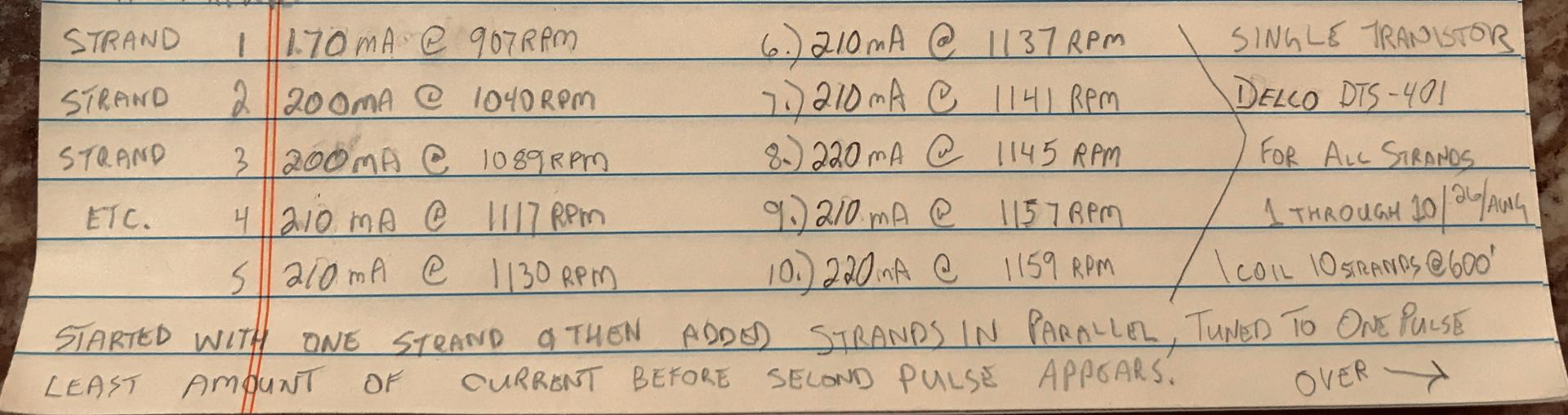
You have a 24V motor which runs 1000RPM drawing 210 mA. I presume this is running at no-load and that load doesn't change. Initially you use a single strand winding. When you increase that to 2 strands in parallel, the current doesn't change however the RPM increase ~3%. Fair statement?
Going from 1 strand to 2 halves the coil resistance. You have doubled the utilized copper in the coil. This increase of copper increases efficiency, or in other words, decreases loss (I^2R). This halving of resistance also increases the applied armature voltage due to cutting the resistive drop in half.
As for the observed performance changes, current doesn't change. Motor current is dependent on motor load (torque) which at no-load, as the case here, consists of rotor friction and aero drag. So for a few percent Chang in RPM, current essentially remains same.
The increase in RPM is due to the reduced voltage drop in the coil. The source voltage remains the same but less voltage drop in the coil means a higher voltage applied to the armature. Since this armature voltage must equal the flux times velocity per Faraday, the velocity (RPM) increases.
No surprises.
Regards,
bi
{edit}
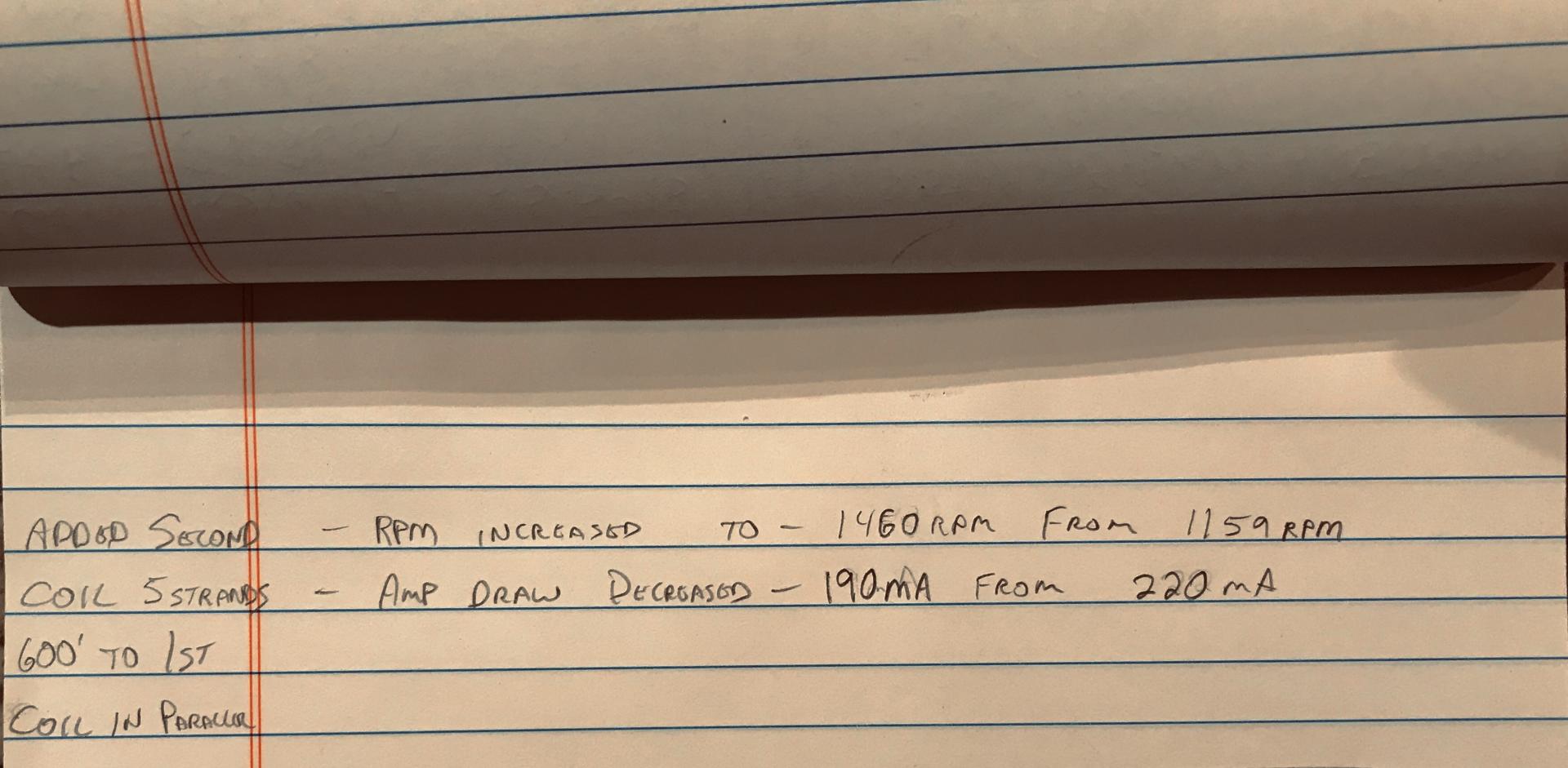
Dave just update data from his notes. This is still consistent with my description. The RPM increase is larger that first stated. This increases the developed torque to spin at no-load and hence the proportionate increase in current.Originally posted by jettis View PostComment
-
Question
bi,
When a motor is connected to a battery, how can the amps measured on the positive line be the same as those measured on the negative line if the load is consuming power?
An ampere is a unit of measure of the rate of electron flow or current in an electrical conductor. One ampere of current represents one coulomb of electrical charge (6.24 x 10¹⁸ charge carriers) moving past a specific point in one second.
Current is a count of the number of electrons flowing through a circuit. One amp is the amount of current produced by a force of one volt acting through the resistance of one ohm.]
Just wondering what your thoughts are on this matter.Last edited by Turion; 12-04-2019, 11:18 PM.Comment
-
Electric circuit basics
Originally posted by Turion View Post
Originally posted by Turion View PostHello Turion,Originally posted by Turion View Post
You certainly have some audacity to ask me (what seems like) a serious question after all the insults and ridicule which you direct my way. No doubt I'm a fool to give a serious answer, but wtf. How can current be the same in and out of the load when that load is consuming power? Answer is potential.
I think I mentioned before; you really would benefit from a basic course in electricity which includes circuits.
Regards,
biComment
-
Originally posted by bistander View Post
Here are my lab notes, the second image is when I put another coil in parallel with the first, using the same circuit. Rpm increased to 1460 from 1159 and current draw went down to 190mA from 220mA.Attached FilesComment
-
-
Hi Dave,Originally posted by jettis View Post
I'd help if I could see the apparatus. Also, what is it that you think is "magical"?
Regards,
biComment
-
Comment

This forum is preserved as a permanent archive. The community continues at eMedia Press.
- If this is your first visit, be sure to check out the FAQ by clicking the link above. You may have to register before you can post: click the register link above to proceed. To start viewing messages, select the forum that you want to visit from the selection below.

 Tweet
Tweet
Comment