This forum is preserved as a permanent archive. The community continues at eMedia Press.

Announcement

Collapse
No announcement yet.

Radiant spike puts out more than current

Collapse
X
 
  • Filter
  • Time
  • Show
Clear All
new posts

  • Originally posted by erfinder View Post
    This is about the spike right? What exactly is the spike? On my bench it is a potential which can overcome any impedance it encounters, useless if not paired with its opposite, current which can overcome any impedance it encounters.
    Love it

    Comment


    • Why is it so hard to understand that the spike doesn't create itself? Why is it so difficult to comprehend that it is the collapsing (changing) magnetic field (via self-induction) which induces the high voltage that we collect at the switch? Why do we refuse to accept that the collapsing magnetic field itself is not being collected? Are we so blind that we cannot see that the collapsing magnetic field, a changing magnetic field is not limited to self-induction, but can also induce in neighboring coils?

      What is capacity? Why is it necessary to add a capacitor in parallel with the coil before we can see the spike doing work in the inductor? Shouldn't we try and expand our present understanding of what the spike is, what capacity is, and how the two are related? In addition to this, wouldn't it be wise to try and understand how and when a coil itself could be considered as a capacitor?

      In my opinion it is a mistake to take the potential developed at the switch and route it to a coil, prior to determining how this exact same task is already taking place via a different, albeit inherent means. Under the right conditions a transfer takes place without our needing to route anything anywhere.

      Questions like these, motivated the design and construction of a machine I call the 100% Orthogonal, and its successor, the 100% Orthogonal Motor-Generator. Among other things these devices are proof of principle apparatus. Machines which demonstrate that collection of effects associated with the collapsing magnetic field do not end at the switch (self-induction), but are extended when applicable, via transformer action (mutual induction).

      I could give a demonstration, but what purpose would it serve? Would such a demo lead to replication attempts? What is a replication? Ultimately, anything that anyone says is speculation......isn't it? Impressions were made on me, I am trying to make one on you. I don't need anyone nor want anyone to replicate what I have found, or what I think I have found. I believe you can do better.


      Regards

      Comment


      • Just love Erfinder's work having seen a tiny piece of it.

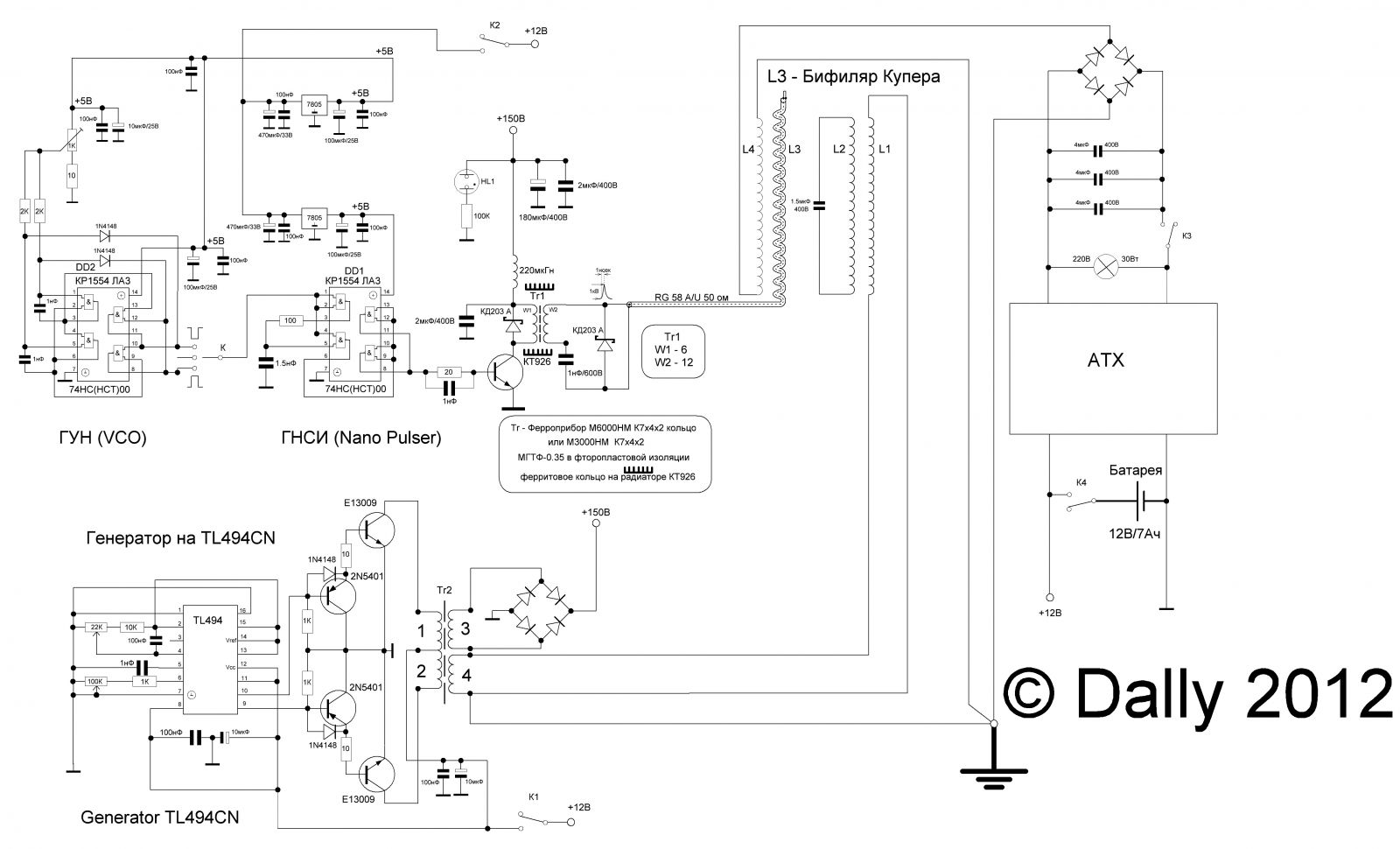
        We're talking about a spike, so I think this may be on topic. Attached is a schematic of Dally's device.

        If you look over this schematic, what you see is a series of coils wound on an air core. The inner-most coil I'll call the exciter winding. Next is the resonant winding. On top of that is something you don't normally see--a coaxial cable winding that accepts as its input a spike. And lastly is the outer winding that I'll call the collector coil.

        Could this schematic just be a page taken from the diary of a madman, or is it something that has been proven to work and that we should learn from? I can't answer that, but with the same disease the rest of you all have, I just have to look and find out for myself.

        My thinking here is the spike is a reversal of the flyback concept. Instead of getting a spike from the collapsing magnetic field, we are placing a spike into the magnetic field created by the resonant tank circuit. Of course timing is critical, but nature will jump-in and put things where they need/must go.

        My theory of operation says this spike somehow disconnects the mutual inductance associated with normal transformer operation. Now look closer, why the coax cable? At first I thought it is being used because it makes a transmission line where propagation time is controllable simply with the length, plus you get the inverted reflection from the dead-short termination. This could be true and all there is to it, but am sure? No, I am not.

        I am most curious as to how Erfinder perceives this arrangement. He has been digging far deeper than anyone I know and can probably see and put words towards this that may prove extremely helpful and insightful. He might even incorporate it into one of his devices achieving amazing results. I'm hopeful yes.

        If for no other reason, let this soak in a bit. Something good surely can come of it.
        Attached Files

        Comment


        • Via this image, we can see whatever we want.


          What does this have to do with the spike? The spike is an induced potential. The source of the spike is a fast change in the magnetic environment of a coil of wire. The more we comprehend about the magnetic field, the more we understand about the spike. The solenoid is a magnetic gate. Whether the image is an accurate representation of the magnetic field is a matter of opinion. Some opinions are based on fact. FACT is the graphic represents an understanding which has stood the test of time. It will continue to stand till it is superseded by ones with deeper insight than the ones who set it and watched it cure.

          What can we learn from this image? Among other things...aside from the obvious, I see a closed gate.


          Regards

          Comment


          • Originally posted by erfinder View Post

            Via this image, we can see whatever we want.


            What does this have to do with the spike? The spike is an induced potential. The source of the spike is a fast change in the magnetic environment of a coil of wire. ...

            What can we learn from this image? Among other things...aside from the obvious, I see a closed gate.
            Regards
            I too see a closed gate, but only in this instance of the spike. I also believe that when the mag field collapses, the coil becomes a kind of pump - where the dielectric forces mobilized by/responding to the collapsing mag field enter the coil thru what is commonly known as the bloch wall.
            Bob

            Comment


            • Originally posted by Bob Smith View Post
              I too see a closed gate, but only in this instance of the spike. I also believe that when the mag field collapses, the coil becomes a kind of pump - where the dielectric forces mobilized by/responding to the collapsing mag field enter the coil thru what is commonly known as the bloch wall.
              Bob
              Hi Bob,

              When going by the established, it is understood that the current does not change directions when the switch opens. The property of inductance opposes the change and via this opposition maintains the current in the same direction.....

              That being said we are still dealing with a closed gate during the collapse.

              Just what is the bloch wall? I have studied just about every document ever posted on the net concerning this very specific location, but not a single one of them has shed any light on what its true purpose is, assuming it exists. When faced with such circumstances, if this concept is needed, then it must be given a purpose, the bloch wall cannot exist just to exist. I have a purpose for it, whats yours?


              Regards

              Comment


              • Bloch wall --- not common

                Originally posted by Bob Smith View Post
                - where the dielectric forces mobilized by/responding to the collapsing mag field enter the coil thru what is commonly known as the bloch wall.
                Hi Bob,

                The term Bloch wall is specific to a certain type of domain wall (barrier) separating magnetic domains in ferromagnetic materials. The subject coil is shown with an air core meaning there is no ferromagnetic material and no domains so there cannot be a Bloch wall.

                Perhaps you meant to say dielectric inertial plane. This is a term used by some to describe the center of a magnet and when in a permanent magnet, Mr. Ufopolitics also calls it a Bloch wall. I feel that is a mistake on his part and have argued with him about it on several of his threads. Regarding the dielectric inertial plane, I don't know if that is what you refer to, or if such a thing actually exists, or what it is, or what its purpose is. It appears to be a term used in an alternate theory of magnetism.

                Obviously you have your own beliefs and I'm fine with that. But it is not common to refer to bloch walls in air core coils.

                Regards,

                bi

                Comment


                • Hi Bi
                  I'm personally more partial to Ken Wheeler's terminology vis a vis what is commonly referred to as the Bloch Wall. I was trying to be consistent after reading what JB posted here:
                  I've pondered a great deal on what he said here.
                  Bob

                  Comment


                  • Originally posted by erfinder View Post
                    Hi Bob,

                    When going by the established, it is understood that the current does not change directions when the switch opens. The property of inductance opposes the change and via this opposition maintains the current in the same direction.....

                    That being said we are still dealing with a closed gate during the collapse.

                    Just what is the bloch wall? I have studied just about every document ever posted on the net concerning this very specific location, but not a single one of them has shed any light on what its true purpose is, assuming it exists. When faced with such circumstances, if this concept is needed, then it must be given a purpose, the bloch wall cannot exist just to exist. I have a purpose for it, whats yours?

                    Regards
                    Hi Erfinder
                    Thanks for the response. To be truthful in answering your question, my purpose for this part of the coil and its action has not yet taken on a definitive shape. I am finding that a pulsed higher impedance coil seems to stress the dielectric greater than a low impedance coil will. This seems to indicate that the dielectric's push-back and resulting "pumping" action of the coil (thru the bloch wall/dielectric plane) is increased. I'm just beginning to grasp this.

                    How to utilize this push-back - I guess for me this is a next challenge to consider.
                    Bob

                    Comment


                    • Block Wall & Zero Force Motor

                      Read the last couple months of John Bedini's posts here on the bloch wall and the zero force motor. The 3d Monopole Coil How To Build
                      Sincerely,
                      Aaron Murakami

                      Books, Videos, ESTC Conference Info, Blog, etc. https://emediapress.com

                      Comment


                      • Regarding the image I posted, I am just asking folks to consider what is taking place between the turns. I have my reasons for suggesting that the image represents a "closed gate". If this is a closed gate, what constitutes an open gate?

                        The region between the two poles is called a "wall" I like the idea, for it implies that all curvature which the field lines, if such things exist, end at the wall. It's never been enough for me to just give something a name, it needs a purpose, and this region has a purpose. Whether we all can agree on what that purpose is is another story.

                        What does this have to do with the spike?


                        Regards

                        Comment


                        • The spike.....

                          When I use the term, I am referring to the result of opposition to change in current as we are all familiar. In addition to this, I am referring to opposition to change in voltage, this we are not so familiar with.

                          Ladies and gentlemen, there are two spikes, and with the two, a complete disconnect from "electricity" as we know it. I choose to pay for converting electricity from the form which we are all familiar with into the form we are not familiar with for the purpose of driving capacitance based loads. My time on the bench staring at these machines has helped form my presently held belief that a coil can be considered as both an inductance and capacitance. On that note, my use of the term capacitance in "capacitance based loads" is not limited to the presently held concept of capacity.

                          I am learning everyday from my peers, that no demonstration is good enough. There will always be a few who **** on your efforts, or say you are ****ting on the community. This post and any that may follow, with or without a demonstration, is not for them.

                          Lenz's Law

                          I have come to consider this law more as an observation, and consideration. We are informed of our situation, and are informed of what we should expect when we build and operate electrodynamic equipment in a specific manner. I have learned that it is unnecessary to build systems in an attempt to beat an "observation". It makes more sense to build the system, expect the law to apply, and find through "observation" when the law is inapplicable. I have done this, the results make one sick to the stomach. We are blind, so blind. Give me time, I will show you just how blind, and will show how this, my observation applies to the aforementioned "spike(S)".


                          Regards

                          Comment


                          • Bloch wall

                            Originally posted by Aaron View Post
                            Read the last couple months of John Bedini's posts here on the bloch wall and the zero force motor. The 3d Monopole Coil How To Build
                            Thanks Aaron,

                            I've been directed there before and read most. And went over his posts again. He misuses the term and may be the source for the continued misuse by members. I think he does a disservice to members by not researching the term and either using it correctly or calling his "feature" by a different name, like a Bedini wall.

                            When somebody familiar with ferromagnetic materials and magnetism comes across such an incorrect use of a well known and well defined term, it brings credibility questions to the source. I just don't understand how one can think there are ferromagnetic domains and domain walls in an air core coil.

                            bi
                            Last edited by bistander; 12-29-2015, 09:55 PM.

                            Comment


                            • Bloch Wall

                              Originally posted by bistander View Post
                              Thanks Aaron,

                              I've been directed there before and read most. And went over his posts again. He misuses the term and may be the source for the continued misuse by members. I think he does a disservice to members by not researching the term and either using it correctly or calling his "feature" by a different name, like a Bedini wall.

                              When somebody familiar with ferromagnetic materials and magnetism comes across such a incorrect use of a well known and well defined term, it brings credibility questions to the source. I just don't understand how one can think there are ferromagnetic domains and domain walls in an air core coil.

                              bi
                              Please post your corrections over there so you can set it straight.

                              Overunity is an incorrect term but it is obvious what it means and it has made itself into the language to mean something that is over 1.0 COP.

                              Bloch Wall is used generically to describe the point of transition between North and South and that point is movable. John knows more about the nature of magnets than most who consider themselves to be experts in magnets - documentation always beats conversation and he has the proven results on the bench.

                              Whether you like his terminology or not, he has the results that the "experts" do not - so perhaps the definitions need to move in the direction of his understanding and not the other way around. The conventional view of magnets and how they operate are wrong and that view is desperately needing an upgrade.
                              Sincerely,
                              Aaron Murakami

                              Books, Videos, ESTC Conference Info, Blog, etc. https://emediapress.com

                              Comment


                              • Originally posted by erfinder View Post
                                Regarding the image I posted, I am just asking folks to consider what is taking place between the turns. I have my reasons for suggesting that the image represents a "closed gate". If this is a closed gate, what constitutes an open gate?

                                The region between the two poles is called a "wall" I like the idea, for it implies that all curvature which the field lines, if such things exist, end at the wall. It's never been enough for me to just give something a name, it needs a purpose, and this region has a purpose. Whether we all can agree on what that purpose is is another story.

                                What does this have to do with the spike?
                                Regards
                                I hope I'm not being a pain, but I'm going to try to proceed from what I have observed, guided by what I have read, to state how I see things...

                                According to Tesla, there is potential difference present between the turns in a coil; there is storage of charge, or capacitance. See his patent for electromagnets for details. Because of this potential difference between turns, there must also forces of attraction between them; and taking this logic one step further, perhaps interaction with the dielectric along the coil between the windings, in a manner similar to that which occurs at the bloch wall or dielectric plane at the coil's midpoint.

                                What could this mean? If the dielectric is interacting with the coil between each of the windings as well as at the overall midpoint, then these areas are points at which charge enters the coil from the dielectric to produce the Lenz' Law (opposing spike) effect. IOW, Lenz' Law is a dielectric's response to an initial pulse in the coil.

                                Bob

                                Comment

                                Working...
                                X