
My music talent is limited mostly listener.
A music of the spheres module on Vb3 also a liitle melodyne
weaves in and out between
-
Do you mean a video showing filtering the (square) waveform and producing new waveforms from pure sine waves?Originally posted by mikrovolt View Post
In the meantime, this video shows how the sound/waveform changes purely through changing the intensity of the harmonics. The drawbars/sliders he pushes in and out along the top of the organ each control the volume of a specific wavelength/octave and/or harmonic, so by adjusting the volume of one of those harmonics the resulting waveform can change completely (at about 17 mins in the video).
Tony Monaco Hammond B3 Settings and Sounds! - YouTubeLeave a comment:
-
Back to the standing waves (music or frequency)again.Originally posted by dR-Green View Post
Very good, appreciate your contribution. The practical transmission line.
the directional coupling method to sample the signal content.
locating the BNC connection point ?
http://www.energeticforum.com/attach...ransformer-jpg I do remember Sputin's.
If you have time to video a demonstration of sampling.
Looking for an example like this:
Your website so people can find the kits, plans, software.
Making a directional coupling ? If I recall correctly you use 30 Ohm.Last edited by mikrovolt; 05-23-2017, 10:56 PM.Leave a comment:
-
Very thankful for that share BroMikey!Originally posted by BroMikey View Post
Yes, Aaron is very patient and understanding of how to calmly and efficiently communicate with people who are new to this world, while at the same time giving all the details an experienced individual would need to know.
GREAT TEACHER WITH MUCH PATIENCE!Leave a comment:
-
Thanks Bob
The lights on the input appear to be dropping in power when the
1 wire connect takes place.
Here is another 1 wire job
https://www.youtube.com/watch?v=Qm1O2-gQPPk

https://www.youtube.com/channel/UC4gDE7umjeq0uvP5gETepvw/videosLast edited by BroMikey; 04-19-2017, 07:00 AM.Leave a comment:
-
Originally posted by BroMikey View Post
Great video find, Mike!
It does a good clear job of illustrating SWP principles.
A couple of things to note:
- running the transmitting ignition coil at Resonance
- virtual ground (plastic coated aluminum foil)
Resonance has some important effects on electricity. I will get into the resonance element in another post.
The virtual ground essentially places one leg of the circuit's window of potential difference in the ambient (dielectric) medium . This stresses the ambient/dielectric/aether, causing it to supply necessary charge to bring equilibrium to the pulsating potential difference in the system, thereby powering the circuit.
The ambient/dielectric/aether is a huge reservoir of charge
This is a great illustration. Thanks for sharing it.
BobLeave a comment:
-
Leave a comment:
-
If I am not mistaken Peter L. did an SSG using the 3 battery system
and left some of his multifilar connections open. Many have witnessed
some gains.
In Peter's case the run time was extended for a variety of possible
reasons, including this one. It would be great to see a circuit
verify that this open connection actually draws in energy.
When I put 4' or 8' fluorescent tubes into one side of the socket
it will light up even before I connect the other side. But that HV
open air connect even though lit is not free.
Any video that hides the input and output values is an insult to
honest experimenting when claims are made of FREE ENERGY.
This is my personal opinion, as I am not interested in a goose chase.
Put up the data or shut up If people want to tinker that is fine
just call it that. Any competent investigator knows when he or she
has exceeded the norm's of the present model's.
Good Day.Leave a comment:
-
I watched Woopy's video with some interest. I believe he is demonstrating the phenomenon we were discussing in this thread. There is tremendous opportunity in this kind of configuration due to the endless supply of charge that resides in the ambient medium (what some call the aether). Because of this tremendous reservoir that is available to those who know how to tap into it, there is a corresponding tremendous resistance to see progress in development for this kind of simple technology. I would encourage readers to read thru the thread, and not get bogged down in the digressions. The quote below summarizes in very simple terms what I and some others believe this single wire power (SWP) approach is all about.Originally posted by RAMSET View Post
Happy Easter
Bob
Originally posted by Bob Smith View PostLeave a comment:
-
but I see no harm in investigating a little bit turning a few knobs and switches
Leave a comment:
-
The Single Wire Power (SWP) effect is one means to tapping an endless reservoir of ambient electrical charge that can do real work. Lets try to rein in things to keep that our focus.
As I see it, one of the most important elements of the SWP effect consists in creating a wide window of potential difference within a circuit. This window, when activated in pulsed fashion, stresses the aether and causes the aether/ambient to respond with a charge to restore equilibrium.
One example (taken from the work of Don Smith): If we look at a capacitor, we encounter a window of potential difference between the input and output sides. If we pulse the input side with a high enough charge, the dielectric will respond by supplying a charge to the output side.
I'll leave it there for tonight.
BobLeave a comment:
-
I watched some of the video's where Aaron talking in conferenceOriginally posted by Duncan View Post
helped me to realize so many ways to disassociate water some with
infinitesimal amounts of power which sort of reminded me how one
wire power transfer might relate to these subjects.
Thanks for the great thread.
Leave a comment:
-
sorry thx - to err is human
Hi Dave --- single wire and whatever may arise, It seems a refreshing and free flowing thread and its nice to see you reading it.
so sorry thx I should have been clearer. Its actually the three still photgraphs shown in the research article on the web page I linked to I was considering re- boiling, - to wit ----

and
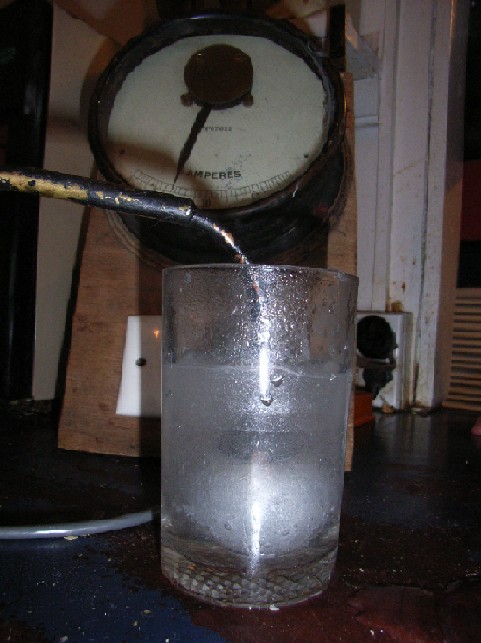
and obviously boiling furiously
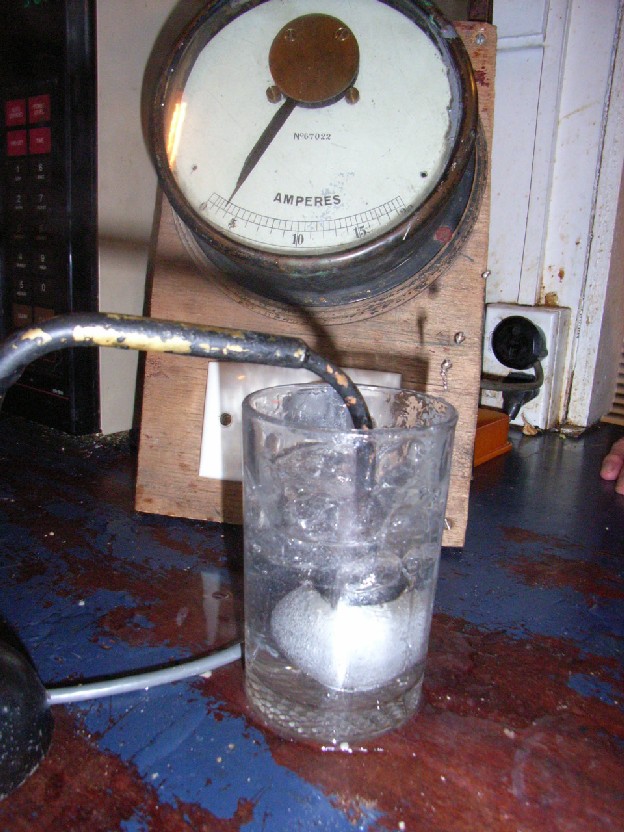
It is assumed (at least by me) that current is directly proportional to (real) energy consumption in this case.
the energy graph Peter is experiancing seems very similar to that which I demonstrated with a couple of spoons.
I have no intension of building anything like Peters boiler for tea cups but rather try to focus on that huge energy drop down when boiling occurs . maximise the effect and extract heat from a gently boiling tank. a balancing act sure but I think (or perhaps hope) its worth a try . as I wrote earlier I have managed (by buggering about with shape and spacing) to get a gallon tank boiling using 18 watts of real power . can I extract into a radiator ? can I reproduce the thing ? I don't know yet thx but I hope you get the gist of whats caught my attention and why the fact it isn't a straight line power graph is important, after all nothing like this is possible with resistance heating . from Peters pictures I see he is using tap water and hence quite high 'real power' consumption relative to the deionised water (I am now using). does it matter if I circulate deionised water through my radiator ? I think not a jot its only the heat exchange I require
Leave a comment:
-
Boiling water at altitude
This video actually shows that he is not boiling water. The water is not going through a phase change from liquid to vapor. Although we see some kind of vapor rising from the bowl, the temperature of the water that he shows is 66C. The charts that show at what temperature water boils for a given altitude usually start a bit above 70C for an altitude of around 9000 meters (29527 Ft). It's safe, I think, to assume he is nowhere near that kind of altitude. Even at 3000 meters he would need to get much nearer 90C to cause water to boil. Considering the size of his electrodes I don't think he is causing a plasma between the plates. What he is probably showing is electrolysis.Originally posted by Duncan View Post
https://www.google.com/search?q=boil...FeFE_ninoQM%3ALeave a comment:


Leave a comment: