This forum is preserved as a permanent archive. The community continues at eMedia Press.

Announcement

Collapse
No announcement yet.

anything that works?

Collapse
X
 
  • Filter
  • Time
  • Show
Clear All
new posts

  • Farmhand
    replied
    Originally posted by mbrownn View Post
    Your system needs to be matched to the output of the panels which is a problem with changing light conditions,
    That is true, as long as the hardware is rated for the amps, a single
    microprocessor controlled setup can be programmed to take various input
    amps (different sized panels) up to whatever the hardware can handle. And if
    the hardware is designed to allow it the input can be used in different ways.

    Before building the hardware for my simple setup I didn't even know how to
    program the chip to do what I wanted, but I did know what I wanted it to do.
    With the main power mosfet on a continuously increasing pulse width relative
    to the input anything from an open circuit to 100% duty can be done as long as
    the hardware is appropriate. I had to learn as I went. With some clever
    programming many things are possible.

    I believe that in an open source community if a few people pooled resources
    a very useful and reliable solar charge controller platform could be designed
    along with detailed building instructions, PCB layouts, parts lists, program
    code frameworks ect. So those that wish can make them on the cheap.
    That goes for wind and combined systems as well.

    Obviously people on these forums do not want that, so the best I can hope
    for is that I show my stuff and maybe some guy in china will see something
    useful about it and maybe include new features into future commercial designs.

    If the open source community were to up the ante and out do anything with
    comparable functions on the market but for a fraction of the cost to build
    then the commercial entities will have no choice but to "out do" open source.
    Benefiting all consumers.

    Cheers
    Leave a comment:


  • velacreations
    replied
    Originally posted by mbrownn View Post
    Your system needs to be matched to the output of the panels which is a problem with changing light conditions, I think the Bedini units may do that but I am not sure, best ask them that.

    Yes they are very expensive but as I see it I would expect that.

    1) No economy of scale as they don't have a huge manufacturing facility

    2) Each unit is hand built in the US and not in a Chinese sweat shop

    3) its a business so profits are applied

    Imagine how much a cheap transistor radio would cost if it was hand built in the US by a top electrical engineer
    Many US made solar charge controllers that are vastly more complicated than these circuits (MPPT) range at 1/5-1/3 the price of his systems. I think your reason #3 is really the big reason for the exaggerated prices.

    Reading that web page, there is quite a bit of misinfo about solar charging, makes me a little suspicious. The fact that there is no info on quantifying the proposed benefits is another suspicious issue. Typically, a $1K device has some reading material to go with it, a bit of data that tells us exactly what it does.

    The main benefit, as I see it, is an increase of charge efficiency. We might see up to 25% increase, though if you have a MPPT already, I seriously doubt it, probably more on the range of 10% increase. Still, at 25% increase in power delivered, that is something. But I can purchase a 25% increase in solar power for $200 (US made panels), or 1/5 the price of these systems.

    The next major benefit would be the conditioning of the batteries, and building or buying a voltage desulfator, you are looking at less than $200.

    So, for $400, you can have the benefits of his $900 device.

    IMO, their benefits do not justify the cost. If they had some data on the details of these benefits, then we could examine that, and maybe I am wrong, but going by the info I have, it seems like a big markup.

    So, I will play with some small things and see what they do. I have collected a lot of bad batteries to play with the 3BGS, so if I can brng some of them back to life, that would be cool.

    Leave a comment:


  • mbrownn
    replied
    Originally posted by velacreations View Post
    Looking online, I find that Bedini sells Tesla Solar charge controllers, which I assume are what we are talking about here. They are not cheap, though:
    Tesla Chargers | Tesla Solar Tracker III

    I have a MPPT controller right now, and although it only gives me a few amps early in the morning, it is still charging the batteries in low light ( not sure how efficient compared to these ones). But my MPPT controller was 1/3 the price of these things.
    Your system needs to be matched to the output of the panels which is a problem with changing light conditions, I think the Bedini units may do that but I am not sure, best ask them that.

    Yes they are very expensive but as I see it I would expect that.

    1) No economy of scale as they don't have a huge manufacturing facility

    2) Each unit is hand built in the US and not in a Chinese sweat shop

    3) its a business so profits are applied

    Imagine how much a cheap transistor radio would cost if it was hand built in the US by a top electrical engineer

    The benefits they have are what I have listed and more

    No he does not make OU Claims the reasons being similar to the fact you cant make any therapeutic claims for vitamins, we all know that vitamins do have therapeutic effects but under law no claims can be made. Even though JB's devices make no such claims I would not be surprised if they did under certain conditions however producing a charger or charging system to work under a variety of conditions would probably prevent the units displaying such properties.

    By the way, I have no links with JB or his company its just that I have confidence that they will be a good product.

    Actually I understand there has been some changes at John's company so I am not sure which parts are John's and which are not, best check with him.

    Now back to the fan, I say that because it can be built for almost zero cost and you can do lots of tests with it finding what it can do and what it cant and it does not matter if you burn it out. Use it as a learning tool, that is why John gave it to us. Once you have got the hang of it either build or buy a bigger one. For someone who lives off grid like you these devices are great for keeping your batteries in good condition. There are mods to increase power too.

    A computer fan is good for batteries up to 4Ah it can be modified to work well up to 10Ah. Bigger devices, bigger batteries. Check out the bigger fans too.

    Leave a comment:


  • gr8dane
    replied
    Originally posted by velacreations View Post
    I'm reposting this, because the last several posts have been completely off topic.

    Please post links to devices that meet the following criteria:
    - Replicated several times by others
    - Produces usable quantity of output
    - Has been measured and verified of output by independent sources

    And preferably post ones that you have personally replicated and measured output.

    If you don't have anything that meets that criteria, no need to post.

    One of the main discussions on these forums is the tech developed by Nikola Tesla. You want to see over unity as it were do some hard digging and read about what that man was able to do 100 years ago. Read and watch DR Lindeman's stuff of Tesla. Eric Dollard has been able to recreate many of his claims.

    There are many things that can get you very close of even exceed cop <1 which is what we are really talking about. I have seen a cop of at least 1.0 out of some of my Bedini replications and even with some of the JT circuits on this thread. Lasersaber Linx ans the Slayer circuit. Edit: wasnt trying to say Ive achieved cop>1 with these. Just that I see it as being possible.

    The idea here is to combine efforts to share knowledge and to try and advance some of this tech with out the support of Govn't or the financial institution. I am personally working on a patent for a high efficiency device and even that process is expensive as hell thats just the patient process much less anything else.

    Dont be so skeptical or cynical This isnt the place for that but only in certain context To end my rant I will give you a more resent name with a proven cop>1 device E. Gray.
    Last edited by gr8dane; 01-02-2013, 11:47 AM. Reason: Correction and typo

    Leave a comment:


  • Farmhand
    replied
    Originally posted by velacreations View Post
    Thanks for your comments mbrowwn. What were your results using these chargers for 12 volt batteries? I have followed the Bedini devices for some time, but I have often seen it mentioned that they do not show OU or COP>1, rather they are efficient chargers. Has your experience been different?

    I like your proposal about making use of dusk/dawn, low level light on the solar panels. I currently have 400+ watts of solar panels, but typically, in the mornings, they are only outputting 40 watts or so, until about 10 am.

    So, it might be possible to construct a system that used the Bedini charger at those low levels, if it could deliver more than the 40 watts.

    Running the whole array through a Bedini setup would be interesting, but it would have to be sized to handle the whole 400+ watts.

    I will do some more research on it, but if you have any details based on your own tests, I would appreciate it.
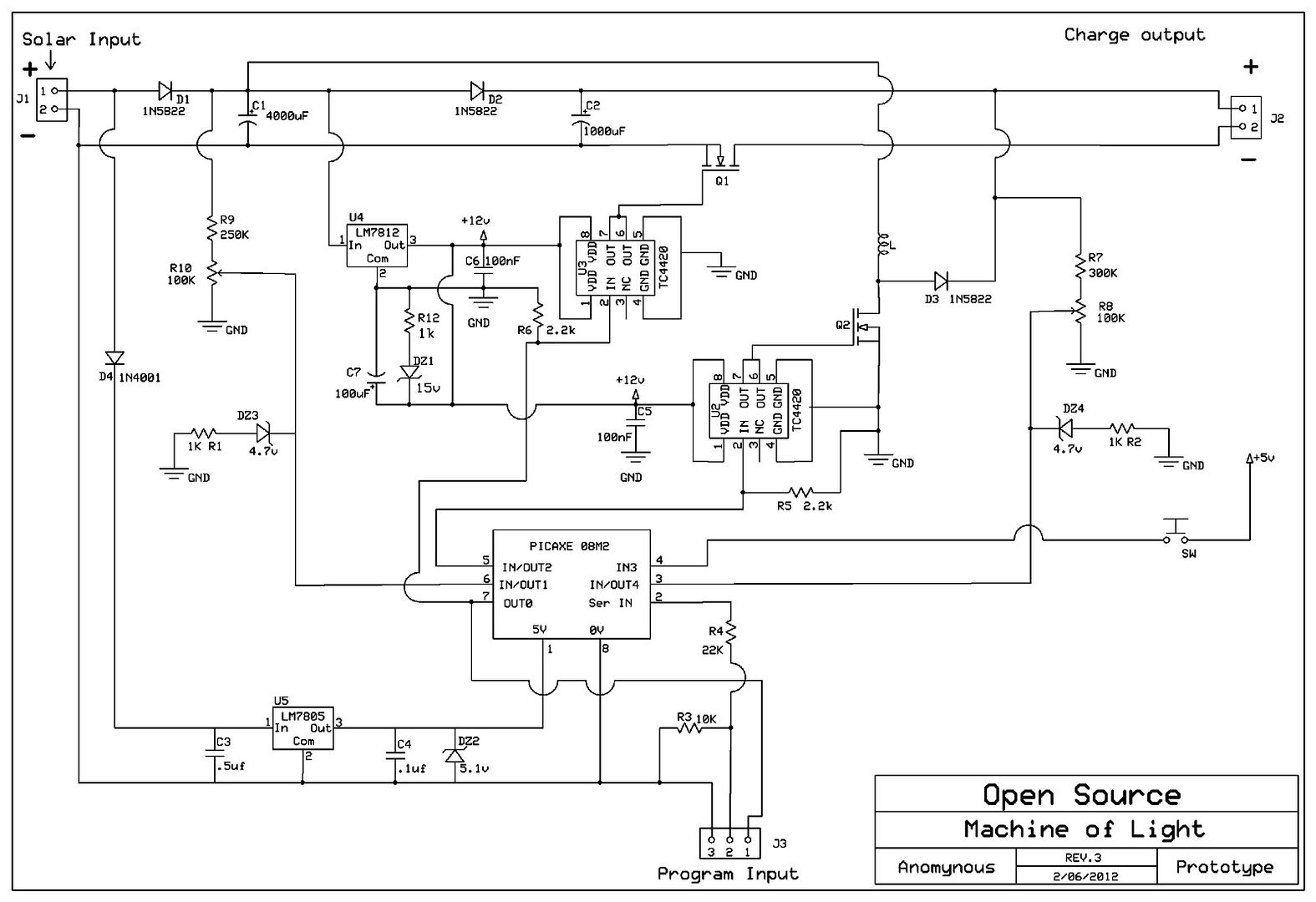
    All you need is a boosting device or a voltage doubler cap dump arrangement.

    Like this.


    My first attempt. The boost coil works at 20 kHz and boosts the input voltage
    into a capacitor up to the set voltage (about 25v for me) then dumps it, but
    only up to 16.5 volts solar input, when it switches the boost off and just pulses as
    required to maintain between 16.5 and 18 volts on the panel input.

    If the solar power drops off like a cloud or overcast day the batteries are pulsed
    with capacitor discharges from between 20 to 25 volts depending on input power.

    When the battery reaches the set voltage (14.8 volts for me) the battery is
    floated with minimal pulsing (a few watts at most) until it drops below the set
    voltage 13.6v when it is gets the full power again ect.

    I made it mainly as a battery conditioner that looks after itself.
    I have the code I wrote for it on the other computer I can supply it if wanted.

    Mine works every day it will still pulse the battery with less than 12 volts
    input, slowly but from over 20 volts.

    Cheers
    Last edited by Farmhand; 01-02-2013, 09:28 AM.

    Leave a comment:


  • velacreations
    replied
    When you say " build that fan" are you referring to Imhotep's device?

    Sizing for my 400+ watt solar system would be a challenge, based on what I am seeing. Of course, I could buy a 60 amp charger for $1k (yikes!). Boy, that free energy ain't cheap!

    Leave a comment:


  • mbrownn
    replied
    Originally posted by velacreations View Post
    Thanks for your comments mbrowwn. What were your results using these chargers for 12 volt batteries? I have followed the Bedini devices for some time, but I have often seen it mentioned that they do not show OU or COP>1, rather they are efficient chargers. Has your experience been different?

    I like your proposal about making use of dusk/dawn, low level light on the solar panels. I currently have 400+ watts of solar panels, but typically, in the mornings, they are only outputting 40 watts or so, until about 10 am.

    So, it might be possible to construct a system that used the Bedini charger at those low levels, if it could deliver more than the 40 watts.

    Running the whole array through a Bedini setup would be interesting, but it would have to be sized to handle the whole 400+ watts.

    I will do some more research on it, but if you have any details based on your own tests, I would appreciate it.
    The only Bedini chargers I have, I built myself.

    My fan had a charging efficiency of 97% + or - 5% while its mechanical was around 25% + or - 10% I think, trying to remember

    Electrically the SSG does not show a cop>1 but combined with the mechanical it does.

    Now a SG (trifilar) with a bridge rectifier if running on a C20 rate can but there is a problem. It crystallized my battery after couple of cycles making it impractical and not really repeatable. If you ask, I am sure others will tell you about this problem as it is well known.

    To get electrical COP's greater than 1, typically we have to build exactly to the inventors specifications which most of us cannot do although it isn't impossible. They tent to express this high COP only under certain conditions and like the 3BGS these conditions can be hard to maintain.

    There are many devices that produce anomalous results in one way or another, motors being a typical example. Just take your electric drill motor and disconnect one of the field coils, now watch the huge build up of voltage on the armature as it arcs all over the place. Where is that voltage coming from? If you now short that disconnected coil the arcing stops as the energy is being dissipated in the shorted coil. If you know what you are doing you can use this energy to power another device almost doubling the efficiency of the system

    so if the motor is 35% efficient it becomes 70% efficient or there abouts. Now power it with PWM at the right frequency and duty cycle and you get x2 again but in practice we are just closing the gap on that 100% to maybe 95%

    Now we need to add a third gain such as recycling the inductive kickback but because of capacitive losses it is only x1 unless we place that cap across the source thus reducing the input by half.

    The key components of these types of devices are pulses, inductors and something to store energy in which can be capacitors (50% efficient) batteries (80+% efficient) or inductors (10 to 97+% efficient)

    Remember energy in a system has to be conserved but power does not, if we discharge the energy twice as fast we have doubled the power. As an inductor can give us back close to the same energy we put in we have just doubled up the energy and so 4 times the power but we have to meet the right criteria for that to happen and we aint there yet.

    Now I can waffle on for ages but you won't get it or believe it unless you do it yourself. Build that fan and you will be on your way to understanding. Its no good us trying to tell you, you have to see it happen and as we are not there with you, you will have to build it yourself. We can give you all the help you need on the forum.

    Sizing the Bedini systems to your solar is the hardest part

    Leave a comment:


  • velacreations
    replied
    Looking online, I find that Bedini sells Tesla Solar charge controllers, which I assume are what we are talking about here. They are not cheap, though:
    Tesla Chargers | Tesla Solar Tracker III

    I have a MPPT controller right now, and although it only gives me a few amps early in the morning, it is still charging the batteries in low light ( not sure how efficient compared to these ones). But my MPPT controller was 1/3 the price of these things.

    Leave a comment:


  • velacreations
    replied
    Thanks for your comments mbrowwn. What were your results using these chargers for 12 volt batteries? I have followed the Bedini devices for some time, but I have often seen it mentioned that they do not show OU or COP>1, rather they are efficient chargers. Has your experience been different?

    I like your proposal about making use of dusk/dawn, low level light on the solar panels. I currently have 400+ watts of solar panels, but typically, in the mornings, they are only outputting 40 watts or so, until about 10 am.

    So, it might be possible to construct a system that used the Bedini charger at those low levels, if it could deliver more than the 40 watts.

    Running the whole array through a Bedini setup would be interesting, but it would have to be sized to handle the whole 400+ watts.

    I will do some more research on it, but if you have any details based on your own tests, I would appreciate it.

    Leave a comment:


  • mbrownn
    replied
    Overunity devices are all over the place and have been used for years in my opinion.

    Just take a standard universal motor and run it on DC, you will find it is 35 to 50% efficient. Now use it with Pulse width modulation and you find its efficiency jumps to 70 to 90+% efficiency, how can that be? The motor is actually no more efficient than it was before but there is something about pulsing a coil that improves "apparent" efficiency in a motor. This is called inductive kickback, it supplies a current in the motor that we did not apply that actually causes torque.

    This in my opinion is an overunity event.

    Not only does it provide torque but it can also be captured in a capacitor or battery.

    As farmhand says, the induction motor is very interesting. Its build should tell us it will have a similar efficiency to a universal motor and I believe it does, 30 to 50%. It is its overunity principals that actually manifest an "apparent" efficiency of 80+%. Ask what is powering the rotor?

    This in my opinion is a different overunity event.

    You ask if there is anything that works? yes there is but getting us past that "apparent" 100% efficiency is not quite so simple.

    Leave a comment:


  • velacreations
    replied
    Mbrowwn says this in another thread about Imhotep's device:


    Originally posted by mbrownn View Post
    Hi velacreations

    I don't know what this whole debate has been about, didn't anyone tell you about the fan?

    All they had to do was show you that because it is scalable like this http://www.modvid.com/bedini/images/bedini_monopole.jpg or even bigger like this http://www.cheniere.org/images/peopl...ni/Image12.jpg They are even available in kit form to make the build easier like this http://projectavalon.net/Bill_Ryan_J...enerator_1.jpg

    OK this does need batteries and noone has successfully looped one back to itself as far as I know but they do work.

    Now go on, build a fan and test it, you know you want to.

    The instructions are here Imhoteps Labs select Imhotep-Bedini-SSG

    To show the overunity you will need two cheap lead acid batteries, in good condition, whose amp hour rating is around 10 to 20 times the amp drain of the fan. The hardest part is measuring the mechanical power of the fan as it is so small.

    You will get a charging efficiency in excess of 90%

    The mechanical efficiency is around 20 to 40%

    If you don't get these results just ask any of us for help, I think most could help you get there.

    If you add generator coils to the fan, this is difficult because it is so small, their output will be about half the mechanical power giving a total electrical output of 100 to 120%. My tests showed that combining the outputs was inconclusive but if they go to two separate batteries the efficiency was more evident.

    It is not a good idea to loop it back to the supply as batteries do not like to be charged and discharged at the same time, It shortens their life and the pulse output of the fan would short on the source.

    This is a proof of concept type of device and not practical to run your house, but once you understand that there must be an input from another source, ie an open system then that leaves lots of other possibilities for building open systems. This explanation is the only thing mainstream science has had to say on it but will not, as far as I know, confirm the results. No conspiracy, its just they haven't tested it.

    The conspiracy theory is why haven't they tested it?

    Good luck with your build, I hope you get it right first time

    Leave a comment:


  • mbrownn
    replied
    Originally posted by velacreations View Post
    I have not built one, but I have been reading about it. Seems simple enough, but I'm still looking at it.

    I would be interested in how it could increase the output of a solar system, as that is what powers my home. I used sealed lead acid batteries as storage.

    Give us your thoughts on it, and I can play with some things, take measurements, post results. If it could increase my output, even by a little bit, it would still be very interesting.
    You could use the Bedini fan, joule thief, stingo Bedini solid state oscillator or similar device for this.

    When the light level drops so that the charging circuit trips out because your panels are producing less than 12v you could still power one of these circuits. These circuits use inductive kickback to pulse the battery and so will produce a much higher voltage than the input. Typically this voltage can be 10x or more than the supply if required.

    Bedini and similar circuits have been used with solar panels to charge 12v batteries in the middle of the night even with cloud cover and no moon. Ok in these conditions the output is very small but in dawn and dusk times as well as the full moon significant amounts of charge can be gained at very high efficiency

    Even during the day a Bedini circuit can improve charging efficiency so you store more watts of energy with the same panels and the same light exposure. Normal charging gives around 70 to 80% charging efficiency, pulse chargers are even better, the Bedini chargers are typically above 95%.

    One thing you will need to watch in my opinion, gel batteries can have a shorter life if over charged as they dry out, I choose flooded lead acid because you can always top them up. Most of the cheaper sealed batteries are the flooded type and can be opened and topped up if you know what you are doing.

    Another advantage to Bedini type circuits is that they de-sulphate lead acid batteries keeping their capacity to a maximum. Some mistake this regain in capacity as overunity but it is not. Even brand new batteries can gain in capacity because the plate structure is reformed with a finer grain giving a higher surface area after a few cycles.

    Bedini chargers can recondition dead lead acid batteries provided the cell structure is intact and there is no short.

    If you choose to buy one of these chargers or a kit they are available from the inventor here Welcome to Renaissance Charge -

    I always built my own Bedini devices and didn't follow his exact instructions but was able to produce excellent results

    Leave a comment:


  • velacreations
    replied
    check out the GEGEBNE link from above, very interesting, lots of measurements. JLN is stll doing tests, but this is simple enough just about anyone could do it. It does have some limitations, but COP of 1.7-2.5 is very interesting.

    JLN has many examples of interesting, working devices. Some exhibit COP >1, based on his results. Some of the devices are fairly complicated, but this one is simple.

    Leave a comment:


  • velacreations
    replied
    Originally posted by mbrownn View Post
    It is also scalable, have you built and tested one?

    I think you should, they are fascinating and useful too. You can even use them to increase the overall output from a solar system.
    I have not built one, but I have been reading about it. Seems simple enough, but I'm still looking at it.

    I would be interested in how it could increase the output of a solar system, as that is what powers my home. I used sealed lead acid batteries as storage.

    Give us your thoughts on it, and I can play with some things, take measurements, post results. If it could increase my output, even by a little bit, it would still be very interesting.

    Leave a comment:


  • velacreations
    replied
    in related news, JLN has released a new update:
    The GEGENE : a Great Efficiency GENErator with a Tesla bifilar coil...

    Let me know what you guys think of that.

    Leave a comment:

Working...
X