
Elliptical polarization - Wikipedia, the free encyclopedia
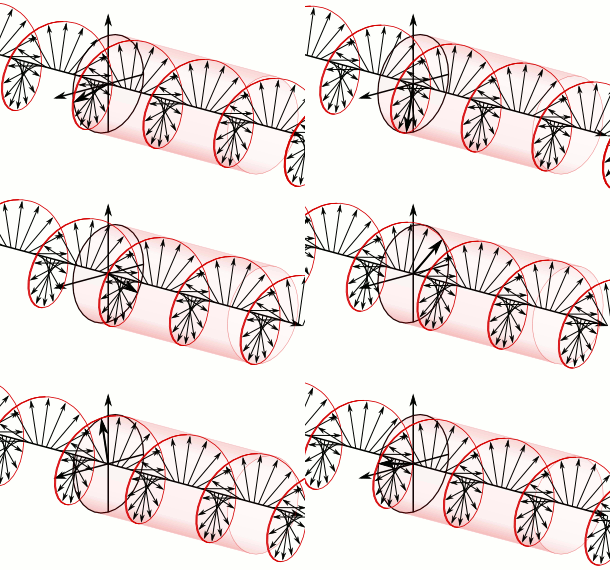
In electrodynamics, elliptical polarization is the polarization of electromagnetic radiation such that the tip of the electric field vector describes an ellipse in any fixed plane intersecting, and normal to, the direction of propagation. An elliptically polarized wave may be resolved into two linearly polarized waves in phase quadrature, with their polarization planes at right angles to each other. Since the electric field can rotate clockwise or counterclockwise as it propagates, elliptically polarized waves exhibit chirality.
Other forms of polarization, such as circular and linear polarization, can be considered to be special cases of elliptical polarization.
Other forms of polarization, such as circular and linear polarization, can be considered to be special cases of elliptical polarization.

one of Dave's Post: http://www.energeticforum.com/renewa...magnet-27.html
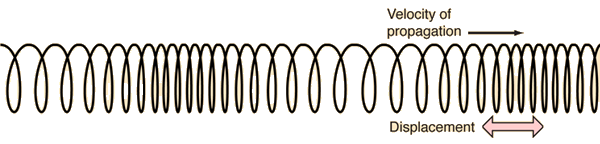
In longitudinal waves the displacement of the medium is parallel to the propagation of the wave. A wave in a "slinky" is a good visualization. Sound waves in air are longitudinal waves.


How a Fresnel lens focuses light


The discovery of polarization (polarization.com)
Fresnel 1816 memoir to the Academie explained diffraction in detail and with unprecedented predictive power, but polarization was not mentioned. He was aware of the problem but did not have an explanation at the time. So polarization remained for several more years a big hole in the wave theory of light. The key problem was unpolarized light (of course!). The symmetry of unpolarized light suggested to Fresnel that light could have a longitudinal component: then, how did it convert to transverse polarized waves? Finally, around 1821 it occurred to him that unpolarized light was made of transverse waves changing direction very fast. The transverse nature of light also explained Fresnel experimental results showing that rays perpendicularly polarized could not interfere. A wave theory of polarized light was born! (well, it was not accepted universally, as it seemed to imply a solid ether!). Although Young arrived to the same conclusions at about the same time there was no priority dispute (for a change!) between them: each gave credit to the other.

You can see an example of natural polarization every time you look at a lake. The reflected glare off the surface is the light that does not make it through the "filter" of the water, and is the reason why you often cannot see anything below the surface, even when the water is very clear

 [/IMG]















Leave a comment: