This forum is preserved as a permanent archive. The community continues at eMedia Press.

Announcement

Collapse
No announcement yet.

Dr. Steven E. Jones JT Variation

Collapse
X
 
  • Filter
  • Time
  • Show
Clear All
new posts

  • #91
    As you vary the frequency, the voltage rises
    As seen in the lightbulb, a voltmeter or a scope.
    You can say that by changing the frequency you are sweeping the coil.

    If you sweep the coil and the voltage rises very quickly you can
    say this is a high Q where as a mild gradual change is a low Q

    When you first tune a resonant circuit it is sometimes useful
    to start with a low or medium Q and after you are happy with the
    operation you can replace the componants with a higher Q for little higher performance.

    The best tool is your brain the scope is not as important.

    Comment


    • #92
      Originally posted by ltseung888 View Post
      YouTube - ‪Coil Resonance Tutorial 1‬‏

      Giantkiller sent me the above video. It confirmed that at resonance, the output voltage is a sine wave no matter the input!

      Tuning with a signal generator is easier. But we still need to deal with forced resonance and natural resonance.

      Forced resonance can be obtained with the signal generator providing a certain frequency to the secondary LCR circuits.

      Natural resonance occurs when the two seconday LCR circuits can "self run" when the signal generator is taken away.

      Thank you to Giantkiller.

      Praise the Lord.
      @ltseung888
      I did not start this thread, but am tired of your diatribe, really if you started your own thread maybe you could sucker someone into paying attention, at least you would not be wasting the time and space for people interested the original intent of this thread.

      Comment


      • #93
        Hey,

        Remember I was finding a way to determine the natural frequency of a coil? I think I have found a way to determine natural frequency of any medium. However, I have to study, research, and doing more experiments to examine this method.

        Like mikrovolt suggested, we need to play around with low Q first, then go all out with high Q. Thank you mikrovolt. Also thank you Michael John for the varicap diode idea. If we can locked down the natural frequency of a medium, we can extract a pool of energy from it.

        Comment


        • #94
          What is that method of finding natural frequency of coil ?

          Comment


          • #95
            Originally posted by quantumuppercut View Post
            Hey,

            Remember I was finding a way to determine the natural frequency of a coil? I think I have found a way to determine natural frequency of any medium. However, I have to study, research, and doing more experiments to examine this method.

            Like mikrovolt suggested, we need to play around with low Q first, then go all out with high Q. Thank you mikrovolt. Also thank you Michael John for the varicap diode idea. If we can locked down the natural frequency of a medium, we can extract a pool of energy from it.


            I would add you could also transfer energy from one point to another

            YouTube - ‪Water Goblet Resonance‬‏
            Last edited by MonsieurM; 07-02-2011, 09:50 PM.
            Signs and symbols -Confucius.

            Comment


            • #96
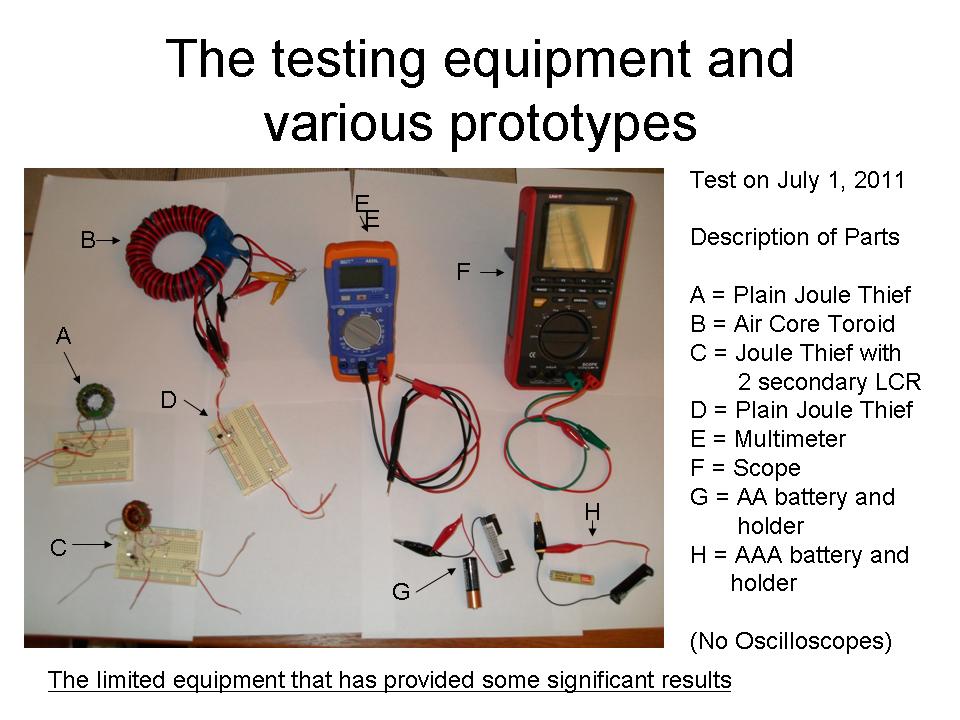
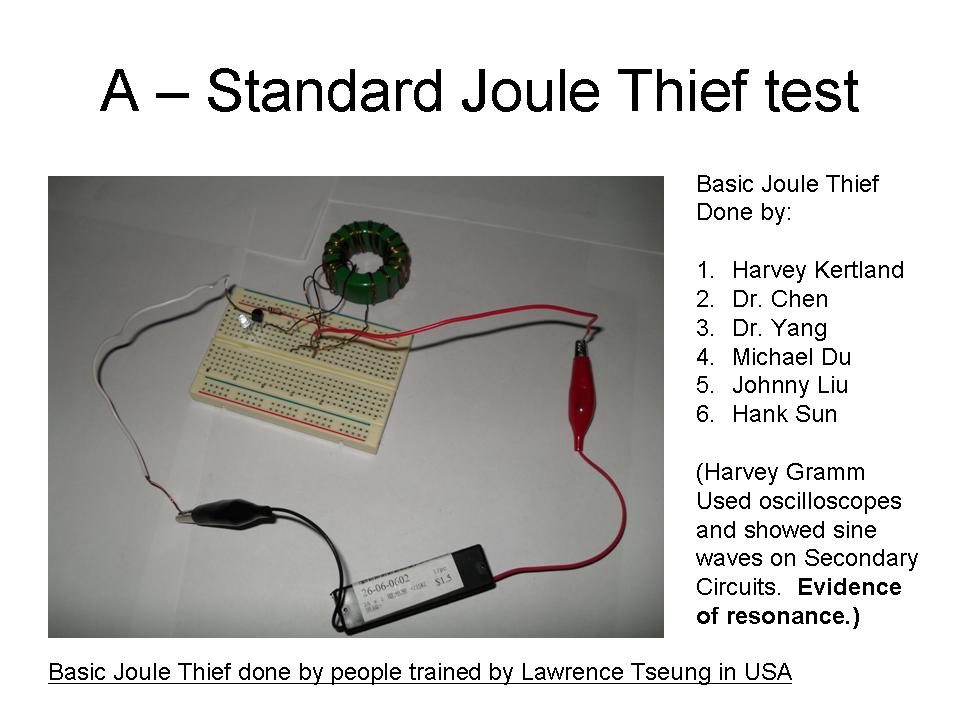
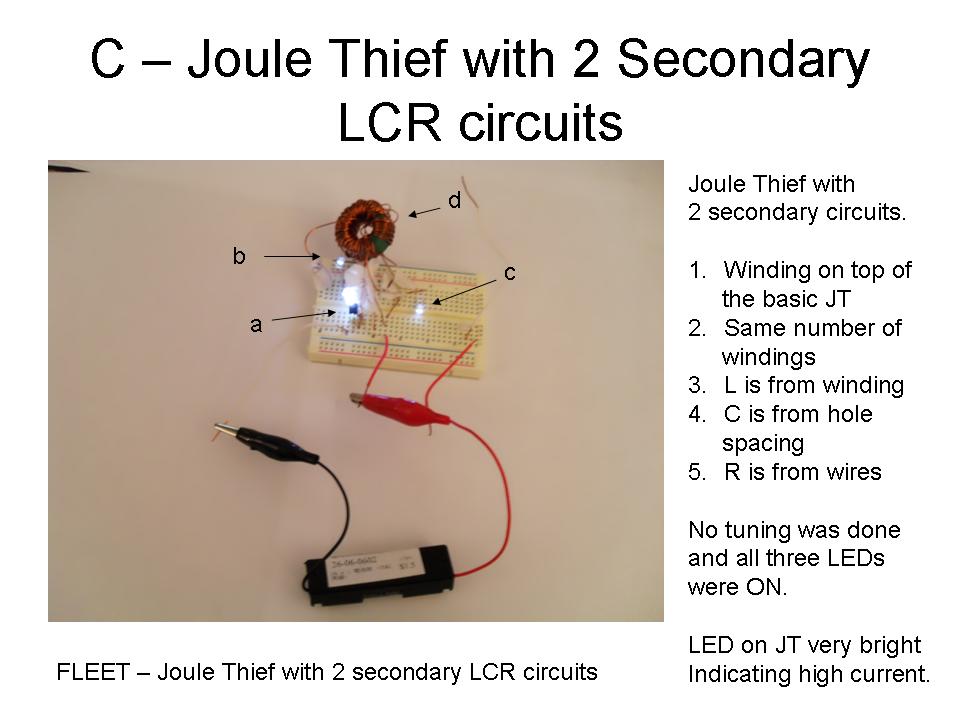
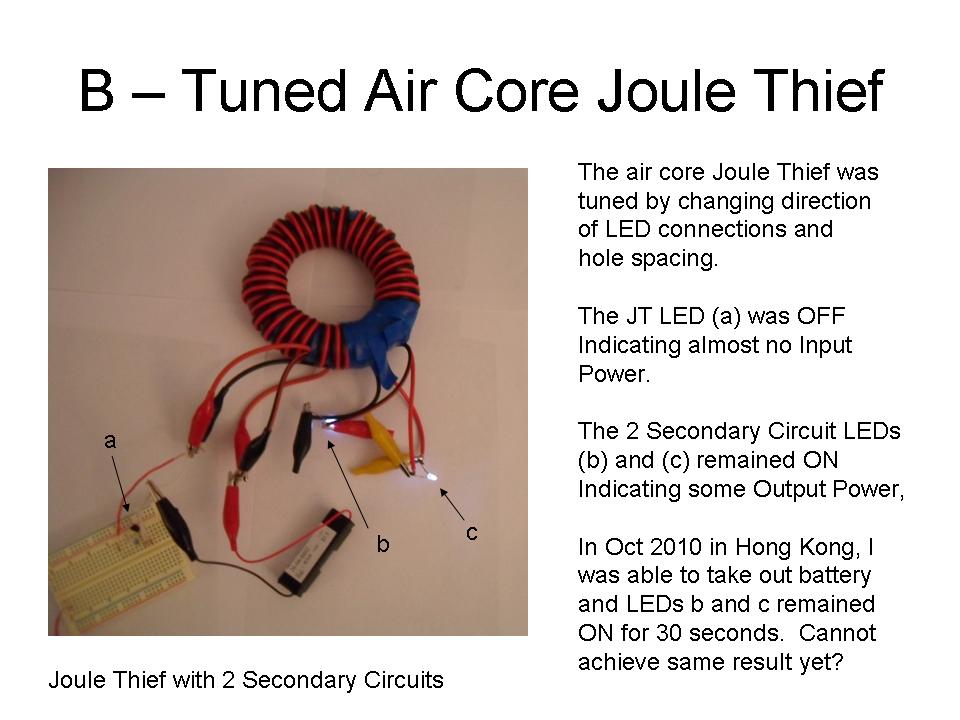
              Summary of experiments done by Trained persons in USA

              I am showing some of the experiments done by people I helped to train in USA with limited equipment. We did not have the oscilloscopes yet but impressive results have been obtained.

              I have a SCOPE that can show one waveform. That is already better than most who rely only on multimeters.

              The following was achieved:
              1. Standard ferrite core Joule Thief.
              2. Joule Thief with 2 secondary circuits. No tuning and 3 LEDs were lighted.
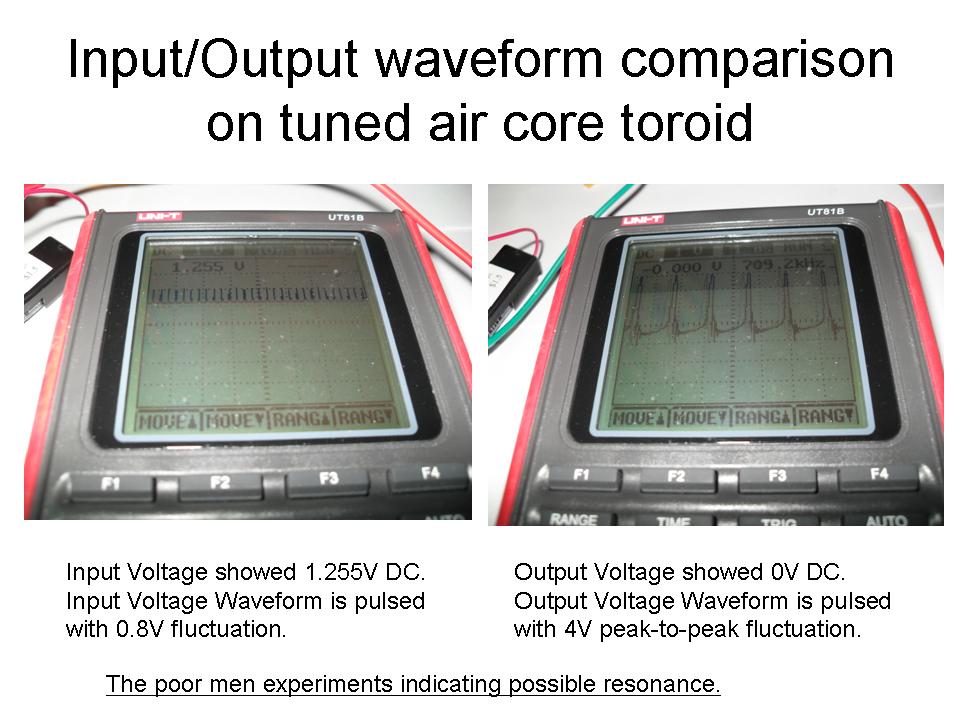
              3. Tuned Air-core toroid with low Input (LED off) and higher Output (LEDs ON)
              4. Voltage Waveforms showing pulsing DC Input Voltage and higher pulsing Output Voltage with no DC.

              Without the Oscilloscopes and Signal Generators, the above is likely to be the best we can achieve.

              You can do better than that if you have access to good oscilloscopes and signal generators. You are encouraged to share your results.

              Praise the Lord.
              Attached Files

              Comment


              • #97
                Prof. Steven Jones works together with me

                Originally posted by DrStiffler View Post
                @ltseung888
                I did not start this thread, but am tired of your diatribe, really if you started your own thread maybe you could sucker someone into paying attention, at least you would not be wasting the time and space for people interested the original intent of this thread.
                Dear DrStiffler,

                Please note that Prof. Steven Jones and I work together. I sent two FLEET prototypes to him in Dec. 2010 to start his research.

                Your work on resonance is highly respected.

                With Prof. Jones JT variant showing COP=8, we are confirming the basic resonance approach. The chance of having a Steven Mark type device is getting better and better.

                Lawrence Tseung

                Comment


                • #98
                  Thank you MonsieurM for the vid.


                  boguslaw hi,

                  I searched a bit on the internet of how people find coil natural frequency. So far I see people pulse it and use a scope to see the ringing. The frequency then considered resonance frequency of the coil.

                  My method is a bit different based on philosophy. I consider the coil and core(medium) have their own frequency. Let's say a magnet wheel and a LC circuit as the muller experiment going on right now. Obviously the LC tank and magnet wheel have different frequency. Until they matched, they have a mutual frequency. I see the core as the magnet wheel and the coil and cap as LC tank. In order to obtain the true natural frequency, we need to map out the hill of resonance. The problem is with high Q, you can go right pass it so fast without notice, so I propose we use resistance to widen the bandwidth and tune them with variable L or C . This is on low Q, once we obtain the hill frequency, we can concentrate on improving the Q.

                  The core is powered by nature. When we extract energy from it, nature will have to speed it up to replenish its state. I've set up some experiment today to test out my method. So far it does follow what predicted. However, even if succeed I do not know what harmonic and will have to use calculation without a scope. If we can find the natural frequency of water and air, we can widely spread this information so everyone can use it.

                  Comment


                  • #99
                    Check this out

                    coil self-resonant frequency estimation, theory, and history

                    coil self-resonant frequency estimation, theory, and history

                    Hi Ed,

                    Mark R. posted the self capacitance formula due to Medhurst
                    in a previous post. If you use this formula in conjuction with standard
                    inductance formulas for soleniods (like Wheeler's), you can compute
                    the self resonant (no top terminal) frequency of most coils
                    . I have found
                    that it works very well for predicting most of Malcolm's measured
                    frequencies.

                    If you want to read a little more of Medhurst try:
                    "HF Resistance and Self-Capacitance of Single-LAyer Solenoids" by
                    R.G. Medhurst, Wireless Engineer, Vol 2, p35, Feb 1947

                    *Note: the range of frequencies he used does not allow his Q formulas
                    to work at normal Tesla coil frequencies.


                    If you are just interested in computing self-resonant frequencies
                    there is another method which I have found useful and generally accurate
                    to about 10% for all coil sizes - space wound or not. Its limitation is that
                    it probably shouldn't be used for aspect ratios (Height/Diameter)<1 due
                    to the assumptions of the original derivation.

                    The formula is:
                    (1/5)
                    29.85 x (H/D)
                    F = -------------------
                    N x D

                    (hope the ascii came out)
                    where
                    F= self resonant frequency in Mhz of an 'isolated' coil
                    H= coil height in meters
                    D= coil diameter in meters
                    N= total number of turns

                    Make sure the top line reads " (H/D) to the 1/5 power"
                    Note that the frequency is a very weak function of the
                    aspect ratio (H/D), but a fairly strong function of the number of turns
                    and the diameter.

                    This is an adapation of the formula for Helical Antennas found
                    in Reference Data for Radio Engineers as well as in the section on
                    slow wave structures in "Fields and waves in Communication Electronics"
                    by S Ramo, J R Whinnery, and T D Van Duzer. A form of this equation also
                    appears in both of the Corum brother's books:
                    "Vacuum Tube Tesla Coils" and "TC Tutor"

                    Incidentally, the Corums incorrectly attribute the analysis of the helix to
                    Kandoian and Sichak. These guys actually just made a simplification of the
                    formula reported earlier by JR Pierce (1947) and Franz Ollendorf (1925)
                    and even more amazing : Pocklington (1897) (see below).
                    Signs and symbols -Confucius.

                    Comment


                    • Originally posted by ltseung888 View Post
                      Dear DrStiffler,

                      Please note that Prof. Steven Jones and I work together. I sent two FLEET prototypes to him in Dec. 2010 to start his research.

                      Your work on resonance is highly respected.

                      With Prof. Jones JT variant showing COP=8, we are confirming the basic resonance approach. The chance of having a Steven Mark type device is getting better and better.

                      Lawrence Tseung

                      Are you guys aware of the work of the German Prof. Claus Turtur?


                      He explains the basic theory of how both the "static" magnetic field and the electrostatic field actually convert ZPE into these fields and that is where free energy eventually comes from. I have referred to him in my "article" over at pes:

                      Article:Free Electric Energy in Theory and Practice - PESWiki


                      I think with Turtur's work you have the foundation for explaining where the excess energy coming out of these kind of circuits comes from: It is converted by charge carriers from the ZPE field....

                      Comment


                      • Originally posted by boguslaw View Post
                        What is that method of finding natural frequency of coil ?
                        YouTube - Broadcast Yourself.
                        Atoms move for free. It's all about resonance and phase. Make the circuit open and build a generator.

                        Comment


                        • Thank you MonsieurM. I ran across that page too a while back. Those guys are experts. But I have to agree with DrStiffler that those are self resonance frequency and not spatial. Still, we can use it to estimate the range to track.

                          Thanks Lamare,

                          Professor Turtur gave good explanation to understand where the energy coming from. I also like his magnet motor wrapped around a LC circuit. This is exactly what the muller experimentalist are doing now. We're on the right track after all.

                          Inquorate,

                          Excellent! Seems like DrStiffler is a life time ahead of me. Once again I'm not original but I'm more happy because of the confirmation. Do you have an exact number of this spatial frequency? Seems like it's an air type.

                          QU

                          Comment


                          • Originally posted by quantumuppercut View Post
                            Thank you MonsieurM. I ran across that page too a while back. Those guys are experts. But I have to agree with DrStiffler that those are self resonance frequency and not spatial. Still, we can use it to estimate the range to track.

                            Thanks Lamare,

                            Professor Turtur gave good explanation to understand where the energy coming from. I also like his magnet motor wrapped around a LC circuit. This is exactly what the muller experimentalist are doing now. We're on the right track after all.

                            Inquorate,

                            Excellent! Seems like DrStiffler is a life time ahead of me. Once again I'm not original but I'm more happy because of the confirmation. Do you have an exact number of this spatial frequency? Seems like it's an air type.
                            Always a pleasure, not being as well instructed as you guys on spacial resonance, i went ahead and looked it up, and hold and behold: this is for you Farmhand

                            An electrostatic spatial resonance model for coaxial helical structures with applications to the filamentous bacteriophages.

                            It is found that coaxial helices with optimally mated symmetries can lock into spatial resonance configurations that maximize their interaction. The resonances are represented as vectors in a discrete three-dimensional space[
                            An electrostatic spatial resonance model for coaxial helical structures with applications to the filamentous bacteriophages.

                            Last edited by MonsieurM; 07-03-2011, 04:20 PM.
                            Signs and symbols -Confucius.

                            Comment


                            • Quantumuppercut,
                              The LTSpice program does joule thieves, and bode plots such as
                              stop filters absorbs but can be radiant if not grounded. This info can be used
                              to design and build coils.

                              I made a 6 pole crystal filter on a crystal oscillator the signal was too narrow for most equipment.
                              This helped me to see that radio equipment in general uses wider signals
                              for good audio but the equipment hides alot of narrow pulse as you get up in frequency.

                              The Jones 8X is not an extreme frequency sensitive device but measuring the smaller GHz harmonics require nanosecond resolution.

                              Comment


                              • Originally posted by MonsieurM View Post
                                Always a pleasure, not being as well instructed as you guys on spacial resonance, i went ahead and looked it up, and hold and behold: this is for you Farmhand

                                An electrostatic spatial resonance model for coaxial helical structures with applications to the filamentous bacteriophages.


                                An electrostatic spatial resonance model for coaxial helical structures with applications to the filamentous bacteriophages.

                                You guys may also like this article I downloaded somewhere:


                                It talks about mixing two frequencies with a difference of Phi:

                                Now, what do you suppose happens when we take two frequencies, f1 = 1 unit, and f2 = a frequency that is Phi times larger, or f2 = 1.6180339, and modulate them-- nonlinearly mix them-- in an AM modulator? The two new frequencies are the sum, which is 2.6180339-- hey, that's the same as Phi^2, and the difference, which is .6180339-- hey, isn't that Phi to the -1th power? Yup, it is.
                                So we stumble upon the very interesting fact that powers of Phi are automatically generated whenever we "heterodyne" or modulate two frequencies that are related by a ratio equal to Phi.
                                This may be a very interesting piece of the puzzle:

                                Would this be a good mix to try with some alt-sci experiments involving plant growth, healing waveforms, vortex generation, etc.? Would this have any bearing on Dan Winter's gravity = Phi harmonic implosion ideas? On Tom Bearden's insistence that you need nonlinear mixing to accomplish scalar electromagnetics magic?
                                How about Moray B. King's ideas in his book Tapping the Zero-Point Energy, where he describes a cascade of simple resonators with nonlinear breakover thresholds or switching, which is supposed to be able to shift high frequency energy down the spectrum into the lower frequencies, with attendant amplitude increase? Is this what living things do within their nonlinear cellular and nerve structure?

                                Comment

                                Working...
                                X