Announcement

Collapse
No announcement yet.

Glue Battery

Collapse
X
 
  • Filter
  • Time
  • Show
Clear All
new posts

  • #16
    I have a question, and maybe it's just me missing the point, but why is it so bad that things work with moisture still in them. Don't get me wrong, i see the point of finding a dry cell battery, but if you can make a cell out of cardboard and glue and it works, why does it matter if it corrodes or retains moisture. isn't the point to be able to make power out of simple household objects? all batteries die eventually (and yes i do understand that a dry cell should not die in theory) so even if this isn't the battery breakthrough of the century, it seems to me it's still power on the cheep, and that should be exciting in and of itself.
    just this man's opinion
    i see a lot of these battery posts and people always talk about the moisture content as if it's a bad thing. like i said, maybe i am just missing the point, but from where i am sitting power is power, moisture or not. and being able to make a battery on the fly with simple materials is still useful on some level
    just curious
    N8
    The absence of proof is not proof of absence

    Comment


    • #17
      Originally posted by Neight View Post
      I have a question, and maybe it's just me missing the point, but why is it so bad that things work with moisture still in them. Don't get me wrong, i see the point of finding a dry cell battery, but if you can make a cell out of cardboard and glue and it works, why does it matter if it corrodes or retains moisture. isn't the point to be able to make power out of simple household objects? all batteries die eventually (and yes i do understand that a dry cell should not die in theory) so even if this isn't the battery breakthrough of the century, it seems to me it's still power on the cheep, and that should be exciting in and of itself.
      just this man's opinion
      i see a lot of these battery posts and people always talk about the moisture content as if it's a bad thing. like i said, maybe i am just missing the point, but from where i am sitting power is power, moisture or not. and being able to make a battery on the fly with simple materials is still useful on some level
      just curious
      N8


      You make a great point. It was a simple battery that was easy to make, and it just that. Nothing last forever and making a battery out of something that you don't expect is a nice experiment.
      All truth passes through three stages. First, it is ridiculed. Second, it is violently opposed. Third, it is accepted as being self-evident. - Arthur Schopenhauer

      Comment


      • #18
        Standard chemistry

        Originally posted by ibpointless2 View Post
        Even If the aluminum had other metals alloyed to it, its still the same one metal. When they are alloyed to another metal they become a new metal. So i'm still using the same metal, even though its not pure aluminum its still the same metal. In order to separate the other metals from the aluminum would require some type of energy to do so, but I'm not giving energy I'm taking energy.

        So in order to have a galvanic reaction you need the cell to have dissimilar metals. Even if one metal is a aluminum-copper alloy and the other is a aluminum-magnesium alloy, that is still dissimilar metals and yes that is galvanic reaction. But if both plates are only aluminum-magnesium alloy then it can't be galvanic because both metals are the same and thus no electron flow.


        If you do have more reason as to why the same metal water battery idea works then please post. Thanks. I really want to solve this.
        IB

        This is really simple and youre not discovering anything new here. Most of it is high school chemistry. Research how they make stainless steel and why there are rust marks in it sometimes. If Stainless (which is an alloy), were truly one metal as you suggest, they wouldnt have to do special processes to knife surfaces like passivation. Look into passivation of ALL metals and how this natural process protects the surface.

        Don't look at an alloy as "one metal" (as you simply stated) because this is not what it is. Just because your eye cannot focus to the molecular level of an electron microscope so you see the different particles of each different material bonded together into ONE alloy, doesnt mean they arent there making up the tightly knit jigsaw piece.
        Look at it this way...is OIL one material? No! Its a substance made up of a whole plethera of differing hydrocarbon chains linked together to form 'one unit' and when you set it alight or extract the energy in some other form, it breaks down.
        Now lets go back to the Aluminium/Magnesium alloy. When that hits water, the particles of Magnesium react with water and start forming hydrogen bubbles on its surface. If it is linked to another metal, then an electrolysis effect will be accentuated and speed up the degradation of the magnesium. This is employed in the shipping/boat industry where boats will clamp magnesium anodes to the hull as a sacraficial component rather than the hull being eaten. It is also used in construction, pipelines and anywhere where metals are exposed to corrosive elements which create naturally destructive electrical currents.

        IB, all you have here is 'decomposition'. What happens when you bury a piece of live matter? As it breaks down in a corrosive environment (moisture/oxygen), heat and all sorts of chemical reactions occur creating energy. The same happens with alloys and dissimilar metals depending on the components and sometimes they create their own oxygen which fuels the process further. However...is it free???? NO. Something is always consumed and then transformed into another type of energy.

        There are ways of making free energy but what you are proposing is not one of them. As stated earlier, this is textbook stuff. Educate yourself first on the basics.

        TP

        Comment


        • #19
          Originally posted by teslaproject View Post
          IB

          This is really simple and youre not discovering anything new here. Most of it is high school chemistry. Research how they make stainless steel and why there are rust marks in it sometimes. If Stainless (which is an alloy), were truly one metal as you suggest, they wouldnt have to do special processes to knife surfaces like passivation. Look into passivation of ALL metals and how this natural process protects the surface.

          Don't look at an alloy as "one metal" (as you simply stated) because this is not what it is. Just because your eye cannot focus to the molecular level of an electron microscope so you see the different particles of each different material bonded together into ONE alloy, doesnt mean they arent there making up the tightly knit jigsaw piece.
          Look at it this way...is OIL one material? No! Its a substance made up of a whole plethera of differing hydrocarbon chains linked together to form 'one unit' and when you set it alight or extract the energy in some other form, it breaks down.
          Now lets go back to the Aluminium/Magnesium alloy. When that hits water, the particles of Magnesium react with water and start forming hydrogen bubbles on its surface. If it is linked to another metal, then an electrolysis effect will be accentuated and speed up the degradation of the magnesium. This is employed in the shipping/boat industry where boats will clamp magnesium anodes to the hull as a sacraficial component rather than the hull being eaten. It is also used in construction, pipelines and anywhere where metals are exposed to corrosive elements which create naturally destructive electrical currents.

          IB, all you have here is 'decomposition'. What happens when you bury a piece of live matter? As it breaks down in a corrosive environment (moisture/oxygen), heat and all sorts of chemical reactions occur creating energy. The same happens with alloys and dissimilar metals depending on the components and sometimes they create their own oxygen which fuels the process further. However...is it free???? NO. Something is always consumed and then transformed into another type of energy.

          There are ways of making free energy but what you are proposing is not one of them. As stated earlier, this is textbook stuff. Educate yourself first on the basics.

          TP


          What happens when you don't use metal and instead use Graphite? Graphite is not a metal and it has shown to work in my cells before. Using only graphite plates for both anode and cathode I see a voltage. I how can it be galvanic if no metals are used?

          I do think there is something special here, repeated test have shown that some of the cells are not your average battery or galvanic cell or even like a capacitor. These cells are very different, just because my cell has reached 0 volts doesn't mean its not producing power it just means its charging in the negative direction. Yes I know that sounds crazy but the graphite glue cell started off at 20mV and slowly drained til it got to 0 volts but didn't stop there it continued on in the negative Milli volt range. And Yes I tested a capacitor (ceramic) and it will drained too but when it got to 0 volts it stayed above 0 volts and bounced around from 0 to 5mV never going negative like what the graphite glue cell did.
          All truth passes through three stages. First, it is ridiculed. Second, it is violently opposed. Third, it is accepted as being self-evident. - Arthur Schopenhauer

          Comment


          • #20
            Fallen in love?

            Originally posted by ibpointless2 View Post
            What happens when you don't use metal and instead use Graphite? Graphite is not a metal and it has shown to work in my cells before. Using only graphite plates for both anode and cathode I see a voltage. I how can it be galvanic if no metals are used?

            I do think there is something special here, repeated test have shown that some of the cells are not your average battery or galvanic cell or even like a capacitor. These cells are very different, just because my cell has reached 0 volts doesn't mean its not producing power it just means its charging in the negative direction. Yes I know that sounds crazy but the graphite glue cell started off at 20mV and slowly drained til it got to 0 volts but didn't stop there it continued on in the negative Milli volt range. And Yes I tested a capacitor (ceramic) and it will drained too but when it got to 0 volts it stayed above 0 volts and bounced around from 0 to 5mV never going negative like what the graphite glue cell did.
            IB

            Careful man, you seem to me like an 'scientist' who has fallen in love with an idea and can't give it up even after it is proven void. Just because YOU don't understand it doesn't mean that everyone doesn't comprehend the angle on it.

            So what...now after all the explanations I have given for the same metal experiments you hang on to graphite/water (of which there is an explanation), and yet the output is so infinitesimal that its pathetic to even consider it. Can you amplify it? Can you even run a led for 1 second after charging a cap for 24 hours with the graphite water cell? No. What use is it then when there are so many other options to shake the lattice and gain free energy??

            Anyway, I wish you well in your experiments.

            Comment


            • #21
              The following relates to the glue crystal battery

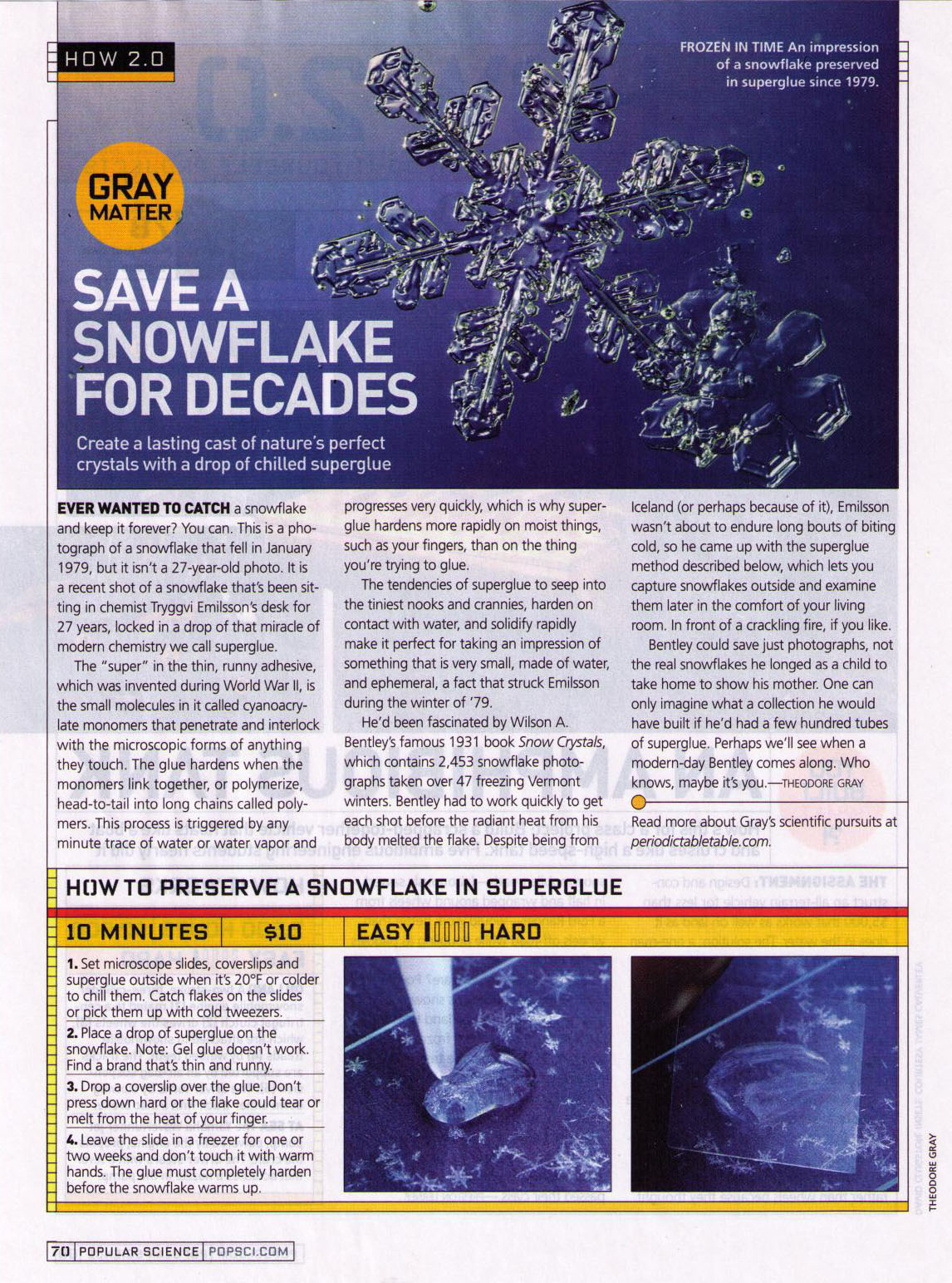
              Save a Snowflake for Decades

              Ever wanted to catch a snowflake and keep it forever? You can. This is a photograph of a snowflake that fell in January 1979, but it isn't a 27-year-old photo. It is a recent shot of a snowflake that's been sitting in chemist Tryggvi Emilsson's desk for 27 years, locked in a drop of that miracle of modern chemistry we call superglue. The 'super' in the thin, runny adhesive, which was invented during World War II, is the small molecules in it called cyanoacrylate monomers that penetrate and interlock with the microscopic forms of anything they touch. The glue hardens when the monomers link together, or polymerize, head-to-tail into long chains called polymers. This process is triggered by any minute trace of water or water vapor and progresses very quickly, which is why superglue hardens more rapidly on moist things, such as your fingers, than on the thing you're trying to glue.

              The tendencies of superglue to seep into the tiniest nooks and crannies, harden on contact with water, and solidify rapidly make it perfect for taking an impression of something that is very small, made of water, and ephemeral, a fact that struck Emilsson during the winter of '79.

              He'd been fascinated by Wilson A. Bentley's famous 1931 book Snow Crystals, which contains 2,453 snowflake photographs taken over 47 freezing Vermont winters. Bentley had to work quickly to get each shot before the radiant heat from his body melted the flake. Despite being from Iceland (or perhaps because of it), Emilsson wasn't about to endure long bouts of biting cold, so he came up with the superglue method described below, which lets you capture snowflakes outside and examine them later in the comfort of your living room. In front of a crackling fire, if you like.

              Bentley could save just photographs, not the real snowflakes he longed as a child to take home to show his mother. One can only imagine what a collection he would have built if he'd had a few hundred tubes of superglue. Perhaps we'll see when a modern-day Bentley comes along. Who knows, maybe it's you.
              the whole article, save it on your pc

              Signs and symbols rule the world, not words nor laws.” -Confucius.

              Comment


              • #22
                Trials

                Ive tried recreating your glue cell but after a few hours it crumbled and fell off the paper. Ive made another large one that I expect will take a few days to dry. I will post a vid when that cell is dry.

                Links:
                ibpointless2 Glue cell recreation
                ibpointless2 Glue cell Observations 1

                Comment

                Working...
                X