
 Tweet
Tweet
Here is the concept I begun testing and intend to finish, which I believe is very strong. I thought some might find the concept interesting.
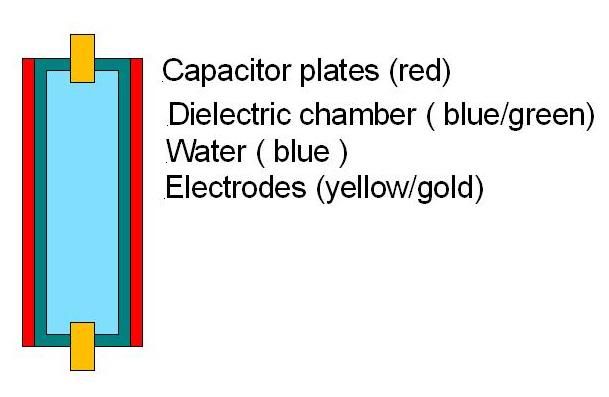
Imagine an electrolyser cell, yet simplified.
There are only two plates and each is covered with a dielectric.
In between the plates is water.
Because of the dielectric, there is no way for charge to leave one plate transit the water and end on the other plate, Rather the plates act more like a capacitor.
If you were to run a current through the water, (from two electrodes see rough diagram below) you would notice a sharp decrease in the capacitance of the plates.
-------------------------
x~~~~~~~~~~~~~~~x
-------------------------
The dashed lines above are the capacitor plates with insulation, in between them is water. The "x" marks are electrodes to cause a current to run through the water parallel to the plates. The squiggly lines are the water. If you imagine the fields, you would have the water molicules aligning its poles in the plate to plate (vertical in this portrayal) direction. The current is going from electrode to electrode, in the horizontal direction, thus the dielectric field of the capacitor, and the current are orthogonal or perpendicular to each other.
Here is where the magic happens. It is known to those skilled in the art (brushing up on my patent writing skills That to decrease the capacitance of a charged capacitor causes an increase in the energy state. This arises from the law of conservation of charge, and is explained very well in the Hidink patent 4095156. This is the fundamental concept behind parametrics, variation of the parameters of a system to affect an increase in energy, in this case, we are talking about capacitance.
So now that you understand the layout of the simple cell, and the concept of decreasing capacitance causing an increase in energy, you will see the simple elegance of what I am trying to do.
Imagine charging such a capacitor to some very high voltage (I am working with 12kv). Now discharge this capacitor through its own dielectric (water). As the discharge occurs, the increase in current through the water, causes a sharp decrease in capacitance of the cell!Our discharge diminishes the very capacitance that holds it. It is known that the area under the curve in an oscilloscope reading equates to the energy in the pulse. Here one discharge of a normal capacitor has an area x. Here the discharge should be (and preliminary tests show this to be correct) larger than X. To what degree I am not sure yet.
Now imagine what this means. We will have two outputs here. One will be gas liberated from the electrodes, the other will be our electrical discharge. My plan is to recycle the discharge back into the capacitor from whence it came, thus completing one cycle.
I call this device the cross field cell, as it plays dielectric force against current. (the two being perpendicular to each other).
Imagine an electrolyser cell, yet simplified.
There are only two plates and each is covered with a dielectric.
In between the plates is water.
Because of the dielectric, there is no way for charge to leave one plate transit the water and end on the other plate, Rather the plates act more like a capacitor.
If you were to run a current through the water, (from two electrodes see rough diagram below) you would notice a sharp decrease in the capacitance of the plates.
-------------------------
x~~~~~~~~~~~~~~~x
-------------------------
The dashed lines above are the capacitor plates with insulation, in between them is water. The "x" marks are electrodes to cause a current to run through the water parallel to the plates. The squiggly lines are the water. If you imagine the fields, you would have the water molicules aligning its poles in the plate to plate (vertical in this portrayal) direction. The current is going from electrode to electrode, in the horizontal direction, thus the dielectric field of the capacitor, and the current are orthogonal or perpendicular to each other.
Here is where the magic happens. It is known to those skilled in the art (brushing up on my patent writing skills
That to decrease the capacitance of a charged capacitor causes an increase in the energy state. This arises from the law of conservation of charge, and is explained very well in the Hidink patent 4095156. This is the fundamental concept behind parametrics, variation of the parameters of a system to affect an increase in energy, in this case, we are talking about capacitance.So now that you understand the layout of the simple cell, and the concept of decreasing capacitance causing an increase in energy, you will see the simple elegance of what I am trying to do.
Imagine charging such a capacitor to some very high voltage (I am working with 12kv). Now discharge this capacitor through its own dielectric (water). As the discharge occurs, the increase in current through the water, causes a sharp decrease in capacitance of the cell!Our discharge diminishes the very capacitance that holds it. It is known that the area under the curve in an oscilloscope reading equates to the energy in the pulse. Here one discharge of a normal capacitor has an area x. Here the discharge should be (and preliminary tests show this to be correct) larger than X. To what degree I am not sure yet.
Now imagine what this means. We will have two outputs here. One will be gas liberated from the electrodes, the other will be our electrical discharge. My plan is to recycle the discharge back into the capacitor from whence it came, thus completing one cycle.
I call this device the cross field cell, as it plays dielectric force against current. (the two being perpendicular to each other).
 [/QUOTE]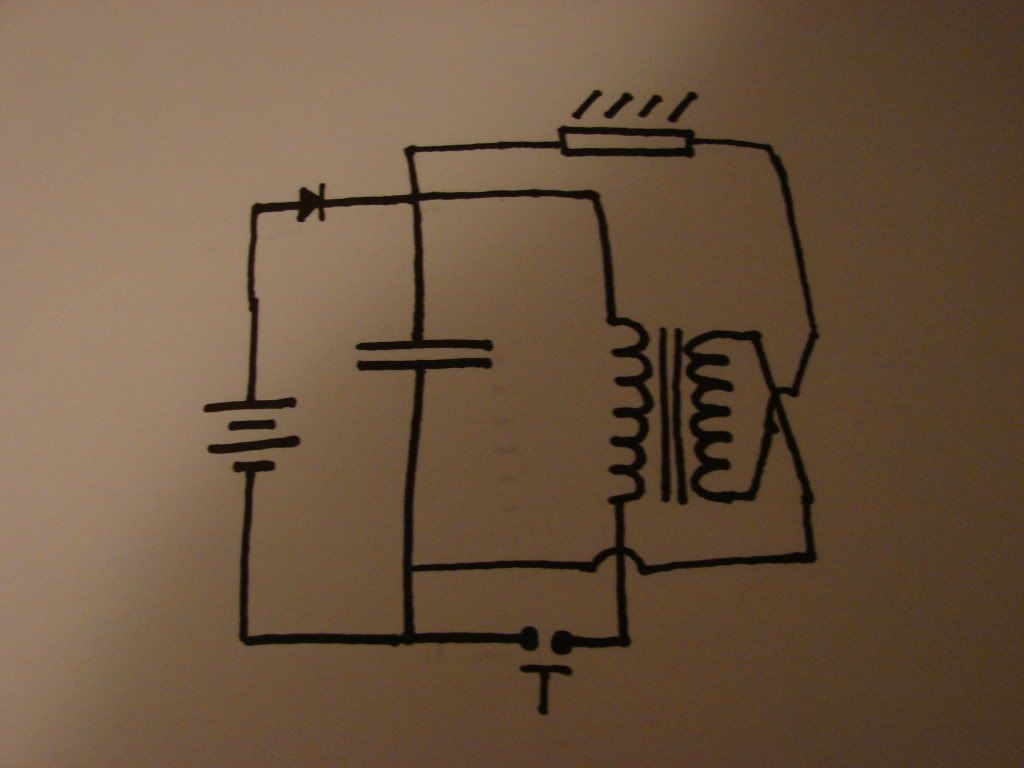

Comment