
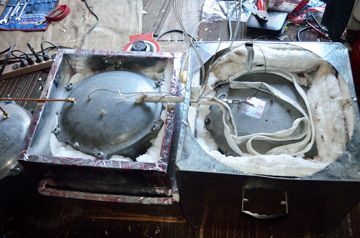
I thought it would still be too hot, figured a small stainless bowl with a hole drilled in bottom and thermowell ran through and ceramic insulation stuffed around the case should protect it. And yes 400c is mighty hot and hard to wrap ones head around. How do you guys check pressure inside your retort?
Those using copper in reflux packing etc , how does it hold up?
I can get a stainless reflux if copper will not work.
Thank you thank you for the help guys, you rock!
-
Hello mindxploration, nice looking system that you have. I also use an All American Aluminum pressure cooker as a retort, with all bakelite pieces removed. I have had no trouble with it.m I also installed it inside an aluminum can with 4" of high temp insulation all around, and used high temp band heaters for heating it.
You will need PD controllers to control the heaters, and they come with thermocouple inputs. You will want to get high temp thermocouples to go with them. That will resolve your question.
The American Aluminum pressure cookers come with a pressure relief valve, which will have to be removed, and it is where you can install your immersion thermocouple. See photo of retort and its first condenser trap, which is also an American Aluminum pressure cooker. In fact my entire pyrolysis system is based upon several of these pressure cookers.
Leave a comment:
-
Thanks for the help excalibur. It is an all american pressure cooker with metal to metal seal, already replaced the bakelite handles and will replace bakelite wingnuts with steel. Also have it slid in second aluminum drum and 2" ceramic insulation shoved in between the walls to hold heat. Using carbon steel plate in between burner and aluminum. Will be using exhaust cement on threads. Was planning on another temp guage on reflux as well as pressure guage but seems I need a chemical diaphragm seal etc to use pressure guage in extreme heat zone...
reflux will be packed with steel bearings, steel wool and ceramic Raschig rings. Thanks again for any input everyone.
While ordering the retort thermometer I figured 500c thermometer can handle 500c.... fail.
Received the tel tru thermo with clear warning stickers of 200f max case temp. Ordered appropriate thermowell for unit, whopping 4lbs. Should I still be concerned with radiant heat above retort being near 200f open air temp?Attached FilesLast edited by mindxploration; 10-23-2015, 09:48 PM.Leave a comment:
-
-
Tidy work and a good start for a first attempt. The proposed reflux size seems like a good place to begin with. The key thing is that it matches the retort for size so it will operate within a usable temperature range. Be prepared to tweak the size or add/subtract insulation to achieve this.Originally posted by mindxploration View Post
The retort looks like aluminum, possibly a pressure cooker? Does it have a rubber seal? It will need a high temperature gasket or metal-to-metal seal. The pot itself in its' current form will lose too much temperature from heat radiation. It will likely require heat applied on the sides as well as the base. Any tapered pipe threads in the hot zone will be leaky. Tapered fittings or flanges are best. Good idea on the thermowell. Ideal is that it reads the actual liquid temperature. Another sensor in the reflux is essential.
Everyone's got to start somewhere. You are wise to start with a small experimental prototype. Good luck. I hope to read of progress as you test. Thanks for sharing.Leave a comment:
-
Better view of individual condenser and tank setup. As well as safety bubbler and guage. I know guage is unnecessary as it shows vacuum and psi.Attached FilesLeave a comment:
-
-
Hello everyone , new here and hoping for some feedback on my current setup. I haven't tapped for thermowell or reflux column yet, was thinking 2"x36" reflux on my 40l retort? Also I plan on purchasing a centrifuge but not sure how nice of one I will need for my planned uses. Hoping to use the diesel in my off grid motorhome heater and possibly fuel mercedes 300sd with om617 engine. Thanks for all the help you have all given already through this thread, I wouldn't be anywhere close to completion without.Attached FilesLeave a comment:
-
-
rozier56
Do you guys think that a longer/taller reflux column with more packing filler will be beneficial?Leave a comment:
-
Hello,Originally posted by kedigen View Post
I can't excess this videos. Please help me.Leave a comment:
-
Yes I know it is an cross linked polymer & also I am thinking on the same line as you that's why today i use only 100 gms of it in a pilot plant made up of mostly glass components & result is , it emits only very small amount gas may be some acid as per you and rest black char or carbon no petroleum residue at all so the conclusion is that it not suitable for pyrolysis .Thanks wheels for your input . keep posting to maintain this wonderful forum aliveOriginally posted by wheels View PostLast edited by sunilkm153; 09-20-2015, 07:44 PM.Leave a comment:
-
No that is not pure polystyrene. It is a cross linked polymer of polystyrene. If it remained on it's own, it could possibly be processed. But in this case, I am not totally sure, but suggest it could be full of issues. I assume this is used and this mostly spent, but there could still be a sufficient amount of acid left to cause issues.Originally posted by sunilkm153 View Post
The Polymer is prepared by the process of Sulfonation to create Sulfonoc Acid that is locked into the Polymer. Sulfonic Acid is a crystaline solid and a very powerful Acid. Basically it is a Solid form of Sulpuric acid. It is used in Water treatment as a water softener, via Ion exchange. But it is also used as a catalyst in Organic Chemistry and dissolves into Organic liquids. So that means it will likely dissolve into the Fuel you produce. At the temperatures we use I am not sure what would then happen exactly, but most likely you are going to have some major corrosion issues. Another possible is that a closely related acid called Sulfurous Acid could also be created. It is, once again, basically Sulfuric Acid in a Gas form. So that is likely going to pass through the system, causing corrosion on the way and then expelling into the air. That could be dangerous if you breathed it. So my opinion is forget trying to use this stuff.Leave a comment:
-
I got polystyrene not in expanded form but as tiny small shiny granules of polystyrene sulphonateOriginally posted by wheels View Post
( resin used in water treatment plants)Leave a comment:

Leave a comment: