If this is your first visit, be sure to
check out the FAQ by clicking the
link above. You may have to register
before you can post: click the register link above to proceed. To start viewing messages,
select the forum that you want to visit from the selection below.
That's a good idea - Peter and I did the same for the Save on Home
Energy book.
However, the panel on the very top of the fridge is problematic.
When the fridge is running, if you place your hand on top and go around
the perimeter, some of the fridge's we experimented with had hot spots
that ran around the to perimeter about 1-2 inches inward from the very
edge.
If insulating the entire top, the insulation will lock that heat into the
fridge casing when the fridge is running. The idea will work as long as you
insulate the top of the fridge where the hot spots don't exist.
The insulation on the back of the fridge is fine.
You can open the fridge for a few minutes to let out the cold and it will
speed up how fast it kicks on and let it run for a bit and use your hand
around the top and you'll see what I mean.
Aaron i got that book to support you and Peter but have had not time to read it yet(who has time now days right?), thanks for the heads up will take a closer look. Thank you very much for the added info, love to do a pilot scale model of that one day
I don't know about these kinds of things. Seems to me that when you use the heat from your fridge, your house heating system will have to work just a bit harder to keep your house warm....
Of course, I live in a country where the heating system in the house needs to be on at least 9 months of the year, so in a warmer climate this may be a good idea, but not for me I'm afraid.
I don't know about these kinds of things. Seems to me that when you use the heat from your fridge, your house heating system will have to work just a bit harder to keep your house warm....
Of course, I live in a country where the heating system in the house needs to be on at least 9 months of the year, so in a warmer climate this may be a good idea, but not for me I'm afraid.
Wouldn't it actually work in just the opposite direction? The heat from the fridge helps warm the house up as it moves the thermal energy from inside the box to outside the box.
The insulator keeps the household heat from seeping into the box by reflecting it. At the same time, it keeps the interior cool and thus cuts down on electrical expenses.
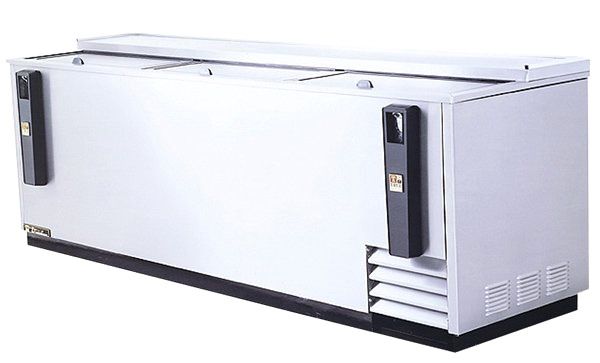
If you really want to save energy on a fridge, stop opening the door and letting all that cold air flow out onto the floor
Refrigerators should be horizontal where you open the top and all the cold air stays in the container. Models that operate in this way have been shown to cut energy consumption by nearly 90% depending on use.
Newer refrigerators 'pretend' to be using drawers - but in reality, the sides of the drawers (and bottoms too) are wide open and all that cold air flows out onto the floor.
The original refrigeration units worked this way. Supermarkets have refrigerated sections with huge open air (no tops) chill boxes that keep stuff cool all day long. Hot air does not mix with cold air and a boundary layer sits between them insulating one from the other as gravity separates them. Interestingly though, sometimes you can see the cold air pouring over the top of the rails and spilling out onto the floor if the dew point is just right.
Amazing what we do with the energy at our disposal.
"Amy Pond, there is something you need to understand, and someday your life may depend on it: I am definitely a madman with a box." ~The Doctor
Here is a question for all, how can we heat a room of 100 cubic ft to 20c with an air conditioning unit when the temperature is minus 1 degree centigrade outside.
One valid thing to be done with a fridge besides
insulating the proper places on the fridge is power
factor correction - a simple pf cap can make a big
difference.
On some of the old fridges we tested, while running,
the power factor was 0.5!!
On my personal fridge, when running, is as high as 0.98.
I think most of the newer fridges are probably also
already pf corrected.
The kill-a-watt meter does give an accurate pf reading
as one of its functions.
This of course isn't for everyone as you have to splice
a cap into the ac line and have it preferably stored
safely under the base of the fridge. Should only be done
by qualified electricians and the cap of course should
be matched properly.
Originally posted by Michael John NunnerleyView Post
Here is a question for all, how can we heat a room of 100 cubic ft to 20c with an air conditioning unit when the temperature is minus 1 degree centigrade outside.
Mike
The soil 6 feet deep is probably closer to 15°C.
Take your freezer and turn it around so you are trying to chill the soil from between 10°C and 16°C down to 0°C and let the radiator coils dump the heat into the house.
Originally posted by Michael John NunnerleyView Post
Here is a question for all, how can we heat a room of 100 cubic ft to 20c with an air conditioning unit when the temperature is minus 1 degree centigrade outside.
Mike
Pull the heat right out of the freezing cold air - as long as there is a
lower temperature that the heat in 1C can move towards? And turn
the air conditioner around so the output heat is blowing into the room?
Something like that? lol
I was defrosting a fridge once and happened to touch the wall of the fridge 12 inches away from the light. It was HOT from the light bulb.
I unscrewed the bulb and saved a lot from many directions, heating the interior when the door was opened being the most important of them.
I later bought a vestfrost fridge which is made in Denmark.
It uses a spotlight mounted outside the door which lights the interior when the door opens but does not add heat to the interior.
Anyone can modify a fridge this way as it would be worth the trouble.
It also has a capacitor to give the motor a boost at start up. I think this very nice fridge uses 850w per day. (Very low, but still a lot if I am going to use batteries.)
I was defrosting a fridge once and happened to touch the wall of the fridge 12 inches away from the light. It was HOT from the light bulb.
I unscrewed the bulb and saved a lot from many directions, heating the interior when the door was opened being the most important of them.
I later bought a vestfrost fridge which is made in Denmark.
It uses a spotlight mounted outside the door which lights the interior when the door opens but does not add heat to the interior.
Anyone can modify a fridge this way as it would be worth the trouble.
It also has a capacitor to give the motor a boost at start up. I think this very nice fridge uses 850w per day. (Very low, but still a lot if I am going to use batteries.)
jeanna
I figured that LED lights in the frig or freezer would be a good idea. Less heat.
Don't work on small size refrigerator because the heat exchanger is placed inside the fridge wall. I rarely see fridge with external tube, which are mostly old model here.

 Tweet
Tweet




Comment