Announcement

Collapse
No announcement yet.

The Swinging Gym - model for an effective gravity wheel?

Collapse
X
 
  • Filter
  • Time
  • Show
Clear All
new posts

  • The Swinging Gym - model for an effective gravity wheel?

    I initially made reference to this device in the F.M. Chalkalis thread in the following three posts:


    I see that David (Matos de Matos) has started a thread (http://www.energeticforum.com/103878-post1.htmlYouTube - Dennis Barber Swinging Gyms Hanbury Steam Rally Stoke Prior Fair 19th September 2009
    The object, of course, is to swing the cage back and forth until it finally goes "over the top," and continues rotating. It can easily sap all your strength to reach the top, even if you understand how to get it there (which the fellows in the video obviously don't), but once over the top it takes relatively little effort to keep the rotation going, and not much more than that to accelerate it.

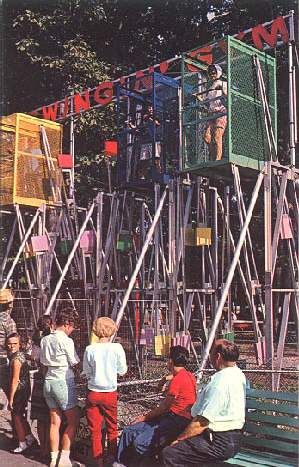
    As you can see, the human occupant, or occupants, enter a cage at ground level that is suspended in such a way as to always keep the cage in a vertical position, and this is unlike any other gravity wheel design I have seen, where routinely the suspended item or items either swing freely or become inverted at some point in the rotation. I believe this is one key factor that makes rotation with the Swinging Gym possible. Another factor is the positioning of the six suspension arms and counterweights. This becomes evident in the two photos shown below. The first photo shows the Swinging Gym about half way between the bottom and the top of a cycle, while the second shows the unit closer to the ground.


    Upon examining the two photos, one can see that each side of the cage is suspended from 3 pivot points (one at the top of the support frame, and two further down, to form a triangle pattern. The two lower support arms are attached one at the front, and one at the rear, of the cage side at the bottom. The upper support arm is attached to the centerline of the cage side somewhere near shoulder height of the occupants (depending on their actual height of course), and I believe this height of attachment is also a factor that contributes to success. The final contributing factor of the build is the positioning and weight values of the six diamond-shaped counterweights seen at the ends of the support arms. Without the counterweights, it would probably be impossible to ever get over the top and rotate. Now of course there must be a"perfect" setting to counter the weight of the cage and its occupants that would allow for best performance, so in a scaled build of this device it would be best to allow a method of sliding the counterweights and locking them in place. I can attest to the fact that I had much better luck operating the device when I was 13 years of age than when I was in my early 30's, even though at the later date I was far more stronger and had more weight for weight shifting purposes. Because of my additional 35 pounds or so, the stationary counterweights were inadequate in weight. It should be noted that the full amount of the counterweights is less than the weight of the cage alone, and that, for this reason, the cage will always seek ground level if left alone. Therefore, there is an initial imbalance, which becomes an even more pronounced imbalance when weight is added to the cage. The imbalance factor is important to retain to some extent, as it enhances the inertial thrust at the rotational arc perimeter.

    A human can rotate this device, either alone or with a companion, through use of cleverly and properly timed weight shifting within the cage, so the question becomes whether or not the correct and necessary human weight shifting movements can be simulated by other means that would allow for continuus rotation. Such other means might include mechanical, magnetic, electromagnetic, hydraulic, gravity, or inertial actuated means, or a combination of these, or possibly other, methods. If anyone reading this has the opportunity to use one of these Swinging Gyms, and to take video of one rotating successfully this summer at an amusement park or carnival, please do so and post links here so that we can study the required weight shifting movements in detail. I can tell you that the trick is to always maintain a position within the cage that is closely adjacent to to the outer perimeter of the rotating arc, as this develops the greatest inertial thrust both going down and going up. The operator's position within the cage must begin to shift from one side to the other close to the top, and again near the bottom, of the rotation, in order to keep weight distribution close to the arc perimeter. Also, the operator needs to bend their knees to keep their weight low as they near the bottom, and then extend the body mass to a full height while going up. You can see that either side of the cage has bars that the operator can hold onto. If going down, you are holding the bar at one side, and if going up you are holding the bar on the opposite side. When shifting weight from one side to the other, you hold onto the side you are on with one hand as you step to the middle and reach out to grasp the opposite handlebar. At this point, which should be within 10 degrees or so of the top or bottom of a cycle, you should be holding both bars, and should then continue deliberately leaning and moving quickly to the side you are aiming for. In your arms and hands, it feels like you are actually "pulling" the cage lower as you approach the bottom, and then "lifting" it higher, as you begin to move upward. This cannot be so, of course, but it does give you the feeling that this is what you are doing when you move correctly. And believe me, even when you know the right way to move, this activity can quickly leave you feeling totally exhausted, and will greatly increase your heart rate. My second trial, in my early thirties, left me feeling like I was going to have a heart attack. I was in great physical shape at that time, and a non-smoker. I gave it all I had, which was a bit too much, and had to lie down for about an hour afterwards to recuperate. So let that be a warning. You are much better off to take along a strong young teenage boy of about 100 to 120 pounds, to whom you have thoroughly explained how to achieve rotation, and to videotape his attempt, than to try this out yourself if you are over thirty years of age, over 150 pounds of weight, or not in great physical shape. It is hard to find these machines nowadays, because many states outlawed them after some serious accidents occurred. These were caused by inexperienced users who failed to keep a firm hand hold, and who lost their balance and were buffeted around inside the cage. One can fall against the cage side or bottom with enough force to receive a serious concussion if balance is lost and a firm grasp is not maintained by at least one hand at all times.

    Let me know if any of you are interested in building a scaled down replica that could be used as a test prototype. If so, the first step would be to approximate the measurements of the full size version shown in the video, so as to show the scaling dimensions of the build parameters in diagrams. The next step would be to produce an animated demonstration showing the unit in rotation, and then to show the movements that are required by a human operator to achieve rotation. All of this must be defined clearly before anyone can start thinking about possible methods of achieving continuous rotation through other than human powered methods.

    I'm already stretched quite thin between my Pipe Dream project and summer rehab projects at my home and cottage (the summer season is short here in Maine), but will attempt to answer any questions, and help to steer others in the right direction. I will also help to approximate dimensions using my own recollections, as well as the video and still pictures, and will try to give a basic starting reference for that in my next post.

    Best to all, Rick
    Last edited by rickoff; 07-24-2010, 03:51 AM. Reason: sp
    "Seek wisdom by keeping an open mind to alternative realities, questioning authority, and searching for truth. Only then, when you see or hear something that has 'the ring of truth' to it, will it be as if a veil has been lifted, and suddenly you will begin to hear and see far more clearly than ever before." - Rickoff

  • #2
    Here's an original advertisement for a mobile swinging gym setup of the type that is most commonly found at traveling carnivals that go from town to town during the summer.


    These are of a somewhat smaller scale than some stationary units found at amusement parks, since they must be built to clear bridge underpasses on highways. The first time I tried one, at age 13, was at an amusement park in New Jersey some 52 years ago. We estimated that the top of the cage was 30 feet above ground at its highest point in the rotation, and the ride operator said our estimate was just about right. The units in the above photo are constructed a bit differently than the ones shown in the video of my previous post, but the triangular support framework and triangular pattern of the pivot points is closely related. The main difference in this suspension is that the upper pivot arm is connected to the top center of the cage side, rather than at shoulder height as shown in the video, and I believe that makes rotation more difficult, although it adds more stability to the suspension. This photo does show more clearly, however, the actual connections of the pivot arms to the cage. It also shows two important human weight shifting attributes.
    1. In the cage closest to the viewer there are two boys. Both should be in the position maintained by the boy on the right side of the cage. The cage is moving downward, and will soon be at the bottom of the arc. The boy at the right side is bending his knees to shift his weight lower in the cage while "pulling" on the bar at the right side as the cage moves down, and is just beginning to reach for the handle bar at the other side of the cage. Ideally, he should have his body weight lowest at bottom dead center (BDC), and be holding both bars at that point, but also leaning more to the left and moving quickly in that direction, and should begin to extend his body as the cage passes BDC and moves upwards, very much like the boy who is already at the left side. These boys are actually working aginst each other. Now look at the fellow in the highest cage. He is centered in the cage, at a full standing height, and with both bars being held. If he is already rotating, then he appears to be rotating counter-clockwise, and is about to make his move to the left side of the cage. This move should begin somewhere around 30 degrees from the top, and the final lurch to the left should occur at about 10 degrees. While going down, it is most advantageous to keep the body as close to the cage side as possible, but to also begin turning the body so that you will be able to step towards the other side near the bottom.

    Now if we reasonably estimate the cage height at 7 feet from top to bottom, then the cage scales to about 7ft x 3.5ft x 2ft, approximately. The pivot arms are each about 8 ft in overall length, including the counterweights, and are about 5 ft between their pivot points. The supporting triangular framework is about 11 ft high from its base to the uppermost pivot point, and perhaps 5 to 6 ft wide at the base. The base is slightly obscured in the photo, but the width of the trailer is stated as 7ft 10 inches, and this would be measured at the widest part, where the wheels and fenders protrude. The cage would be suspended so that the bottom of the cage would be close to the ground or base level, perhaps just 6 inches above. So, if the distance between pivot points on the pivot arms is about 5 ft, then the lower pivot points on the triangular frame are about 5 ft + 6 inches, above the base. These are just rough guesstimates, of course, but not very far from actual measurements, so gives a reference to draw up some construction diagrams of the parts, which can then be scaled down to a manageable experimental build. A frame height of perhaps 2 to 3 ft from base to upper pivot point would be quite adequate for experimental purposes, and at 2.2 ft would represent a 1/5 scale model.
    "Seek wisdom by keeping an open mind to alternative realities, questioning authority, and searching for truth. Only then, when you see or hear something that has 'the ring of truth' to it, will it be as if a veil has been lifted, and suddenly you will begin to hear and see far more clearly than ever before." - Rickoff

    Comment


    • #3
      Here's another still photo that shows a different, but more stable setup. Notice the bars extending from the framework to the ground, where they are likely anchored well. You could rightly say that this is an improved version. Stability is important where you have an out of balance condition. As you can see, three cages are reaching the top nearly in unison. If all four were doing this then the combined thrust could lift the base off the ground if not anchored down sufficiently. The pivot arms appear to be longer on these units than in the previous post's photo, perhaps around 9.5 ft overall length, which would place the counterweights where they would relieve more of the human burden, and that's why these people seem to be doing so well. The designer probably assumed that by making the ride easier, more people would choose to go on it, and to also go on repeat rides, and that makes sense. The green and blue cages are rotating counter-clockwise. The person in the blue cage has just cleared top dead center (TDC), while the woman in the green cage is about 15 degrees or so past TDC, starting to bend knees, and preparing to turn her body so that she will be facing towards the opposite direction near the bottom of the rotation. The fellow in the yellow cage is standing in the wrong place unless he is rotating clockwise and is in the process of making his move from the left side of the cage to the right side as he goes over the top.

      Last edited by rickoff; 07-18-2010, 07:21 AM.
      "Seek wisdom by keeping an open mind to alternative realities, questioning authority, and searching for truth. Only then, when you see or hear something that has 'the ring of truth' to it, will it be as if a veil has been lifted, and suddenly you will begin to hear and see far more clearly than ever before." - Rickoff

      Comment


      • #4
        Originally posted by rickoff View Post

        I can tell you that the trick is to always maintain a position within the cage that is closely adjacent to to the outer perimeter of the rotating arc, as this develops the greatest inertial thrust both going down and going up. The operator's position within the cage must begin to shift from one side to the other close to the top, and again near the bottom, of the rotation, in order to keep weight distribution close to the arc perimeter. Also, the operator needs to bend their knees to keep their weight low as they near the bottom, and then extend the body mass to a full height while going up. You can see that either side of the cage has bars that the operator can hold onto. If going down, you are holding the bar at one side, and if going up you are holding the bar on the opposite side. When shifting weight from one side to the other, you hold onto the side you are on with one hand as you step to the middle and reach out to grasp the opposite handlebar. At this point, which should be within 10 degrees or so of the top or bottom of a cycle, you should be holding both bars, and should then continue deliberately leaning and moving quickly to the side you are aiming for. In your arms and hands, it feels like you are actually "pulling" the cage lower as you approach the bottom, and then "lifting" it higher, as you begin to move upward. This cannot be so, of course, but it does give you the feeling that this is what you are doing when you move correctly.

        Best to all, Rick
        Pumping of a Swing - Physics | Grinnell Collegeshows that, as you shorten the path on the way up, reducing the time where kinetic changes to potential energy, and reducing the work of gravity, some kinetic energy is left over to pump the swing.
        Did you see my last thread where I am using rotating Halbach permanent cylinders as weights and as pumping mechanisms?
        http://www.energeticforum.com/renewa...scillator.html
        It may be a perpetual machine of the third kind.

        David

        Comment


        • #5
          True, it would require less exertion if you start out with a fully balanced system, where the counterweights balance out the weight of the cage and its occupant, when the occupant is positioned at the center of the cage. This may well be the situation where we would like to begin testing at, since it will allow for the least exertive forces possible. On the other hand, closely balancing the system will greatly reduce the inertial momentum, which is a very important factor in attaining and maintaining rotation with this device. Remember that, in your swing example, there is no counterweight. You have the full weight of the suspended swing and rider providing inertial thrust. Now suppose that instead of hanging that swing from rope or chain, that it was suspended from rigid bar stock. You would still have the same swinging pendulum effect. But what if you extended the bars an equal distance above the pivot point and placed a weight there equal to the swing rider's weight? The system would then be balanced, and should be ideal according to your reasoning. In actuality, though, this removes all inertial thrust except the slight amount that can be gained by the rider through body positioning, and it is quite unlikely that the rider could gain a high arc position, let alone go over the top and rotate.

          As shown in my previous post, extending the counterweights of the Swinging Gym does make it easier in that it requires less exertion from the rider. So there definitely is a positioning of the counterweights that would prove ideal for the load of the cage and its contents. That ideal will not be a balanced load, though. Instead, it will be an unbalanced situation that provides for strong inertial thrust, but which does not require exhaustive exertion by the rider. For the Swinging Gym, this imbalance is designed to be always greater than the rider's weight, but it certainly could be optimized for whatever the rider's weight might be. An optimized imbalance, with rider aboard, might be somewhere in the neighborhood of, let's say, 100 pounds. If set up this way, the rider would find operation relatively easy, but it would still allow for good inertial thrust. I'm certain that, set up this way, I could rotate the machine with relative ease for an extended period of time, and that mimicking the required weight shifting movements by other than human means would be quite possible.

          I hope you can find one of these Swinging Gyms this summer and try it out for yourself, and then this will all be much clearer. What state are you located in? In the northeast US there are numerous town and county fairs where traveling carnivals make the rounds, and where you would most likely find one of these machines.

          Best 2 U David,

          Rick
          "Seek wisdom by keeping an open mind to alternative realities, questioning authority, and searching for truth. Only then, when you see or hear something that has 'the ring of truth' to it, will it be as if a veil has been lifted, and suddenly you will begin to hear and see far more clearly than ever before." - Rickoff

          Comment


          • #6
            Originally posted by rickoff View Post
            Remember that, in your swing example, there is no counterweight. You have the full weight of the suspended swing and rider providing inertial thrust. Now suppose that instead of hanging that swing from rope or chain, that it was suspended from rigid bar stock. You would still have the same swinging pendulum effect. But what if you extended the bars an equal distance above the pivot point and placed a weight there equal to the swing rider's weight? The system would then be balanced, and should be ideal according to your reasoning. In actuality, though, this removes all inertial thrust except the slight amount that can be gained by the rider through body positioning, and it is quite unlikely that the rider could gain a high arc position, let alone go over the top and rotate.

            I hope you can find one of these Swinging Gyms this summer and try it out for yourself, and then this will all be much clearer. What state are you located in? In the northeast US there are numerous town and county fairs where traveling carnivals make the rounds, and where you would most likely find one of these machines.

            Best 2 U David,

            Rick

            Comment


            • #7
              Okay, you can disagree with me, but about what, exactly, are you disagreeing with? And what is this "robot battery powered child in a fixed rod?" I have absolutely no idea what you are talking about, David, as I simply can't visualize that.

              So are you saying that a swinging gym would be optimized for performance if the total of the counterweights equaled the weight of the cage plus the rider? If so, then it looks like we will simply have to agree to disagree and leave it at that. Yes, I have pumped many a swing in my younger years, and remember that quite well. And yes, it is relatively easy to pump a swing, but that's because you have inertia working for you both when swinging downward and swinging upward through the arc. Remember, a swing is unbalanced - there is no counterweight above the pivot point. As I said in my last post, if you suspended the swing from rigid metal rods that were extended an equal distance past the pivot point, and fastened counterweights there to equal the total weight at the bottom of the swing (including the rider), then you would have an almost impossible time trying to pump the swing. Don't believe that? Well then, try it and let's see.

              Exactly balancing out the Swinging Gym would prove just as futile. You really do need a good amount of inertial thrust to swing, and rotate the device. Yes, the standard Swinging Gym is purposely engineered so that it is not that easy to get over the top, Some are easier than others, as my last post with photo shows. The counterweights are extended further out on that build, which relieves some of the operator burden, and they could certainly be extended even further out. At some point of extension you would find the ideal setting to allow for operator ease while also leaving enough imbalance to provide good inertial thrust. In my last post, I suggested that perhaps a 100 pound imbalance might be ideal. That would be much less imbalance than a standard Swinging Gym setup, but should still allow for adequate inertia. The extension would have to be made adjustable, of course, to provide the same 100 pound imbalance for varying cage loads (riders of different weights, and multiple riders).

              Too bad you don't live where you could try out a Swinging Gym, but you could certainly build a full scale one almost entirely from junked parts. And a small one, with a 2 to 3 foot high frame could also be quite useful for experiments, even though it won't allow you the experience of riding it over the top.

              Best regards to all,

              Rick
              Last edited by rickoff; 07-19-2010, 06:39 AM.
              "Seek wisdom by keeping an open mind to alternative realities, questioning authority, and searching for truth. Only then, when you see or hear something that has 'the ring of truth' to it, will it be as if a veil has been lifted, and suddenly you will begin to hear and see far more clearly than ever before." - Rickoff

              Comment


              • #8
                Originally posted by rickoff View Post
                So are you saying that a swinging gym would be optimized for performance if the total of the counterweights equaled the weight of the cage plus the rider?

                Best regards to all,

                Rick

                Comment


                • #9
                  [QUOTE=Matos de Matos;104476]The picture shows the battery operated robot that bends the knees on the bottom and rises then on the top.
                  [QUOTE]

                  It is the other way around:
                  The picture shows the battery operated robot that raises the legs on the bottom and bends the knees on the top.

                  Comment


                  • #10
                    Originally posted by Matos de Matos View Post
                    The picture shows the battery operated robot that bends the knees on the bottom and rises then on the top.
                    Hi David,

                    I'm well aware of the attributes and functional parameters of a pendulum, so no need to cover that again. I'm glad to hear that you would not suggest counterbalancing the full weight of the cage plus the rider, and so it seems you would agree that a useful Swinging Gym type of device does need at least some amount of imbalance. By useful, of course, I mean a device capable of doing work, such as pumping water or generating electricity. A fully balanced sytem would not be a useful device. True, just one gram of imbalance added to the top of a balanced system could theoretically cause the unit to rotate downwards, but the developed torque would be insufficient to accomplish any useful work. To do that we need an appropriate weight of imbalance working for us, and that's why I suggested perhaps allowing for a 100 pound imbalance after taking into account the weight of the cage plus the weight of the rider. This would make operation of the device quite easy, but would allow for plenty of useful torque development as well. Would you not agree?

                    Rick

                    p.s. - What is it that the large circle at the bottom of your last post is supposed to represent? Also, why does the the robot have knees bent at the top and the right side, as well as the bottom of the circle? Then too, why is the circle skewed on the left side to show a solid and a dotted curve?

                    This isn't meant to represent a robot mimicking the human movements used with a Swinging Gym, is it? If it is then it is way off.
                    "Seek wisdom by keeping an open mind to alternative realities, questioning authority, and searching for truth. Only then, when you see or hear something that has 'the ring of truth' to it, will it be as if a veil has been lifted, and suddenly you will begin to hear and see far more clearly than ever before." - Rickoff

                    Comment


                    • #11
                      Originally posted by rickoff View Post
                      Hi David,

                      p.s. - What is it that the large circle at the bottom of your last post is supposed to represent? Also, why does the the robot have knees bent at the top and the right side, as well as the bottom of the circle? Then too, why is the circle skewed on the left side to show a solid and a dotted curve?

                      This isn't meant to represent a robot mimicking the human movements used with a Swinging Gym, is it? If it is then it is way off.
                      Hi Rick:

                      Did you look at the clips on this page?
                      It is very elucidative, specially the first, where he shows how to pump a pendulum pulling the weight inwards on ascending.

                      Pumping of a Swing - Physics | Grinnell College

                      Comment


                      • #12
                        Originally posted by Matos de Matos View Post
                        Hi Rick:

                        Did you look at the clips on this page?
                        It is very elucidative, specially the first, where he shows how to pump a pendulum pulling the weight inwards on ascending.

                        Pumping of a Swing - Physics | Grinnell College
                        Sorry, I am at my cottage in a remote area of Maine for several days, and only have slow dial-up service here, so cannot view any clips. I can most assuredly tell you, however, that if you keep to the inward side of the Swinging Gym cage as it is ascending from the bottom, you will not make it over the top. The outward side of the cage, as it comes down, becomes the inward side going up, so it would be very easy to just stay on that side if it would work, but it doesn't. I have fully explained the body movements and timing that is necessary for successful operation, and suggest that you review those. You can show me diagrams and video clips until the cows come home, but it doesn't matter. When it comes to the Swinging Gym, which is the subject of this thread, I have the experience to know what works and what doesn't. I suggest that you draw a diagram of a Swinging Gym apparatus, and then show (inside the cage) where you think a human operator should be positioned every 30 degrees for best performance. This thread is about mimicking the successful operator of a Swinging Gym, not a swing, so let's start with the correct apparatus. You could use the attached simple image, or make your own. The attachment simply and roughly depicts twelve 30 degree positions, and does not mean to suggest that 12 cages should be suspended within one device. Let's assume that the operator is rotating the device clockwise.


                        Rick
                        Attached Files
                        "Seek wisdom by keeping an open mind to alternative realities, questioning authority, and searching for truth. Only then, when you see or hear something that has 'the ring of truth' to it, will it be as if a veil has been lifted, and suddenly you will begin to hear and see far more clearly than ever before." - Rickoff

                        Comment


                        • #13
                          "Amy Pond, there is something you need to understand, and someday your life may depend on it: I am definitely a madman with a box." ~The Doctor

                          Comment


                          • #14
                            Originally posted by rickoff View Post
                            When it comes to the Swinging Gym, which is the subject of this thread, I have the experience to know what works and what doesn't. I suggest that you draw a diagram of a Swinging Gym apparatus, and then show (inside the cage) where you think a human operator should be positioned every 30 degrees for best performance. This thread is about mimicking the successful operator of a Swinging Gym, not a swing, so let's start with the correct apparatus. You could use the attached simple image, or make your own. The attachment simply and roughly depicts twelve 30 degree positions, and does not mean to suggest that 12 cages should be suspended within one device. Let's assume that the operator is rotating the device clockwise.

                            Rick
                            http://www.energeticforum.com/renewa...ics-quest.html
                            http://www.energeticforum.com/renewa...scillator.html
                            http://www.energeticforum.com/renewa...ted-wheel.html
                            http://www.energeticforum.com/renewa...um-hammer.html
                            333333333.JPG

                            Comment


                            • #15
                              Originally posted by Matos de Matos View Post
                              [ATTACH]6085[/ATTACH]
                              Hi David,

                              I saw where you filled in some circles inside the "cages" of the drawing. I was hoping for some stick figure bodies, but the circles are a good start. I am assuming that each circle represents a weight, rather than a body, and that the placement of each circle is where you expect that the weight will have the optimum effect on rotation of the Swinging Gym. You partially have it correct on the right half of the rotation, but the left side is way off. What you show would actually provide rotation if this were a Bessler type wheel built with multiple cages. Those who attempt Bessler wheel builds always wrestle with the problem of somehow having the weights outward on the way down, and moving them inward on the way up. The idea being, of course, that the outward weights will have enough leverage to lift the inward weights. The Swinging Gym cage suspension solves that problem by automatically shifting the outward weight to the inside on the way up. With wide enough cages, the weights could be kept very close to center on the way up. So there you have it - the solution to the Bessler wheel dilemma. As to the single cage Swinging Gym, though, it's an altogether different story. In the Swinging Gym, you want to be standing at full height against the right side of the cage for the 3 o'clock position. Why? Because this distributes your weight as close as possible to the outer arc perimeter, where it will have the most leverage. Only after you pass 3 o'clock should the knees begin to bend, and this is because you want to maintain your body weight as close to the arc perimeter as is possible. At 4 o'clock and 5 o'clock, the right side of the cage is moving further and further away from the arc perimeter, while the bottom of the cage is moving closer, so the knees continue bending to bring the rider's weight closer to the cage bottom and the arc perimeter. At 6 o'clock, the bottom of the cage is closely aligned with the arc perimeter, and the rider should be positioned at the center of the cage with knees bent the maximum amount. As the rotation continues, to 7 and 8 o'clock, the rider is progressively straightening the knees and moving to the left side of the cage in order to maintain a position as close to the arc perimeter as is possible. At 9 o'clock, the rider is standing at full height and pressed against the left side of the cage, where body weight is most evenly distributed as close as possible to the arc perimeter, just as in the 3 o'clock position. The reason for staying close to the arc perimeter on the way up, as well as on the way down, is to provide leverage and inertial thrust. Now there is a point in the upward half of the rotation where maintaining weight at the left side of the cage becomes a liability. As the cage moves on to the 10 and 11 o'clock positions, the left side of the cage is moving further and further away from the perimeter, and the rider is already standing at full height, so cannot get any closer to the arc perimeter unless he jumps up and grabs the top of the cage and lifts his knees up toward his chest. That would be too difficult, and too dangerous, for a Swinging Gym rider, so at about 10 o'clock the rider instead begins moving quickly towards the right side of the cage, making it to the middle by 11 o'clock, and fully to the right by 12 o'clock. This is the precise method used by any experienced rider to rotate the Swinging Gym. And, being an experienced rider myself, I assure you that this works quite well. Therefore, any proposals for mimicking the necessary human movements should provide not only for up and down weight shifting, but also shifting along a horizontal plane from cage side to side at the correct timing points.

                              Rick
                              Last edited by rickoff; 07-22-2010, 05:14 AM. Reason: sp
                              "Seek wisdom by keeping an open mind to alternative realities, questioning authority, and searching for truth. Only then, when you see or hear something that has 'the ring of truth' to it, will it be as if a veil has been lifted, and suddenly you will begin to hear and see far more clearly than ever before." - Rickoff

                              Comment

                              Working...
                              X