If this is your first visit, be sure to
check out the FAQ by clicking the
link above. You may have to register
before you can post: click the register link above to proceed. To start viewing messages,
select the forum that you want to visit from the selection below.
I think there are no worries here re: Hendershot's MKIII.
In that device he didn't use household foil of any sort.
Rather, he cracked open an AC cap and harvested the foil from it,
removing the oil. Hence, the foil he was using was
the same material you would find in a cap.
But ... realize that other materials might work too since we
are after "diamagnetism".
I messed around with coils a bit and wanted to understand what occurs
if you wrap wire around diamagnetic material instead of ferromagnetic
material. There didn't seem to be very much written about this
since most people are making coils for electronics and want
ferro material or "air" or another exotic material that gives good
magnetism.
Electricians learn to be real careful NOT to wrap cabling around
copper pipes in a home, because this can be very dangerous.
A voltage can be induced in the plumbing and someone taking a bath
might get zapped.
The equations for coils and solenoids want you to give the
value of the permeability. So diamagnetic materials probably
have a permeability constant too ... but we also have
this interesting Lenz Law phenomenon.
For energy harvesting, coils NEAR diamagnetic material might
make sense ... especially if you can minimize the effects
of a DRAG on the prime mover or reduce attenuation.
So mine will be 3 Baskets with Capacitors inside and a Large Ring Magnet underneath
Now the magnet should be what way up??
Ok Gazzasore,
I think your mixing up the various devices.
Hendershot's "motor/generator" would have a ring magnet and would be
spinning a shaft.
Hendershot's fuelless/generator would have the horseshoe magnet,
bar, solenoid arrangement.
I think a ring magnet just sitting under a coil won't do much.
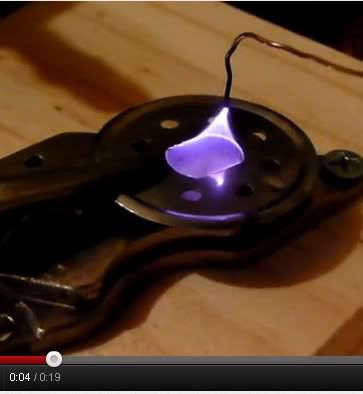
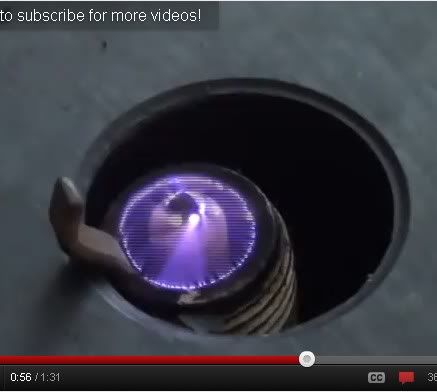
On the other hand, I and others have done the FUN experiment of
taking a high-voltage lead from a FLY-BACK transformer,
and bringing it near a Neodymium magnet. When this is done,
it forms an ARC that SPINs in a cone shape. The voltage has to be
pretty high for an ARC to form in just air. The dialectric break down
is a pretty high voltage. When NOT arching, there still may be
an invisible vortex there spinning and unseen to the eye.
So mine will be 3 Baskets with Capacitors inside and a Large Ring Magnet underneath
Now the magnet should be what way up??
No I'm not confused between the 2
Its just no one has had any success yet
So we have to start looking outside the box
I'm the one to do that because I don't know much about about electrical stuff
So I won't be blinded by it!
I do have a problem though
It seem getting Iron is near on impossible Can I use something other than Iron?
and even Magnet wire is proving very hard
although Ebay seems my likely source
Its just no one has had any success yet
So we have to start looking outside the box
I'm the one to do that because I don't know much about about electrical stuff
So I won't be blinded by it!
I do have a problem though
It seem getting Iron is near on impossible Can I use something other than Iron?
and even Magnet wire is proving very hard
although Ebay seems my likely source
It is usually the " Virgin" Mind that finds the most ease in out of the box ideas .... unhindered by the shakles of "Squared" Laws ..... and capable of circling the angles
It seem getting Iron is near on impossible Can I use something other than Iron?and even Magnet wire is proving very hard although Ebay seems my likely source
Yeah... The Iron age appears to be over. I noticed that too.
Railroad spikes. Earth Ground pipes @ hardware store.
Really various metals that are magnetic can work, you just have
to account for there permeability in your design. So if the permability
constant is LESS than IRON, it may mean you need more turns
in your coils to compensate. If there is a diamagnetic material in the
metal, things get more complicated.
There are metals that have an even higher permeability than Iron.
So those would be ideal but even more esoteric.
Air has a permeability of "1"... It is the baseline.
When you think about the Earth's field being so tiny .. say 50 uT,
then "AIR" might be OK, because what we really want
to be spinning is an invisible field in the air. My reasoning
here is that this is ideal because:
a) everyone can do it... we all live in air... nothing special needed,
b) no friction, no heat -- at low power
c) we are dealing with subtle energies at first ... and then
building up enough power to move magnets eventually...
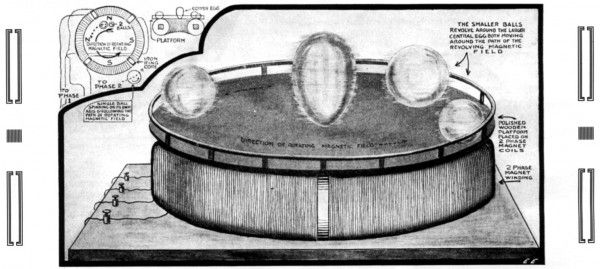
So, the little spinning magnet on a thread experiment,
which btw works even w/o a coil ... to a lesser degree ..
reveals that a spin can be established using the Earth's field,
w/o any INPUT from any power source, as long as you
maintain the correct orientation relative to the VECTOR
of the Earth's field.
It stands to reason, therefore, that you can create a spinning field
with wires and geometry, induce a small bit of power, and then
with that small amount of power, attempt to move a magnet...
And.... BTW... the permeability of a magnet may be "near" Iron.
I was trying to figure that out and found some people saying that is so.
I am not certain about this. More research needed.
[QUOTE=morpher44;223818]Yeah... The Iron age appears to be over. I noticed that too.
Railroad spikes. Earth Ground pipes @ hardware store.
Really various metals that are magnetic can work, you just have
to account for there permeability in your design. So if the permability
constant is LESS than IRON, it may mean you need more turns
in your coils to compensate. If there is a diamagnetic material in the
metal, things get more complicated.
There are metals that have an even higher permeability than Iron.
So those would be ideal but even more esoteric.
Ok I bought this what I thought was a Wrought Iron spike it looks like Iron but doesn't break like iron
One photo here is Iron the one that looks stringy
I am told thats the best way to tell if you have iron or If you cut half way through and break it It should look stringy
Hi Morpher
Does the Basket coil make its own magnetic field or energy field ?
...
Would having heat near a coil help to get the field flowing?
...
Ps What if the shaft for the motor was energised had power to it or the shaft was a magnet??
All coils of any style will self-oscillate with a tiny oscillation.
There is input from the ambient environment. There are radio
spectrum signals, lightning strikes around the planet, solar
phenomenon, all making little "radiant" events that impact the coil.
Basket weave coils are an attempt to reduce capacitance so that
the coil has a linear response curve from low frequencies up
to much higher frequencies. It makes the coil more "ideal",
in other words. At the resonant peak, the curve will DROP
down due to the capacitance -- so we want to minimize this
if we are after the high frequencies. There is more energy
in the higher frequencies.
Heat and magnetism don't mix. If you put a magnet in a flame,
for example, the magnet will loose its magnetism temporarily.
Tesla used this to create a crude generator. A pendulum would
swing a magnet towards a magnetic material near a flame.
It would stick. The flame would erase the magnetism,
the pendulum would swing the other way, only to repeat.
Its slow .. but works.
See Chapter XXXVI, "Thermo-Magnetic Motors And Pyro-Magnetic
Genrators", page 424 of the book
"The Inventions, Researches and Writings of Nikola Tesla",
1992 Barnes & Noble Books, ISBN 0-88029-812-X.
Not sure about the shaft idea. Certainly everything could be tried
and looked at .. if you imagine it helps. You never know what you might
find.

 Tweet
Tweet








Comment