
rolled Capacitor formula
Actually, there is another formula for capacitance that might
apply even better.
See this URL: Welcome to the Laushaus
-
Some thoughts on hand-made capacitor
I looked up Kraft paper, and there are several
thicknesses and weights:
thick (inches) weight (lbs)
------------------------------------
.003 30
.004 40
.005 50
.006 60
.007 70
.009 90
The formula for a capacitor is C=eA / d
were C is capacitance in Farads, e is permitivity, A is
area in square meters, d is distance between plates.
You can re-arange this formula to compute for d.
d = eA / C
e is 8.854187817E-12 F/m * 3.85 (constant for paper).
Plug in the 7.8nF desired capacitance, and
2.75 in by 91.125 in for the size of the capacitor (roughly),
you end up with a d equal to
distance = 0.027818 in (0.706566 mm)
To achieve that distance between plates with say 30lb
Kraft paper, you would need about 9 sheets
-- RATHER THAN ONLY 1 SHEET --
This may explain why some have not been able to get the 7.8nf value
with 1 sheet of kraft paper.
The plates were too close together for this smaller capacitance goal.
The instructions in various stuff written about Hendershot's
Fuelless Generator don't mention putting MORE sheets between
the plates to create that thickness ... but the math works
out that way.
Wax paper, on the other hand, has a thickness of about 1mm --
.03937 in. and dielectric constant of about 2.7.
Plug in those numbers an you need this thickness:
distance = 0.019508 in (0.495514 mm)
which works out to be "thinner", actually than the wax paper itself.
You can succeed with one sheet of wax paper if you perhaps
lengthen the foil to 93 inch or so with this thickness and
this dieletric constant. Hence, it appears that
- Wax Paper -- 1 sheet
- 30lb Kraft paper -- 9 sheets between plates.
The paper has a better dielectric constant, so you need to adjust
the plates so that they are more distant from each other to
compensate -- according to the math.Leave a comment:
-
I remember reading reading somewhere that
It was said that Lesters Windings of his Magnets was the key to his device
So what happens if you wind a coil around a magnet
Do you get a super Magnet
I will try and find where it was saidLeave a comment:
-
Create Free Energy with Magnetic Power Generator at Home
Create Free Energy with Magnetic Power Generator at Home - Video DailymotionLeave a comment:
-
Here's the coils inside a ring magnet, inside the spinning field of the ring magnet

Leave a comment:
-
The funny thing is in some of those photo's it showed the motor in good detail
It seems to me there were 2 types of motors one with basket coils and then one similar to an alternator I can see how the Alternator type could put out many HP and still be light
The the Basket Coil type as I see it would not and would be good for toys as it was built
Then there was The Hendershot Generator as the video build typeLeave a comment:
-
Gazzasore you should have left the pics up, thread repeating sometimes helps refresh our memory, or we learn something new and see with a different perspective
Leave a comment:
-
We know by studying the magnetron (proven tech) that a torus shaped magnet has a spinning field inside, Hendershot was tapping this field to turn his rotor.

Radar Basics - MagnetronLeave a comment:
-
Something that intrigues me is Hendershot wound a coil that picks up the earths magnetic field and converts it into current, the coils had to have current running through them to turn a magnet in his fueless motor.
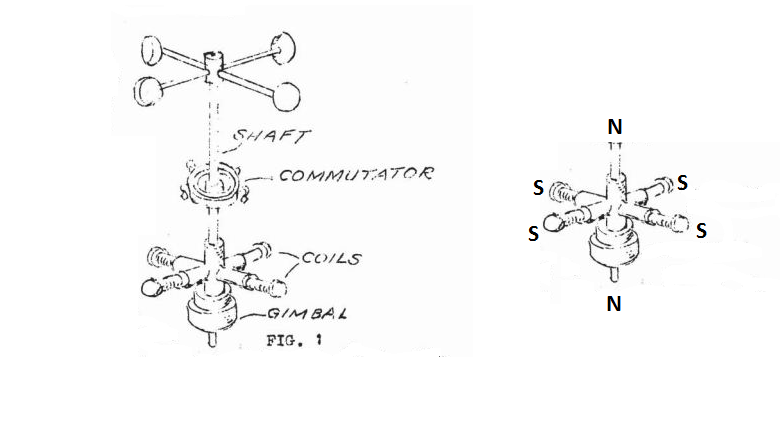
This is just one configuration there are many, but the configuration is interesting, reminds me of the Adam's magnet motor.Leave a comment:
-
David Porter
David Porter's statements in this video are
reminiscent of the Hendershot Motor.
Some things similar are:
* 1850 RPM is similar to Hendershot Newspaper story where
1800 RPM was quoted as the value when they tested his larger
motor at the Army base
* David Porter says at the end of this clip the power is taken
from the magnet ... and they have to replace the magnet after
a period of time.
* Hendershot may also be pulsing the magnet with a duty cycle.
David Porter is doing that with modern electronics, sensors
to observe shaft location, TTL logic to PULSE the coils and the right
time and computer interface to make duty-cycle configurable @
runtime. Hendershot would have had to do this with coils and
capacitors.
David Porter - YouTubeLeave a comment:
-
Gazzasore -- thread repeating...
Hey Gazzasore
Btw, this thread already has posted many of these pictures.
Things are starting to repeat. You might scroll back and see
if its been done before by previous contributors.
Many posts are off topic too... which I suppose is just bound to
happen.
-morpher44Leave a comment:
-
Morpher the Hendershot Motor Mystery PDF
How many versions do you have I have 2 one is 140 page the other is 57 page
I also have The Hendershot Motor - by the Utility Engines
THE FOLLOWING IS THE LESTER J. HENDERSHOT STOREY AS TOLD BY MARK M. HENDERSHOT
& secrets of perpetual power hendershot mystery by barry hilton
and many other PDF files if you want any let me know and Ill send them to you
Gaz
Leave a comment:


Leave a comment: