Announcement

Collapse
No announcement yet.

Allotropic Nitrogen - Active Nitrogen

Collapse
X
 
  • Filter
  • Time
  • Show
Clear All
new posts

  • Allotropic Nitrogen - Active Nitrogen

    Active Nitrogen is "made" when high voltage is exposed to almost pure nitrogen with an almost non-existent amount of oxygen or other gases. The nitrogen with glow with a GOLDEN color. This was discovered by Lord Rayleigh.

    Please see this for more info:
    Lateral Science - Strutt`s Allotropic Nitrogen

    LORD RAYLEIGH`S
    ACTIVE NITROGEN

    "What of nitrogen? Is not it`s apparent great simplicity of action all a sham?" Michael Faraday

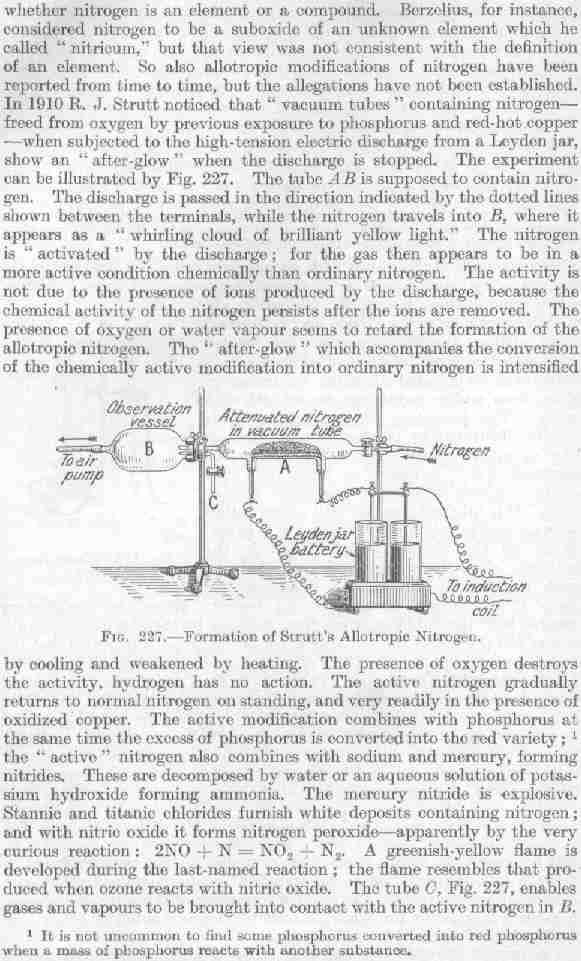
    In 1910 R.J.Strutt (Lord Rayleigh) discovered that an electrical discharge in nitrogen gas produced "active nitrogen", an allotrope considered to be monatomic. The "whirling cloud of brilliant yellow light" produced by his apparatus reacted with quicksilver to produce explosive mercury nitride.
    From Modern Inorganic Chemistry, J.W.Mellor 1934 --


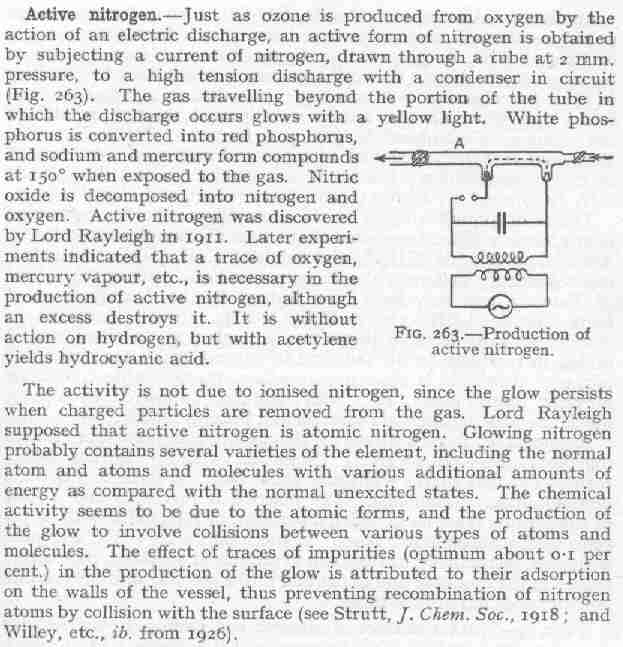
    From A Text-Book of Inorganic Chemistry, J.R.Partington 1946 --
    Sincerely,
    Aaron Murakami

    Books, Videos, ESTC Conference Info, Blog, etc. https://emediapress.com

  • #2
    golden swirling light

    The reason I am posting this thread on allotropic nitrogen \ active nitrogen, I can't mention at this point.

    There is a device that has golden swirling light inside as the shaft with rotors is spinning up to very high speeds...the light gets more intense the faster it goes. It isn't just for show, but it seems that there is some extracted energy from this into the electrical circuits to keep it going.

    The plastic cylinder that the shaft/rotors are sealed inside appears to be filled with nitrogen as 'possibly evidenced' by the swirling golden light inside.

    The most sense I have been able to make out of it is that it is nitrogen and is possibly operating as Marinov's SAP - self accelerating plasma tube.
    Please see this post for it:


    Make sure to look at this diagram on that page:
    Ionising gas in donut tube-"x"


    and appears to be a hybrid with an electromechanical battery:
    A review of advancements and insights in science and technology, focusing on secure and official government resources.

    using a passive magnetic bearing system like the Halbach Array
    and can get to well over 100,000 rpm while self running.

    Any comments?
    Sincerely,
    Aaron Murakami

    Books, Videos, ESTC Conference Info, Blog, etc. https://emediapress.com

    Comment


    • #3
      Hi Aaron,

      I think you are right about the swirling golden light being the same type of reaction as in the 1920 J Strutt experiments, and Marinov's SAP tube, and that the gas used in the "donut tube" configuration is probably Nitrogen. Are you thinking of utilizing the effect for an experiment? One thing to take note of is that the strength of the swirling yellow light is increased by cooling the nitrogen, not by heating it, and that the yellow light is activated and sustained after the capacior/inductor discharge.

      Interesting link to the EMB's Aaron. These are really high-revving units! The high revs are made possible by frictionless magnetic bearings, which levitate the rotor shaft, and the high revs are what make the kinetic storage in a lightweight flywheel successful. Great output to input efficiency of 95%. Only problem I see with these is that the cost to build or buy them would be very high, and you would need about 20 of these EMB's (each the size of a large size coffee can) to power an electric motor vehicle for a range of 200 miles, and then you need a way to recharge the EMB's when taveling - a "charging station" infrastructure. That's the downside. Once again, the companies that build and control these recharging stations would control the cost of recharging, and we would be at their mercy. Bummer!

      By the way, the "donut tube" configuration brings to mind something I heard Jim Sabori mention in his Papp engine video. He was showing the inside of the long chamber from the top, and then flipped it over (end to end) to show what he called the "donut" chamber. I believe that was in the segment near the end of the video, where they disassembled the parts down to the engine block.

      Best regards, Rick
      "Seek wisdom by keeping an open mind to alternative realities, questioning authority, and searching for truth. Only then, when you see or hear something that has 'the ring of truth' to it, will it be as if a veil has been lifted, and suddenly you will begin to hear and see far more clearly than ever before." - Rickoff

      Comment


      • #4
        nitrogen effects

        Hi Rick,

        I have a massive compilation about electromechanical batteries and most of it is not available publicly online. If I can find it in the near future, I'll upload it.

        For the golden light effect, I'm not ready to do an experiment with any of it yet. I'm really working on getting it through my head the purpose in that particular setup.

        I was reminded last night of a reference in the book Secrets of Cold War Technology by Gerry Vassilatos....VERY RECOMMENDED...CHAPTER 1 ON TESLA! Reference in there is about Tesla mentioning that the ULTIMATE spark gap quencher is sealed with magnets and filled with nitrogen. The nitrogen sucks the electrons away so there is pure aetheric flow.

        If it soaks up electrons, that adds another variable.

        But, when the nitrogen is in its active glowing state is it possible it is donating electrons in its highly energetic state? Maybe there is free current obtained from that gas in that state?

        It makes sense that it would be cooler as any of these systems that would be over 1.0 cop should have some negentropic effects like cooling. Maybe the gas itself is acting as a capacitor to store charge and release it over time?
        Sincerely,
        Aaron Murakami

        Books, Videos, ESTC Conference Info, Blog, etc. https://emediapress.com

        Comment


        • #5
          Allotropic Nitrogen | Active Nitrogen

          Any other interest in allotropic nitrogen?
          Sincerely,
          Aaron Murakami

          Books, Videos, ESTC Conference Info, Blog, etc. https://emediapress.com

          Comment


          • #6
            I've had some interest in the past about the SAP. I thought about it in terms of mercury vapour, but it appears it may actually require activated nitrogen. Since the plasma accelerates when a load is applied, I don't see why that won't produce excess energy.

            A discharge in nitrogen usually produces UV and is the basis for the TEA Laser. Those are simple to build (for Meyers applications) and the after effect, if done correctly, would be the golden vapor. An added benefit.

            But I don't like the reactions which produce hydrogen cyanide, a lethal gas.

            Any other info you have would be well recieved.

            Comment


            • #7
              I too remember reading about Nitrogen quenched spark gap in the Secrets of Cold War Technology book and thought it would be interesting to build one (ok some shop that has necessary tools to build it for me).

              I do not believe HCN (Hydrogen Cyanide) is created through arc discharge in the Nitrogen spark gap environment, else we'd be making HCN in the air spark gaps as well (air contains 78% Nitrogen).

              As the clipping says, when acetylene or cholorform flame is fed by active nitrogen, then HCN is a product.

              But this brings me to something else. If air contains so much Nitrogen, why are we not seeing more of the golden colour discharge in air spark gaps? Does Oxygen (or Ozone) play some role in supressing the effect of Nitrogen? If Activated Nitrogen removes electrons, then perhaps Oxygen adds them in and so the air spark gaps are not as effective as vacuum or ones with the Noble Gases?

              Also, the mention of Activated Nitrogen being monoatomic makes me think about ORME (Orbitally Rearranged Monoatomic Element). True, David Hudson talked about Gold ORME and the requirement for its precipitation was 5,000 C for several minutes in a carbon arc discharge, but then again this is Nitrogen and we also have a HV arc discharge so perhaps it is not so different. Perhaps just the temperature to achieve Nitrogen ORME is lower?

              Just tossing it out there...
              Last edited by amigo; 02-27-2009, 08:59 PM.
              Are the ravings of a lunatic signs of a genius?

              Comment


              • #8
                Easy Nitrogen Source

                Scientific American once ran an article showing how to build a Nitrogen UV laser, based on the switch disclosed in Pat. #4178563. This laser is super radiant, meaning that the laser beam is built up during a single pass through the discharge area. Pat. #3879681 provides an improved geometry.

                The Nitrogen can be obtained by aspirating the combustion products of a small flame, drawing this gas through a CO2 scrubber, such as, I believe, chalk, as well as a drying chamber filled with silica granules.

                This system removes the Oxygen, so it should work for experiments with Activated Nitrogen, without the cost of an orange tank from the welding supply. This might be really good for quenching a spark gap.

                Comment


                • #9
                  I'd love to get a spark gab (tube) filled with Nitrogen, but the gap should be adjustable and I'm puzzled how would that be done when the tube contents is filled with Nitrogen.

                  I have been considering some ideas using externally placed magnets to move one arm of the gap, but then I think there's an issue of a contact between that arm and the output pin it connects to as it could possibly create arcing around that area.
                  Are the ravings of a lunatic signs of a genius?

                  Comment


                  • #10
                    @Aaron: Interesting thread indeed. I have not done my set-up exactly the same, though many similarities. My gas is also mix of Nitrogen, mercury vapor - and mixed in is ferrite dust.

                    Did you had a look at this design/concept?
                    Emc2 Fusion Development Corporation
                    I think the big-budget scientist can just not get their minds down to work with low budget - thus they can not think about simple options either. In this case they have a wonderful concept, but still go to the big autoclave rather than considering magnetic options.

                    Guess it is as I always say: It has already been done. Only there are so much to read and so little time!

                    @amigo: Easy to solve this problem. Buy some stainless bolts with Teflon locking nuts. Drill hole in front (thread) end of bolt, insert a tungsten rod (tig welder use same). Mount the bolts at both ends on glass tube to use for vacuum as well as observations; I used HT two part silicon (I think you will call it 'Gasket Maker' in USA). Can adjust easily and have strong clean spark.
                    Therefore we need to find NEW ways, NEW experiments and NEW lines of thoughts.

                    Comment


                    • #11
                      Originally posted by Aromaz View Post
                      @amigo: Easy to solve this problem. Buy some stainless bolts with Teflon locking nuts. Drill hole in front (thread) end of bolt, insert a tungsten rod (tig welder use same). Mount the bolts at both ends on glass tube to use for vacuum as well as observations; I used HT two part silicon (I think you will call it 'Gasket Maker' in USA). Can adjust easily and have strong clean spark.
                      Hmmm, but wouldn't the gas escape through the bolt when you are screwing/unscrewing to adjust the distance, or through the seal between the bolt and the glass. I thought that there are totally different requirements for high pressure or high vacuum seals and chambers?

                      Would you happen to have a photo of it, or maybe a drawing?

                      Thanks.
                      Last edited by amigo; 02-28-2009, 11:08 PM.
                      Are the ravings of a lunatic signs of a genius?

                      Comment


                      • #12
                        Originally posted by amigo View Post
                        Hmmm, but wouldn't the gas escape through the bolt when you are screwing/unscrewing to adjust the distance, or through the seal between the bolt and the glass. I thought that there are totally different requirements for high pressure or high vacuum seals and chambers?

                        Would you happen to have a photo of it, or maybe a drawing?

                        Thanks.
                        The Teflon is sealing the screw thread of the bolt. Does not turn too easy, but is OK. Because the nut is steel, and your tube is glass; the only way to bond them is with with epoxy. Because of heat building up from spark, you will have to use high temperature silicon.

                        Everything is completley sealed.

                        Unless off course you want to purchase a commercial product - which you will be able to get in a lab supply shop.
                        Last edited by Aromaz; 03-01-2009, 12:33 AM.
                        Therefore we need to find NEW ways, NEW experiments and NEW lines of thoughts.

                        Comment


                        • #13
                          Curious Nitrogen Properties

                          Nitrogen gets more interesting - see these threads:


                          Sincerely,
                          Aaron Murakami

                          Books, Videos, ESTC Conference Info, Blog, etc. https://emediapress.com

                          Comment


                          • #14
                            Thermolecular Reactions

                            Internet Archive: Free Download: The Kinetics Of Chemical Change In Gaseous Systems

                            If you get the pdf, you can search for: active nitrogen


                            Some simple explanation as to their opinion of the source of the
                            Active Nitrogen Afterglow.

                            -----------------------------------------------------------

                            The "Thermolecular Reactions" chapter may be the earliest reference I've
                            seen of "over unity" in that exact term.
                            Sincerely,
                            Aaron Murakami

                            Books, Videos, ESTC Conference Info, Blog, etc. https://emediapress.com

                            Comment


                            • #15
                              How to Make Nitrogen Hydroxide

                              Here is a 3 page compilation of this thread. I condensed it into a couple
                              categories. It is short and sweet. It is INCOMPLETE. There are a few
                              things that need to be added that may or may not be apparent to get
                              a full working motor. But it will give the Nitrogen Hydroxide story and more.
                              How to Make Nitrogen Hydroxide
                              Sincerely,
                              Aaron Murakami

                              Books, Videos, ESTC Conference Info, Blog, etc. https://emediapress.com

                              Comment

                              Working...
                              X