Announcement
Collapse
No announcement yet.
A Solid State electrical generation
Collapse
X
-
Hi Ufo,Originally posted by Ufopolitics View PostHello guys,
Please, remember this is just the "controller" side.
Now from the bulbs terminal he should connect primaries plus secondaries to output.
Regards
Ufopolitics
And when he does that what will happen? I tried a couple of different ways to generate the proper signal. And those worked to get a varying DC signal of opposite phase. BUT, although I tried multiple different methods of driving the primary coils and various ways of coupling them to the secondary I was never able to get more than about 20% power transfer to the secondary.
I know you were working on this also. Were you ever able to get the primary and secondary to work like some have claimed?
Or has anyone been able to get the power transfer that is claimed?
Take care,
Carroll
Leave a comment:
-
Hello guys,
Please, remember this is just the "controller" side.
Now from the bulbs terminal he should connect primaries plus secondaries to output.
Regards
Ufopolitics
Leave a comment:
-
Dc/ac
Hi Arne,Originally posted by seaad View PostNice workmanship. Yes.
But this is actually uninteresting
According to my simulations and tests so far the performance will not exceed 70% direct to resistors (bulbs) as in the video or via a, n=100%, transformer (Figuera N, S electromagnets) to a resistor load.
The only thing I wonder about is the relatively long delay of bright light (energy) from the bulbs (OU extra??) in Hanons orginal video after he halted the movement of the "commutator" knob. But that can also be some delay in the camera light sensor and its rendition.
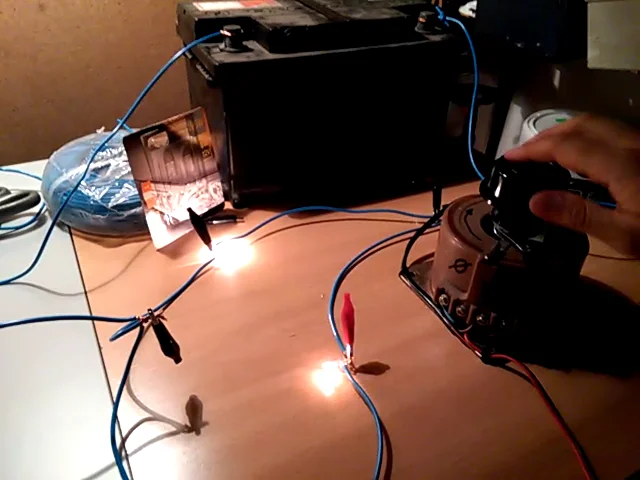
One Variac powered with DC. I used a variac (or autotransformer) to power two lightbulbs designed for 12 volts and 5 W from a 12 volts battery. This method works to regulate the intensity of each lightbulb in opposite way. But I have noted that this method presents a complex dynamic response: it seems that two effects are acting simultaneously. One effect acts very quicly to change the intensity. A second effect seem to react a bit slower that the first effect and it rebalances the final intensity to each lightbulb. You may only note this second effect when moving slowly the roll in the variac, when you stop there is a second action changing the light intensity after some tenths of second. If you move quickly the roll back and forth there is not enough time to see this second effect. In summary the dynamic response seems to be quite complex, maybe because of different magnetic fields fighting into the toroidal core. Only using about 1/4 or 1/2 of the total variac length I got a total regulation of the light intensity between the maximun light intensity and almost zero light intensity.
Regards Arne
I don't think your measured 70% is due to an RMS conversion. Losses will be primarily due to resistance, Rdson and switching. But yes, just an automated version of Hanon's twist-the-knob video.
Regards,
bi
Leave a comment:
-
Nice workmanship. Yes.
But this is actually uninteresting
According to my simulations and tests so far the performance will not exceed 70% direct to resistors (bulbs) as in the video or via a, n=100%, transformer (Figuera N, S electromagnets) to a resistor load.
The only thing I wonder about is the relatively long delay of bright light (energy) from the bulbs (OU extra??) in Hanons orginal video after he halted the movement of the "commutator" knob. But that can also be some delay in the camera light sensor and its rendition.
One Variac powered with DC. I used a variac (or autotransformer) to power two lightbulbs designed for 12 volts and 5 W from a 12 volts battery. This method works to regulate the intensity of each lightbulb in opposite way. But I have noted that this method presents a complex dynamic response: it seems that two effects are acting simultaneously. One effect acts very quicly to change the intensity. A second effect seem to react a bit slower that the first effect and it rebalances the final intensity to each lightbulb. You may only note this second effect when moving slowly the roll in the variac, when you stop there is a second action changing the light intensity after some tenths of second. If you move quickly the roll back and forth there is not enough time to see this second effect. In summary the dynamic response seems to be quite complex, maybe because of different magnetic fields fighting into the toroidal core. Only using about 1/4 or 1/2 of the total variac length I got a total regulation of the light intensity between the maximun light intensity and almost zero light intensity.
Regards Arne
Leave a comment:
-
Generation?
Nice workmanship.
How is it not simply a transformer?
Regards,
bi
Leave a comment:
-
Hello swompwalker!!Originally posted by swompwalker View PostI am posting this as an interesting article on a theme of intereting articles!?
A Solid State implementation by creasysee! - Perhaps Inspired by Marathonman.
I would say that most of the info is here. Clemente Figuera
Man, that sure does looks wonderful!!
Excellent work!!
Regards
Ufopolitics
Leave a comment:
-
A Solid State electrical generation
I am posting this as an interesting article on a theme of intereting articles!?
A Solid State implementation by creasysee! - Perhaps Inspired by Marathonman.
I would say that most of the info is here. Clemente Figuera
Leave a comment: