Announcement

Collapse
No announcement yet.

Split Positive Boost Charger

Collapse
X
 
  • Filter
  • Time
  • Show
Clear All
new posts

  • Originally posted by SkyWatcher View Post
    Though using recovery winding with single diode, sending pulse back
    to input series batteries, when we are not taking current from them,
    would be like bedinis original basic free energy generator device.
    Testing of this particular experiment continues, the voltage actually
    settled out to 12.6 volts per battery, when allowed to rest over night.
    peace love light
    Yes part of Bedini's ORIGINAL design (HE has so many) and most everything
    John built was made to collect energy back to the run batteries. This was
    evidenced way back in the early days when Tom Bearden was showing
    one of John's table top units powered by the ever-ready 9volts.

    But what I have always wondered was do these pulse machines only work
    at 600-800 rpm's? or will they work at 3000 rpm's? This week Peter cleared
    that up for me also. The reason I talk about that is that my oscillator
    circuits will run at 3000 hz nicely and even tho I am missing out on the
    mechanical side of it.

    I don't have any coils wound up with 8 power strands and one trigger
    (I assume a trigger wire of smaller awg) but I do have this winding machine.
    I need to work on rolling up individual spools to the correct length to put
    on my litzing machine. 130 feet of 20 awg is the recommended litzed
    configuration.

    Also I find it very interesting that Peter's machine had a 3 magnet stack
    in each pole that was an experiment all to itself. This is a feature brought
    out in the 2010 conference by John Bedini. I don't know how successful
    this small machine was using the gated magnets but according to John
    this special arrangement of magnets (ceramic-rubber- neo?) Can't
    remember the order.

    Listen again and you will hear Peter say that the wheel had reached a
    higher RPM and the magnets had stopped shuffling around. So it does
    confirm an idea I had about gated magnetic poles operating at low RPM'S.

    Had to throw that in
    Last edited by BroMikey; 08-14-2016, 09:37 PM.

    Comment


    • Hi all, thanks for sharing the information Peter.
      And also to you mike, thanks for sharing your ideas.
      How are you coming along mike, any experiments in the works or builds going.

      The experiment is now at the 54 hour mark.
      After an hour rest, all 3 battery voltages added and divided by 3, each battery is resting at 12.59 volts, though that may drop slightly if allowed to rest longer.
      One more 6 hour run and we are at the 60 hour mark.
      peace love light

      Comment


      • Hi all, i decided to place all 3 batteries in parallel, before continuing the experiment.
        As they balance out among each other, each one is showing 12.62 volts.
        I will leave them connected in parallel all night and check this tomorrow, then continue the experiment.
        peace love light

        Edit: Ok, each battery settled at 12.6 volts with overnight rest, while connected in parallel.
        Continuing experiment.
        Last edited by SkyWatcher; 08-15-2016, 04:00 PM.

        Comment


        • Hi all, the experiment is at the 61 hour mark, or 488 watt/hours.
          I again placed all 3 batteries in parallel and all are showing 12.60 volts.
          I will let them sit over night and see what they settle to tomorrow sometime.
          So far, it seems like we have recycled almost all the energy, minus losses.
          I have an idea, to use 12 volt leds, in series with the primary of oscillator coil.
          This would give us more practical power used in that section of the circuit, instead of just going through a coil alone.
          Though that is for later experiments.
          For now, i will continue this experiment, until the batteries get close to 12 volts under load and go from there.
          Does that sound right, or should i discharge them further under load.
          peace love light
          Last edited by SkyWatcher; 08-16-2016, 03:48 AM.

          Comment


          • Hi all, ok, with all 3 batteries connected in parallel overnight, for 14 hours, each battery is resting at 12.57 volts.
            I will continue the experiment.
            Your comments on these results so far, are welcome.
            peace love light

            Comment


            • Originally posted by SkyWatcher View Post
              Hi all, ok, with all 3 batteries connected in parallel overnight, for 14 hours, each battery is resting at 12.57 volts.
              I will continue the experiment.
              Your comments on these results so far, are welcome.
              peace love light

              Yes please continue this experiment. Remember that when the charge
              battery is at 12.50v the circuit gets the other 12.50v making this
              a 50-50 calculation but as the charge battery approaches 15v and on
              past the circuit is left with 10v. Somewhere between 3.2watts up to
              3.8watts is what the circuit might be taking on average as the charge
              battery cycles.

              The average is 3.5watts maybe depending on the time needed to
              charge battery 3 at all voltages. To me it looks like your battery will
              never go down with this circuit so let's see if you can get another
              60hrs and then we will know something for sure.

              You have an excellent opportunity to show experimenters that they
              can run a light for nearly free. Everyone likes that idea.

              Comment


              • Hi mike, thanks for sharing.
                I think this experiment is more of a proof of principle.
                The series batteries are using an average of around 8 watts.
                So the experiment has already proven, that we can recycle the energy and get more.
                The next thing to work on, at least for me, is to get more usable power out of it, which is what dave and matt are already doing.
                Though of course, i will continue the experiment and see if it will give more usable power out.
                peace love light

                Comment


                • Originally posted by SkyWatcher View Post
                  I think this experiment is more of a proof of principle.
                  The series batteries are using an average of around 8 watts.
                  Yes the series batteries are sending 8 watts and the charge battery
                  is receiving 4.5watts on average but not collecting 4.5watts some
                  is wasted.

                  The circuit waste is 15 percent.

                  The light bulbs are getting 3.5watt average minus 15%. Like any
                  joule ringer it is not uncommon to light bulbs to near full brightness
                  at 1/3rd the energy normally required. So this portion of the experiment
                  does not count, all that is important is that the circuit eats X amount
                  of power. Unless the pulsing gets fed back as you are doing.

                  13ah + 13ah +13ah = 39ah = 12.3v X 39amps = 480watt/hrs

                  480watt/hrs/3.5watts = 137hrs of run time conventionally

                  This means that if your circuit stops producing after 137 hrs
                  that you have not gotten any extra or O.U..

                  Are you near the 137 hr mark yet?

                  The goal is to get more than 137 hrs of runtime.


                  Originally posted by SkyWatcher View Post
                  Hi mike
                  So the experiment has already proven, that we can recycle the
                  energy and get more.
                  I wish I could agree but until we reach the 137hr mark we can't claim
                  anything extra and that is the goal. If this seems wrong to you please
                  explain.


                  Originally posted by SkyWatcher View Post
                  The next thing to work on, is what dave and matt are already doing.


                  To be clear just any motor being pulsed is not the same thing as
                  THE MOTOR DOING THE PULSING. Just to be clear. A motor that is
                  receiving pulses is more efficient than a motor that is running off
                  straight DC.

                  The Matt Mod Motor appears on the surface to some to be a 2 pole
                  motor running off straight DC, but that is not what it is. What Peter
                  is using is an ENERGIZER and what MATT has created is an an ENERGIZER
                  also that operates mechanically without the use of a transistor as
                  John Bedini does.

                  The booster saves power because it uses pulse DC plus a means
                  of tuning and is sent to the Motor that is an ENERGIZER that pulses
                  itself mechanically AGAIN to the batteries while running for nearly free.

                  It is an ENERGIZER with off the shelf parts such as in this case a
                  scooter motor that has been modified. It was originally conceived
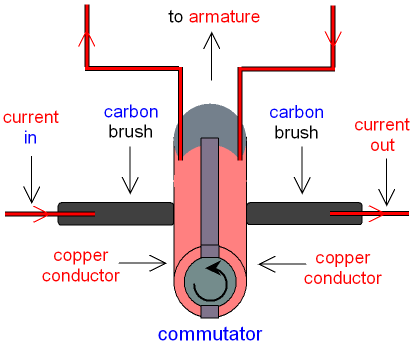
                  when experiments from patents used commutators for switching
                  power from one battery set to another and is also known as TESLA
                  SWITCHING.

                  As you know Sky, The Tesla Switch commutator can start out with
                  nothing more than a cylindrical shaped piece of wood like a rolling pin
                  that has copper or brass plates on it.

                  It has been said that creating this same effect electrically can be
                  done but it is not as easy as it may seem. It is my thought that both
                  AC and DC energy goes to both run and charge battery while the
                  mechanical is free. Not only is there free mechanical but also the
                  run and charge batteries can gain in energy while this TESLA SWITCH/ENERGIZER runs. Many experiments have been done with
                  commutators that had to be driven by an outside source of power
                  to perform their function. SO why not have the commutator power
                  itself for free? That is what the Mod Motor does.


                  Last edited by BroMikey; 08-17-2016, 10:03 AM.

                  Comment


                  • Hi mike, thanks for sharing those valuable thoughts and perspectives, i will definitely ponder over that.
                    I said this, So the experiment has already proven, that we can recycle the
                    energy and get more.
                    Because, if the series batteries are using around 8 watts and my system has now already run for 74 hours or 592 watt/hours, technically, we have exceeded what is supposed to be in the batteries.
                    Though it has not given this setup extra obvious usable work, instead, it has given it unobvious extra work, by the charging and recycling of energy in the batteries.
                    And as i said, apparently, matt and dave have made a system work, that obtains more obvious usable power or work.
                    The experiment continues.
                    peace love light

                    Comment


                    • Originally posted by SkyWatcher View Post
                      the series batteries are using around
                      8 watts and my system has now already run for 74 hours or
                      592 watt/hours, technically, we have exceeded what is supposed to be
                      in the batteries.

                      The experiment continues.
                      peace love light
                      Yes please, keep at it. This is where the men are separated from the boys
                      with all that long drawn out pain in the back data collection. Trust me it
                      will pay off in one form or another. You will become submersed to the
                      point that sometimes you will have to rely on faith to get you thru.

                      Yes your batteries are past the 480watt/hrs I see what you mean there
                      and after 74hrs of running your light at 3.5watt average we can gain
                      a perspective.

                      3.5w X 74hrs = 259watt/hrs of practical usable light from a set of batteries
                      capable of 219 watt/hrs more than this figure, if the batteries are discharged
                      conventionally.

                      The goal is to get the 219watt/hrs more and then anything after is extra.

                      I understand that battery charging presents losses, that is another case
                      in point, but from the outside looking in all investigators will ask you right
                      off the top "Did you get more"?

                      The project shows we can charge a battery with batteries? Of course it
                      proves that, which is nothing new. So you are circulating battery juice
                      around and back again from battery to battery hey? Plus
                      the light has taken 259watt/hrs from the battery set?

                      We will see if your battery voltage stays up. The voltage does give us an
                      idea what is going on. A 259watt/hr count taken by the bulbs is over half
                      of the entire battery pack ah capacity.

                      Since you are observing voltage at every run we should be at 12.3volts
                      or less due to battery plate charging resistance. So at this point we or "YOU"
                      are at over the half way mark. You should not be reading 12.6volts.

                      I noticed you did not include a starting voltage this time. Are the batteries
                      dropping down? Right when I need that reading more than ever to determine
                      if your batteries are staying up.

                      This is where your critics will take you apart by demanding not only all of
                      the voltage readings but the irregular voltage over time going to the lights.

                      Many have uses data tracking software to be sure just how much extra
                      is actually being realized especially if your watt/hr count turns out to be
                      very close to conventional.

                      We are only guessing at the actual watt/hr draw that the circuit is pulling.
                      The actual would be important when the run time is close to conventional.
                      For instance if the differential feeding the circuit is 10volts 90 percent of the
                      time then a 14v or 15v figure 90 percent of the time. An average must be
                      made depending on where the majority of the time is spend at one voltage.

                      But that is only important when your watt/hr count becomes so close to
                      what a conventional run would offer that you become unsure. In this way
                      if the desired result needs to be refined thru tuning you will be able to tell
                      if the system has improved by a careful watch on the numbers.

                      Please let us all know how your battery voltage is looking. 2 days ago
                      you offered the voltage and everyday before that, as part of your data
                      collection, but now no voltages are available?

                      Last edited by BroMikey; 08-18-2016, 07:23 AM.

                      Comment


                      • Hi mike, thanks for sharing your thoughts.
                        I have seen what i needed to see with that setup and i see no critics.
                        It showed me, we can recycle the energy beyond the rated capacity, as said, next step is to turn that into more observable and usable work or power.
                        I stopped that particular experiment, though i changed the circuit somewhat and i am still using the same batteries with more watts being drawn from the series batteries.
                        This way, i can still get a pretty good idea of what is left in the batteries and still rotating them.
                        I'm using the boost converter again, based on the circuit you made, with daves guidance.
                        This way i can get a constant and higher voltage through the oscillator circuit, right now the booster is at 14.5 volts and series batteries are drawing .55 amps.
                        Each series battery is now resting at around 12.4 volts, after using the increased wattage circuit, the charge battery was sitting at 12.6 volts, still running the updated circuit experiment.
                        It has been running 5 hours already or around 67 watt/hours added to the previous circuit total of 77.5 hours or 620 watt/hours.
                        The previous system was taking too long, i'll be gray haired before we get enough data results with that setup, lol.
                        The booster output is showing .39 amps at 14.5 volts through oscillator circuit or 5.7 watts
                        peace love light
                        Last edited by SkyWatcher; 08-18-2016, 04:22 PM.

                        Comment


                        • Originally posted by SkyWatcher View Post
                          H
                          I stopped that particular experiment, though i changed the circuit


                          The previous system was taking too long, i'll be gray haired before we get enough data results with that setup, lol.

                          The booster output is showing .39 amps at 14.5 volts through oscillator circuit or 5.7 watts

                          It does take a great deal of time. Remember all that counts is what you are
                          burning up. The circuit is burning energy but it looks like you are saying
                          you are also burning watt/hrs when the energy goes back into another
                          battery.

                          Here let me explain it this way. If I have a 2 liter cup of water and I pour
                          1 liter of it into a 1 liter cup, I have not lost any of the water. This is the
                          same idea with transferring energy from 1 battery to another.

                          Theoretically no water is lost or in this case no battery power so you can
                          not keep stating that you have spent that energy so therefore you have
                          free energy.

                          I understand how you feel on the long wait. From your last reading it looks
                          like your parallel over night voltage is around 12.45V? I can't tell and let
                          me tell you that I am your worst critic.

                          Even with all of the loose ends with figuring it seems you have burnt up
                          close to 300 watt/hrs out of the 480watt/hrs and you parallel resting
                          battery voltage is what? Well when you stop the circuit find out. It is
                          important to stick to the same measurements.

                          I think you hooked them together? Now you are offering only running
                          voltages under a load. This makes it impossible to judge how much
                          voltage you have lost from the previous run.

                          The energy transferred from battery to battery is as follows

                          Taking your 620watt/hr figure of re-circulated battery power plus
                          energy consumed by the circuit minus my approx figure of 300watt/hrs
                          that the circuit used or:

                          620watt/hrs - 300watt/hrs = 320watt/hrs was recirculated for reuse.

                          So you need another 180watt/hrs to break even with conventional, that
                          is another 180watt/hrs consumed by the circuit.


                          Last edited by BroMikey; 08-18-2016, 08:57 PM.

                          Comment


                          • Hi mike, thanks for sharing your perspective on this.
                            I'm simply saying, i agree with you, the observable watt/hours is still below conventional.
                            However, we are beyond conventional, in terms of battery charging that is not observable or usable and i agree, that does us no good for practical application.
                            Which is why i said, it is more of a proof of principle so far, as far as recycling of energy.
                            And i am still giving rest voltages, not voltages under load.
                            And i have no critics, just people asking questions, it's all good.
                            peace love light

                            Comment


                            • Originally posted by SkyWatcher View Post
                              Hi mike, thanks for sharing your perspective on this.
                              I'm simply saying, i agree with you, the observable watt/hours is still below conventional.
                              Okay my mistake, 12.40v + 12.40v +12.60v / 3 = 12.45v resting.

                              Not bad for having moved so many units of energy around plus burning
                              up way over half of the available energy that is suppose to be 480watt/hrs
                              only. Not bad.

                              I am excited then. Are you kidding? This is great.

                              As you said and posted about your type of battery 12.25v is about half?
                              or maybe 12.3v is half so you are doing mighty good. So you have upped
                              the usage? No problem, I have my bearings on the figures.

                              Run rabbit run. You are over as far as the figures show at this point
                              which are subject to change based on your battery voltages that seem
                              to be higher than they are suppose to be.
                              Last edited by BroMikey; 08-19-2016, 02:12 AM.

                              Comment


                              • Hi all, Hi mike, i'm glad to see you are excited, it does seem like good results so far.
                                So, since the circuit change, i have run the system for 18.5 hours at an average of around 13.4 watts from the series batteries.
                                Or a running total now, including previous circuit watt/hours, of 868 watt/hours.
                                The booster is outputting a constant 14.5 volts at around 5.7 watts, varying a bit, depending on voltage of charging battery.
                                I am placing all 3 batteries in parallel to equalize.
                                They are sitting at 12.43 volts each at the moment and i will let them sit connected in parallel until sunday morning, as i'm celebrating birthday today and tomorrow.
                                Here is the circuit i am using at the moment.
                                peace love light

                                Comment

                                Working...
                                X