This forum is preserved as a permanent archive. The community continues at eMedia Press.

Announcement

Collapse
No announcement yet.

Missunderstanding and misconceptions in transformers

Collapse
X
 
  • Filter
  • Time
  • Show
Clear All
new posts

  • Missunderstanding and misconceptions in transformers

    Transformers and magnetic flux

    A transformer is basically two coils, one usually powered with the second giving an output. It relies on magnetic flux interactions between the coils, and by adding a core we can increase coupling and efficiency. We know that during changes of current in the primary, the flux density in the core changes and this induces a current in the secondary, constant current results in no induced current in the secondary.

    So assuming we are working with a constantly changing current in the primary and we have a good core material, we have a reasonable transformer. When we consider the secondary current. This current flows in the opposite direction to the primary and so produces a magnetic field that opposes that created by the primary.

    If this is the case, how is it possible to get the high efficiency output of a transformer, the the currents in the secondary must oppose the magnetic field of the primary with its own magnetic field?

    For me Both magnetic fields must coexist.

    If we take a simple spool and wind two coils on it, then place an iron rod in the core, we have a simple transformer. We can measure the magnetic field to some extent by testing how much weight that core can hold when we apply a current. It is possible to see that when we draw a current from the secondary, the core will drop the weight it can hold to some extent. Possible proof of opposing currents cancelling magnetic fields, but if were the case surely the current in the secondary must drop too, but it does not. What am I missing here?
  • #2
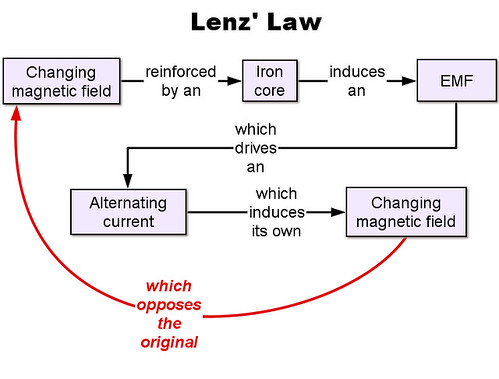
    I'm not an expert, but I understand that electric field generates a magnetic field. That changing magnetic field in the primary induces electric field in the secondary and that electric field generates another magnetic field which opposes to the electric field in the primary.

    So, when you connect a load it's generated a back magneto motive force that opposes to the original force that creates the energy. This phenomenon is called reflectance.

    The dipole transforms quantum energy to electrical usable energy. This dipole (electric field) generates a magnetic field that goes from the source to the load. When the load is connected a reverse MMF goes from the load to the energy source, destroying it (killing the dipole).

    It's something similar to this:
    Last edited by Magnethos; 05-29-2015, 09:09 AM.
    "A knot cannot be undone, without knowing the way it was made" Aristotle

    Comment


    • #3
      Originally posted by Magnethos View Post
      I'm not an expert, but I understand that electric field generates a magnetic field. That changing magnetic field in the primary induces electric field in the secondary and that electric field generates another magnetic field which opposes to the electric field in the primary.

      So, when you connect a load it's generated a back magneto motive force that opposes to the original force that creates the energy. This phenomenon is called reflectance.

      The dipole transforms quantum energy to electrical usable energy. This dipole (electric field) generates a magnetic field that goes from the source to the load. When the load is connected a reverse MMF goes from the load to the energy source, destroying it (killing the dipole).

      It's something similar to this:

      Comment


      • #4
        I don't have a technical knowledge about how happens, but I can explain something about how I think it happens.

        You've made a good observation about 80% and 20%. Think about a magnet. A magnet is 50% south and 50% north.


        50% of force in forward direction and 50% force in backward direction means a total of zero. Zero means no resultant force.

        Space is maybe the same. 50% and 50%, which means zero, neutral. For that reason the particles are called Neutrinos (neutral).

        About what you say is very interesting. Have you thought about that the opposite forces don't cancel each other because they've different phases? It could be an explanation. To cancel each other they have to flow in opposite directions and the same phase. When the phase is different they don't fully cancel each other.
        "A knot cannot be undone, without knowing the way it was made" Aristotle

        Comment


        • #5
          Think about a slope and the 2 guys, one in the rear and other in the front.
          To stop the car they've to perform difference forces in the rear and in the front.


          Maybe in the transformer it's more easy to the current to travel in one direction and more difficult to travel in the other direction. That is similar to the slope example.
          Current travels in the path of least resistance.
          Last edited by Magnethos; 05-29-2015, 10:54 AM.
          "A knot cannot be undone, without knowing the way it was made" Aristotle

          Comment


          • #6
            Hi guys,

            Mbrownn you are slightly mistaken about how a transformer works. The secondary current does NOT oppose the primary current. Here is a simple test to prove that to yourself. Connect a transformer to an AC source with no load on the secondary. Using a clamp on ammeter or a regular ammeter measure the current going through the primary winding. Now put a load on the secondary and again check the primary winding current. You will see it has gone UP not down.

            If I recall correctly the explanation for that effect is that without any secondary current flow the primary current creates such a strong magnetic field it saturates the core and that raises the impedance to the point that only enough current flows to maintain the saturation of the core. Then when a load is applied it reduces the magnetic field causing an increase in primary current to try and maintain the magnetic field.

            All of that is from memory so you might want to check that on an electronics training site to make sure it is all correct.

            Carroll
            Just because someone disagrees with you does NOT make them your enemy. We can disagree without attacking someone.

            Comment


            • #7
              Originally posted by Magnethos View Post
              About what you say is very interesting. Have you thought about that the opposite forces don't cancel each other because they've different phases? It could be an explanation. To cancel each other they have to flow in opposite directions and the same phase. When the phase is different they don't fully cancel each other.

              Comment


              • #8
                Originally posted by Magnethos View Post
                Think about a slope and the 2 guys, one in the rear and other in the front.
                To stop the car they've to perform difference forces in the rear and in the front.


                Maybe in the transformer it's more easy to the current to travel in one direction and more difficult to travel in the other direction. That is similar to the slope example.
                Current travels in the path of least resistance.
                Interesting Idea.

                Originally posted by citfta
                Mbrownn you are slightly mistaken about how a transformer works. The secondary current does NOT oppose the primary current. Here is a simple test to prove that to yourself. Connect a transformer to an AC source with no load on the secondary. Using a clamp on ammeter or a regular ammeter measure the current going through the primary winding. Now put a load on the secondary and again check the primary winding current. You will see it has gone UP not down.
                Yes I understand this, the current in the secondary lowers the inductance of the primary.

                Originally posted by citfta
                If I recall correctly the explanation for that effect is that without any secondary current flow the primary current creates such a strong magnetic field it saturates the core and that raises the impedance to the point that only enough current flows to maintain the saturation of the core. Then when a load is applied it reduces the magnetic field causing an increase in primary current to try and maintain the magnetic field.

                All of that is from memory so you might want to check that on an electronics training site to make sure it is all correct.

                Carroll
                This seems to make sense and so is possible, but still does not explain how we can get 80% current output and have the two opposing fields.

                Thanks for the input guys

                Comment


                • #9
                  Originally posted by mbrownn View Post
                  This is a possibility. In my basic transformer test I would say the magnetic force was reduced by about 20% although I have no means of measuring it accurately. There is obviously a lot more to this than is written about in the standard physics text books.

                  I consider electrical theory to be an oversimplified incomplete theory.the effects are not linear or as you would intuitively expect.
                  First of all everyone knows that science cannot explain everything. Maybe it could be because to explain everything it's needed an extended and a different approach to solve the questions.

                  About the effects in the real world, almost everything is non-linear. Of course.

                  I've heard about bucking coils, but I don't know anything about them.
                  "A knot cannot be undone, without knowing the way it was made" Aristotle

                  Comment


                  • #10
                    Just the other day I was watching a video where someone had a magnet on the front of a CRT. You could clearly see the effect of the magnet on the screen. Then he put another magnet of opposite polarity on top of the first one. The effect on the screen was that the effect was greatly reduced which implies the second magnetic field was cancelling the first magnetic field. Since the first magnet was right against the screen it's effect was not totally cancelled but was greatly reduced.

                    So if in a transformer the current in the secondary creates a magnetic field that opposes the field from the primary then the effect would be it would weaken the field of the primary and thus allow more current to flow in the primary. Does that make sense now?

                    On an additional note. All this theory applies only if you are applying a normal sine wave AC input into the primary. If you want to see something interesting apply a very short pulse rapid DC input to the primary and see what effect that has on the kind of load you can run.

                    Carroll
                    Just because someone disagrees with you does NOT make them your enemy. We can disagree without attacking someone.

                    Comment


                    • #11
                      Originally posted by citfta View Post
                      Just the other day I was watching a video where someone had a magnet on the front of a CRT. You could clearly see the effect of the magnet on the screen. Then he put another magnet of opposite polarity on top of the first one. The effect on the screen was that the effect was greatly reduced which implies the second magnetic field was cancelling the first magnetic field. Since the first magnet was right against the screen it's effect was not totally cancelled but was greatly reduced.

                      So if in a transformer the current in the secondary creates a magnetic field that opposes the field from the primary then the effect would be it would weaken the field of the primary and thus allow more current to flow in the primary. Does that make sense now?

                      On an additional note. All this theory applies only if you are applying a normal sine wave AC input into the primary. If you want to see something interesting apply a very short pulse rapid DC input to the primary and see what effect that has on the kind of load you can run.

                      Carroll
                      Do you remember that Floyd Sweet made a modification in a TV and he was able to see "cycloids"?

                      I would like to know more about this because I have no idea what a cycloid is, what is the modification in the TV and what is the relation between cycloids and magnetism.

                      "A knot cannot be undone, without knowing the way it was made" Aristotle

                      Comment


                      • #12
                        I don't know anything about Sweet's modification to a TV but here is a link to the definition of a cycloid:


                        Carroll
                        Just because someone disagrees with you does NOT make them your enemy. We can disagree without attacking someone.

                        Comment


                        • #13
                          Originally posted by citfta View Post
                          All this theory applies only if you are applying a normal sine wave AC input into the primary. If you want to see something interesting apply a very short pulse rapid DC input to the primary and see what effect that has on the kind of load you can run.

                          Carroll

                          Comment


                          • #14
                            Originally posted by mbrownn View Post
                            my device is unconventional.
                            I understand you. You want to know how to understand better your unconventional model. So you're trying to find anything that might help to you.

                            As you know, 99.99% of the models are based on conventional theories. So it won't be easy.
                            "A knot cannot be undone, without knowing the way it was made" Aristotle

                            Comment


                            • #15
                              Originally posted by Magnethos View Post
                              I understand you. You want to know how to understand better your unconventional model. So you're trying to find anything that might help to you.

                              As you know, 99.99% of the models are based on conventional theories. So it won't be easy.

                              Comment

                              Working...
                              X