

 Tweet
Tweet
sharp gradients
Hi Elias,
I believe it is more than one. The main sharp gradient I think is the collapsing magnetic field in the coil.
Hitting a battery directly with that through the diode from the bottom of the coil (collector) may be another sharp gradient...maybe not as sharp as the collapsing field. Or if charging caps, the caps discharging to a battery could be considered a sharp gradient.
Sharp gradients seem to simply produce a much stronger potential difference getting a stronger influx of the virtual photon potential to move towards the different "poles."
Possibly every fast off/on in the transistor could be a sharp gradient...every off/on of a diode may be a sharp gradient...each and every single one probably collectively adds to the potential in the circuit.
Originally posted by elias
View Post
I believe it is more than one. The main sharp gradient I think is the collapsing magnetic field in the coil.
Hitting a battery directly with that through the diode from the bottom of the coil (collector) may be another sharp gradient...maybe not as sharp as the collapsing field. Or if charging caps, the caps discharging to a battery could be considered a sharp gradient.
Sharp gradients seem to simply produce a much stronger potential difference getting a stronger influx of the virtual photon potential to move towards the different "poles."
Possibly every fast off/on in the transistor could be a sharp gradient...every off/on of a diode may be a sharp gradient...each and every single one probably collectively adds to the potential in the circuit.


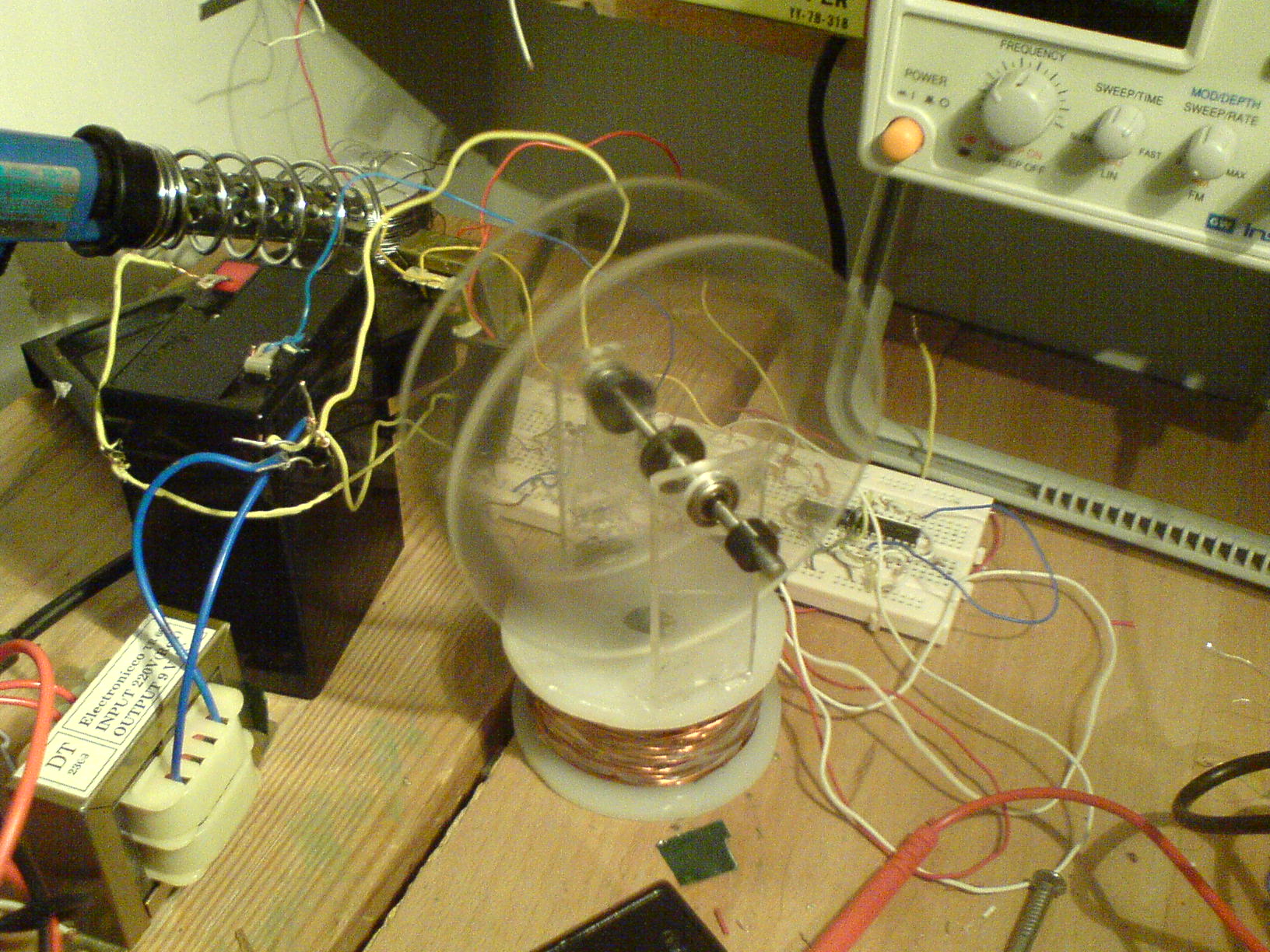


 I need them to charge the battery. I connected the input of my SSG to the mains to be able to charge batteries without using batteries! The only major difference my setup has with the SSG is the hall effect sensor and the mosfet instead of the transistor. because I was told that sharper the pulses better the Radiant, So I decided to use this setup (Like Bedini's Monopole) and with a rotor with 8 magnets.
Comment